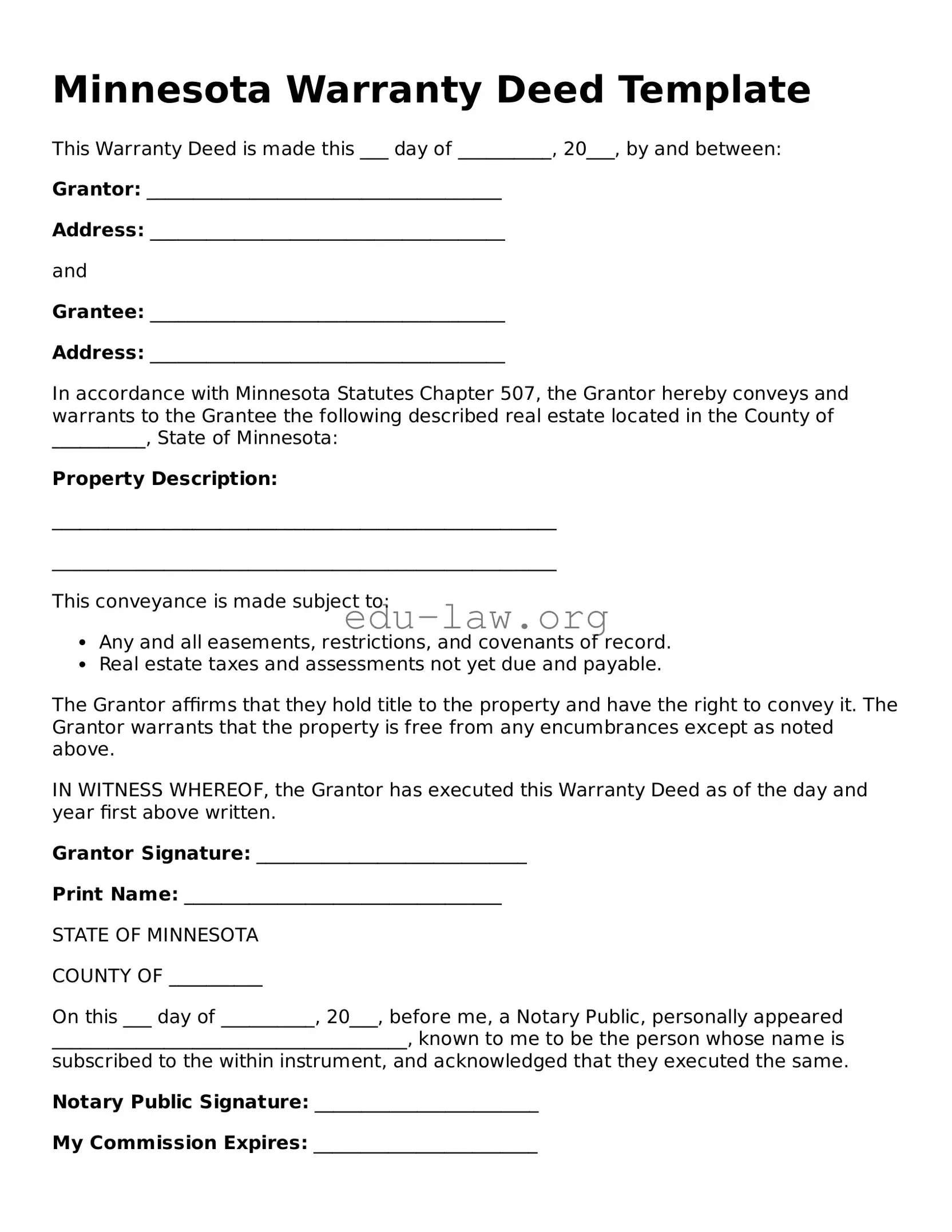
The Minnesota Deed form serves as a crucial legal document in real estate transactions, facilitating the transfer of property ownership from one party to another. It includes essential details such as the names of the grantor and grantee, a description of the property being transferred, and the date of the transaction. This form not only outlines the rights being conveyed but also specifies any conditions or restrictions tied to the property. Additionally, it requires the signatures of the involved parties, often necessitating notarization to ensure its validity. Understanding the components and requirements of the Minnesota Deed form is vital for anyone looking to buy or sell property in the state, as it helps protect the interests of both the seller and the buyer while ensuring compliance with state laws.
Minnesota Warranty Deed Template
This Warranty Deed is made this ___ day of __________, 20___, by and between:
Grantor: ______________________________________
Address: ______________________________________
and
Grantee: ______________________________________
Address: ______________________________________
In accordance with Minnesota Statutes Chapter 507, the Grantor hereby conveys and warrants to the Grantee the following described real estate located in the County of __________, State of Minnesota:
Property Description:
______________________________________________________
______________________________________________________
This conveyance is made subject to:
The Grantor affirms that they hold title to the property and have the right to convey it. The Grantor warrants that the property is free from any encumbrances except as noted above.
IN WITNESS WHEREOF, the Grantor has executed this Warranty Deed as of the day and year first above written.
Grantor Signature: _____________________________
Print Name: __________________________________
STATE OF MINNESOTA
COUNTY OF __________
On this ___ day of __________, 20___, before me, a Notary Public, personally appeared ______________________________________, known to me to be the person whose name is subscribed to the within instrument, and acknowledged that they executed the same.
Notary Public Signature: ________________________
My Commission Expires: ________________________
| Fact Name | Details |
|---|---|
| Purpose | The Minnesota Deed form is used to transfer ownership of real property from one party to another. |
| Types of Deeds | Common types include Warranty Deed, Quit Claim Deed, and Special Warranty Deed. |
| Governing Laws | The Minnesota Deed is governed by Minnesota Statutes Chapter 507. |
| Execution Requirements | The deed must be signed by the grantor and notarized to be valid. |
Once you have the Minnesota Deed form ready, you can begin filling it out. This process involves providing specific information about the property and the parties involved. After completing the form, it will need to be submitted for recording with the appropriate county office.
What is a Minnesota Deed form?
A Minnesota Deed form is a legal document used to transfer ownership of real estate from one person or entity to another. It outlines the details of the property and the parties involved in the transaction. There are different types of deeds, such as warranty deeds and quitclaim deeds, each serving a specific purpose in property transfer.
Who needs a Minnesota Deed form?
Anyone who is buying or selling property in Minnesota will need a deed form. This includes homeowners, real estate investors, and businesses. The deed serves as proof of ownership and is essential for recording the transaction with the county.
What information is required on a Minnesota Deed form?
A Minnesota Deed form typically requires the names of the grantor (the seller) and grantee (the buyer), a legal description of the property, and the date of the transfer. Additionally, the form may need to include any special conditions or considerations related to the transfer.
How do I fill out a Minnesota Deed form?
To fill out a Minnesota Deed form, start by clearly writing the names of both parties. Next, provide the legal description of the property, which can usually be found on the property's tax statement or title. Finally, sign the deed in front of a notary public to make it legally binding.
Do I need to have the deed notarized?
Yes, in Minnesota, the deed must be signed in front of a notary public. This step is crucial as it verifies the identities of the parties involved and ensures that the signatures are legitimate. Notarization helps prevent fraud in property transactions.
Where do I file a Minnesota Deed form?
After completing and notarizing the deed, you must file it with the county recorder's office where the property is located. This filing makes the transfer official and provides public notice of the new ownership.
Is there a fee to file a Minnesota Deed form?
Yes, there is usually a fee to file a Minnesota Deed form. The amount varies by county. It's best to check with your local county recorder's office for the specific fees and accepted payment methods.
Can I use a generic deed form for my property transfer?
While you can use a generic deed form, it is advisable to use a Minnesota-specific deed form. This ensures that all state requirements are met and reduces the risk of errors that could delay the transfer process.
What happens if I don’t file the deed?
If you don’t file the deed, the property transfer may not be recognized legally. This can lead to issues in the future, such as disputes over ownership or difficulties when trying to sell the property. Filing the deed is a crucial step in protecting your rights as a property owner.
Not providing the correct legal description of the property. This is essential for identifying the specific piece of land being transferred.
Failing to include all necessary parties. Ensure that all individuals involved in the transaction are listed, including grantors and grantees.
Using incorrect names. Names must match exactly as they appear on legal documents to avoid confusion or disputes.
Omitting the date of the transaction. This detail is crucial for establishing the timeline of ownership.
Not signing the deed in front of a notary. A signature without notarization may render the document invalid.
Forgetting to include the consideration amount. This is the value exchanged for the property and is often required by law.
Leaving out the mailing address for the grantee. This information is necessary for future communications and tax purposes.
Not checking for liens or encumbrances. Failing to address existing claims can lead to legal issues down the road.
Using outdated forms. Always ensure you have the most current version of the deed form to comply with current laws.
Neglecting to file the deed with the appropriate county office. Without proper filing, the transfer of ownership may not be recognized.
When dealing with property transactions in Minnesota, several documents often accompany the Minnesota Deed form. Each of these documents serves a specific purpose in ensuring that the transfer of property is legally sound and properly recorded. Here’s a list of commonly used forms and documents that you might encounter:
Understanding these documents can greatly assist in navigating the complexities of property transactions. Each plays a vital role in ensuring that all parties are protected and that the transaction proceeds smoothly. Always consider consulting with a legal professional to ensure that all necessary forms are completed accurately and in accordance with Minnesota law.
The Minnesota Deed form is similar to the Warranty Deed, which is a legal document used to transfer property ownership. A Warranty Deed guarantees that the seller has clear title to the property and has the right to sell it. This type of deed provides the buyer with protection against any claims or disputes regarding the property’s title. In both forms, the transfer of ownership is formalized, but the Warranty Deed offers additional assurances to the buyer about the property's history and legal standing.
Another document akin to the Minnesota Deed is the Quitclaim Deed. Unlike the Warranty Deed, a Quitclaim Deed transfers whatever interest the seller has in the property without any guarantees. This means that if the seller does not have clear title, the buyer receives no protection. Both documents serve the purpose of transferring property, but the Quitclaim Deed is often used in situations where the parties know each other, such as in family transfers or divorces.
The Bargain and Sale Deed is also similar to the Minnesota Deed. This type of deed conveys property without warranties, similar to the Quitclaim Deed, but it implies that the seller has ownership of the property. It is often used in foreclosure sales or by fiduciaries. While both the Bargain and Sale Deed and the Minnesota Deed facilitate the transfer of property, the former does not provide the same level of assurance regarding the title.
The Special Purpose Deed is another related document, typically used for specific transactions, such as transferring property into a trust. Like the Minnesota Deed, it serves to transfer ownership, but it often comes with unique stipulations based on the purpose of the transaction. Both documents are essential for formalizing property transfers, but the Special Purpose Deed may include additional requirements based on the specific context of the transfer.
The Grant Deed is similar as well, as it is commonly used in property transactions. A Grant Deed guarantees that the property has not been sold to anyone else and that there are no undisclosed encumbrances. While the Minnesota Deed focuses on the transfer of ownership, the Grant Deed provides some level of assurance regarding the title, making it a bit more protective for the buyer.
The Deed of Trust is another document that shares similarities with the Minnesota Deed. While primarily used in financing arrangements, it involves the transfer of property to a trustee for the benefit of a lender. This document allows for the property to be used as collateral for a loan. Both documents involve property transfer, but the Deed of Trust has a specific financial purpose, making it more complex than a standard Minnesota Deed.
The Personal Representative's Deed is also comparable, especially in the context of estate management. This document is used to transfer property from a deceased person's estate to their heirs or beneficiaries. Like the Minnesota Deed, it formalizes the transfer of ownership, but it is specifically tied to the probate process and the distribution of an estate.
The Executor's Deed is another similar document, used when an executor of an estate sells property on behalf of the deceased. This deed allows for the transfer of real estate as part of the estate settlement process. While both the Minnesota Deed and the Executor's Deed facilitate property transfers, the latter is specifically tied to the responsibilities of an executor in handling an estate.
The Life Estate Deed is also noteworthy. This type of deed allows a person to transfer property while retaining the right to live in it for the rest of their life. Upon the death of the life tenant, the property automatically transfers to the designated beneficiaries. Both the Life Estate Deed and the Minnesota Deed involve property transfer, but the Life Estate Deed includes specific conditions regarding the rights of the original owner.
Lastly, the Affidavit of Heirship is similar in that it is often used to establish ownership of property when someone passes away without a will. This document identifies the heirs and their relationship to the deceased, facilitating the transfer of property to them. While the Minnesota Deed is a formal transfer document, the Affidavit of Heirship serves as a supporting document to clarify ownership in situations where a will is not present.
When filling out the Minnesota Deed form, there are important guidelines to follow. Here’s a list of things you should and shouldn’t do:
Understanding the Minnesota Deed form can be tricky. Here are eight common misconceptions that people often have about it:
Not all deeds serve the same purpose. Different types of deeds, like warranty deeds and quitclaim deeds, have distinct functions and implications.
While a deed is a legal document, it can be amended or revoked under certain circumstances. This usually requires a new deed to be created.
In Minnesota, a deed does not necessarily need to be notarized, but it must be signed by the grantor. However, notarization can help prevent disputes later on.
While it’s advisable to consult a lawyer, anyone can prepare a deed. However, it’s important to ensure that all legal requirements are met.
In Minnesota, filing a deed with the county is required to make the transfer of property official. Without filing, the deed may not be recognized.
Deeds can also be used for gifting property, transferring ownership between family members, or even for estate planning purposes.
A recorded deed can still be challenged in court under certain conditions, such as fraud or lack of capacity of the grantor.
While deeds are generally intended to be permanent, they can be revoked or modified through legal processes if necessary.
Being aware of these misconceptions can help individuals navigate property transactions more effectively. Always consider seeking professional advice when dealing with legal documents.
When filling out and using the Minnesota Deed form, it’s important to keep several key points in mind to ensure the process goes smoothly. Here are some essential takeaways:
By keeping these points in mind, you can navigate the process of filling out and using the Minnesota Deed form more effectively.