In the landscape of business formation, the Minnesota Articles of Incorporation form serves as a critical document for those looking to establish a corporation in the state. This form encapsulates essential information about the corporation, including its name, the purpose of its existence, and the address of its principal office. Additionally, it requires details about the registered agent, who acts as the official point of contact for legal matters. The form also mandates the listing of the corporation's initial board of directors, establishing a foundational governance structure. Filing the Articles of Incorporation is not merely a bureaucratic step; it signifies the beginning of a legal entity that can enter contracts, own property, and be held liable independently of its owners. Moreover, it is crucial to ensure that the information provided is accurate and complies with Minnesota law, as any discrepancies can lead to delays or complications in the incorporation process. Understanding the nuances of this form is imperative for entrepreneurs aiming to navigate the complexities of corporate law effectively.
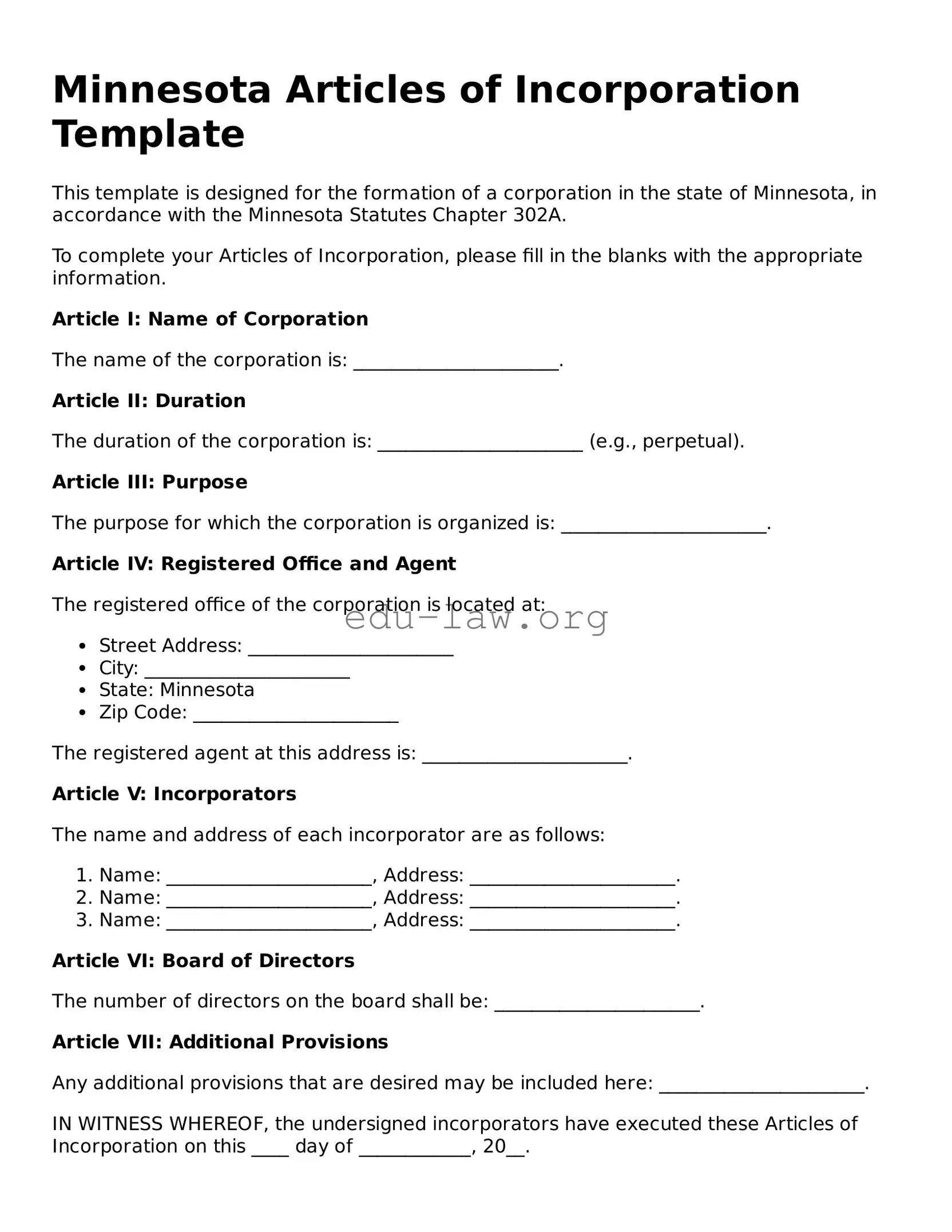
Minnesota Articles of Incorporation Template
This template is designed for the formation of a corporation in the state of Minnesota, in accordance with the Minnesota Statutes Chapter 302A.
To complete your Articles of Incorporation, please fill in the blanks with the appropriate information.
Article I: Name of Corporation
The name of the corporation is: ______________________.
Article II: Duration
The duration of the corporation is: ______________________ (e.g., perpetual).
Article III: Purpose
The purpose for which the corporation is organized is: ______________________.
Article IV: Registered Office and Agent
The registered office of the corporation is located at:
The registered agent at this address is: ______________________.
Article V: Incorporators
The name and address of each incorporator are as follows:
Article VI: Board of Directors
The number of directors on the board shall be: ______________________.
Article VII: Additional Provisions
Any additional provisions that are desired may be included here: ______________________.
IN WITNESS WHEREOF, the undersigned incorporators have executed these Articles of Incorporation on this ____ day of ____________, 20__.
Signature of Incorporator: ______________________
Signature of Incorporator: ______________________
Signature of Incorporator: ______________________
By filing these Articles of Incorporation with the Minnesota Secretary of State, the corporation will be legally established in the state of Minnesota.
| Fact Name | Description |
|---|---|
| Governing Law | The Minnesota Articles of Incorporation are governed by the Minnesota Statutes, Chapter 302A. |
| Purpose | The form is used to officially create a corporation in the state of Minnesota. |
| Required Information | Key details include the corporation's name, registered office address, and the names of the initial directors. |
| Filing Fee | A filing fee is required when submitting the Articles of Incorporation, which varies based on the type of corporation. |
| Submission Method | Articles can be filed online or by mail with the Minnesota Secretary of State. |
| Effective Date | The corporation can specify an effective date for the Articles, which can be immediate or a future date. |
| Amendments | Once filed, changes to the Articles of Incorporation require a formal amendment process. |
Once you have the Minnesota Articles of Incorporation form, you will need to complete it accurately to ensure your business is properly established. This form requires specific information about your organization, including its name, purpose, and structure. After filling out the form, you will submit it to the appropriate state agency along with any required fees.
What are the Minnesota Articles of Incorporation?
The Minnesota Articles of Incorporation is a legal document that establishes a corporation in the state of Minnesota. This form serves as the official record of your corporation's creation and outlines important details such as the corporation's name, purpose, registered agent, and the number of shares authorized. Filing this document with the Minnesota Secretary of State is the first step in forming a corporation and is essential for gaining legal recognition and protection for your business.
What information do I need to provide when completing the Articles of Incorporation?
When filling out the Articles of Incorporation, you will need to provide several key pieces of information. First, you must choose a unique name for your corporation that complies with Minnesota naming requirements. Next, you should describe the purpose of your corporation, which can be general or specific. Additionally, you will need to identify a registered agent, who will be responsible for receiving legal documents on behalf of the corporation. Finally, indicate the number of shares the corporation is authorized to issue. This information is crucial for ensuring your corporation is set up correctly and operates within the law.
How do I file the Articles of Incorporation in Minnesota?
Filing the Articles of Incorporation in Minnesota can be done online or by mail. To file online, visit the Minnesota Secretary of State's website, where you can complete the form and pay the filing fee electronically. If you prefer to file by mail, you can download the form, fill it out, and send it along with a check or money order for the required fee to the appropriate address. It's important to keep a copy of the submitted form for your records, as this document is essential for your corporation's legal standing.
What happens after I file the Articles of Incorporation?
Once you file the Articles of Incorporation, the Minnesota Secretary of State will review your submission. If everything is in order, they will process your application and issue a Certificate of Incorporation. This certificate is proof that your corporation has been legally formed and can begin conducting business. After incorporation, it's important to comply with ongoing requirements, such as holding annual meetings and filing annual renewal forms, to maintain your corporation's good standing.
Incorrect Business Name: One common mistake is not ensuring that the business name is unique. Before submitting the form, it’s essential to check that your chosen name isn’t already in use by another registered entity in Minnesota. This can lead to delays or outright rejection of your application.
Missing Registered Agent Information: Every corporation must designate a registered agent. Failing to provide accurate and complete information about the registered agent can cause issues. This individual or entity will receive legal documents on behalf of the corporation, so their details must be correct and up-to-date.
Inaccurate Purpose Statement: The purpose of your corporation should be clearly defined. Many people either leave this section too vague or fail to align it with their actual business activities. A well-defined purpose helps in compliance and can prevent misunderstandings down the line.
Omitting Required Signatures: All necessary signatures must be included on the form. Sometimes, individuals forget to sign or fail to have the required number of incorporators sign the document. This can result in the form being returned or rejected, which delays the incorporation process.
The Minnesota Articles of Incorporation form is a foundational document for establishing a corporation in the state of Minnesota. Alongside this form, several other documents may be required or beneficial for the incorporation process. Below is a list of common forms and documents that are often used in conjunction with the Articles of Incorporation.
These documents collectively support the establishment and ongoing operation of a corporation in Minnesota. Properly preparing and maintaining these forms is essential for compliance and effective management of corporate affairs.
The Minnesota Articles of Incorporation form shares similarities with the Certificate of Incorporation, which is often used in other states. Both documents serve as foundational legal paperwork required to establish a corporation. They typically include essential details such as the corporation’s name, purpose, and the names of the initial directors. Just like the Articles of Incorporation, the Certificate of Incorporation must be filed with the appropriate state agency, ensuring that the business is recognized legally and can operate within that jurisdiction.
Another document that resembles the Minnesota Articles of Incorporation is the Bylaws. While the Articles lay the groundwork for the corporation, the Bylaws provide the internal rules and procedures that govern the corporation's operations. This includes how meetings are conducted, the roles of officers, and how decisions are made. Both documents are crucial for a corporation, but they serve different purposes—one focuses on external recognition, while the other outlines internal management.
The Operating Agreement is similar to the Articles of Incorporation in that it is essential for establishing a business entity, particularly for limited liability companies (LLCs). This document outlines the management structure and operational procedures of the LLC. Just as the Articles of Incorporation define the corporation’s existence, the Operating Agreement defines how the LLC will function, detailing member responsibilities and profit distribution.
Additionally, the Statement of Information is akin to the Minnesota Articles of Incorporation in that it provides key information about a business entity after it has been formed. This document typically includes details about the business's address, officers, and registered agent. While the Articles of Incorporation are filed at the outset, the Statement of Information is often required on a periodic basis to keep the state updated on the corporation’s status and structure.
Lastly, the Certificate of Good Standing can be compared to the Articles of Incorporation. This document certifies that a corporation is legally registered and compliant with state regulations. It is often required when a business seeks to expand into other states or when applying for loans. Both documents affirm the corporation's legitimacy, but the Certificate of Good Standing is more of a confirmation of ongoing compliance rather than the initial establishment of the business.
When filling out the Minnesota Articles of Incorporation form, it is important to follow certain guidelines to ensure accuracy and compliance. Here are some recommendations:
Understanding the Minnesota Articles of Incorporation form is essential for those looking to establish a business in the state. However, several misconceptions often arise regarding this important document. Below are five common misconceptions, along with clarifications.
Addressing these misconceptions can help individuals navigate the process of forming a corporation in Minnesota more effectively. Understanding the true nature and purpose of the Articles of Incorporation is crucial for compliance and future business operations.
When considering the Minnesota Articles of Incorporation form, it’s essential to understand the process and requirements. Here are some key takeaways to keep in mind: