In Michigan, navigating the process of settling a deceased person's estate can be daunting, especially when the estate is relatively small. The Michigan Small Estate Affidavit serves as a vital tool for individuals seeking to simplify this process. This form allows heirs to claim assets without the need for formal probate proceedings, provided the total value of the estate does not exceed a certain threshold. Typically, this threshold includes various types of property, such as bank accounts, personal belongings, and real estate, but excludes specific debts and liabilities. To utilize the Small Estate Affidavit, heirs must meet certain eligibility criteria and follow a structured process, which includes completing the affidavit accurately and submitting it to the appropriate financial institutions or entities. This streamlined approach not only saves time and resources but also reduces the emotional burden on families during a challenging period. Understanding the requirements and implications of this form is crucial for anyone involved in the estate settlement process in Michigan.
Michigan Small Estate Affidavit Template
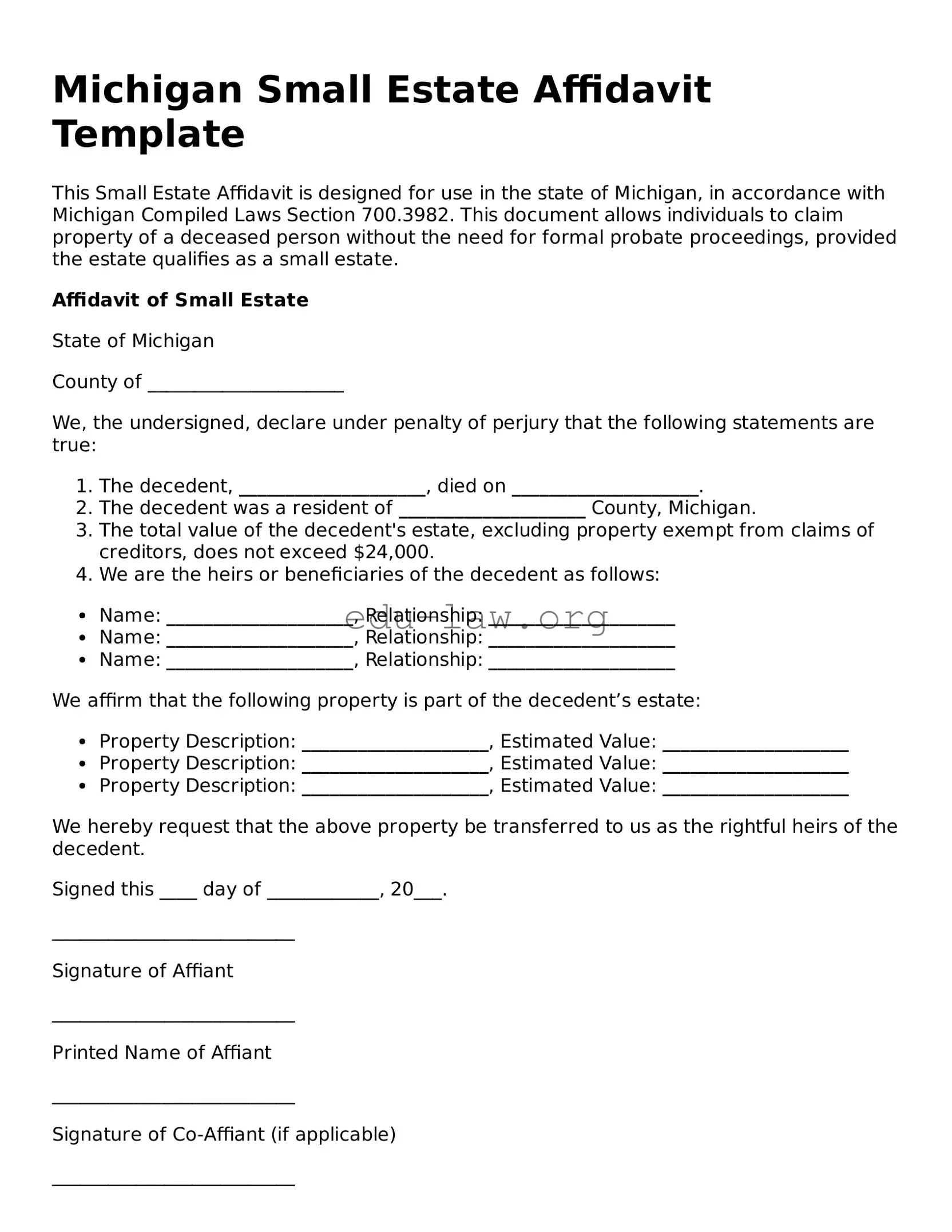
This Small Estate Affidavit is designed for use in the state of Michigan, in accordance with Michigan Compiled Laws Section 700.3982. This document allows individuals to claim property of a deceased person without the need for formal probate proceedings, provided the estate qualifies as a small estate.
Affidavit of Small Estate
State of Michigan
County of _____________________
We, the undersigned, declare under penalty of perjury that the following statements are true:
We affirm that the following property is part of the decedent’s estate:
We hereby request that the above property be transferred to us as the rightful heirs of the decedent.
Signed this ____ day of ____________, 20___.
__________________________
Signature of Affiant
__________________________
Printed Name of Affiant
__________________________
Signature of Co-Affiant (if applicable)
__________________________
Printed Name of Co-Affiant (if applicable)
State of Michigan
County of _____________________
Subscribed and sworn to before me this ____ day of ____________, 20___.
__________________________
Notary Public
My Commission Expires: ____________
| Fact Name | Description |
|---|---|
| Purpose | The Michigan Small Estate Affidavit allows heirs to claim property without going through probate for estates valued under a certain limit. |
| Value Limit | As of 2023, the estate must be valued at $25,000 or less for individuals, or $50,000 or less for married couples. |
| Governing Law | The form is governed by the Michigan Compiled Laws, specifically MCL 700.3981. |
| Eligibility | Heirs must be individuals who are entitled to inherit under Michigan law, including spouses, children, and other relatives. |
| Filing Requirements | The affidavit must be signed by the heir and notarized before it can be presented to financial institutions or other entities holding the deceased's assets. |
| Timeframe | The affidavit can be filed immediately after the death of the estate owner, provided the estate meets the necessary criteria. |
| Limitations | This process cannot be used for real estate or for estates that exceed the specified value limits. |
After gathering the necessary information and documents, you are ready to fill out the Michigan Small Estate Affidavit form. This process will help you officially declare your right to claim the assets of a deceased person without going through a lengthy probate process.
Once you have submitted the form, the court will process your affidavit. If everything is in order, you will receive confirmation that you can proceed with claiming the assets listed. Keep a copy of the submitted affidavit for your records.
What is a Michigan Small Estate Affidavit?
The Michigan Small Estate Affidavit is a legal document that allows individuals to claim assets from a deceased person's estate without going through the formal probate process. This form is typically used when the total value of the estate is below a certain threshold, which is currently set at $24,000 for personal property and $15,000 for real property. By using this affidavit, heirs can simplify the transfer of assets, making it a more efficient option for settling smaller estates.
Who is eligible to use the Small Estate Affidavit in Michigan?
To use the Small Estate Affidavit, you must be an eligible heir or beneficiary of the deceased person. Generally, this includes spouses, children, parents, or siblings. The affidavit can only be used if the deceased has been dead for at least 28 days and if the total value of the estate falls below the specified limits. Additionally, you must not be aware of any pending probate proceedings for the estate.
How do I complete and file the Small Estate Affidavit?
To complete the Small Estate Affidavit, you need to fill out the form with accurate information regarding the deceased, the assets involved, and your relationship to the deceased. After completing the form, it must be signed in front of a notary public. Once notarized, you can present the affidavit to institutions holding the deceased’s assets, such as banks or property management companies, to claim those assets. No filing with the court is required, but keep a copy for your records.
What happens if the estate exceeds the Small Estate limit?
If the total value of the estate exceeds the limit set for small estates, you cannot use the Small Estate Affidavit. In such cases, you will need to initiate formal probate proceedings to settle the estate. This process can be more complex and may involve court hearings, the appointment of a personal representative, and additional legal requirements. It's advisable to consult with a legal professional if you find yourself in this situation.
Incorrect Information: Individuals often provide inaccurate details about the deceased, such as the name or date of death. This can lead to delays in processing the affidavit.
Not Meeting the Value Threshold: Some people mistakenly believe they can use the Small Estate Affidavit for estates that exceed the allowable value limit. It is crucial to verify the current threshold before proceeding.
Failure to Include All Heirs: When filling out the form, individuals sometimes omit necessary heirs or beneficiaries. This can complicate the distribution process and create potential disputes.
Inadequate Signatures: The affidavit requires signatures from all heirs or beneficiaries. Neglecting to obtain these signatures can render the document invalid.
Not Notarizing the Affidavit: Many individuals forget that the Small Estate Affidavit must be notarized. Without a notary's signature, the affidavit may not be accepted by financial institutions or courts.
When dealing with the Michigan Small Estate Affidavit, several other forms and documents may be necessary to ensure a smooth process. Each of these documents serves a specific purpose in managing the estate and facilitating the transfer of assets. Below is a list of commonly used forms that accompany the Small Estate Affidavit.
Gathering these documents can significantly streamline the process of settling an estate. Each document plays a vital role in ensuring compliance with legal requirements and honoring the wishes of the deceased. It is advisable to prepare these forms carefully to avoid delays in the estate administration process.
The Michigan Small Estate Affidavit is similar to the Affidavit of Heirship, which is often used in cases where a decedent has not left a will. This document allows heirs to establish their right to inherit property without going through formal probate. By providing information about the deceased and their family members, the Affidavit of Heirship helps streamline the transfer of assets to rightful heirs, much like the Small Estate Affidavit facilitates the transfer of small estates without extensive court involvement.
Another document that shares similarities with the Small Estate Affidavit is the Will. While a Will outlines the wishes of a deceased person regarding asset distribution, it requires probate to be validated. The Small Estate Affidavit, on the other hand, allows for a more straightforward process when the estate's total value falls below a certain threshold. Both documents serve the purpose of ensuring that assets are distributed according to the deceased's intentions, but they differ in their legal requirements and processes.
The Declaration of Trust can also be compared to the Small Estate Affidavit. A Declaration of Trust is used to manage and distribute assets held in a trust, often avoiding probate altogether. Similar to the Small Estate Affidavit, it simplifies the transfer of assets and can expedite the process for beneficiaries. However, a trust must be established while the grantor is alive, whereas the Small Estate Affidavit is used posthumously for small estates.
The Affidavit for Collection of Personal Property is another document that resembles the Small Estate Affidavit. This affidavit allows individuals to collect personal property of a deceased person without going through probate, provided the estate is small. Both documents are designed to simplify the transfer of assets, but the Affidavit for Collection is specifically for personal property, while the Small Estate Affidavit can cover a broader range of assets.
The Transfer on Death Deed (TOD) also bears similarities to the Small Estate Affidavit. A TOD allows an individual to designate beneficiaries for real estate, which automatically transfers upon the owner’s death. This document bypasses probate, similar to how the Small Estate Affidavit facilitates asset distribution without court intervention. Both documents aim to ease the transfer process and reduce the burden on beneficiaries.
The Probate Petition for Summary Administration is another related document. This petition is filed when an estate is small and qualifies for a simplified probate process. Like the Small Estate Affidavit, it aims to expedite the administration of an estate, but it still involves some level of court oversight. Both documents provide alternatives to traditional probate, making it easier for heirs to access their inheritance.
The Affidavit of Survivorship is also comparable. This document is used when a joint tenant passes away, allowing the surviving tenant to claim full ownership of the property without going through probate. Similar to the Small Estate Affidavit, it provides a streamlined method for transferring assets to heirs, ensuring that the process is efficient and less burdensome.
Lastly, the Small Estate Affidavit can be likened to the Family Settlement Agreement. This agreement is often used when heirs agree on how to distribute a decedent's assets without formal probate. While the Small Estate Affidavit allows for a legal declaration of asset distribution, the Family Settlement Agreement relies on the mutual consent of the heirs. Both documents aim to simplify the process of estate administration, but they differ in their legal frameworks and requirements.
When filling out the Michigan Small Estate Affidavit form, it is crucial to approach the process with care. Here are some key do's and don'ts to consider:
The Michigan Small Estate Affidavit form is a tool designed to simplify the process of settling small estates. However, several misconceptions surround its use and requirements. Below is a list of common misunderstandings:
Understanding these misconceptions can help individuals navigate the process of using the Michigan Small Estate Affidavit more effectively. Always consider consulting with a legal professional for personalized guidance.
When dealing with the Michigan Small Estate Affidavit form, it's essential to understand its purpose and how to use it effectively. Here are some key takeaways to keep in mind: