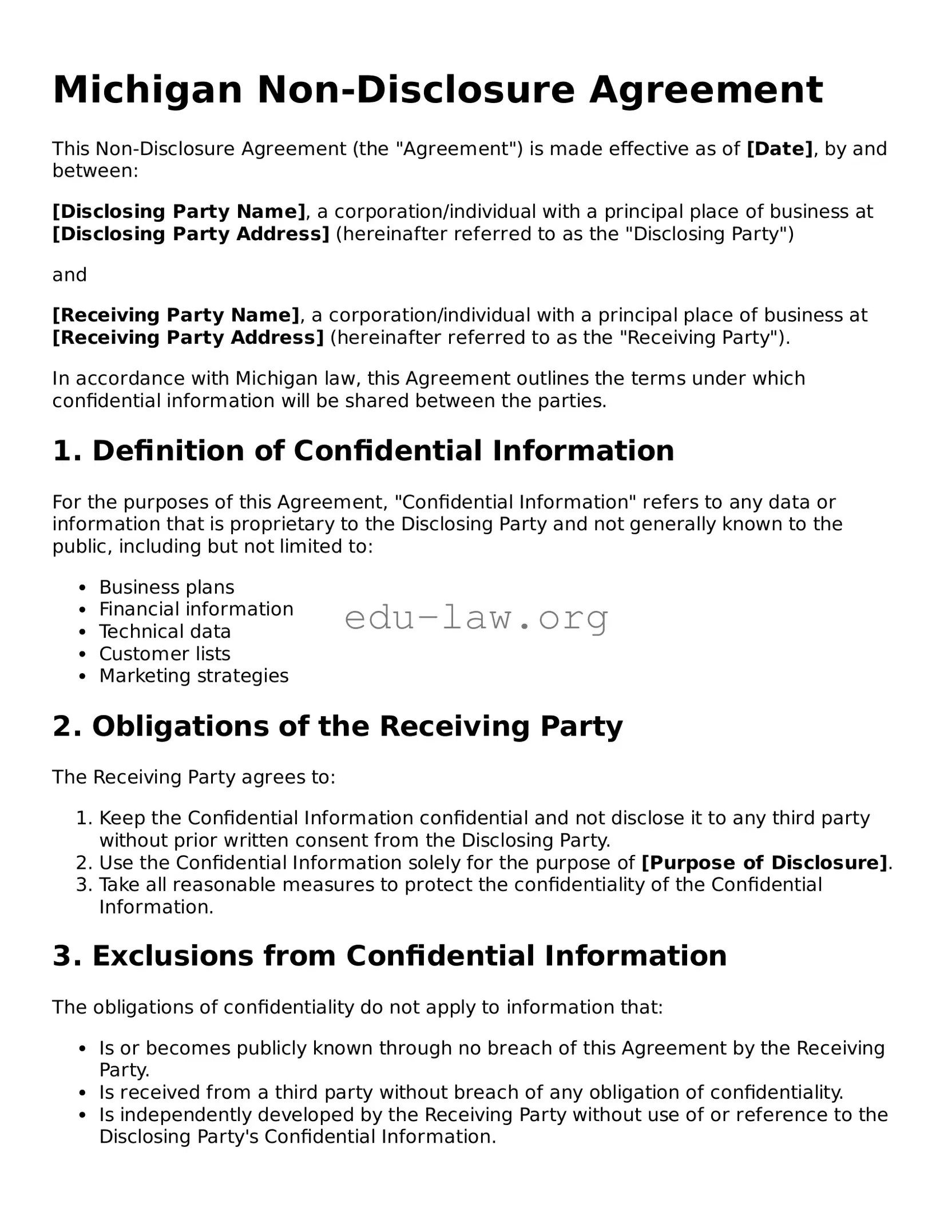
In the realm of business and professional relationships, the Michigan Non-disclosure Agreement (NDA) form serves as a crucial tool for protecting sensitive information. This legal document establishes a formal understanding between parties regarding the confidentiality of shared information. Key elements of the NDA include definitions of what constitutes confidential information, the obligations of the parties involved, and the duration of the confidentiality obligations. Additionally, the form outlines the consequences of any breach, ensuring that parties are aware of the potential legal repercussions of unauthorized disclosures. By clearly delineating the terms of confidentiality, the Michigan NDA fosters trust and encourages open communication between businesses, employees, and contractors. Understanding the nuances of this agreement can help individuals and organizations safeguard their proprietary information while navigating the complexities of professional interactions.
Michigan Non-Disclosure Agreement
This Non-Disclosure Agreement (the "Agreement") is made effective as of [Date], by and between:
[Disclosing Party Name], a corporation/individual with a principal place of business at [Disclosing Party Address] (hereinafter referred to as the "Disclosing Party")
and
[Receiving Party Name], a corporation/individual with a principal place of business at [Receiving Party Address] (hereinafter referred to as the "Receiving Party").
In accordance with Michigan law, this Agreement outlines the terms under which confidential information will be shared between the parties.
1. Definition of Confidential Information
For the purposes of this Agreement, "Confidential Information" refers to any data or information that is proprietary to the Disclosing Party and not generally known to the public, including but not limited to:
2. Obligations of the Receiving Party
The Receiving Party agrees to:
3. Exclusions from Confidential Information
The obligations of confidentiality do not apply to information that:
4. Term
This Agreement will commence on the effective date and will continue for a period of [Number of Years] years, unless terminated earlier by either party with written notice.
5. Governing Law
This Agreement shall be governed by and construed in accordance with the laws of the State of Michigan.
6. Miscellaneous
This Agreement constitutes the entire understanding between the parties regarding the subject matter herein and supersedes all prior discussions or agreements. Any amendments must be in writing and signed by both parties.
IN WITNESS WHEREOF, the parties hereto have executed this Non-Disclosure Agreement as of the date first above written.
Disclosing Party Signature: ____________________________
Name: [Name of Disclosing Party Representative]
Title: [Title of Disclosing Party Representative]
Receiving Party Signature: ____________________________
Name: [Name of Receiving Party Representative]
Title: [Title of Receiving Party Representative]
| Fact Name | Description |
|---|---|
| Purpose | The Michigan Non-disclosure Agreement (NDA) is designed to protect confidential information shared between parties. |
| Governing Law | This agreement is governed by the laws of the State of Michigan. |
| Parties Involved | The NDA typically involves at least two parties: the disclosing party and the receiving party. |
| Duration | The duration of confidentiality obligations can vary, but it is common for NDAs to specify a time frame for which the information must remain confidential. |
| Exclusions | Certain information may be excluded from confidentiality obligations, such as information that is publicly available or independently developed. |
| Enforcement | If a party breaches the NDA, the injured party may seek legal remedies, including injunctions or damages. |
| Signatures | The NDA must be signed by both parties to be legally binding and enforceable. |
After obtaining the Michigan Non-disclosure Agreement form, you will need to complete it accurately to ensure that all necessary information is provided. This will facilitate the process of protecting confidential information between the parties involved.
What is a Michigan Non-disclosure Agreement (NDA)?
A Michigan Non-disclosure Agreement is a legal document that helps protect sensitive information shared between parties. It ensures that the receiving party does not disclose or misuse the confidential information provided by the disclosing party. NDAs are commonly used in business settings, especially when discussing trade secrets, proprietary information, or any data that could harm a business if leaked.
Who should use a Non-disclosure Agreement?
Any individual or organization that needs to share confidential information may benefit from using an NDA. This includes businesses sharing trade secrets with employees, partners discussing joint ventures, or freelancers working with companies. Essentially, if you are sharing information that could give someone else an unfair advantage or harm your business if disclosed, an NDA is advisable.
What are the key components of a Michigan NDA?
A typical Michigan NDA includes several important elements. First, it defines what constitutes confidential information. Second, it outlines the obligations of the receiving party, including how they should handle the information. Third, the duration of the confidentiality obligation is specified, indicating how long the information must remain confidential. Lastly, it may include provisions for legal remedies in case of a breach.
How can I enforce a Non-disclosure Agreement in Michigan?
Enforcing an NDA in Michigan generally involves proving that the receiving party has breached the agreement. This can be done by showing that they disclosed confidential information without permission. If a breach occurs, the disclosing party may seek legal remedies, which could include monetary damages or injunctive relief. It is important to keep records of all communications and any evidence of the breach to support your case.
Not Clearly Identifying the Parties: One common mistake is failing to clearly define who is involved in the agreement. Make sure to include full names and addresses of all parties. This ensures everyone knows who is bound by the terms of the agreement.
Leaving Out Confidential Information: It's essential to specify what information is considered confidential. Vague descriptions can lead to misunderstandings. Be as detailed as possible to avoid confusion later on.
Ignoring the Duration of the Agreement: Some people forget to state how long the confidentiality obligations will last. Without a specified duration, it can be unclear when the obligations end, which may lead to disputes down the line.
Not Including Exclusions: It's important to outline what information is not covered by the agreement. Omitting this can lead to issues if either party later claims that certain information is confidential when it is not.
Failing to Get Signatures: A Non-disclosure Agreement is not valid without signatures from all parties involved. Ensure that everyone signs the document and that the date of signing is included. This step is crucial for the agreement to be enforceable.
When entering into a Non-disclosure Agreement (NDA) in Michigan, several other forms and documents may complement this important contract. These additional documents can help clarify the terms of the NDA, protect intellectual property, or outline the relationship between the parties involved. Here are four common forms often used alongside an NDA:
Understanding these additional documents can enhance the effectiveness of your Non-disclosure Agreement. Each plays a unique role in protecting sensitive information and fostering a secure environment for business relationships. When used together, they create a comprehensive framework that benefits all parties involved.
A Non-Disclosure Agreement (NDA) is often compared to a Confidentiality Agreement. Both documents serve to protect sensitive information from being disclosed to unauthorized parties. While an NDA typically focuses on preventing the sharing of proprietary information, a Confidentiality Agreement can cover a broader range of confidential matters, including trade secrets and personal data. In essence, both agreements emphasize the importance of keeping information private and outline the responsibilities of the parties involved in safeguarding that information.
An Employment Agreement shares similarities with an NDA, particularly when it includes clauses about confidentiality. Employers often require employees to sign an NDA as part of their employment contract to ensure that sensitive company information remains protected during and after their tenure. This mutual understanding helps build trust and establishes clear expectations regarding the handling of proprietary information within the workplace.
A Non-Circumvention Agreement is closely related to an NDA, particularly in business dealings. While an NDA focuses on confidentiality, a Non-Circumvention Agreement prevents one party from bypassing the other to engage directly with a third party. This document is often used in situations where one party introduces another to potential clients or business opportunities, ensuring that the introducer receives credit and compensation for their efforts.
A License Agreement can also bear similarities to an NDA, especially in the context of intellectual property. When licensing intellectual property, the licensee often gains access to proprietary information. A License Agreement may include confidentiality clauses to protect the licensor's interests. This ensures that the licensee does not disclose or misuse the confidential information they receive, maintaining the integrity of the intellectual property involved.
Lastly, a Partnership Agreement can reflect elements of an NDA when it includes confidentiality provisions. In a partnership, parties may share sensitive business information to operate effectively. Including confidentiality clauses in a Partnership Agreement helps protect that information from being disclosed to competitors or the public. This fosters a collaborative environment where partners can share insights and strategies without fear of losing their competitive edge.
When filling out the Michigan Non-disclosure Agreement (NDA) form, it is essential to be thorough and careful. Here are some guidelines to help ensure that the process goes smoothly.
By following these guidelines, you can help ensure that your Non-disclosure Agreement is effective and serves its intended purpose.
Misconceptions about the Michigan Non-disclosure Agreement (NDA) can lead to confusion and improper use of the document. Here are five common misconceptions:
Many people believe that all non-disclosure agreements are identical. In reality, each NDA can be tailored to meet the specific needs of the parties involved, including the scope of confidential information and the duration of the agreement.
While businesses frequently use NDAs, individuals can also benefit from them. For example, freelancers, consultants, and employees may use NDAs to protect sensitive information shared during their work.
This misconception overlooks the fact that NDAs typically define specific information that must remain confidential. Information that is publicly available or independently developed is usually not covered by the agreement.
Some believe that NDAs lack legal standing in Michigan. However, when properly drafted, NDAs are enforceable under Michigan law, provided they meet certain legal requirements.
This is not accurate. Most NDAs include a specified duration for confidentiality obligations, after which the parties are no longer bound by the agreement.
Filling out and using the Michigan Non-disclosure Agreement (NDA) form is an important step in protecting sensitive information. Here are some key takeaways to consider:
By keeping these points in mind, you can effectively use the Michigan Non-disclosure Agreement to protect your valuable information.