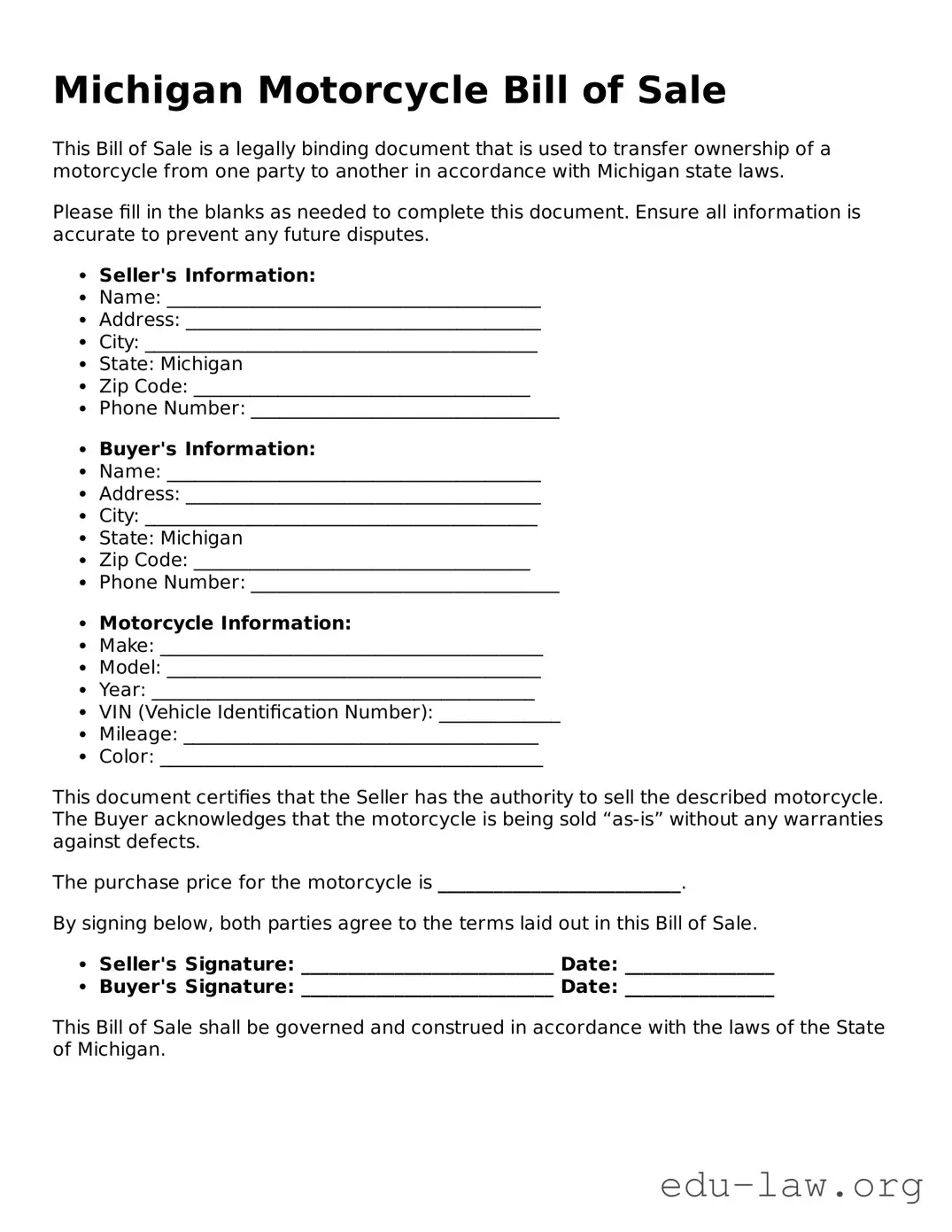
The Michigan Motorcycle Bill of Sale form serves as a crucial document in the process of buying or selling a motorcycle in the state. This form captures essential information about the transaction, including the details of the motorcycle, such as the make, model, year, and vehicle identification number (VIN). Additionally, it records the sale price, ensuring both parties agree on the financial aspects of the deal. The form also requires signatures from both the seller and the buyer, which formalizes the transfer of ownership. Along with the signatures, the date of the transaction must be documented to create a clear record of when the sale took place. Having a properly completed bill of sale is vital, as it can help protect both parties in case of future disputes or questions regarding the motorcycle’s ownership. Furthermore, this document may be required when registering the motorcycle with the Michigan Secretary of State, highlighting its importance in the legal process of ownership transfer.
Michigan Motorcycle Bill of Sale
This Bill of Sale is a legally binding document that is used to transfer ownership of a motorcycle from one party to another in accordance with Michigan state laws.
Please fill in the blanks as needed to complete this document. Ensure all information is accurate to prevent any future disputes.
This document certifies that the Seller has the authority to sell the described motorcycle. The Buyer acknowledges that the motorcycle is being sold “as-is” without any warranties against defects.
The purchase price for the motorcycle is __________________________.
By signing below, both parties agree to the terms laid out in this Bill of Sale.
This Bill of Sale shall be governed and construed in accordance with the laws of the State of Michigan.
| Fact Name | Description |
|---|---|
| Purpose | The Michigan Motorcycle Bill of Sale form serves as a legal record of a transaction between a buyer and a seller of a motorcycle, ensuring both parties have documentation of the sale. |
| Required Information | This form typically requires details such as the motorcycle's make, model, year, Vehicle Identification Number (VIN), as well as the names and addresses of both the buyer and seller. |
| Governing Law | The sale of motorcycles in Michigan falls under Michigan Compiled Laws, specifically the Michigan Vehicle Code (MCL 257.233), which governs the necessity of vehicle title transfers. |
| Additional Uses | Beyond facilitating a sale, the bill of sale can also be useful for registration purposes, and it may be needed for obtaining insurance coverage on the motorcycle. |
Once the Michigan Motorcycle Bill of Sale form is completed, it serves as an important document for the transfer of ownership of a motorcycle. This document should be handled with care, ensuring that all necessary details are accurately filled out. Following these steps will guide you through the process.
Once all the details are accurately filled and validated through signatures, the form becomes an official document transferring ownership. Keep it in a safe place until it is needed for registration or alongside other ownership papers.
What is a Michigan Motorcycle Bill of Sale form?
A Michigan Motorcycle Bill of Sale form is a document that serves as proof of the sale of a motorcycle between a buyer and a seller. This form typically includes essential information such as the names and addresses of both parties, the motorcycle's make, model, year, vehicle identification number (VIN), sale price, and the date of the sale. It acts as a legal record and can be useful for title transfer and registration purposes.
Is a Bill of Sale required to sell a motorcycle in Michigan?
While it is not mandated by law to have a Bill of Sale for a motorcycle transaction in Michigan, it is highly recommended. Having a Bill of Sale can provide clarity and protection for both the buyer and the seller. It ensures there is a formal agreement and can help resolve disputes or provide evidence of ownership if needed in the future.
What information should be included in the Michigan Motorcycle Bill of Sale?
Essential details to include in the Bill of Sale are the following: full names and addresses of both the buyer and seller, the motorcycle's make, model, year, and vehicle identification number (VIN). Additionally, record the sale price and the date of the transaction. Signature lines for both parties should also be included to affirm the agreement.
Can a Michigan Motorcycle Bill of Sale be used for other vehicles?
No, the Michigan Motorcycle Bill of Sale is specifically tailored for motorcycle transactions. If you are buying or selling other vehicles, such as cars, trucks, or recreational vehicles, a different bill of sale form should be utilized to comply with regulations specific to those vehicle types.
Where can I obtain a Michigan Motorcycle Bill of Sale form?
The Michigan Motorcycle Bill of Sale form can be acquired from various sources. Many online legal document platforms provide free templates that are easy to fill out. Alternatively, you may visit your local Department of Motor Vehicles (DMV) office, where staff can provide guidance and resources to obtain the necessary documentation.
What should I do with the Bill of Sale after the transaction?
After the transaction is complete, both the buyer and the seller should keep a copy of the signed Bill of Sale for their records. The buyer will need this document when registering the motorcycle with the state, while the seller may need it for personal record-keeping or to demonstrate the completion of the sale. It is advisable to store the Bill of Sale in a safe location for future reference.
Incomplete Seller Information: Failing to provide all necessary details about the seller, such as full name, address, and contact number, can create confusion and legal issues down the line.
Missing Buyer Details: Just like with the seller, it's crucial to include complete buyer information. Leaving this blank can delay the transfer of ownership.
Incorrect Vehicle Identification Number (VIN): The VIN must be precise. A simple mistake can render the document invalid and complicate the registration process.
Failure to State the Purchase Price: Not including the agreed-upon purchase price can lead to ambiguity regarding the transaction and potential tax issues.
Omission of Date of Sale: It’s important to document when the sale occurred. Without this, there could be disputes over the timeline of the transaction.
Signing Mistakes: Missing signatures from either the buyer or seller invalidates the Bill of Sale. Both parties must sign and date the form for it to be legally binding.
Not Having Witnesses or Notarization: While not always required, having witnesses or notarizing the document adds an extra layer of authenticity and can help prevent future disputes.
Forgetting to Keep a Copy: After filling out the form, both parties should retain a copy for their records. Not doing so can create complications if issues arise after the sale.
When purchasing a motorcycle in Michigan, many important documents are involved in the process. The Motorcycle Bill of Sale is one of the key documents, but several other forms and documents can support the transaction, ensuring that both the buyer and seller have a clear understanding of the sale. Below is a list of other essential documents often used alongside the Motorcycle Bill of Sale.
Gathering all these documents can seem daunting, but each one plays a crucial role in ensuring a smooth transaction. It is essential for buyers and sellers to understand the purpose and importance of these forms to protect their interests and comply with Michigan laws.
The Michigan Vehicle Bill of Sale serves a similar purpose as the Motorcycle Bill of Sale. Both documents provide proof of the transfer of ownership for a vehicle. While the Motorcycle Bill of Sale focuses specifically on motorcycles, the Vehicle Bill of Sale encompasses all types of motor vehicles, such as cars and trucks. Both forms require essential details like the purchase price, the date of sale, and the buyer and seller's information.
A Boat Bill of Sale is another document that shares similarities. Like the Motorcycle Bill of Sale, it is used to officially document the sale of a boat. This form includes details about the boat, such as its make, model, and identification number, as well as the buyer and seller information. Both documents help protect the interests of both parties in the sale by providing a record of the transaction.
The ATV Bill of Sale resembles the Motorcycle Bill of Sale in terms of purpose and structure. Both documents facilitate the transfer of ownership, specifically for all-terrain vehicles. They require similar information, such as the vehicle’s make, model, VIN, and details about the transaction, making them crucial for ensuring a smooth sale and transfer process.
A Snowmobile Bill of Sale is another comparable document. This form serves to record the sale of a snowmobile, capturing information about the vehicle and the parties involved in the transaction. Just like the Motorcycle Bill of Sale, it establishes a clear record of ownership transfer, which can be important for registration and future sales.
The Personal Watercraft Bill of Sale is similar to the Motorcycle Bill of Sale as it documents the sale of personal watercraft, such as jet skis. Both documents serve as legal proof of the transaction, detailing the vehicle’s specifications and the parties' contact information. This is essential for both buyers and sellers to ensure clarity and legality in the exchange.
The Lease Agreement is another legal document that's somewhat similar. While leasing does not entail ownership transfer, it outlines the terms of using property, whether it's a motorcycle, vehicle, or another asset. Like the Motorcycle Bill of Sale, it includes essential information about the involved parties and the property in question. Both documents serve to protect the interests of the parties by clearly setting out expectations and responsibilities.
The Gift Letter for a Vehicle can also be likened to the Motorcycle Bill of Sale. Although one is for a sale and the other is for a gift, both documents are crucial for transferring ownership. They document the change in ownership status and include relevant details about the vehicle. This clarity helps prevent issues that could arise later for the recipient and the giver.
The Power of Attorney for Vehicle Transactions bears resemblance through its capacity to authorize someone to act on another's behalf in selling a vehicle. While it doesn’t facilitate the sale directly, it can support the process, similar to how the Motorcycle Bill of Sale serves to finalize it. Both documents empower individuals to handle vehicle ownership matters effectively.
Lastly, the Certificate of Title is a vital document related to ownership. It doesn’t serve the same purpose as a bill of sale but is linked to the process of transferring ownership. The Motorcycle Bill of Sale often needs the title as part of the registration process, highlighting their connection in ensuring that ownership is legally recognized and documented.
When filling out the Michigan Motorcycle Bill of Sale form, being mindful of the details can make the process smoother. Here’s a helpful guide on what to do and what to avoid.
The Michigan Motorcycle Bill of Sale form is an important document for anyone buying or selling a motorcycle. However, several misconceptions surround its purpose and usage. Below is a detailed list addressing these misconceptions.
Understanding these misconceptions can help ensure smoother motorcycle transactions in Michigan. Being well-informed leads to better decisions during the buying or selling process.
The Michigan Motorcycle Bill of Sale is an important document that records the transfer of ownership from the seller to the buyer.
It is recommended to complete the form accurately, including the motorcycle's make, model, year, color, and Vehicle Identification Number (VIN).
Both the seller and the buyer should sign the Bill of Sale. This provides legal backing and helps prevent disputes in the future.
A Bill of Sale can serve as proof of purchase, which is essential for registering the motorcycle with the state.
Including the purchase price in the document can help in calculating sales tax during the registration process.
If there are any warranties or conditions regarding the sale, it’s wise to note them in the Bill of Sale.
Keep a copy of the Bill of Sale for your records, as it may be needed for future reference, especially for tax purposes or selling the motorcycle again.
Finally, always check for updates or changes to Michigan's laws regarding motorcycle sales, as requirements can evolve over time.
State of Florida Bill of Sale - The document can act as a legal safeguard against theft claims.
Texas Motorcycle Bill of Sale - This form may vary by state, requiring adaptations based on local regulations.