In Michigan, the Medical Power of Attorney form plays a crucial role in ensuring that individuals can make their healthcare preferences known, even when they are unable to communicate them themselves. This legal document allows a person, often referred to as the "principal," to designate a trusted individual, known as the "agent," to make medical decisions on their behalf. The form covers important aspects such as the scope of the agent's authority, which can include decisions about treatments, medications, and end-of-life care. It also emphasizes the importance of clear communication between the principal and the agent, ensuring that the agent understands the principal's values and wishes regarding medical care. Additionally, the form must be signed and dated in the presence of a witness or a notary public to be valid, highlighting the necessity of proper execution to uphold the principal's rights. By completing this form, individuals can have peace of mind knowing that their healthcare decisions will be respected, even in times of crisis.
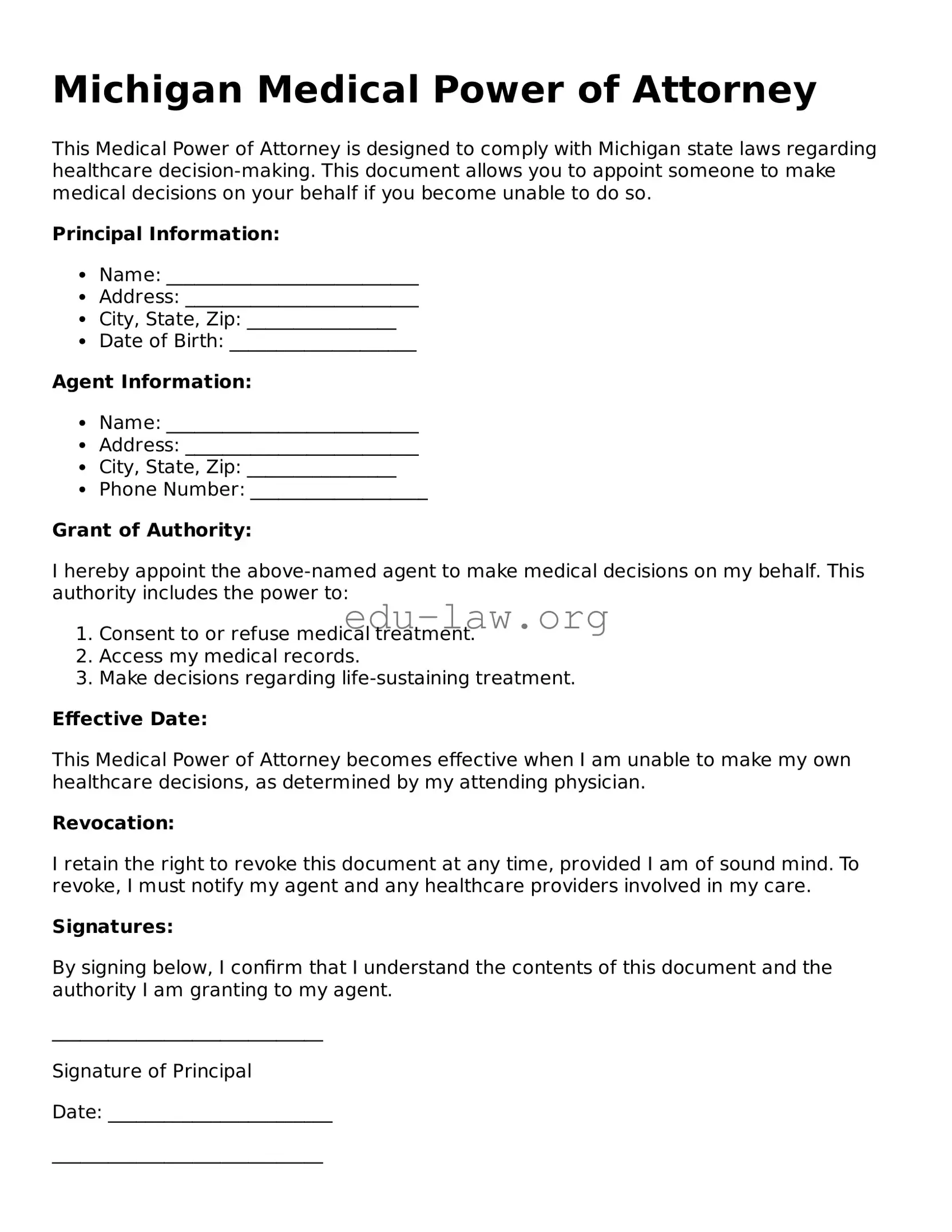
Michigan Medical Power of Attorney
This Medical Power of Attorney is designed to comply with Michigan state laws regarding healthcare decision-making. This document allows you to appoint someone to make medical decisions on your behalf if you become unable to do so.
Principal Information:
Agent Information:
Grant of Authority:
I hereby appoint the above-named agent to make medical decisions on my behalf. This authority includes the power to:
Effective Date:
This Medical Power of Attorney becomes effective when I am unable to make my own healthcare decisions, as determined by my attending physician.
Revocation:
I retain the right to revoke this document at any time, provided I am of sound mind. To revoke, I must notify my agent and any healthcare providers involved in my care.
Signatures:
By signing below, I confirm that I understand the contents of this document and the authority I am granting to my agent.
_____________________________
Signature of Principal
Date: ________________________
_____________________________
Signature of Agent
Date: ________________________
Witnesses:
This document must be signed in the presence of two witnesses who are not related to the principal or the agent.
Date: ________________________
| Fact Name | Details |
|---|---|
| Definition | The Michigan Medical Power of Attorney form allows an individual to designate another person to make medical decisions on their behalf if they become incapacitated. |
| Governing Law | This form is governed by the Michigan Compiled Laws, specifically MCL 700.5501 to 700.5518, which outline the legal framework for medical powers of attorney in Michigan. |
| Principal Requirements | The individual creating the form, known as the principal, must be at least 18 years old and of sound mind at the time of signing. |
| Agent Authority | The designated agent has the authority to make a wide range of medical decisions, including consent to or refusal of treatment, based on the principal's wishes. |
| Revocation | The principal can revoke the medical power of attorney at any time, as long as they are competent to do so, by providing written notice to the agent. |
| Witness Requirements | The form must be signed in the presence of at least two witnesses or a notary public to ensure its validity. |
Filling out the Michigan Medical Power of Attorney form is a straightforward process that allows you to designate someone to make healthcare decisions on your behalf. Once completed, this form needs to be signed and dated in the presence of a notary public or witnesses to ensure its validity.
What is a Michigan Medical Power of Attorney?
A Michigan Medical Power of Attorney is a legal document that allows you to designate someone you trust to make healthcare decisions on your behalf if you become unable to do so. This trusted individual, often referred to as your agent or surrogate, can make choices regarding your medical treatment, access your medical records, and communicate with healthcare providers. It ensures that your healthcare preferences are respected, even if you cannot voice them yourself.
Who can be appointed as my agent in a Medical Power of Attorney?
In Michigan, you can appoint any competent adult as your agent. This could be a family member, close friend, or anyone you trust to make decisions in your best interest. However, it is important to note that certain individuals, such as your healthcare provider or an employee of your healthcare provider, cannot serve as your agent unless they are related to you.
How do I create a Medical Power of Attorney in Michigan?
Creating a Medical Power of Attorney in Michigan involves a few straightforward steps. First, you need to complete the appropriate form, which can be obtained online or from legal offices. Next, you must sign the document in the presence of two witnesses or a notary public. It's essential to ensure that the witnesses are not related to you or beneficiaries of your estate to avoid any conflicts of interest. Once completed, provide copies to your agent and your healthcare providers.
Can I change or revoke my Medical Power of Attorney?
Yes, you can change or revoke your Medical Power of Attorney at any time, as long as you are still mentally competent. To revoke it, you can simply notify your agent and any healthcare providers who have a copy of the document. It is advisable to create a new Medical Power of Attorney if you wish to appoint a different agent or make changes to your existing document. Always keep a record of any changes made.
What happens if I don’t have a Medical Power of Attorney?
If you do not have a Medical Power of Attorney in place and become unable to make your own healthcare decisions, your family members may need to go through a legal process to appoint a guardian. This can be time-consuming and stressful for your loved ones during an already difficult time. Having a Medical Power of Attorney ensures that your wishes are known and that decisions can be made swiftly by someone you trust.
Not choosing the right agent. It’s essential to select someone who understands your wishes and can make decisions on your behalf. Many people choose a family member without considering their ability to handle such responsibilities.
Failing to discuss your wishes. It’s a common mistake to fill out the form without having an open conversation with your chosen agent. Your agent should be aware of your preferences regarding medical treatment.
Not signing the form in front of witnesses. In Michigan, you must have your Medical Power of Attorney signed in the presence of at least two witnesses or a notary public. Skipping this step can lead to your document being deemed invalid.
Using outdated forms. Laws can change, and using an old version of the Medical Power of Attorney form may not meet current legal requirements. Always ensure you are using the most recent version.
Overlooking alternate agents. It’s wise to name an alternate agent in case your primary choice is unable or unwilling to serve. Many people forget this important step, which can lead to complications.
Being vague about medical preferences. The form allows you to specify your wishes regarding treatment. Providing unclear instructions can lead to confusion and may not reflect your true desires.
Neglecting to review the document regularly. Life circumstances change, and so do your preferences. Failing to review and update your Medical Power of Attorney can result in outdated decisions being made on your behalf.
Not considering the implications of the decisions. People often fill out the form without fully understanding the weight of the decisions their agent will make. It’s crucial to think through the potential outcomes of your choices.
Ignoring state-specific requirements. Each state has its own laws regarding Medical Power of Attorney forms. Not adhering to Michigan’s specific rules can invalidate your document.
The Michigan Medical Power of Attorney form allows an individual to designate a trusted person to make healthcare decisions on their behalf if they become unable to do so. This document is often used in conjunction with other legal forms to ensure comprehensive planning for medical and financial matters. Below is a list of related documents that may be beneficial to consider.
Utilizing these documents in conjunction with the Michigan Medical Power of Attorney can help ensure that both healthcare and financial decisions align with an individual's preferences and needs. It is advisable to consult with a legal professional to ensure all documents are properly executed and reflect the individual's intentions accurately.
The Michigan Medical Power of Attorney form shares similarities with the Advance Healthcare Directive. Both documents empower individuals to designate a trusted person to make medical decisions on their behalf when they are unable to do so. This means that if a person becomes incapacitated, their appointed agent can step in to ensure that their healthcare preferences are honored. The Advance Healthcare Directive often combines the power of attorney with specific instructions regarding medical treatments, making it a comprehensive tool for managing one’s healthcare wishes.
Another document comparable to the Michigan Medical Power of Attorney is the Living Will. While the Medical Power of Attorney focuses on appointing someone to make decisions, a Living Will outlines an individual’s preferences regarding end-of-life care and medical interventions. For instance, it might specify whether a person wishes to receive life-sustaining treatments or palliative care. Together, these documents provide a clearer picture of a person’s healthcare wishes and help guide their appointed agents in making decisions that align with those wishes.
The Durable Power of Attorney is also similar, though it typically extends beyond medical decisions to encompass financial matters. Like the Michigan Medical Power of Attorney, it allows an individual to designate someone to act on their behalf. However, the Durable Power of Attorney can cover a broader range of decisions, including property management and financial transactions. This distinction makes it essential for individuals to consider both documents if they want to ensure that their medical and financial affairs are handled according to their preferences.
Lastly, the Do Not Resuscitate (DNR) order is another related document. While the Michigan Medical Power of Attorney allows an agent to make medical decisions, a DNR specifically instructs healthcare providers not to perform CPR in the event of cardiac arrest. It reflects a person's wishes regarding resuscitation efforts and is often used in conjunction with a Medical Power of Attorney. Together, these documents ensure that an individual’s healthcare preferences are respected in critical situations, providing clarity for both family members and medical professionals.
When filling out the Michigan Medical Power of Attorney form, follow these guidelines to ensure accuracy and compliance.
Understanding the Michigan Medical Power of Attorney form is essential for anyone considering designating a medical decision-maker. However, several misconceptions can lead to confusion. Here is a list of eight common misconceptions about this important legal document:
By understanding these misconceptions, individuals can make informed decisions about their medical planning and ensure that their wishes are honored in times of need.
When considering a Medical Power of Attorney in Michigan, it's essential to understand the implications and processes involved. Here are some key takeaways to keep in mind: