In Michigan, a Living Will serves as a crucial tool for individuals to express their healthcare preferences in the event they are unable to communicate those wishes themselves. This form addresses key medical decisions, particularly regarding end-of-life care, by allowing individuals to outline their desires for treatment in critical situations. It encourages open discussions among family members and healthcare providers, ensuring that one’s values and wishes are respected. Key components of the form include the designation of a healthcare representative, a section for specific treatment preferences, and an option to indicate the desire for organ donation. By completing this form, individuals can alleviate potential stressors for their loved ones during difficult moments, fostering a sense of clarity and guidance that can be invaluable in times of crisis. Adopting a proactive approach to healthcare planning can significantly ease the burden on families, making the Living Will an essential part of responsible life management.
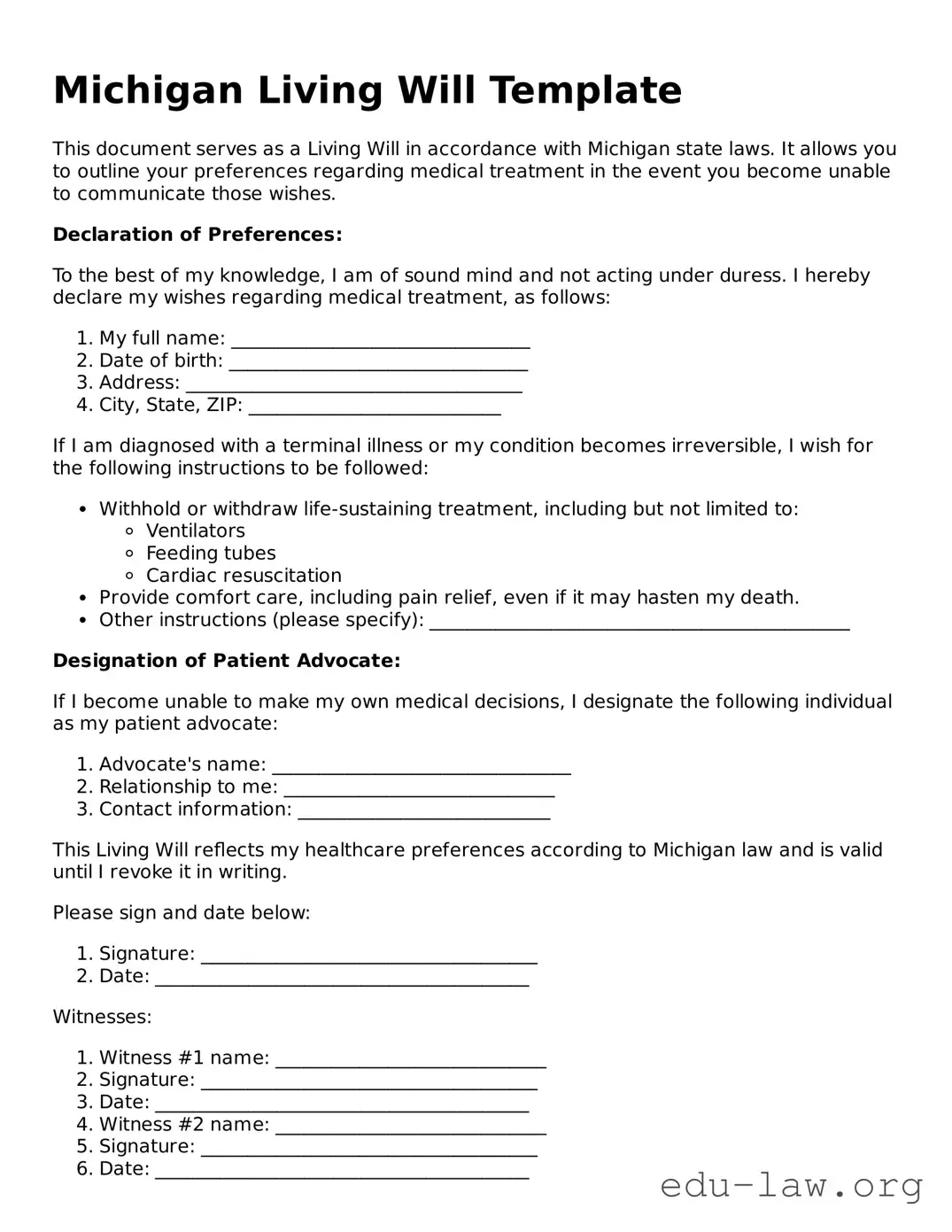
Michigan Living Will Template
This document serves as a Living Will in accordance with Michigan state laws. It allows you to outline your preferences regarding medical treatment in the event you become unable to communicate those wishes.
Declaration of Preferences:
To the best of my knowledge, I am of sound mind and not acting under duress. I hereby declare my wishes regarding medical treatment, as follows:
If I am diagnosed with a terminal illness or my condition becomes irreversible, I wish for the following instructions to be followed:
Designation of Patient Advocate:
If I become unable to make my own medical decisions, I designate the following individual as my patient advocate:
This Living Will reflects my healthcare preferences according to Michigan law and is valid until I revoke it in writing.
Please sign and date below:
Witnesses:
This template provides a framework for you to express your wishes. It is recommended that you consult a legal professional for personalized guidance.
| Fact Name | Description |
|---|---|
| Definition | A Michigan Living Will is a legal document that outlines an individual's wishes regarding medical treatment in the event they become unable to communicate their preferences. |
| Governing Law | The Michigan Living Will form is governed by the Michigan Compiled Laws, specifically the Estates and Protected Individuals Code (EPIC), Act 386 of 1998. |
| Healthcare Decisions | This document focuses primarily on healthcare decisions, allowing individuals to specify preferences for life-sustaining treatment. |
| Eligibility | Any adult aged 18 or older can create a Living Will in Michigan, provided they are of sound mind. |
| Durability | A Living Will remains in effect even if the person becomes incapacitated, ensuring that the document's wishes are honored during critical times. |
| Revocation | Individuals have the right to revoke their Living Will at any time, as long as they are still mentally competent to do so. |
| Executor Requirement | There is no requirement for a witness or notary for a Living Will in Michigan, but having one can provide additional assurance. |
| Common Misunderstanding | It is often confused with a Durable Power of Attorney for Healthcare, but a Living Will specifically addresses end-of-life treatment preferences. |
| Health Provider Notification | Medical providers must be informed of the existence of the Living Will so that they can adhere to the individual's stated wishes. |
Filling out the Michigan Living Will form is a personal and important decision that requires your thoughtful attention. This document allows you to express your wishes regarding medical treatment in the event that you become unable to communicate or make decisions for yourself. Taking a bit of time to understand how to properly complete this form is essential to ensure that your healthcare preferences are honored.
After completing these steps, ensure that the document is stored in a secure yet accessible place. Communicate openly with your family and healthcare providers about your Living Will, so they understand your preferences. Taking these proactive measures can provide peace of mind for you and your loved ones.
What is a Living Will in Michigan?
A Living Will is a legal document that outlines your preferences for medical treatment in case you become unable to communicate your wishes due to illness or injury. In Michigan, this form helps ensure that your specific desires regarding life-sustaining treatments, such as resuscitation efforts or ventilation, are respected. By clearly stating your preferences in your Living Will, you can guide your loved ones and healthcare providers in making decisions that align with your values and beliefs.
How do I create a Living Will in Michigan?
To create a Living Will in Michigan, you need to follow a few straightforward steps. First, gather your thoughts about the medical treatments you wish to receive or refuse. Consider discussing your wishes with family members or healthcare providers beforehand to ensure clarity. Then, you can fill out the living will form, which is available through various sources, including healthcare institutions and legal aid websites. After completing the form, you should sign it in the presence of witnesses—typically two individuals who are not related to you and who stand to inherit from your estate. This step is crucial, as having valid witnesses strengthens the enforceability of your Living Will.
Can I modify my Living Will after it is created?
Yes, you can modify your Living Will whenever you feel it's necessary. If your medical condition changes, your beliefs evolve, or simply you want to update your preferences, you are free to do so. To make a modification, it's essential to create a new Living Will, as prior documents will be voided once the new one is signed and witnessed. Always ensure that your family and healthcare providers have the most up-to-date version, so everyone is informed of your wishes.
What happens if I don't have a Living Will in Michigan?
If you do not have a Living Will in place, medical decisions will default to your family members or possibly appointed guardians. Without a Living Will, there is no formal indication of your wishes regarding life-sustaining treatment, which can lead to stress and uncertainty for your loved ones during difficult times. Additionally, family members might disagree on the type of care you would have wanted, leading to potential conflict. By drafting a Living Will, you provide clear guidance, helping ease the burden on your family and ensuring that your preferences are honored.
Failing to clearly define medical preferences. It’s important to be explicit about what types of treatments you do or do not want. Ambiguity can create confusion for healthcare providers.
Not signing the document. A Living Will must be signed to be valid. Make sure you sign in front of a witness or a notary if required.
Overlooking witness requirements. In Michigan, you typically need at least one witness who is not a relative and is not mentioned in the will. Failure to meet this requirement can invalidate the form.
Using outdated forms. Laws change, and so do forms. It’s crucial to use the most recent version of the Living Will form to ensure compliance.
Not reviewing the document periodically. Life circumstances can change, and so can your preferences. Regularly reviewing your Living Will ensures it still reflects your wishes.
Neglecting to inform family members about the Living Will. Your healthcare providers aren't the only ones who should be aware of your choices. Discuss your wishes with family to reduce stress during difficult times.
A Michigan Living Will is an important document for individuals who want to outline their medical care preferences in case they become unable to communicate their wishes. However, several other forms and documents complement the Living Will, providing a more comprehensive approach to healthcare planning. Below are several key documents often used alongside the Michigan Living Will form.
Creating a comprehensive healthcare plan requires understanding and utilizing these additional forms. Each document plays a vital role in ensuring that your healthcare choices align with your values and preferences, safeguarding your wishes when the time comes.
The Michigan Durable Power of Attorney is a document that allows you to appoint someone to make decisions on your behalf if you become unable to do so. Similar to a Living Will, this document focuses on your healthcare decisions. It grants authority to your chosen agent to make medical choices consistent with your wishes, ensuring your preferences are honored even when you cannot communicate them. This document, like the Living Will, emphasizes your rights and autonomy in healthcare matters.
A Health Care Proxy is another important document. It designates a specific individual to make health decisions for you in case you're incapacitated. Much like a Living Will, the Health Care Proxy ensures that the person you trust makes choices aligned with your values and desires. This document is essential for confirming that your healthcare wishes are understood and respected during critical times when you cannot express them yourself.
A Do Not Resuscitate (DNR) order is similar in purpose but focuses specifically on life-sustaining treatments. This document expresses your wish not to receive CPR or other life-saving procedures if your heart stops or you stop breathing. Just like a Living Will, a DNR informs medical personnel of your end-of-life preferences, ensuring that your medical care aligns with your personal wishes at a crucial moment.
The Physician's Orders for Life-Sustaining Treatment (POLST) form provides more detailed instructions regarding your medical care preferences. This document complements a Living Will by translating your wishes into actionable medical orders. POLST is typically used for individuals with serious health conditions. It ensures that emergency medical responders honor your desires regarding treatments when you're unable to speak for yourself.
An Advance Directive encompasses both a Living Will and a Durable Power of Attorney for Health Care. It serves as a broad framework for making your healthcare wishes clear. This comprehensive document allows you to specify your end-of-life preferences as well as appoint someone to handle your medical decisions. Like a Living Will, it emphasizes patient wishes and offers peace of mind for both you and your loved ones.
The Five Wishes document combines healthcare directives with personal wishes. It covers not only medical decisions but also emotional, spiritual, and personal preferences at the end of life. This holistic approach allows for a deeper understanding of your values, similar to a Living Will. It ensures that healthcare providers consider your comfort and dignity in addition to your medical requests.
When it comes to filling out a Michigan Living Will form, clarity and precision are essential. Here are some important do's and don'ts to keep in mind:
By following these guidelines, you can help ensure that your wishes are respected when it matters most.
Many people have misunderstandings about the Michigan Living Will form. Here are some common misconceptions explained:
This is not the case. A Living Will outlines your wishes regarding medical treatment if you become unable to communicate. A DNR order specifically instructs medical personnel not to perform CPR in the event of cardiac arrest. They serve different purposes.
In reality, anyone over 18 can create a Living Will. Accidents and unexpected health issues can affect anyone, regardless of age. Planning ahead can give you peace of mind.
This is a misconception. You can change or revoke your Living Will at any time as long as you are competent to make such a decision. It's important to revisit your wishes periodically.
While many states recognize Living Wills, each state has its own laws and requirements. A Michigan Living Will may not be valid in another state unless it meets local legal standards.
While doctors typically honor a Living Will, there are situations where they might not be able to comply due to legal or medical reasons. Communication with your healthcare provider can help ensure your wishes are understood.
This is not necessary. While legal assistance can be beneficial, many resources are available online that provide templates for creating a Living Will. It’s vital to ensure it meets state requirements.
This is a common misunderstanding. A Living Will provides guidelines for healthcare decisions but does not designate someone to make decisions on your behalf. That requires a separate document, like a Durable Power of Attorney for Healthcare.
It's a misconception that Living Wills are limited to end-of-life scenarios. They can address various medical situations, such as severe injuries or illnesses, where you might not be able to express your wishes.
In fact, discussing your Living Will with family members can be very important. These conversations can help ensure your loved ones understand your preferences, making it easier for them to make decisions if needed.
Filling out and using the Michigan Living Will form is an important step in planning for medical decisions. Here are some key takeaways:
What's Advance Directive - Some people choose to review and update their Living Will regularly as circumstances change.
Georgia Healthcare Power of Attorney Form 2022 - A Living Will is a proactive step towards personalized medical care.
Living Will Form Texas - Your Living Will may work in conjunction with other advance directives, such as a healthcare proxy.