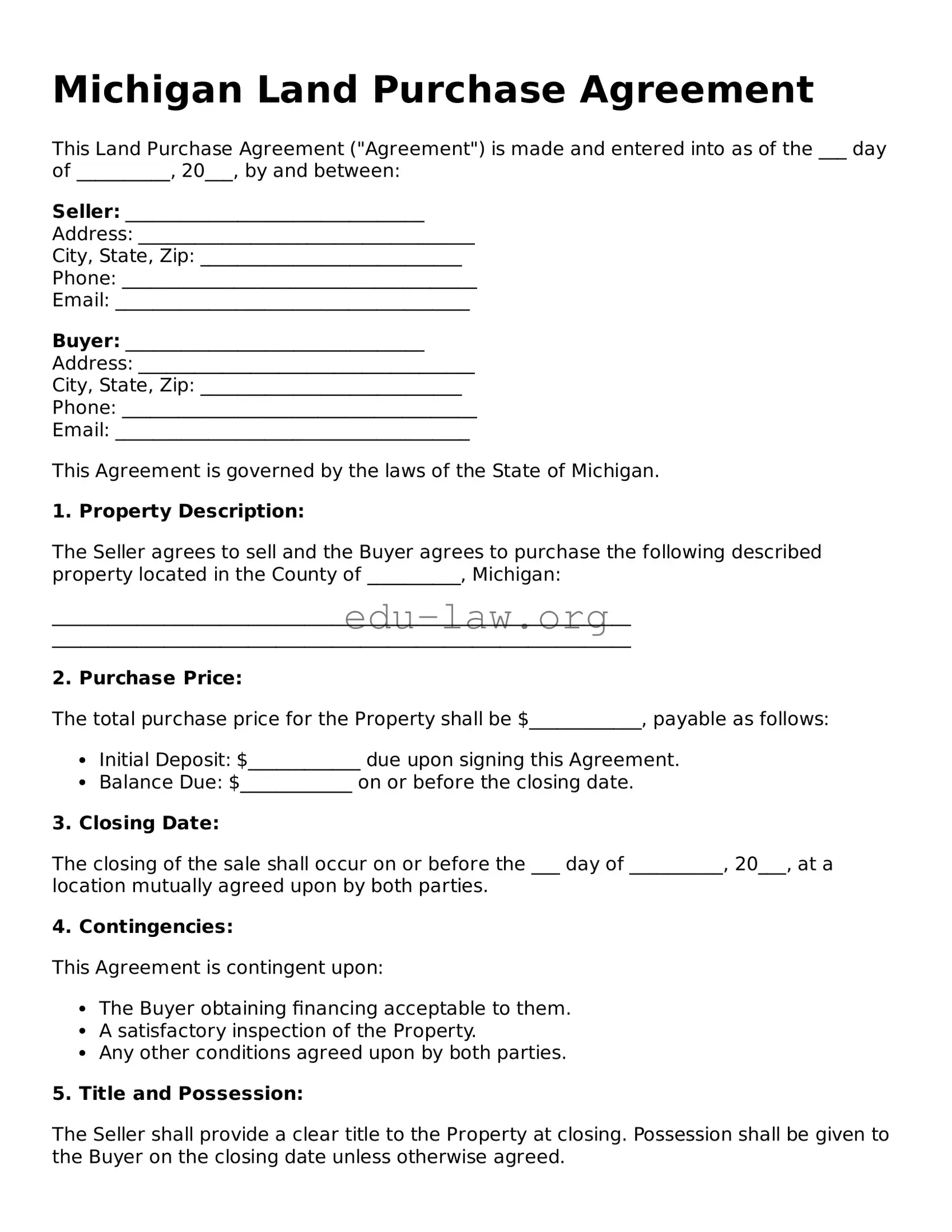
The Michigan Land Purchase Agreement form serves as a crucial document in real estate transactions, ensuring that both buyers and sellers have a clear understanding of their rights and responsibilities. This agreement outlines key elements such as the purchase price, property description, and payment terms, providing a structured framework for the sale. It also addresses contingencies, which are conditions that must be met for the sale to proceed, such as financing approval or property inspections. Additionally, the form includes information on the closing process, which is the final step in transferring ownership. By laying out these details, the Michigan Land Purchase Agreement helps to minimize misunderstandings and protect the interests of all parties involved. Understanding this form is essential for anyone looking to navigate the complexities of buying or selling land in Michigan.
Michigan Land Purchase Agreement
This Land Purchase Agreement ("Agreement") is made and entered into as of the ___ day of __________, 20___, by and between:
Seller: ________________________________
Address: ____________________________________
City, State, Zip: ____________________________
Phone: ______________________________________
Email: ______________________________________
Buyer: ________________________________
Address: ____________________________________
City, State, Zip: ____________________________
Phone: ______________________________________
Email: ______________________________________
This Agreement is governed by the laws of the State of Michigan.
1. Property Description:
The Seller agrees to sell and the Buyer agrees to purchase the following described property located in the County of __________, Michigan:
______________________________________________________________
______________________________________________________________
2. Purchase Price:
The total purchase price for the Property shall be $____________, payable as follows:
3. Closing Date:
The closing of the sale shall occur on or before the ___ day of __________, 20___, at a location mutually agreed upon by both parties.
4. Contingencies:
This Agreement is contingent upon:
5. Title and Possession:
The Seller shall provide a clear title to the Property at closing. Possession shall be given to the Buyer on the closing date unless otherwise agreed.
6. Governing Law:
This Agreement shall be construed in accordance with the laws of the State of Michigan.
7. Signatures:
IN WITNESS WHEREOF, the parties hereto have executed this Land Purchase Agreement as of the date first above written.
______________________________
Seller Signature
______________________________
Buyer Signature
______________________________
Date
______________________________
Date
| Fact Name | Description |
|---|---|
| Purpose | The Michigan Land Purchase Agreement form is used to outline the terms and conditions under which a buyer agrees to purchase real estate from a seller. |
| Governing Law | This agreement is governed by the laws of the State of Michigan, specifically the Michigan Compiled Laws related to property transactions. |
| Key Components | Essential elements of the agreement include purchase price, property description, closing date, and contingencies. |
| Signatures Required | Both the buyer and seller must sign the agreement for it to be legally binding. |
| Importance of Clarity | Clear and detailed terms help prevent misunderstandings and disputes between the parties involved. |
After obtaining the Michigan Land Purchase Agreement form, the next steps involve carefully filling out the necessary information to ensure a smooth transaction. It is important to provide accurate details to avoid any complications later in the process.
What is a Michigan Land Purchase Agreement?
A Michigan Land Purchase Agreement is a legal document that outlines the terms and conditions under which a buyer agrees to purchase land from a seller in Michigan. This agreement typically includes details such as the purchase price, property description, and any contingencies that must be met before the sale is finalized.
What key elements should be included in the agreement?
Essential elements of a Michigan Land Purchase Agreement include the names of the buyer and seller, a detailed description of the property, the purchase price, payment terms, and any contingencies such as financing or inspections. Additionally, the agreement should outline the closing date and any specific obligations of both parties.
Do I need a lawyer to draft or review the agreement?
While it is not legally required to have a lawyer, it is highly recommended. A legal professional can ensure that the agreement complies with Michigan laws and protects your interests. They can also help clarify any complex terms and conditions that may arise.
Can the agreement be modified after it is signed?
Yes, the agreement can be modified, but both parties must agree to the changes. Any modifications should be documented in writing and signed by both the buyer and seller to avoid any misunderstandings later on.
What happens if one party breaches the agreement?
If one party fails to uphold their end of the agreement, the other party may have legal recourse. This could involve seeking damages or specific performance, where the court orders the breaching party to fulfill their obligations as outlined in the agreement. It’s crucial to understand the implications of breaching the contract before signing.
Is there a standard form for the Michigan Land Purchase Agreement?
While there is no official state form, many real estate professionals and legal resources provide templates that comply with Michigan laws. These templates can serve as a useful starting point, but it is wise to customize them to fit the specific details of your transaction.
What should I do if I have questions about the agreement?
If you have questions about the Michigan Land Purchase Agreement, consider reaching out to a qualified real estate attorney or a licensed real estate agent. They can provide clarity and guidance, ensuring you fully understand your rights and obligations before moving forward with the purchase.
Incomplete Information: Many individuals neglect to fill out all required fields. It is essential to provide complete information to avoid delays in the transaction.
Incorrect Property Description: Failing to accurately describe the property can lead to disputes. Ensure that the legal description matches the one found in public records.
Omitting Signatures: A common oversight is forgetting to sign the agreement. Both buyer and seller must sign for the document to be legally binding.
Not Including Contingencies: Some buyers overlook the importance of including contingencies, such as financing or inspection clauses. These can protect you from unforeseen issues.
Ignoring Deadlines: Failing to adhere to specified deadlines can jeopardize the agreement. Be mindful of all dates related to offers, inspections, and closing.
Misunderstanding Terms: Some individuals do not fully understand the terms of the agreement. Take the time to read and comprehend each section to avoid confusion later.
Overlooking Legal Advice: Many people attempt to navigate the process without consulting a legal expert. Seeking advice can help clarify complex issues and protect your interests.
Failing to Disclose Issues: Sellers sometimes do not disclose known issues with the property. Honesty in this regard is crucial to maintain trust and avoid legal repercussions.
Not Keeping Copies: After completing the agreement, some individuals forget to keep copies for their records. Retaining a copy is vital for future reference and any potential disputes.
The Michigan Land Purchase Agreement is a crucial document in real estate transactions, but it is often accompanied by several other forms and documents that facilitate the buying and selling process. Each of these documents serves a specific purpose, ensuring that both parties are protected and that the transaction proceeds smoothly.
In summary, these documents work together with the Michigan Land Purchase Agreement to create a comprehensive framework for real estate transactions. Understanding each document's role can help both buyers and sellers navigate the complexities of property transactions with confidence.
The Michigan Land Purchase Agreement form shares similarities with the Purchase Agreement for Real Estate. Both documents serve as a binding contract between a buyer and seller, outlining the terms of the sale. They include details such as the purchase price, property description, and closing date. Just like the Land Purchase Agreement, this document also specifies contingencies that must be met before the sale is finalized, ensuring that both parties understand their obligations.
Another related document is the Residential Lease Agreement. While primarily used for rental agreements, it also contains essential terms regarding the property, such as the duration of the lease, payment terms, and responsibilities for maintenance. Both agreements require clear communication of expectations and can serve as legal proof of the terms agreed upon by the parties involved.
The Quitclaim Deed is another document that shares similarities. It is often used in property transfers, allowing the seller to relinquish any claim to the property without guaranteeing clear title. Like the Land Purchase Agreement, it requires the identification of the property and the parties involved. However, it does not include terms related to payment, focusing instead on the transfer of ownership.
The Warranty Deed also parallels the Land Purchase Agreement, as it is used in the transfer of real estate. This document guarantees that the seller holds clear title to the property and has the right to sell it. Both documents provide a formal structure for the transaction, ensuring that the buyer is protected against any claims that might arise after the sale.
The Option to Purchase Agreement is similar in that it gives a potential buyer the right, but not the obligation, to purchase a property at a later date. This document outlines the terms of the option, including the purchase price and duration of the option period. Like the Land Purchase Agreement, it requires clear terms to avoid misunderstandings and protect both parties' interests.
The Seller’s Disclosure Statement is another related document. It is often provided alongside the Land Purchase Agreement and requires the seller to disclose known issues with the property. This transparency helps buyers make informed decisions and can prevent disputes after the sale. Both documents emphasize the importance of honesty in real estate transactions.
Finally, the Title Commitment is essential in real estate transactions and complements the Land Purchase Agreement. This document outlines the condition of the title and any liens or encumbrances on the property. It ensures that the buyer receives a clear title at closing, reinforcing the commitments made in the purchase agreement. Both documents work together to protect the interests of the buyer and seller throughout the transaction process.
When filling out the Michigan Land Purchase Agreement form, attention to detail is crucial. Here are nine important do's and don'ts to consider:
Following these guidelines can help ensure that your Land Purchase Agreement is completed correctly and reduces the risk of future disputes.
When dealing with the Michigan Land Purchase Agreement form, several misconceptions can arise. Understanding these can help potential buyers and sellers navigate the process more effectively.
This is not true. The Michigan Land Purchase Agreement can be used for various types of real estate transactions, including commercial and agricultural properties.
While having legal assistance can be beneficial, it is not mandatory. Many individuals successfully complete the form on their own, provided they understand the terms and conditions involved.
This misconception can lead to frustration. In fact, the terms within the agreement can often be negotiated between the buyer and seller before finalizing the deal.
Changes can be made, but they typically require mutual consent from both parties. It is important to document any amendments properly.
While the Michigan Land Purchase Agreement is a critical step in the process, it does not guarantee that the sale will go through. Various factors, such as financing or inspections, can affect the outcome.
When dealing with the Michigan Land Purchase Agreement form, understanding its components and implications is crucial. Here are some key takeaways to consider:
By keeping these takeaways in mind, you can navigate the Michigan Land Purchase Agreement process with greater confidence and clarity.