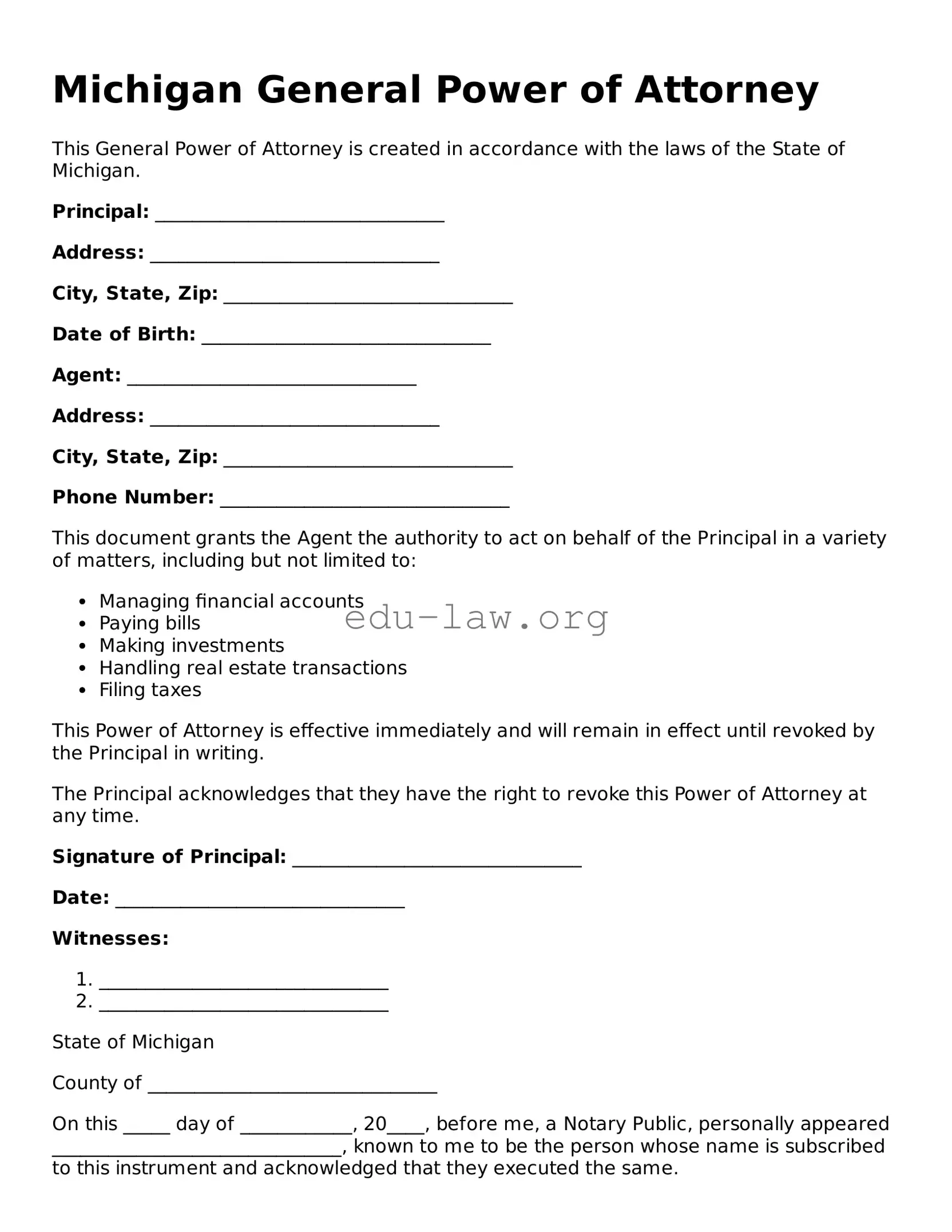
The Michigan General Power of Attorney form is a crucial legal document that allows an individual, known as the principal, to appoint someone else, referred to as the agent, to manage their financial and legal affairs. This form grants broad powers to the agent, enabling them to make decisions on behalf of the principal in various matters, such as handling bank transactions, managing real estate, and overseeing investments. It is essential for anyone looking to ensure their interests are protected, especially in situations where they may become unable to make decisions due to illness or absence. Understanding the specific powers granted and the responsibilities of the agent is vital. Additionally, it is important to consider how to revoke the power of attorney if necessary. This form can be tailored to fit individual needs, providing peace of mind that someone trusted will be in charge when it matters most.
Michigan General Power of Attorney
This General Power of Attorney is created in accordance with the laws of the State of Michigan.
Principal: _______________________________
Address: _______________________________
City, State, Zip: _______________________________
Date of Birth: _______________________________
Agent: _______________________________
Address: _______________________________
City, State, Zip: _______________________________
Phone Number: _______________________________
This document grants the Agent the authority to act on behalf of the Principal in a variety of matters, including but not limited to:
This Power of Attorney is effective immediately and will remain in effect until revoked by the Principal in writing.
The Principal acknowledges that they have the right to revoke this Power of Attorney at any time.
Signature of Principal: _______________________________
Date: _______________________________
Witnesses:
State of Michigan
County of _______________________________
On this _____ day of ____________, 20____, before me, a Notary Public, personally appeared _______________________________, known to me to be the person whose name is subscribed to this instrument and acknowledged that they executed the same.
Notary Public: _______________________________
My Commission Expires: _______________________________
| Fact Name | Details |
|---|---|
| Definition | A Michigan General Power of Attorney form allows an individual (the principal) to designate another person (the agent) to make decisions on their behalf regarding financial and legal matters. |
| Governing Law | The form is governed by the Michigan Compiled Laws, specifically Act 386 of 1978, also known as the Michigan Power of Attorney Act. |
| Durability | This form can be durable or non-durable. A durable power of attorney remains effective even if the principal becomes incapacitated, while a non-durable power of attorney is revoked upon the principal's incapacity. |
| Signing Requirements | The form must be signed by the principal in the presence of a notary public or two witnesses to be considered valid. |
Filling out the Michigan General Power of Attorney form is an important step in designating someone to make decisions on your behalf. After completing the form, you will need to ensure that it is signed and witnessed according to Michigan law. This will help to ensure that your wishes are respected and that the designated person can act effectively when needed.
After completing these steps, ensure that both you and your agent keep copies of the signed form. This will help both parties understand the authority granted and ensure smooth communication in the future.
What is a General Power of Attorney in Michigan?
A General Power of Attorney (POA) in Michigan is a legal document that allows one person (the principal) to authorize another person (the agent) to act on their behalf. This authority can cover a wide range of financial and legal matters, such as managing bank accounts, signing documents, and making decisions regarding property. The agent's powers can be specified in the document, giving them broad or limited authority based on the principal's wishes.
Who can be a principal and an agent in a General Power of Attorney?
In Michigan, any competent adult can serve as a principal. The agent must also be an adult and can be a trusted friend, family member, or professional. It’s important to choose someone responsible, as the agent will have significant control over the principal's affairs.
Does a General Power of Attorney need to be notarized in Michigan?
Yes, for a General Power of Attorney to be legally valid in Michigan, it must be signed by the principal in the presence of a notary public. This notarization helps verify the identity of the principal and ensures that the document is executed properly.
Can I limit the powers granted in a General Power of Attorney?
Absolutely. The principal has the option to limit the powers granted to the agent. This can include specifying particular tasks the agent can perform or setting conditions under which the agent can act. It's essential to clearly outline these limitations in the document to avoid any confusion later.
When does a General Power of Attorney become effective?
A General Power of Attorney can become effective immediately upon signing, or it can be set to take effect at a later date or upon the occurrence of a specific event, such as the principal's incapacity. This flexibility allows the principal to choose what works best for their situation.
Can I revoke a General Power of Attorney?
Yes, the principal can revoke a General Power of Attorney at any time, as long as they are mentally competent. To do so, the principal should create a written revocation document and notify the agent and any relevant third parties. It’s advisable to keep a copy of the revocation for personal records.
What happens if the principal becomes incapacitated?
If the principal becomes incapacitated, the General Power of Attorney remains in effect unless it specifies otherwise. However, if the principal wishes to have a different arrangement in place for decision-making during incapacity, they may want to consider a Durable Power of Attorney instead, which specifically remains valid even if the principal is unable to make decisions.
Can I use a General Power of Attorney for healthcare decisions?
No, a General Power of Attorney is primarily for financial and legal matters. For healthcare decisions, a separate document called a Patient Advocate Designation or Medical Power of Attorney is needed. This document allows the agent to make medical decisions on behalf of the principal if they are unable to do so.
Is there a specific form I need to use for a General Power of Attorney in Michigan?
While there is no specific state-mandated form for a General Power of Attorney in Michigan, it is recommended to use a template that complies with Michigan law. This ensures that the document meets all legal requirements and effectively conveys the principal's intentions.
Not specifying the powers granted: Many individuals fail to clearly outline the specific powers they wish to grant to their agent. This can lead to confusion and potential disputes later on.
Forgetting to date the document: A common oversight is neglecting to include the date when the form is signed. This date is crucial for establishing the validity of the document.
Not signing in front of a witness: In Michigan, it is important to have the document signed in front of a witness. Failing to do so can render the power of attorney invalid.
Neglecting to inform the agent: Some people fill out the form without informing their chosen agent. It is essential that the agent understands their responsibilities and agrees to take on this role.
Using outdated forms: Individuals sometimes use outdated versions of the power of attorney form. Always ensure that you are using the most current version to avoid legal complications.
Failing to consider alternate agents: Not naming an alternate agent can be a mistake. If the primary agent is unable or unwilling to act, having a backup can prevent delays in decision-making.
The Michigan General Power of Attorney form allows an individual, known as the principal, to appoint another person, called the agent, to manage their financial and legal affairs. This document is often used in conjunction with several other forms to ensure comprehensive planning and management of an individual's affairs. Below is a list of commonly associated documents.
These documents, when used together, create a comprehensive framework for managing an individual's financial, legal, and healthcare decisions. It is advisable to consider each document's purpose and implications when planning for the future.
The Michigan Durable Power of Attorney form is similar to the General Power of Attorney in that it allows an individual to appoint someone else to make decisions on their behalf. However, the key distinction lies in its durability. The Durable Power of Attorney remains effective even if the principal becomes incapacitated. This feature ensures that the appointed agent can continue to manage the principal's affairs without interruption, providing a vital tool for long-term planning and care management.
The Michigan Medical Power of Attorney is another related document. This form specifically grants authority to an agent to make healthcare decisions on behalf of the principal. While the General Power of Attorney can cover a broad range of financial and legal matters, the Medical Power of Attorney is focused solely on health-related decisions. This document is particularly important in situations where an individual is unable to communicate their wishes regarding medical treatment and care.
The Michigan Financial Power of Attorney is also comparable, as it allows an individual to designate an agent to handle financial matters. Like the General Power of Attorney, it provides the agent with the authority to manage bank accounts, pay bills, and handle investments. However, the Financial Power of Attorney may include specific limitations or conditions regarding the financial authority granted, making it a more tailored option for those looking to manage their financial affairs while retaining some control.
Lastly, the Michigan Advance Directive for Health Care shares similarities with the General Power of Attorney, particularly in the realm of healthcare decision-making. An Advance Directive combines elements of both a Medical Power of Attorney and a living will. It outlines the principal's preferences for medical treatment and appoints an agent to ensure those wishes are followed. This document is crucial for individuals who want to communicate their healthcare preferences in advance, especially in cases where they may not be able to voice their decisions later on.
When filling out the Michigan General Power of Attorney form, it's important to be careful and thorough. Here are some key do's and don'ts to keep in mind:
Many people have misunderstandings about the Michigan General Power of Attorney form. Clarifying these misconceptions can help individuals make informed decisions. Below are six common misconceptions:
While the General Power of Attorney primarily addresses financial decisions, it can also grant authority over certain personal matters, depending on how it is drafted.
This is not true. A General Power of Attorney can be revoked at any time by the principal, as long as they are mentally competent.
This form can be durable, meaning it remains in effect even if the principal becomes incapacitated. However, this must be specified in the document.
While most adults can serve as agents, there are certain restrictions. For example, the agent should not be the principal's healthcare provider or an employee of the healthcare provider.
Although having the document notarized is highly recommended, it is not strictly required for the General Power of Attorney to be valid in Michigan.
These two documents serve different purposes. A General Power of Attorney focuses on financial and legal matters, while a healthcare power of attorney specifically addresses medical decisions.
Understanding these misconceptions can empower individuals to use the Michigan General Power of Attorney form effectively and responsibly.
When filling out and using the Michigan General Power of Attorney form, keep the following key takeaways in mind:
Taking these steps will help ensure that your General Power of Attorney is effective and aligns with your intentions.