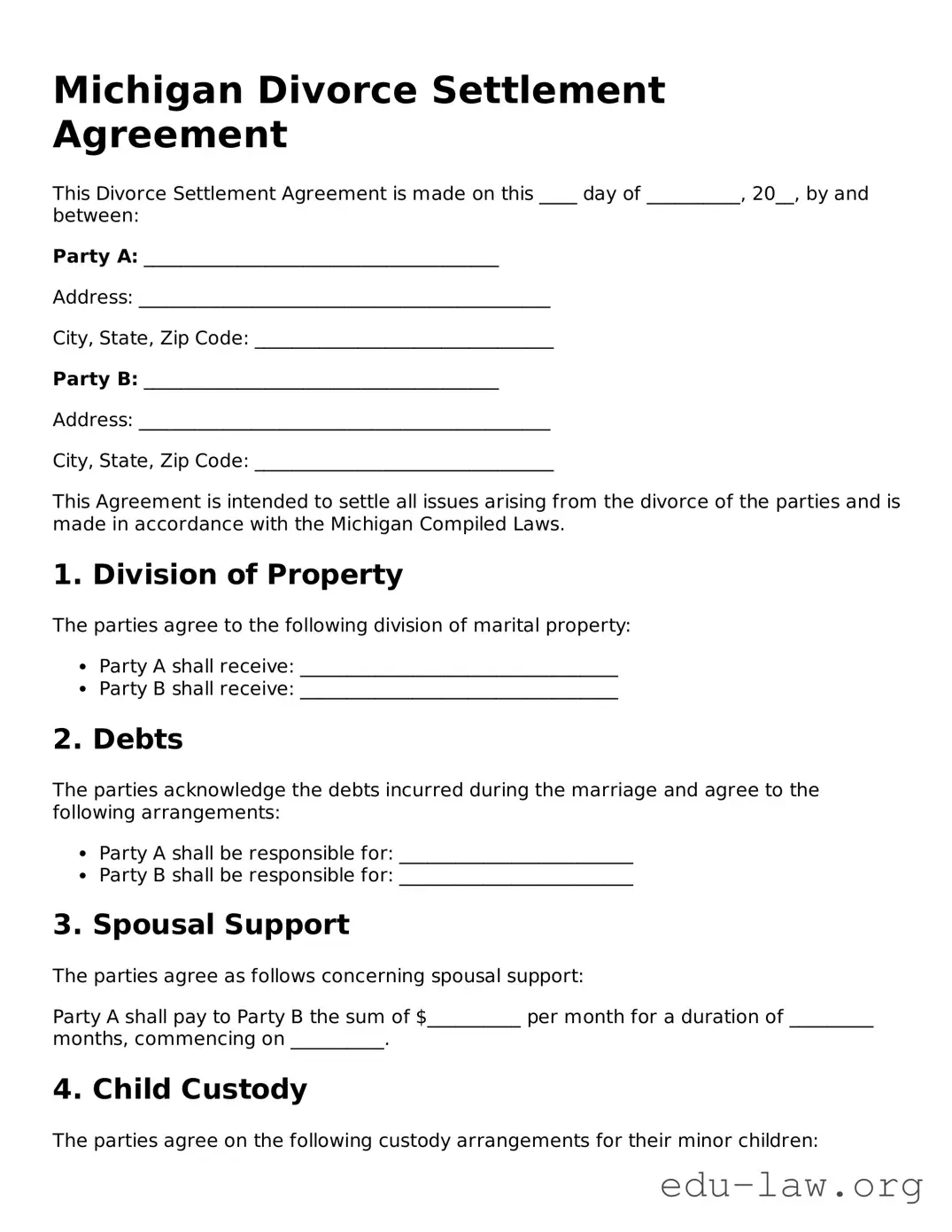
Divorce can be a challenging time for anyone, filled with emotional stress and difficult decisions. To help ease this process, the Michigan Divorce Settlement Agreement form serves as a crucial tool in outlining the terms that both parties have agreed upon regarding the dissolution of their marriage. This comprehensive document addresses important aspects of the divorce, such as division of assets and debts, child custody arrangements, and spousal support. By clearly laying out the expectations for both parties, the form helps to prevent misunderstandings and disputes in the future. Legal aspects surrounding property distribution and child visitation are essential components that must be carefully considered, ensuring that both individuals can move forward on equitable terms. Additionally, the form's completion marks a significant step toward finalizing the divorce, allowing both parties to focus on rebuilding their lives post-separation.
Michigan Divorce Settlement Agreement
This Divorce Settlement Agreement is made on this ____ day of __________, 20__, by and between:
Party A: ______________________________________
Address: ____________________________________________
City, State, Zip Code: ________________________________
Party B: ______________________________________
Address: ____________________________________________
City, State, Zip Code: ________________________________
This Agreement is intended to settle all issues arising from the divorce of the parties and is made in accordance with the Michigan Compiled Laws.
1. Division of Property
The parties agree to the following division of marital property:
2. Debts
The parties acknowledge the debts incurred during the marriage and agree to the following arrangements:
3. Spousal Support
The parties agree as follows concerning spousal support:
Party A shall pay to Party B the sum of $__________ per month for a duration of _________ months, commencing on __________.
4. Child Custody
The parties agree on the following custody arrangements for their minor children:
Child(ren) names: __________________________________________
5. Child Support
Child support shall be established according to the Michigan Child Support Formula. The parties agree that:
Party A/Party B shall pay the amount of $__________ per month for the child(ren) until the age of 18 or until otherwise modified by the court.
6. Finality of Agreement
This Agreement constitutes the entire understanding between the parties. No modification of this Agreement shall be valid unless made in writing and signed by both parties.
7. Governing Law
This Agreement shall be governed by the laws of the State of Michigan.
In witness whereof, the parties have executed this Divorce Settlement Agreement on the date first above written.
_____________________________
Party A Signature
Date: ______________________
_____________________________
Party B Signature
Date: ______________________
_____________________________
Witness Signature
Date: ______________________
| Fact Name | Description |
|---|---|
| Purpose | The Michigan Divorce Settlement Agreement form outlines the terms agreed upon by both spouses regarding the division of assets, debts, and any other relevant matters in a divorce. |
| Governing Laws | This form follows the Michigan Compiled Laws, particularly Chapter 552 which covers divorce and property division. |
| Voluntary Agreement | This form must be signed voluntarily by both parties. It should reflect a mutual understanding of the terms without any pressure. |
| Financial Disclosure | Both parties are required to provide a complete financial disclosure before finalizing the agreement, ensuring transparency in the division of assets. |
| Notarization | While not always required, notarization can add an extra level of validation to the agreement, especially in case of later disputes. |
| Filing | After being signed, the completed Divorce Settlement Agreement must be filed with the court as part of the divorce process. |
| Modifications | Any changes to the agreement after signing must typically be in writing and may require court approval to be enforceable. |
Completing the Michigan Divorce Settlement Agreement form is an important step in finalizing a divorce. After filling out the form, it will be submitted to the court as part of the divorce proceedings. Ensure that all information is accurate and complete, as this document will serve as a record of the agreed-upon terms between both parties.
What is a Michigan Divorce Settlement Agreement?
A Michigan Divorce Settlement Agreement is a legal document that outlines the terms agreed upon by both spouses regarding the division of assets, debts, custody of children, and support obligations. This agreement is crucial in finalizing a divorce, as it helps to clarify responsibilities and rights for both parties.
How do I create a Divorce Settlement Agreement in Michigan?
To create a Divorce Settlement Agreement, both spouses need to discuss and negotiate the terms that will govern their separation. It can be useful to draft the agreement with the help of an attorney to ensure that it covers all necessary legal aspects. After reaching an agreement, both parties should sign the document, and it must then be filed with the court as part of the divorce process.
Do I need a lawyer to file a Divorce Settlement Agreement?
While it is not legally required to have a lawyer, it is highly recommended. A lawyer can provide guidance and ensure that your rights are protected. If both parties agree to the terms without any disputes, filing without legal representation may be feasible. However, the complexities of divorce law can be difficult to navigate alone.
Can a Divorce Settlement Agreement be modified after it is finalized?
Yes, a Divorce Settlement Agreement can be modified after it is finalized, but only under certain circumstances. For example, if there has been a significant change in financial circumstances or in the needs of children, either party can petition the court for a modification. Any agreed modifications must also be documented and approved by the court.
What happens if we cannot reach an agreement?
If spouses cannot reach an agreement, they may need to go to court for mediation or a trial. During a trial, a judge will make decisions about asset division, custody, and support based on the evidence presented. This can be a lengthy and costly process, so it's in both parties' interests to attempt to reach an agreement outside of court.
Inadequate Information: Many individuals fail to provide complete information regarding assets, debts, and income. Missing details can delay the process and complicate negotiations.
Incorrect Financial Figures: Miscalculations of income or asset value can lead to unfair agreements. Double-checking figures is essential to ensure accuracy.
Failure to Disclose Assets: Omitting significant assets can have serious consequences. Transparency is crucial in divorce proceedings, and hidden assets can result in legal issues later.
Ignoring Tax Implications: Some individuals overlook the tax effects of their settlement. Understanding how property division affects taxes is vital to avoid unexpected financial burdens.
Not Considering Future Needs: Focusing only on the present can lead to impractical settlements. Anticipating future expenses, such as children's education and health care, is necessary.
Unclear Terms: Vague language in the agreement can create confusion or disputes down the line. Ensure that all terms and conditions are clearly defined to avoid misinterpretation.
Neglecting Professional Assistance: Many people attempt to fill out the form without legal guidance. Engaging a legal professional can provide invaluable insight and assistance.
Ignoring Required Signatures: Missing signatures or failing to submit the form on time can invalidate the agreement. Check to ensure all necessary signatures are included before submission.
Disregarding State Laws: Familiarity with Michigan laws regarding divorce and asset division is essential. Ignoring state-specific requirements can lead to invalid agreements.
Overlooking Mediation Opportunities: Many individuals fail to consider mediation, which can simplify negotiations. Mediation can lead to more amicable agreements and less courtroom conflict.
When navigating a divorce in Michigan, several key forms and documents are typically needed alongside the Divorce Settlement Agreement form. Each of these documents plays a crucial role in ensuring the process runs smoothly and that both parties have their rights and obligations clearly outlined.
By understanding these documents and their purposes, individuals going through a divorce in Michigan can better prepare for the process, ensuring that all necessary information is provided and agreements are clear.
The Michigan Divorce Settlement Agreement form is quite similar to the Marital Settlement Agreement. Both documents outline the terms and conditions by which a couple agrees to divide their assets, debts, and other responsibilities during a divorce. Just like the Divorce Settlement Agreement, the Marital Settlement Agreement brings clarity to the specifics of asset allocation, spousal support, and custody arrangements, ensuring both parties understand their rights and obligations post-divorce.
Another document akin to this is the Separation Agreement. This agreement serves as a precursor to divorce, allowing couples to live apart while detailing how they will manage their shared responsibilities. Much like the Divorce Settlement Agreement, it addresses issues such as child support, custody, and financial obligations. While a Separation Agreement may be temporary, it often resembles the Divorce Settlement Agreement in organization and intent.
The Child Custody Agreement is yet another document that shares similarities with the Divorce Settlement Agreement. This document specifically focuses on arrangements regarding the custody and parenting of children post-divorce. Both documents emphasize the importance of clarity in parental responsibilities and timing. The Child Custody Agreement, like the Divorce Settlement Agreement, aims to minimize misunderstandings and foster a cooperative co-parenting environment.
The Child Support Agreement also bears a resemblance to the Divorce Settlement Agreement. This document specifically outlines the financial obligations one parent must meet to support their child(ren). In both cases, the focus remains on the welfare of the child and ensuring that their needs are met. The formats of both documents often include consideration for medical expenses, education costs, and other financial matters pertinent to the child’s upbringing.
Another document that can be compared is the Property Settlement Agreement. This document is utilized to determine the division of marital property, much like the Divorce Settlement Agreement does. Both agreements detail how assets will be split, providing a clear framework to avoid disputes later. By laying out these details, both documents ultimately serve the same purpose: to promote fairness and clarity during the divorce process.
The Prenuptial Agreement, though established before marriage, shares some characteristics with the Divorce Settlement Agreement. This legal document outlines asset and debt division should the marriage end, similar to how the Divorce Settlement Agreement specifies these terms post-divorce. Both agreements provide a form of protection for individuals, ensuring they understand what will happen to their financial situations in the event of a marital breakdown.
The Spousal Support Agreement, which details financial support one spouse may pay to another after separation or divorce, also finds its similarities with the Divorce Settlement Agreement. Both documents address the financial dynamics between spouses and help in establishing what is fair and necessary for maintaining a reasonable standard of living. Without clarity in these agreements, both parties may face uncertainties regarding financial responsibilities.
Lastly, the Family Law Agreement often encompasses various topics including divorce and child custody issues, making it similar to the Divorce Settlement Agreement. Both documents aim to resolve family disputes amicably and comprehensively. Instead of dealing with the divorce process piecemeal, the Family Law Agreement encourages a holistic approach to family matters, offering a clearer path to resolution.
When filling out the Michigan Divorce Settlement Agreement form, clarity and accuracy are essential. Here’s a list of tips to help you navigate the process successfully:
Misconception 1: The Divorce Settlement Agreement is a one-size-fits-all document.
This belief is misleading. While the form has standard elements like asset division and custody arrangements, each couple's situation is unique, requiring specific details to be tailored within the agreement.
Misconception 2: A Divorce Settlement Agreement is only necessary if children are involved.
Many people think that only couples with kids need this document. However, even without children, a Divorce Settlement Agreement is crucial for clearly outlining how property and debts will be divided to avoid disputes later.
Misconception 3: Once signed, the Divorce Settlement Agreement cannot be changed.
This is not entirely accurate. While the agreement is legally binding, it can be modified if both parties agree to the changes and follow the appropriate legal process to formalize them.
Misconception 4: The form can be easily filled out without legal help.
While many couples might attempt to complete the form on their own, it is beneficial to seek legal advice. Understanding the implications of the terms used and ensuring all aspects of the settlement are fair is important for both parties.
Settlement Agreement Divorce Georgia - Utilizing this form can prevent misunderstandings related to shared assets in the future.
Marital Settlement Agreement Template - A settled agreement can lead to a more harmonious co-parenting relationship post-divorce.
Typical Divorce Settlement in Florida - It provides clarity and reduces uncertainty during a complicated time in life.
Divorce Settlement Agreement Texas - This agreement can prevent misunderstandings regarding financial obligations.