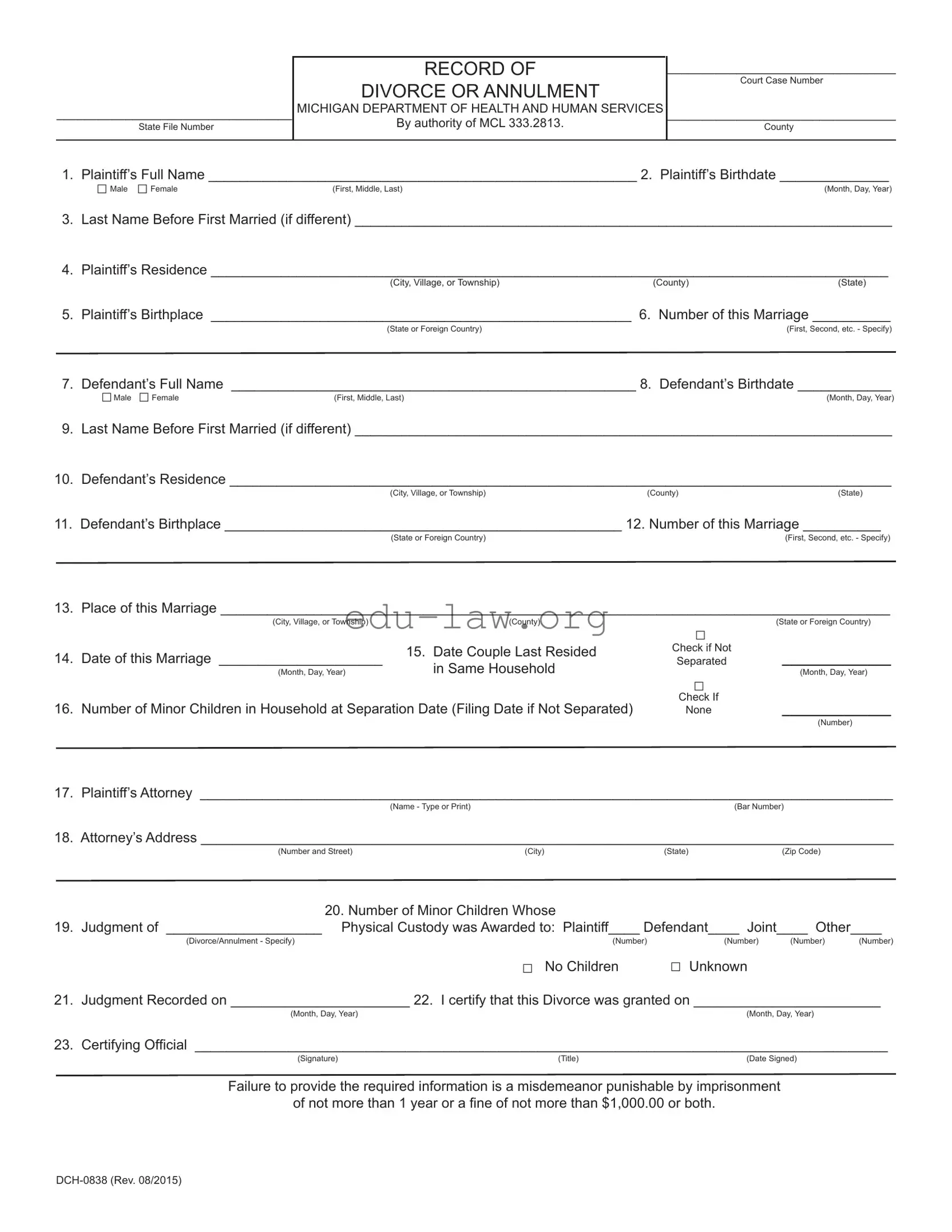
The Michigan DCH 0838 form serves as an essential document in the divorce or annulment process within the state. It is designed to capture critical information about both parties involved in the legal proceedings, ensuring that all necessary details are accurately recorded. This form includes sections for the full names, birthdates, and residences of both the plaintiff and defendant, as well as their marital history, such as previous last names and the number of marriages each has had. Additionally, the form requires information about the marriage itself, including the date and place of the marriage, and the date the couple last resided together. It also addresses the custody arrangements for any minor children, specifying who has been awarded physical custody. Legal representatives are also identified on the form, which includes a section for the attorney’s name and bar number. The DCH 0838 form not only facilitates the legal process but also ensures compliance with state regulations, as failure to provide accurate information can result in legal penalties. By gathering this comprehensive data, the form plays a crucial role in documenting the dissolution of marriage in Michigan.

__________________________________
State File Number
RECORD OF
DIVORCE OR ANNULMENT
MICHIGAN DEPARTMENT OF HEALTH AND HUMAN SERVICES
By authority of MCL 333.2813.
_________________________________
Court Case Number
_________________________________
County
1. Plaintiff’s Full Name _______________________________________________________ 2. |
Plaintiff’s Birthdate ______________ |
||||
□ |
Male |
□ |
Female |
(First, Middle, Last) |
(Month, Day, Year) |
|
|
||||
3.Last Name Before First Married (if different) _____________________________________________________________________
4.Plaintiff’s Residence _______________________________________________________________________________________
(City, Village, or Township)(County)(State)
5. |
Plaintiff’s Birthplace ______________________________________________________ 6. Number of this Marriage __________ |
|||||
|
|
|
|
|
(State or Foreign Country) |
(First, Second, etc. - Specify) |
7. |
Defendant’s Full Name ____________________________________________________ 8. Defendant’s Birthdate ____________ |
|||||
|
□ |
Male |
□ |
Female |
(First, Middle, Last) |
(Month, Day, Year) |
9.Last Name Before First Married (if different) _____________________________________________________________________
10.Defendant’s Residence _____________________________________________________________________________________
(City, Village, or Township)(County)(State)
11. Defendant’s Birthplace ___________________________________________________ 12. Number of this Marriage __________
|
|
(State or Foreign Country) |
|
(First, Second, etc. - Specify) |
||
13. |
Place of this Marriage ______________________________________________________________________________________ |
|||||
|
(City, Village, or Township) |
(County) |
□ |
(State or Foreign Country) |
||
|
|
|
|
|
||
14. |
Date of this Marriage _____________________ |
15. Date Couple Last Resided |
Check if Not |
|
|
|
Separated |
______________ |
|||||
in Same Household |
||||||
|
(Month, Day, Year) |
□ |
(Month, Day, Year) |
|||
|
|
|
|
|
||
|
|
|
Check If |
|
|
|
16. |
Number of Minor Children in Household at Separation Date (Filing Date if Not Separated) |
None |
______________ |
|||
|
|
|
|
(Number) |
|
|
17. |
Plaintiff’s Attorney _________________________________________________________________________________________ |
|||||
|
|
(Name - Type or Print) |
(Bar Number) |
|
||
18. |
Attorney’s Address _________________________________________________________________________________________ |
|||||
|
(Number and Street) |
(City) |
(State) |
(Zip Code) |
|
|
|
20. Number of Minor Children Whose |
|
|
|
||
19. |
Judgment of ____________________ Physical Custody was Awarded to: Plaintiff____ Defendant____ Joint____ Other____ |
|||||
|
(Divorce/Annulment - Specify) |
(Number) |
(Number) |
(Number) |
(Number) |
|
|
|
□ No Children |
□ Unknown |
|
|
|
21. |
Judgment Recorded on _______________________ 22. I certify that this Divorce was granted on ________________________ |
|||||
|
(Month, Day, Year) |
|
(Month, Day, Year) |
|
||
23. |
Certifying Oficial _________________________________________________________________________________________ |
|||||
|
(Signature) |
(Title) |
(Date Signed) |
|
||
Failure to provide the required information is a misdemeanor punishable by imprisonment
of not more than 1 year or a ine of not more than $1,000.00 or both.
| Fact Name | Fact Details |
|---|---|
| Form Purpose | The Michigan DCH 0838 form records the details of a divorce or annulment in the state of Michigan. |
| Governing Law | This form is governed by Michigan Compiled Laws (MCL) 333.2813. |
| Mandatory Information | Key details required include names, birthdates, and residences of both the plaintiff and defendant. |
| Minor Children | The form asks for the number of minor children involved at the time of separation or filing. |
| Judgment Recording | It includes a section for the date the judgment was recorded and the date the divorce was granted. |
| Attorney Information | The form requires the name and bar number of the plaintiff's attorney, if applicable. |
| Legal Consequences | Failure to provide accurate information may lead to a misdemeanor charge, with penalties including fines or imprisonment. |
Filling out the Michigan DCH 0838 form is an important step in documenting a divorce or annulment. This form requires specific information about both parties involved in the legal proceedings. After completing the form, it should be submitted to the appropriate court or agency as directed.
What is the Michigan DCH 0838 form used for?
The Michigan DCH 0838 form is a record of divorce or annulment. It is used to document the legal dissolution of a marriage in the state of Michigan. This form collects essential information about both spouses, including their names, birthdates, and places of residence. It also records details about the marriage, such as the date and location, as well as any minor children involved.
Who needs to fill out the DCH 0838 form?
The form must be completed by the plaintiff, who is the person initiating the divorce or annulment process. If there is an attorney involved, their information must also be included. The defendant, or the other spouse, may not need to fill out this form, but their information is required for the record.
What information is required on the DCH 0838 form?
Several key details are required on the DCH 0838 form. This includes the full names and birthdates of both the plaintiff and defendant, their residences, and their birthplaces. Additionally, the form asks for the date and place of the marriage, the number of minor children in the household at the time of separation, and any custody arrangements. Accurate completion of this form is crucial, as it serves as an official record.
What happens if the information on the DCH 0838 form is incomplete?
Failure to provide the required information on the DCH 0838 form can have serious consequences. It is considered a misdemeanor, which may result in penalties such as imprisonment for up to one year or a fine of up to $1,000, or both. It is important to ensure that all necessary information is filled out completely and accurately to avoid these potential issues.
How is the DCH 0838 form submitted?
The completed DCH 0838 form must be submitted to the Michigan Department of Health and Human Services. It is typically filed with the court handling the divorce or annulment case. After the divorce is granted, the form is recorded as part of the public record. It is advisable to keep a copy of the submitted form for personal records.
Failing to include the State File Number at the top of the form. This number is essential for tracking the case.
Not providing the Court Case Number. This information helps link the divorce record to the correct court proceedings.
Leaving out the Plaintiff’s Full Name. Ensure you include the first, middle, and last names as they appear on legal documents.
Incorrectly indicating the Birthdate format. Use the proper format: Month, Day, Year.
Forgetting to check the gender box for both the plaintiff and defendant. This step is necessary for demographic records.
Not providing the Last Name Before First Married for both parties, if applicable. This detail is important for identification.
Omitting the Residence information. Complete addresses for both parties must be included.
Failing to specify the Number of this Marriage. Indicate whether it is the first, second, etc.
Incorrectly filling in the Date of this Marriage. Ensure the date is accurate and follows the specified format.
Not signing the form or providing the Certifying Official's Title and date signed. This step is crucial for validation.
When navigating the process of divorce or annulment in Michigan, several forms and documents may accompany the Michigan DCH 0838 form. Each of these documents plays a crucial role in ensuring that the legal process runs smoothly and efficiently. Below is a list of commonly used forms that may be required in conjunction with the DCH 0838.
Understanding these documents can alleviate some of the stress associated with the divorce process. Each form serves a specific purpose and contributes to a fair resolution for both parties involved. It is important to gather all necessary paperwork and consult with legal professionals to ensure that everything is completed correctly.
The Michigan DCH 0838 form serves as a record of divorce or annulment, similar to the divorce decree. A divorce decree is a court order that officially ends a marriage. It outlines the terms of the divorce, including asset division, child custody, and support obligations. Both documents are essential for establishing the legal dissolution of a marriage, and they often require similar information about the parties involved, such as names, addresses, and marriage details.
Another document akin to the DCH 0838 is the marriage certificate. This certificate serves as proof of the marriage and includes information such as the names of the spouses, the date of the marriage, and the location. While the DCH 0838 records the end of that marriage, the marriage certificate signifies the beginning. Both documents are critical in legal proceedings and can be required for various purposes, including name changes and legal identification.
The separation agreement also bears similarities to the DCH 0838. This document outlines the terms agreed upon by a couple who are separating but not yet divorced. It may include provisions for child support, custody, and property division. Like the DCH 0838, it requires detailed information about the parties and their children, making it a vital document during the transition from marriage to divorce.
The child custody agreement is another relevant document. This agreement details the custody arrangements for minor children following a divorce. It specifies which parent has legal and physical custody, visitation rights, and child support obligations. Both the child custody agreement and the DCH 0838 are essential for ensuring the welfare of children involved in a divorce, often referencing the same information about the parents and their children.
The financial affidavit is similar in that it provides a detailed account of a person's financial situation during divorce proceedings. This document includes income, expenses, assets, and liabilities, which are crucial for determining support obligations. Like the DCH 0838, the financial affidavit requires accurate information about both parties, ensuring transparency in the divorce process.
The petition for divorce shares similarities with the DCH 0838 as well. This document initiates the divorce process and outlines the grounds for divorce. It includes personal details about both spouses, similar to those found in the DCH 0838. Both documents play significant roles in the legal dissolution of a marriage, as the petition sets the stage for the divorce, while the DCH 0838 records its finalization.
The court order of divorce is another document that parallels the DCH 0838. This order is issued by the court and formalizes the divorce, including any rulings on child custody, support, and property division. Both documents serve as official records of the divorce process, providing necessary information for future legal matters related to the parties involved.
The affidavit of service is relevant as it confirms that the divorce papers have been properly delivered to the other spouse. This document is essential for ensuring that both parties are aware of the proceedings and have the opportunity to respond. Like the DCH 0838, it ensures that legal protocols are followed during the divorce process, maintaining fairness and transparency.
Finally, the parenting plan is similar to the DCH 0838 in that it outlines how parents will raise their children post-divorce. This plan includes details about custody arrangements, visitation schedules, and decision-making responsibilities. Both documents aim to protect the best interests of the children involved, ensuring that their needs are met during and after the divorce process.
When filling out the Michigan DCH 0838 form, there are some important dos and don’ts to keep in mind. Here’s a helpful list:
Following these guidelines will help ensure your form is completed correctly and processed without delay.
The Michigan DCH 0838 form, known as the Record of Divorce or Annulment, is often misunderstood. Here are seven common misconceptions about this form, along with clarifications to help you navigate its requirements.
Understanding these misconceptions can help individuals approach the DCH 0838 form with clarity and ensure compliance with the necessary legal requirements.