When applying to medical school, every detail matters, and one crucial element that can set you apart is the Medical School Letter of Intent form. This form serves as a powerful tool for applicants, allowing them to express their genuine interest in a specific medical school while reinforcing their qualifications. It’s not just a simple note; it’s an opportunity to convey your passion for medicine, your alignment with the school’s values, and your readiness to contribute to the medical community. The form typically includes sections where you can articulate your reasons for choosing that particular institution, highlight relevant experiences, and demonstrate your commitment to the program. Crafting a thoughtful and compelling letter can make a significant difference in your application, showcasing not only your academic achievements but also your personal journey and aspirations in the field of medicine. Understanding the nuances of this form can empower you to present your best self to the admissions committee.
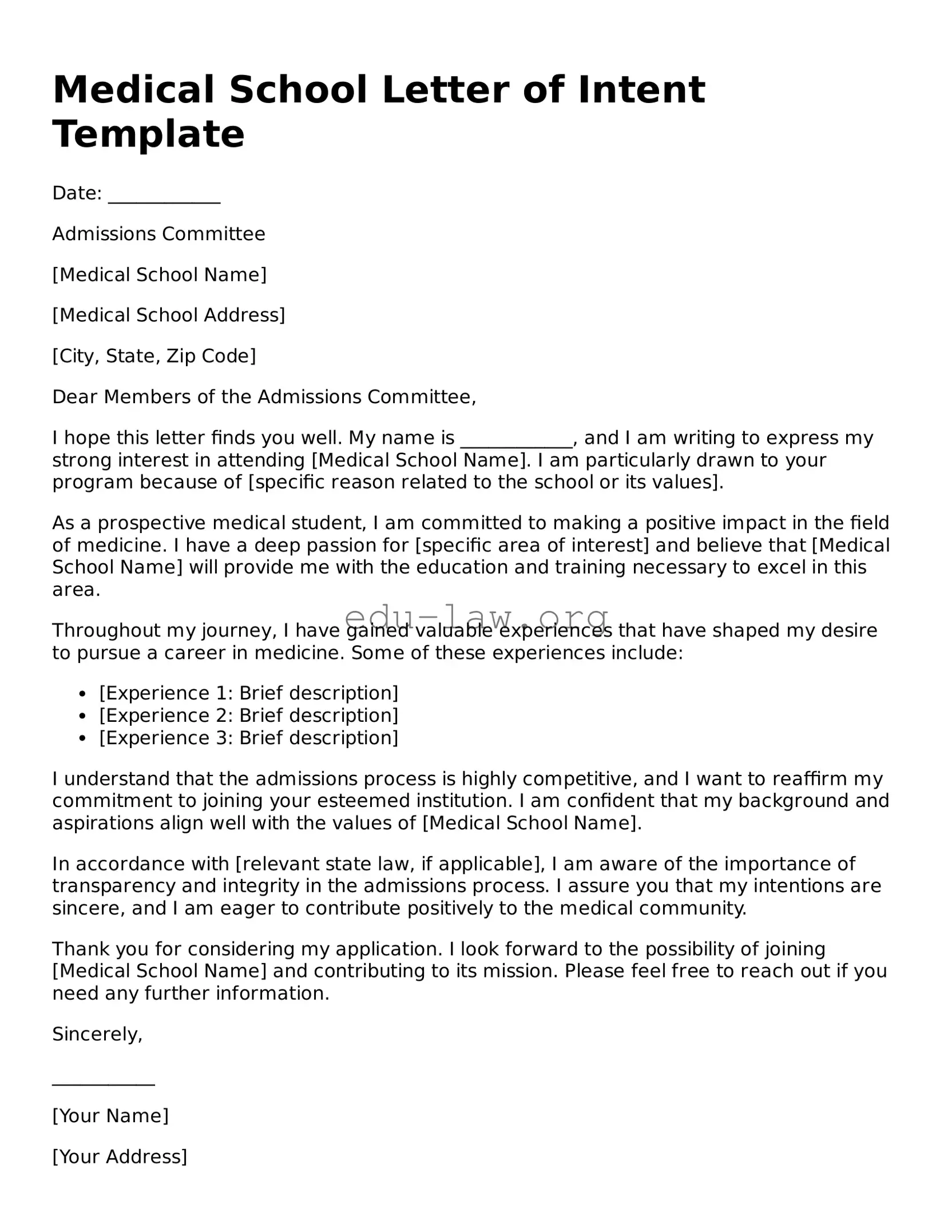
Medical School Letter of Intent Template
Date: ____________
Admissions Committee
[Medical School Name]
[Medical School Address]
[City, State, Zip Code]
Dear Members of the Admissions Committee,
I hope this letter finds you well. My name is ____________, and I am writing to express my strong interest in attending [Medical School Name]. I am particularly drawn to your program because of [specific reason related to the school or its values].
As a prospective medical student, I am committed to making a positive impact in the field of medicine. I have a deep passion for [specific area of interest] and believe that [Medical School Name] will provide me with the education and training necessary to excel in this area.
Throughout my journey, I have gained valuable experiences that have shaped my desire to pursue a career in medicine. Some of these experiences include:
I understand that the admissions process is highly competitive, and I want to reaffirm my commitment to joining your esteemed institution. I am confident that my background and aspirations align well with the values of [Medical School Name].
In accordance with [relevant state law, if applicable], I am aware of the importance of transparency and integrity in the admissions process. I assure you that my intentions are sincere, and I am eager to contribute positively to the medical community.
Thank you for considering my application. I look forward to the possibility of joining [Medical School Name] and contributing to its mission. Please feel free to reach out if you need any further information.
Sincerely,
___________
[Your Name]
[Your Address]
[City, State, Zip Code]
[Your Email]
[Your Phone Number]
| Fact Name | Description |
|---|---|
| Purpose | The Medical School Letter of Intent form expresses a candidate's strong interest in a specific medical school. |
| Timing | It is typically submitted after an interview but before final admissions decisions are made. |
| Content | The letter should include reasons for interest in the school, unique qualifications, and any updates since the application. |
| Format | The letter should be professional, concise, and well-structured, often no more than one page. |
| State-Specific Forms | Some states may have specific requirements for the Letter of Intent; check local medical school guidelines. |
| Governing Laws | There are no specific laws governing the Letter of Intent; however, ethical guidelines from medical boards apply. |
| Submission Method | Letters can usually be submitted via email or through an online application portal, depending on the school. |
| Follow-Up | After sending the letter, candidates may follow up with the admissions office to confirm receipt. |
| Impact on Admissions | While not guaranteed, a well-crafted letter can positively influence admissions decisions. |
| Common Mistakes | Avoid generic statements; personalization and specificity are crucial for a compelling letter. |
Once you have the Medical School Letter of Intent form in front of you, it’s time to gather your thoughts and prepare to fill it out. This form is an essential part of your application process, allowing you to express your commitment to a particular medical school. Completing it accurately and thoughtfully can set you apart from other candidates.
What is a Medical School Letter of Intent?
A Medical School Letter of Intent is a formal communication that an applicant sends to a medical school to express their strong interest in attending if offered admission. This letter not only conveys enthusiasm but also highlights the applicant’s qualifications, experiences, and fit for the program. It serves as a way to reaffirm the applicant's commitment and can be a critical piece in the admissions process, especially if the applicant is on the waitlist or has not yet received a decision.
When should I submit my Letter of Intent?
The timing of your Letter of Intent is crucial. It is best to send this letter after you have submitted your application but before the final admissions decisions are made. If you are on a waitlist, submitting the letter promptly can demonstrate your continued interest. However, make sure to check the specific policies of the medical schools you are applying to, as some may have guidelines regarding the submission of such letters.
What should I include in my Letter of Intent?
Your Letter of Intent should be concise yet comprehensive. Start by expressing your gratitude for the opportunity to apply. Clearly state your desire to attend the school and why you believe it is the right fit for you. Include specific details about your experiences, skills, and how they align with the school’s mission and values. Additionally, if there have been any significant updates to your application, such as new achievements or experiences, be sure to mention them. This is your chance to make a personal connection, so let your passion for medicine shine through.
How long should my Letter of Intent be?
While there is no strict length requirement, a well-crafted Letter of Intent typically ranges from one to two pages. Aim for clarity and brevity. Admissions committees appreciate letters that get to the point while still providing enough detail to convey your enthusiasm and qualifications. Use clear language, and avoid overly complex sentences. Remember, the goal is to leave a lasting impression without overwhelming the reader.
Failing to clearly express their enthusiasm for the program. A letter of intent should convey genuine interest and excitement about attending the specific medical school.
Not personalizing the letter. Generic statements can make it seem like the applicant is applying to multiple schools without genuine interest. Tailoring the content to reflect why that particular school is a good fit is essential.
Overlooking the importance of proofreading. Typos and grammatical errors can undermine the professionalism of the letter. A careful review can help catch these mistakes.
Being overly formal or too casual. Striking the right balance in tone is crucial. A letter should be respectful and professional while still reflecting the applicant’s personality.
Neglecting to include specific experiences or achievements. Highlighting relevant experiences can strengthen the case for admission. This could include volunteer work, research, or unique skills.
Using clichés or vague language. Phrases like “I’ve always wanted to be a doctor” can come off as unoriginal. Instead, sharing personal stories or insights can make the letter stand out.
Failing to mention future goals. Outlining how attending the school aligns with their career aspirations can demonstrate a thoughtful approach to their medical education.
Ignoring the letter's structure. A well-organized letter with clear paragraphs and transitions can make it easier for the reader to follow the applicant’s narrative.
Not addressing why they are a good fit for the school. Applicants should articulate what they can contribute to the school community, enhancing their appeal to the admissions committee.
Submitting the letter too late. Timeliness is important. Sending the letter promptly after receiving an acceptance can show eagerness and respect for the admissions process.
When applying to medical school, candidates often need to submit various documents alongside the Medical School Letter of Intent. Each document serves a specific purpose and helps the admissions committee understand the applicant better. Here’s a list of common forms and documents used in conjunction with the Letter of Intent.
Submitting these documents alongside the Medical School Letter of Intent can strengthen an application. Each piece contributes to a fuller picture of the applicant, showcasing their qualifications, experiences, and dedication to a career in medicine.
The Medical School Letter of Intent is akin to a college application personal statement. Both documents serve as a means for the applicant to express their motivations, experiences, and aspirations. In a personal statement, students share their unique stories and reasons for pursuing a particular field of study. Similarly, the Letter of Intent allows medical school applicants to convey their commitment to a specific institution, highlighting what draws them to that program and how they align with its values.
Another document that shares similarities with the Medical School Letter of Intent is the residency application letter. This letter is crucial for applicants seeking residency positions after medical school. Like the Letter of Intent, it demonstrates the applicant's enthusiasm for a specific program and outlines their qualifications. Both documents require a careful balance of personal reflection and professional accomplishments, showcasing the applicant’s readiness for the next step in their medical career.
The Statement of Purpose for graduate school is also comparable to the Medical School Letter of Intent. In both cases, applicants articulate their goals and the reasons behind their chosen path. The Statement of Purpose often delves into academic interests and research aspirations, while the Letter of Intent emphasizes a commitment to a particular medical school. Both documents are essential for the selection committee to understand the applicant’s motivations and future intentions.
Letters of recommendation, while different in format, share a common purpose with the Medical School Letter of Intent. Both aim to provide insight into the applicant's character and capabilities. A strong letter of recommendation can bolster an application by affirming the applicant's qualifications and suitability for the program. In contrast, the Letter of Intent allows the applicant to personally advocate for themselves, expressing their dedication and fit for the medical school.
The application essays required by some medical schools also resemble the Medical School Letter of Intent. These essays often prompt applicants to reflect on their experiences and motivations for pursuing medicine. Like the Letter of Intent, these essays require careful thought and a clear expression of intent, allowing applicants to showcase their passion for the field and their commitment to the specific school.
Another document that bears similarity is the scholarship application letter. When applying for financial assistance, students often write letters explaining their need for support and their future goals. This is similar to the Medical School Letter of Intent in that both documents require applicants to articulate their intentions and aspirations clearly. Each serves as a platform to demonstrate why the applicant deserves consideration and how they plan to contribute to their chosen field.
Intent to Enroll forms are also closely related to the Medical School Letter of Intent. While the former is a formal declaration of a student's decision to attend a particular school, the latter expresses the applicant's enthusiasm and commitment before an official offer is made. Both documents convey a sense of urgency and commitment, signaling to the institution that the applicant is serious about their decision.
Finally, the cover letter for a job application can be compared to the Medical School Letter of Intent. In both instances, the writer seeks to make a strong impression on the reader. A cover letter outlines the applicant’s qualifications and interest in a specific position, similar to how the Letter of Intent articulates the applicant's dedication to a particular medical school. Both documents require a strategic approach to highlight the applicant's strengths and suitability for the opportunity at hand.
When applying to medical school, the Letter of Intent (LOI) can play a crucial role in demonstrating your commitment and enthusiasm for a particular program. Here are seven important dos and don'ts to consider while filling out the Medical School Letter of Intent form.
By adhering to these guidelines, you can craft a compelling Letter of Intent that captures the attention of the admissions committee and showcases your dedication to pursuing a medical education.
Understanding the Medical School Letter of Intent (LOI) can be challenging, and several misconceptions can cloud applicants' perspectives. Below are nine common misunderstandings about the LOI that aspiring medical students should be aware of:
Many believe that submitting a Letter of Intent commits them to attend that particular school. In reality, it expresses interest but does not obligate the applicant.
Some applicants think that submitting an LOI will automatically secure their acceptance. However, it is just one part of the application process and does not guarantee a spot.
While it's important to convey genuine interest, a concise and focused letter is often more effective than a lengthy one. Admissions committees appreciate clarity and brevity.
Timing is crucial. Sending an LOI too early or too late in the application cycle may not have the desired impact. It’s best to send it when the application status is clear.
Some applicants feel pressured to include new achievements or experiences. While this can be beneficial, it’s not a strict requirement. Reinforcing genuine interest can be sufficient.
Though often used by waitlisted applicants, the LOI can be beneficial for anyone who wants to express strong interest in a school, regardless of their current status.
Sending a generic LOI to multiple institutions can dilute its effectiveness. A tailored letter for each school demonstrates sincerity and commitment.
Some applicants may think that a strong LOI can substitute for an interview. However, personal interactions are crucial in the admissions process and cannot be overlooked.
Some may underestimate the impact of a well-crafted LOI. Taking the time to express genuine interest can positively influence admissions decisions.
By addressing these misconceptions, applicants can better navigate the complexities of the Medical School Letter of Intent and enhance their chances of success in the admissions process.
Filling out and using the Medical School Letter of Intent form can be an important step in the application process. Here are some key takeaways to consider: