A Medical Power of Attorney (MPOA) is a crucial document that empowers individuals to make healthcare decisions on behalf of another person in the event that they become incapacitated. This form is essential for ensuring that medical preferences are honored when an individual cannot communicate their wishes. The MPOA designates a trusted person, often referred to as the agent or proxy, who will have the authority to make decisions regarding medical treatments, procedures, and end-of-life care. It covers a wide range of medical scenarios, from routine healthcare decisions to emergency interventions. By completing this form, individuals can outline their preferences and values, providing clarity for their chosen agent. This not only alleviates the burden on family members during difficult times but also ensures that the individual's wishes are respected. Understanding the components of the MPOA, including the rights and responsibilities of the agent, is vital for anyone considering this important legal tool.
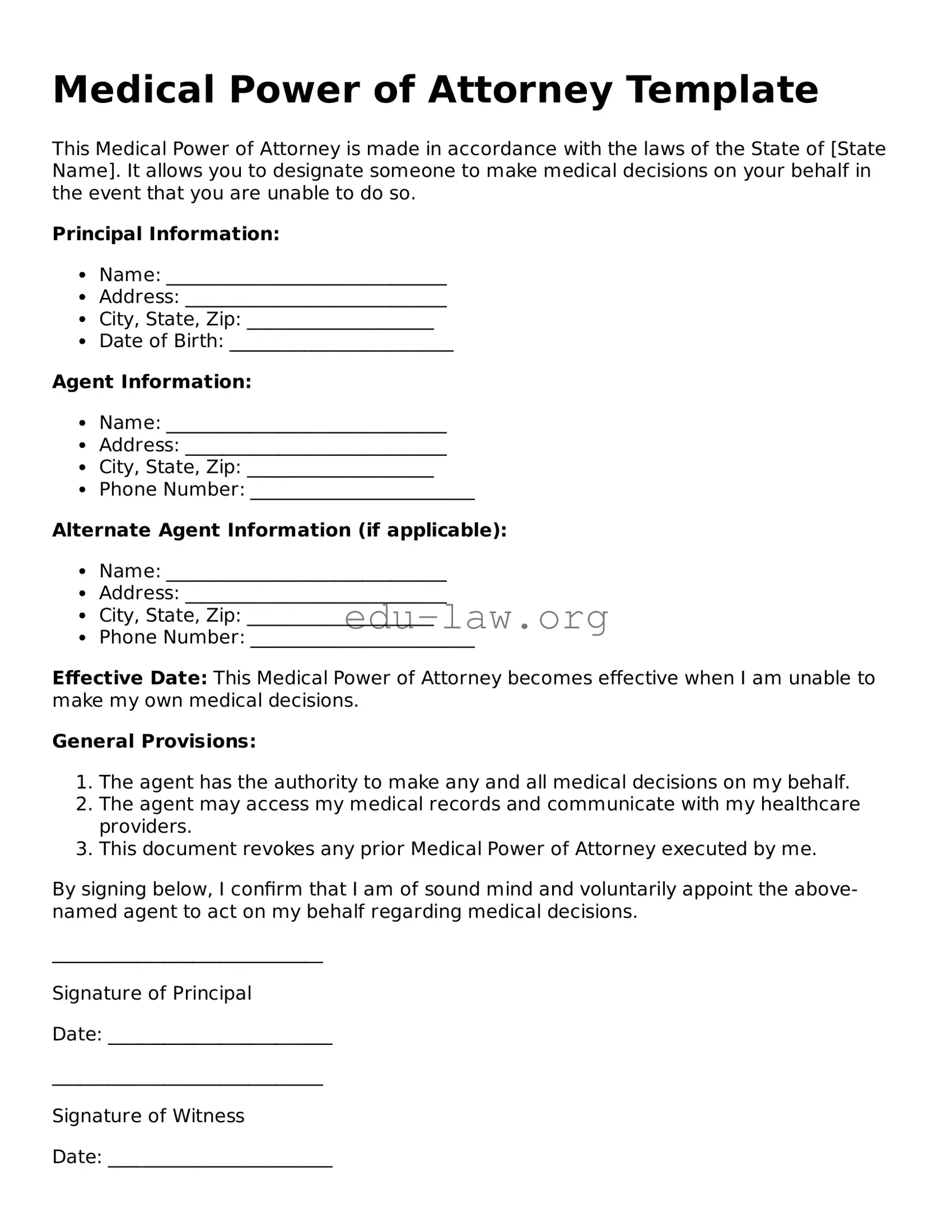
Medical Power of Attorney Template
This Medical Power of Attorney is made in accordance with the laws of the State of [State Name]. It allows you to designate someone to make medical decisions on your behalf in the event that you are unable to do so.
Principal Information:
Agent Information:
Alternate Agent Information (if applicable):
Effective Date: This Medical Power of Attorney becomes effective when I am unable to make my own medical decisions.
General Provisions:
By signing below, I confirm that I am of sound mind and voluntarily appoint the above-named agent to act on my behalf regarding medical decisions.
_____________________________
Signature of Principal
Date: ________________________
_____________________________
Signature of Witness
Date: ________________________
_____________________________
Signature of Witness
Date: ________________________
| Fact Name | Description |
|---|---|
| Definition | A Medical Power of Attorney allows an individual to designate someone to make healthcare decisions on their behalf if they are unable to do so. |
| Governing Law | Each state has its own laws governing Medical Power of Attorney forms. For example, in California, it is governed by the California Probate Code. |
| Durability | This document remains effective even if the principal becomes incapacitated, ensuring continuous representation in medical decisions. |
| Requirements | Most states require the principal's signature and notarization or witness signatures for the form to be valid. |
| Revocation | The principal can revoke the Medical Power of Attorney at any time, as long as they are mentally competent to do so. |
| Limitations | Some states may have specific limitations on the powers granted, such as prohibiting the agent from making decisions about certain medical treatments. |
Filling out a Medical Power of Attorney form is an important step in ensuring that your healthcare decisions are made according to your wishes. This document allows you to appoint someone to make medical decisions on your behalf if you are unable to do so. Here’s how to complete the form effectively.
What is a Medical Power of Attorney?
A Medical Power of Attorney is a legal document that allows you to appoint someone you trust to make medical decisions on your behalf if you become unable to do so. This person, often referred to as your "agent" or "attorney-in-fact," will have the authority to make choices about your healthcare based on your wishes and best interests.
Why do I need a Medical Power of Attorney?
Having a Medical Power of Attorney ensures that your healthcare preferences are honored, even if you cannot communicate them yourself. It provides clarity to your loved ones and healthcare providers about who should make decisions for you, reducing confusion and potential conflict during difficult times.
Who can I appoint as my agent?
You can appoint anyone you trust as your agent, such as a family member, friend, or even a healthcare professional. It’s essential to choose someone who understands your values and wishes regarding medical treatment and who is willing to advocate for you in a healthcare setting.
What decisions can my agent make on my behalf?
Your agent can make a wide range of medical decisions, including choices about treatments, surgeries, and end-of-life care. However, the specific powers granted can vary depending on how the document is drafted. It’s crucial to discuss your wishes with your agent to ensure they are prepared to act in your best interest.
Can I change or revoke my Medical Power of Attorney?
Yes, you can change or revoke your Medical Power of Attorney at any time, as long as you are mentally competent to do so. To make changes, you simply need to create a new document or formally revoke the existing one. It’s advisable to notify your agent and any healthcare providers of any changes you make.
Do I need a lawyer to create a Medical Power of Attorney?
While it’s not strictly necessary to have a lawyer, consulting one can be beneficial, especially if your situation is complex. Many states provide templates and guidelines for creating a Medical Power of Attorney, making it possible for individuals to complete the document on their own if they feel comfortable doing so.
Is a Medical Power of Attorney valid in all states?
Medical Power of Attorney laws can vary from state to state. While many states recognize similar documents, it’s essential to ensure that your Medical Power of Attorney complies with the laws of the state where you reside. Checking with local regulations or seeking legal advice can help ensure your document is valid.
What happens if I don't have a Medical Power of Attorney?
If you do not have a Medical Power of Attorney and become incapacitated, medical decisions may be made by family members or, in some cases, by the court. This can lead to disputes among family members and may not reflect your personal wishes. Having a designated agent helps prevent this uncertainty.
How do I ensure my Medical Power of Attorney is honored?
To ensure your Medical Power of Attorney is honored, share copies of the document with your healthcare providers, your appointed agent, and family members. It’s also helpful to discuss your wishes with your healthcare team so they understand your preferences. Keeping the document accessible and updated is key to ensuring your wishes are respected.
Not selecting a trusted agent. It’s crucial to choose someone who understands your wishes and can make decisions in your best interest.
Failing to discuss your wishes with your agent. Open communication can prevent confusion and ensure your desires are honored.
Leaving the form unsigned. A Medical Power of Attorney is only valid when properly signed by you and, in some cases, witnessed or notarized.
Using outdated forms. Laws can change, so it’s important to use the most current version of the form for your state.
Not specifying any limitations. If there are particular treatments or procedures you want to refuse, make sure to include those details.
Overlooking alternate agents. Designating a backup agent ensures that your wishes can still be honored if your primary agent is unavailable.
Ignoring state-specific requirements. Each state has its own rules regarding Medical Power of Attorney, so familiarize yourself with local laws.
Assuming the form is permanent. Regularly reviewing and updating your Medical Power of Attorney can reflect any changes in your health or preferences.
Neglecting to provide copies. Ensure that your agent and any relevant medical professionals have copies of the completed form.
Failing to keep it accessible. Store the form in a location where it can be easily found in case of an emergency.
When establishing a Medical Power of Attorney, it is often beneficial to consider additional forms and documents that can complement your healthcare planning. These documents help ensure that your wishes are respected and that your healthcare decisions are made according to your preferences. Below is a list of commonly used forms that work alongside a Medical Power of Attorney.
Incorporating these documents into your healthcare planning can provide peace of mind. They help clarify your wishes and ensure that your healthcare decisions are respected, even when you may not be able to voice them yourself. Always consider discussing these documents with a trusted advisor or legal professional to ensure they align with your personal values and legal requirements.
A Living Will is similar to a Medical Power of Attorney in that both documents deal with healthcare decisions. While a Medical Power of Attorney designates an individual to make medical decisions on your behalf, a Living Will outlines your preferences regarding medical treatment in specific situations, such as end-of-life care. Both documents ensure that your wishes are respected when you cannot communicate them yourself.
A Healthcare Proxy is another document that shares similarities with a Medical Power of Attorney. Like the Medical Power of Attorney, a Healthcare Proxy appoints someone to make medical decisions for you. The key difference is that a Healthcare Proxy is often used in conjunction with a Living Will, providing a broader scope for decision-making based on your expressed wishes.
An Advance Directive combines elements of both a Living Will and a Medical Power of Attorney. This document allows you to outline your healthcare preferences while also appointing someone to make decisions on your behalf. It ensures that your wishes regarding medical treatment are clear and that someone you trust is available to advocate for you if needed.
A Declaration for Mental Health Treatment is similar to a Medical Power of Attorney but specifically addresses mental health care decisions. This document allows you to appoint someone to make mental health treatment decisions on your behalf if you become unable to do so. It is particularly important for individuals with mental health concerns, ensuring that their treatment preferences are respected.
A Guardian Designation is another document that can be compared to a Medical Power of Attorney. While the Medical Power of Attorney focuses on healthcare decisions, a Guardian Designation appoints someone to make decisions about your personal affairs if you become incapacitated. This document provides a broader scope of authority, covering not just medical issues but also financial and personal matters.
A Financial Power of Attorney, although primarily focused on financial matters, can complement a Medical Power of Attorney. This document allows you to appoint someone to manage your financial affairs if you are unable to do so. While it does not address healthcare decisions directly, having both documents in place ensures that your medical and financial wishes are clearly outlined and respected.
Finally, a Release of Medical Records form is similar to a Medical Power of Attorney in that it deals with healthcare information. This document allows you to authorize someone to access your medical records, which can be crucial for making informed healthcare decisions. While a Medical Power of Attorney grants decision-making authority, a Release of Medical Records ensures that your appointed agent has the necessary information to act on your behalf effectively.
When filling out a Medical Power of Attorney form, it’s important to be careful and thorough. Here are some dos and don'ts to keep in mind:
Following these tips can help ensure that your Medical Power of Attorney accurately reflects your wishes.
Understanding the Medical Power of Attorney (MPOA) is crucial for making informed decisions about healthcare. However, several misconceptions can cloud this important topic. Here’s a breakdown of nine common misunderstandings:
This is not true. Anyone, regardless of age, can benefit from having an MPOA. Unexpected medical situations can arise at any time, making it wise for adults of all ages to designate a trusted person to make healthcare decisions on their behalf.
This misconception arises from confusion between a Medical Power of Attorney and a Financial Power of Attorney. An MPOA is specifically focused on healthcare decisions, not financial matters.
While it’s common to have one designated agent, you can appoint multiple agents. However, it’s essential to clarify their roles and ensure they can work together effectively.
While both documents deal with healthcare decisions, they serve different purposes. An MPOA designates a person to make decisions, whereas a living will outlines your specific wishes regarding medical treatment.
This is a common misconception. You can revoke or update your MPOA at any time as long as you are mentally competent. It’s important to review your documents periodically to ensure they reflect your current wishes.
While having a lawyer can be helpful, it is not a requirement. Many states provide templates that individuals can use to create a valid MPOA on their own.
This is misleading. An MPOA is important even before a medical crisis occurs. Having one in place ensures that your healthcare preferences are respected if you become unable to communicate your wishes.
It’s essential to inform your healthcare provider about your MPOA and provide them with a copy. This ensures that your designated agent can act on your behalf when necessary.
While laws can vary by state, many states recognize MPOAs created in other jurisdictions. However, it’s wise to check local regulations to ensure your document remains valid.
By debunking these misconceptions, individuals can better understand the importance of a Medical Power of Attorney and take proactive steps to ensure their healthcare wishes are honored.
When considering a Medical Power of Attorney (MPOA), it is essential to understand its significance and the process involved in filling it out. Here are key takeaways to guide you:
By taking these steps, you can ensure that your healthcare preferences are honored and that the right person is making decisions on your behalf when necessary.