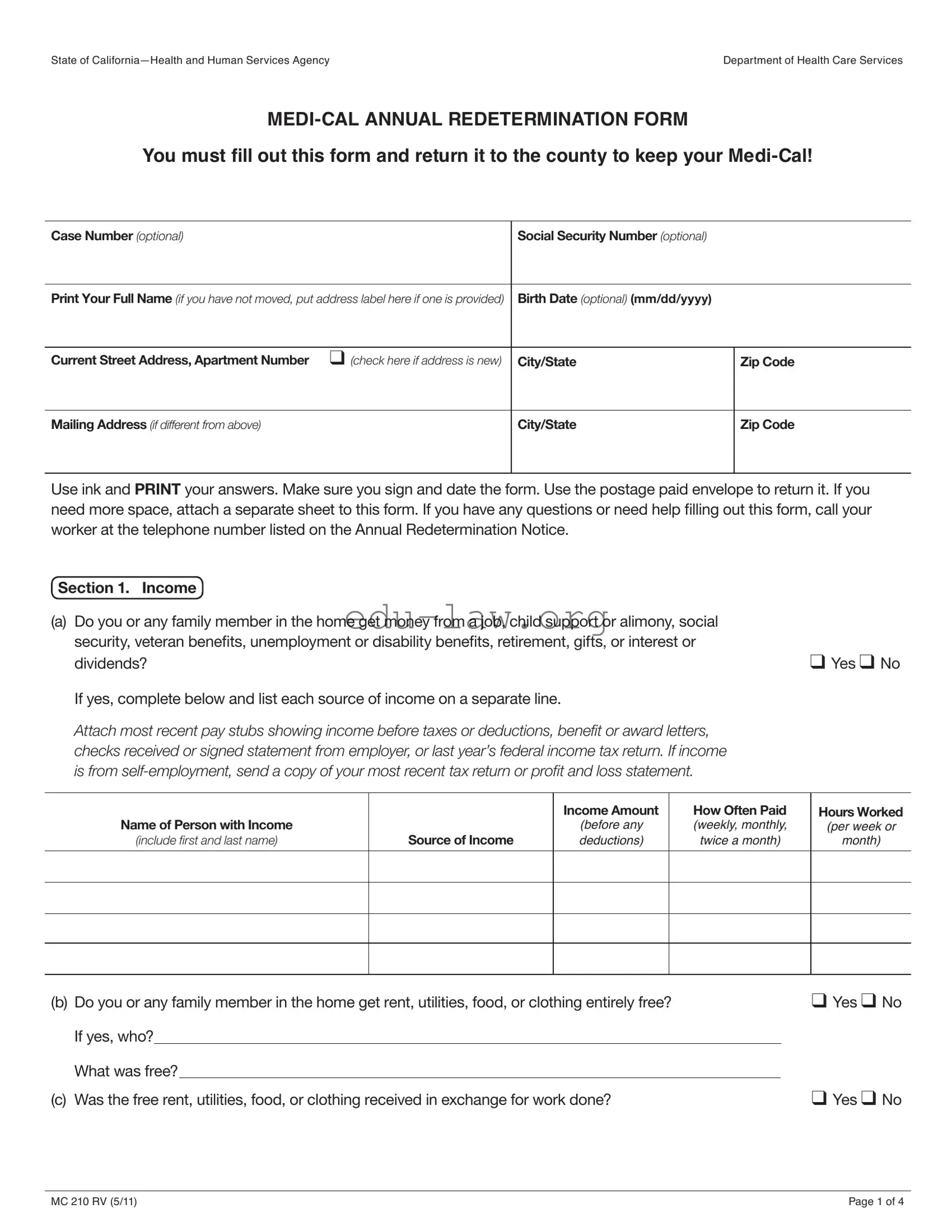
The Medi-Cal Redetermination form plays a crucial role in maintaining eligibility for California's Medicaid program, ensuring that beneficiaries continue to receive necessary health care services. This annual form requires individuals to provide detailed information about their income, living situation, and any changes in health insurance status. It begins with personal identifiers, such as the case number and social security number, although these are optional. The form then delves into various sections, prompting users to disclose their income sources, which may include wages, benefits, or alimony, as well as any expenses that could affect their eligibility. Individuals must also report changes in household composition, such as new arrivals or departures, and any significant life events, such as marriage or childbirth. Furthermore, the form addresses questions related to property ownership and immigration status, which can impact eligibility criteria. Finally, it requires a signature to certify that all provided information is accurate and complete, underscoring the importance of honesty in the process. Failure to submit this form accurately and on time may result in a loss of Medi-Cal benefits, making it essential for recipients to understand and complete it thoroughly.

State of |
Department of Health Care Services |
You must fill out this form and return it to the county to keep your
Case Number (optional) |
Social Security Number (optional) |
|
|
|
|
Print Your Full Name (if you have not moved, put address label here if one is provided) |
Birth Date (optional) (mm/dd/yyyy) |
|
|
|
|
Current Street Address, Apartment Number ❑ (check here if address is new) |
City/State |
Zip Code |
|
|
|
Mailing Address (if different from above) |
City/State |
Zip Code |
|
|
|
Use ink and Print your answers. Make sure you sign and date the form. Use the postage paid envelope to return it. If you need more space, attach a separate sheet to this form. If you have any questions or need help filling out this form, call your worker at the telephone number listed on the Annual Redetermination Notice.
Section 1. Income
(a)Do you or any family member in the home get money from a job, child support or alimony, social security, veteran benefits, unemployment or disability benefits, retirement, gifts, or interest or
dividends? |
❑ Yes ❑ No |
If yes, complete below and list each source of income on a separate line.
Attach most recent pay stubs showing income before taxes or deductions, benefit or award letters, checks received or signed statement from employer, or last year’s federal income tax return. If income is from
Name of Person with Income
(include first and last name)
Source of Income
Income Amount
(before any deductions)
How Often Paid (weekly, monthly, twice a month)
Hours Worked
(per week or
month)
(b) Do you or any family member in the home get rent, utilities, food, or clothing entirely free? |
❑ Yes ❑ No |
||
If yes, who? |
|
|
|
What was free?⁜ |
|
|
|
(c) Was the free rent, utilities, food, or clothing received in exchange for work done? |
❑ Yes ❑ No |
||
MC 210 RV (5/11) |
Page 1 of 4 |

State of
Section 2. Expenses and Deductions |
|
Do you or any family member in the home pay for child or adult care, health insurance or Medicare |
|
premiums, |
❑ Yes ❑ No |
If yes, complete below and list each expense/deduction on a separate line. |
|
Attach proof of expenses/deductions. |
|
Name of Person
with Expense/Deduction
(include first and last name)
Type of
Expense or Deduction
Amount of
Payment
Paid to Whom
How Often Paid (weekly, monthly, twice a month)
Section 3. Other Health Insurance |
|
||||
(a) Did you or any family member have a change in, or get new health, dental, vision, or Medicare |
|
||||
coverage or insurance within the last 12 months? |
❑ Yes ❑ No |
||||
If yes, who has the coverage/insurance? |
|
|
|||
Which type of coverage/insurance? |
|
|
|
||
(b) Is any family member living in the home receiving kidney |
❑ Yes ❑ No |
||||
If yes, who?⁜ |
|
|
|||
(c) Has any family member living in the home received an organ transplant within the last 2 years? |
❑ Yes ❑ No |
||||
If yes, who?⁜ |
|
|
|||
Section 4. Living Situation
(a)Did anyone move into or out of your home, move in with someone else, get married, or have a baby within the last 12 months? (Examples: newborn, child, or adult moved in or out of the home, absent
parent returns home.) |
❑ Yes ❑ No |
If yes, complete below:
Name (include first and last name)
Relationship to You
What Changed?
Date Changed
(b) Does anyone in the home want |
|
|
|
|
|
❑ Yes ❑ No |
||
If yes, who?⁜ ؠ |
|
|
|
|
|
|
||
|
|
|
|
|
|
|
|
|
(c) If a new baby is in home, where was the baby’s place of birth? |
⁜ | |
| |
|
|
||||
|
|
City |
|
|
State |
|
Country |
|
MC 210 RV (5/11) |
Page 2 of 4 |

State of
Section 4. Living Situation continued |
|
|
|
||
(d) Did anyone in the home get inpatient care in a nursing facility or medical institution?⁜ |
❑ Yes ❑ No |
||||
If yes, who?⁜ |
|
|
|
||
|
|
|
|
|
❑ Yes ❑ No |
(e) Is anyone in the home pregnant? |
|
|
|||
If yes, who? |
|
|
|
|
|
Number of babies expected |
|
Due date: ⁜ |
|
|
|
Section 5. Real or Personal Property
(a)Indicate the total amount of cash and uncashed checks held by any family member in the home $
(b)Does anyone have a checking or savings account, life insurance,
wedding), or oil or mineral rights? |
❑ Yes ❑ No |
(c)Did you or any family member in the home sell or give away any money or property in the past 12 months, or have any of the items listed in this section been spent or used as security
for medical costs? |
❑ Yes ❑ No |
Note: If you have answered “yes” to questions (b) or (c), you will also have to fill out a property |
|
supplement form, submit the form to the county and provide verification. |
|
Section 6. Immigration or Citizenship Status Change |
|
Has there been a change in immigration or citizenship status for anyone in the home that has |
|
or wants |
|
full scope |
❑ Yes ❑ No |
If yes, list the name(s) below and send proof of new status. |
|
Name of Person
(include first and last name)
Status Change
(send proof of status)
Section 7. Blindness/Disability/Incapacity |
|
|
|
||||
(a) |
Do you or any family member in the home have a physical or emotional condition that makes it |
|
|
|
|||
|
difficult to work, take care of personal needs, or take care of your children? ⁜ |
|
|
❑ Yes ❑ No |
|||
|
If yes, who? |
|
|
|
|
||
(b) Was the physical, mental, or health condition a result of an injury or accident? |
|
|
❑ Yes ❑ No |
||||
|
If yes, explain |
|
|
|
|||
|
|
|
|
|
|
|
|
|
|
|
|
|
|
|
|
MC 210 RV (5/11) |
Page 3 of 4 |

State of |
Department of Health Care Services |
Section 8. Other Health Program Information and Referrals
(a) |
Check this box if you do not want your child’s information shared with the |
|
|
|
Families Program if your child gets |
|
|
(b) Do you want information on the |
|
❑ Yes ❑ No |
|
|
and Disability Prevention Program, also known as CHDP?) |
|
|
(c) Do you want information on the |
|
|
|
|
feeding women and children under 5 (Women, Infants, and Children Program, also known |
|
|
|
as WIC)? |
|
❑ Yes ❑ No |
(d) Do you want information on the Personal Care Services Program, an |
|
|
|
|
for aged, blind, or disabled persons (also known as |
⁜ |
❑ Yes ❑ No |
Section 9. Signature and Certification
Person completing this form must read and sign below.
➤I have received and read a copy of the Important Information for Persons Requesting
➤I am aware of, understand, and agree to meet all my responsibilities as described on the MC 219 form.
➤I certify that I will report all income, property, and/or other changes that may affect
➤I understand that all of the statements, including benefit and income information, that I have made on this form, may be subject to investigation and verification.
➤I declare, under penalty of perjury, under the laws of the State of California that all information provided on this ⁜ form is true and correct.
Signature
Date
Daytime or Message Telephone Number |
Home Telephone Number ❑ (check here if new number) |
|
|
Signature of Witness (if signed by a mark), Interpreter or Person Assisting |
|
|
|
— County Use Only —
Referrals |
|
|
|
|
❑⁜HF |
❑⁜WIC |
❑⁜MC 13 |
❑⁜MC 210 PS |
❑⁜Other: |
❑⁜CHDP |
❑⁜PCSP |
|
❑⁜DDSD Packet |
|
MC 210 RV (5/11) |
Page 4 of 4 |
| Fact Name | Description |
|---|---|
| Purpose | The Medi-Cal Redetermination form is required to assess ongoing eligibility for Medi-Cal benefits in California. |
| Submission Requirement | Individuals must complete and return the form to their county office to maintain their Medi-Cal coverage. |
| Information Needed | The form requests personal information, income details, and any changes in living situation or health insurance coverage. |
| Governing Law | The process is governed by California Welfare and Institutions Code Sections 14000-14029, which outline eligibility criteria for Medi-Cal. |
| Documentation | Applicants must provide proof of income and expenses, such as pay stubs or tax returns, to support their claims. |
| Signature Requirement | The form must be signed and dated by the individual completing it, certifying the accuracy of the provided information. |
Filling out the Medi-Cal Redetermination form is an important step to ensure you continue receiving benefits. After you submit the completed form, your county will review the information provided to determine your eligibility for the upcoming year. It's essential to provide accurate and complete information to avoid any delays in your benefits.
What is the purpose of the Medi-Cal Redetermination form?
The Medi-Cal Redetermination form is essential for individuals and families who wish to continue receiving Medi-Cal benefits. This form helps the county verify your eligibility for the program annually. By providing updated information about your income, living situation, and any changes in your household, you ensure that your coverage remains active. It is important to complete this form accurately and return it on time to avoid any interruption in your health care services.
How do I fill out the Medi-Cal Redetermination form?
Filling out the Medi-Cal Redetermination form requires careful attention to detail. Start by providing your personal information, such as your name, address, and case number if available. Next, report all sources of income for you and your household members, including employment, benefits, and any financial support received. Don't forget to include expenses and deductions, like child care or health insurance premiums. If you need more space, feel free to attach additional sheets. Finally, make sure to sign and date the form before returning it using the provided postage-paid envelope.
What should I do if my situation changes after I submit the form?
If your situation changes after submitting the Medi-Cal Redetermination form, it's important to report these changes as soon as possible. This includes changes in income, household members, or health insurance coverage. You must report these changes within ten days, as they can affect your eligibility for Medi-Cal. Contact your county worker using the phone number provided on your Annual Redetermination Notice for guidance on how to proceed.
What happens if I do not return the Medi-Cal Redetermination form?
Failing to return the Medi-Cal Redetermination form can lead to a loss of benefits. If the county does not receive your completed form by the deadline, they may assume you no longer wish to participate in the program. This could result in your Medi-Cal coverage being terminated, which may affect your access to necessary health care services. To avoid this, ensure that you complete and submit the form on time, and keep a copy for your records.
Incomplete Personal Information: Failing to provide all required personal details, such as your full name, current address, or Social Security number, can delay your application. Ensure that every section is filled out completely.
Incorrect Income Reporting: Misreporting income sources or amounts is a common mistake. Always double-check the figures you provide and ensure you include all income sources, attaching necessary documentation.
Missing Signatures: Forgetting to sign and date the form is a frequent oversight. Without your signature, the form is considered incomplete, and the application cannot be processed.
Neglecting to Report Changes: If there have been any changes in your living situation, such as new family members or changes in income, failing to report these can lead to issues with eligibility. Always keep the information current.
Improper Documentation: Not providing adequate proof for income, expenses, or other claims can result in delays. Make sure to attach all necessary documents, such as pay stubs or benefit letters, as specified.
Ignoring the Deadline: Submitting the form late can jeopardize your Medi-Cal coverage. Pay attention to deadlines and ensure you send your completed form on time using the provided postage-paid envelope.
The Medi-Cal Redetermination form is a critical document for individuals seeking to maintain their Medi-Cal benefits. Along with this form, several other documents are often required to ensure a comprehensive evaluation of eligibility. Below is a list of commonly used forms and documents that may accompany the Medi-Cal Redetermination form.
Submitting the Medi-Cal Redetermination form along with the appropriate supporting documents is essential for maintaining eligibility. Each document plays a specific role in verifying the information provided and ensuring that the applicant continues to receive necessary health benefits.
The Medi-Cal Redetermination form shares similarities with the Supplemental Nutrition Assistance Program (SNAP) application. Both documents require applicants to provide detailed information about their household income and expenses. This ensures that eligibility for benefits is accurately assessed. Just like the Medi-Cal form, the SNAP application asks about any changes in living situations, such as new household members or changes in employment status, which can affect eligibility. Both forms emphasize the importance of reporting accurate information and may require supporting documentation to verify claims.
Another document similar to the Medi-Cal Redetermination form is the Temporary Assistance for Needy Families (TANF) application. TANF also requires applicants to disclose their financial situation, including income sources and household expenses. This information is crucial for determining the level of assistance a family may receive. Like the Medi-Cal form, TANF applications often include sections on changes in family composition, which can impact benefit eligibility. Both documents aim to provide support to those in need while ensuring that resources are allocated fairly.
The Women, Infants, and Children (WIC) program application is another document that resembles the Medi-Cal Redetermination form. WIC applications require detailed information about household income and the number of family members. This is similar to the Medi-Cal process, where applicants must outline their financial situation. Both forms also ask about the health and nutritional needs of family members, ensuring that assistance is tailored to the specific needs of pregnant women and young children. The focus on family health and well-being is a common thread between these two programs.
The Social Security Administration (SSA) disability benefits application is akin to the Medi-Cal Redetermination form in that it requires comprehensive information about the applicant's medical condition and its impact on their ability to work. Both forms demand documentation, such as medical records or income statements, to support claims. Furthermore, applicants must report any changes in their circumstances, such as new treatments or changes in income, which could affect their eligibility for benefits. This shared emphasis on thoroughness helps ensure that applicants receive the support they need.
The Housing Choice Voucher Program (Section 8) application is another document that parallels the Medi-Cal Redetermination form. Both require applicants to provide information about their income and family size, which are critical for determining eligibility. The Section 8 application also includes questions about any changes in living arrangements or financial situations, similar to the Medi-Cal form. This focus on household dynamics helps both programs allocate resources effectively and ensure that assistance reaches those who need it most.
The Medicare Savings Program application shares commonalities with the Medi-Cal Redetermination form as well. Both documents require applicants to report income and expenses to determine eligibility for assistance. The Medicare Savings Program specifically helps low-income individuals pay for Medicare premiums and other costs, while the Medi-Cal form assesses eligibility for broader health coverage. In both cases, applicants must provide proof of income and may need to report any changes in their financial status to maintain their benefits.
The Unemployment Insurance application is another document that resembles the Medi-Cal Redetermination form. Both forms require detailed information about the applicant's financial situation, including income sources and any changes in employment status. This information is vital for determining eligibility for benefits. The Unemployment Insurance application also emphasizes the need for accurate reporting of income and expenses, similar to the Medi-Cal process, ensuring that assistance is provided fairly and effectively.
Lastly, the Child Health and Disability Prevention (CHDP) Program application aligns closely with the Medi-Cal Redetermination form. Both documents focus on the health needs of children and require information about household income and family size. The CHDP application asks about any changes in health coverage or medical needs, mirroring the questions found in the Medi-Cal form. This shared focus on children's health ensures that families receive the necessary support to maintain their well-being.
When filling out the Medi-Cal Redetermination form, it’s essential to approach the process with care and attention. Here are nine important dos and don’ts to guide you through.
By following these guidelines, you can help ensure a smoother experience when submitting your Medi-Cal Redetermination form. Remember, attention to detail is key!
Here are 10 common misconceptions about the Medi-Cal Redetermination form, along with clarifications to help you navigate the process more easily.
Even if your income remains the same, you still need to complete the form annually to maintain your Medi-Cal eligibility.
This form is mandatory. Failing to submit it can result in losing your Medi-Cal benefits.
Supporting documents, such as pay stubs or proof of expenses, are often required to verify the information you provide.
The form must be filled out completely and accurately. Use ink and print your answers clearly.
Submitting the form late can lead to a lapse in your Medi-Cal coverage. Timeliness is crucial.
Any changes, such as someone moving in or out, must be reported. This information can affect your eligibility.
It’s important to answer every section, even if it doesn’t apply. Use “N/A” where necessary.
While pregnancy can qualify you for certain benefits, you still need to complete the redetermination process.
Any changes in your health insurance status must be reported. This includes new coverage or changes to existing plans.
The form may change from year to year, so it’s important to read the instructions carefully each time you fill it out.
Filling out the Medi-Cal Redetermination form is an important step to maintain your health coverage. Here are some key takeaways to keep in mind: