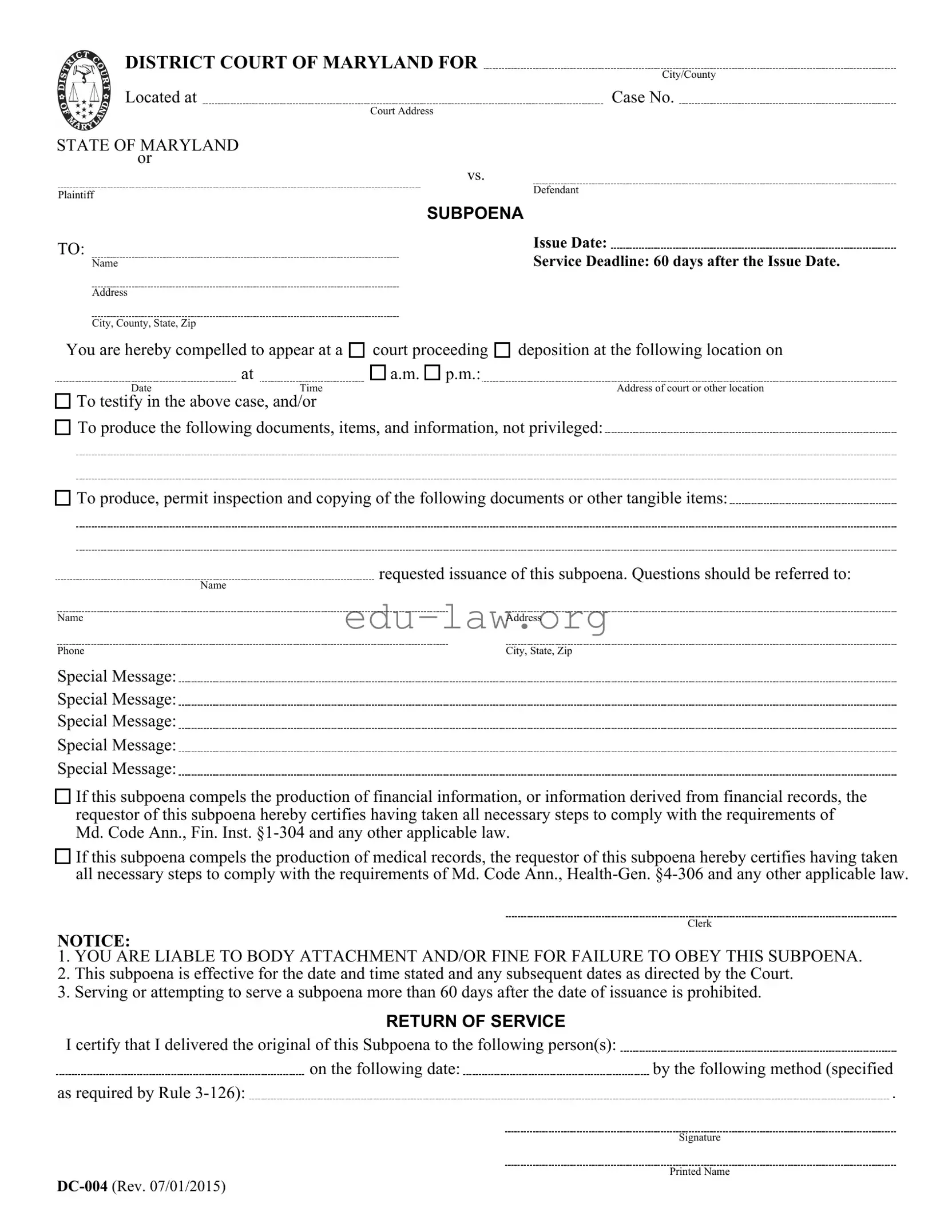
The Maryland Subpoena form is an essential legal document that plays a crucial role in the judicial process. It serves as a formal request for an individual to appear in court or provide specific documents related to a case. The form is issued by the District Court of Maryland and includes vital information such as the case number, the names of the parties involved, and the address of the court or other designated location. Notably, the form specifies the date and time for the appearance or deposition, typically requiring attendance within 60 days of issuance. Individuals receiving a subpoena must understand that failing to comply can lead to serious consequences, including fines or even body attachment. Additionally, the form contains important certifications for the requestor, ensuring compliance with laws related to financial and medical records. This attention to detail ensures that the rights of all parties are respected while facilitating the discovery of necessary evidence. Overall, the Maryland Subpoena form is a powerful tool that underscores the importance of cooperation in the legal system.

DISTRICT COURT OF MARYLAND FOR
City/County
Located at |
Case No. |
STATE OF MARYLAND or
Plaintiff
TO:
Name
Address
City, County, State, Zip
Court Address
vs.
Defendant
SUBPOENA
Issue Date:
Service Deadline: 60 days after the Issue Date.
You are hereby compelled to appear at a
at
DateTime
court proceeding a.m. p.m.:
deposition at the following location on
Address of court or other location
To testify in the above case, and/or
To produce the following documents, items, and information, not privileged:
To produce, permit inspection and copying of the following documents or other tangible items:
requested issuance of this subpoena. Questions should be referred to:
|
Name |
Name |
Address |
Phone |
City, State, Zip |
Special Message:
Special Message:
Special Message:
Special Message:
Special Message:
If this subpoena compels the production of financial information, or information derived from financial records, the requestor of this subpoena hereby certifies having taken all necessary steps to comply with the requirements of Md. Code Ann., Fin. Inst.
If this subpoena compels the production of medical records, the requestor of this subpoena hereby certifies having taken all necessary steps to comply with the requirements of Md. Code Ann.,
Clerk
NOTICE:
1.YOU ARE LIABLE TO BODY ATTACHMENT AND/OR FINE FOR FAILURE TO OBEY THIS SUBPOENA.
2.This subpoena is effective for the date and time stated and any subsequent dates as directed by the Court.
3.Serving or attempting to serve a subpoena more than 60 days after the date of issuance is prohibited.
RETURN OF SERVICE |
|
I certify that I delivered the original of this Subpoena to the following person(s): |
|
on the following date: |
by the following method (specified |
as required by Rule |
. |
|
Signature |
|
Printed Name |
|
| Fact Name | Description |
|---|---|
| Governing Law | The Md Subpoena form is governed by Maryland law, specifically Md. Code Ann., Fin. Inst. §1-304 for financial records and Md. Code Ann., Health-Gen. §4-306 for medical records. |
| Service Deadline | The subpoena must be served within 60 days after the issue date. Serving it after this period is not allowed. |
| Consequences of Non-Compliance | Failure to obey the subpoena may result in body attachment or fines. Compliance is mandatory. |
| Return of Service | The form requires certification of delivery to the individual named in the subpoena, including the date and method of service. |
Completing the Maryland Subpoena form requires careful attention to detail. Once filled out, the form will facilitate the process of compelling an individual to appear in court or produce specific documents. Follow the steps below to ensure accurate completion of the form.
After completing the form, review it for accuracy before submitting it according to the court's guidelines. Proper handling of this document is essential for ensuring compliance and facilitating the legal process.
What is a Maryland Subpoena form?
The Maryland Subpoena form is a legal document issued by the District Court of Maryland that compels an individual to appear in court or produce specific documents related to a legal case. This form is crucial for gathering evidence and ensuring that witnesses are present during court proceedings.
Who can issue a Maryland Subpoena?
A Maryland Subpoena can be issued by a party involved in a legal case, typically through their attorney. The court itself may also issue subpoenas as part of its authority to ensure that necessary evidence is presented. It is important that the person issuing the subpoena has a legitimate interest in the case.
What information must be included in the subpoena?
The subpoena must include several key details: the names of the parties involved, the case number, the date of issuance, and the deadline for service. Additionally, it should specify whether the individual is required to appear in court, provide testimony, or produce documents. Clear instructions regarding the location and time of the appearance are also essential.
What happens if someone fails to comply with a subpoena?
If an individual fails to comply with a subpoena, they may face serious consequences. This can include being held in contempt of court, which may result in fines or even a body attachment. Compliance is not optional; it is a legal obligation that must be taken seriously.
How long does one have to respond to a Maryland Subpoena?
The individual receiving the subpoena has a service deadline of 60 days from the date it was issued. It is crucial to respond within this timeframe to avoid any legal repercussions. If more time is needed, it is advisable to communicate with the issuing party or the court as soon as possible.
Are there any special considerations for medical or financial records?
Yes, when a subpoena requests medical or financial records, specific legal requirements must be met. The requestor must certify that they have complied with relevant laws, such as the Maryland Code regarding financial institutions and health records. This ensures that the privacy of individuals is protected while still allowing for necessary information to be disclosed.
How should a subpoena be served?
A subpoena must be served in accordance with the rules set forth by the court. This typically involves delivering the original subpoena to the individual named in the document. The method of service must be documented, including the date and manner in which it was delivered. Proper service is critical for the subpoena to be enforceable.
Failing to include the case number. This is essential for identifying the specific legal matter.
Not specifying the date and time of the court proceeding or deposition. This information is crucial for compliance.
Leaving out the address of the court or location where the testimony will take place. Without this, the recipient may not know where to go.
Neglecting to list the documents or items that need to be produced. Clear descriptions are necessary for compliance.
Failing to sign the form. A signature is required to validate the subpoena.
Not providing the contact information for questions. This can lead to confusion and delays.
Ignoring the service deadline. Serving the subpoena after 60 days from the issue date is not allowed.
Overlooking the need to certify compliance with applicable laws when requesting financial or medical records. This certification is important for legal compliance.
Using an outdated version of the form. Always ensure the most current version is used to avoid issues.
When dealing with legal proceedings, various documents accompany the Md Subpoena form to ensure that all parties involved understand their rights and responsibilities. Each document serves a specific purpose in the legal process, facilitating communication and compliance. Here are some commonly used forms and documents that often accompany a subpoena:
Understanding these documents can significantly enhance the effectiveness of legal proceedings. Each form plays a critical role in ensuring that the process runs smoothly and that all parties are held accountable. Familiarity with these documents not only aids in compliance but also empowers individuals to navigate the legal landscape with confidence.
The first document similar to the Md Subpoena form is a summons. A summons is a legal document issued by a court that notifies an individual that they are being sued or required to appear in court. Like a subpoena, a summons compels a person to respond, but it typically involves a lawsuit rather than a request for testimony or documents. Both documents serve as formal notifications, ensuring that individuals are aware of their legal obligations and the potential consequences of not complying.
Next, we have a notice to produce documents. This document is often issued in the context of litigation, requesting a party to provide specific documents relevant to a case. Similar to a subpoena, it requires the recipient to gather and present certain records or items. However, a notice to produce is generally less formal and may not carry the same legal weight as a subpoena, which can enforce compliance through court orders. Both documents aim to ensure that relevant information is made available during legal proceedings.
Another related document is a deposition notice. This notice informs a party that they must appear for a deposition, a legal proceeding where witnesses provide sworn testimony outside of court. Like the Md Subpoena form, a deposition notice requires attendance and can also compel the production of documents. Both documents are vital in gathering evidence and ensuring that all parties have access to necessary information during the discovery phase of litigation.
Discovery requests also share similarities with the Md Subpoena form. These requests are made during the pre-trial phase of a lawsuit, asking for specific information or documents from the opposing party. While subpoenas can be issued to third parties, discovery requests are typically directed at the other party involved in the litigation. Both documents aim to facilitate the exchange of information, helping to build a clearer picture of the case before it goes to trial.
A court order is another document that parallels the Md Subpoena form. A court order is a directive issued by a judge that requires a person to do something, such as appear in court or produce documents. While subpoenas are typically initiated by one party in a case, a court order can arise from a judge's ruling. Both documents have the power to enforce compliance, but court orders often carry more authority as they stem directly from judicial decisions.
Lastly, an affidavit can be seen as somewhat similar to the Md Subpoena form in that it is a written statement confirmed by oath or affirmation, used as evidence in court. While an affidavit does not compel appearance or document production like a subpoena, it serves as a formal declaration of facts that can be presented in legal proceedings. Both documents contribute to the evidentiary process, ensuring that truthful information is provided to the court.
When filling out the Maryland Subpoena form, it’s important to follow specific guidelines to ensure that the process goes smoothly. Below are some key do's and don'ts to keep in mind:
By following these guidelines, you can help ensure that your subpoena is processed correctly and that you meet all necessary legal requirements.
Understanding the Md Subpoena form is essential for anyone involved in legal proceedings in Maryland. However, several misconceptions often arise. Below is a list of common misunderstandings about this form, along with clarifications.
By addressing these misconceptions, individuals can better navigate the legal landscape and understand their rights and responsibilities regarding the Md Subpoena form.
Understanding how to fill out and utilize the Maryland Subpoena form is essential for ensuring compliance with legal proceedings. Here are some key takeaways to keep in mind:
By keeping these points in mind, you can navigate the process of filling out and using the Maryland Subpoena form more effectively. Understanding your responsibilities not only helps ensure compliance but also contributes to the integrity of the legal process.