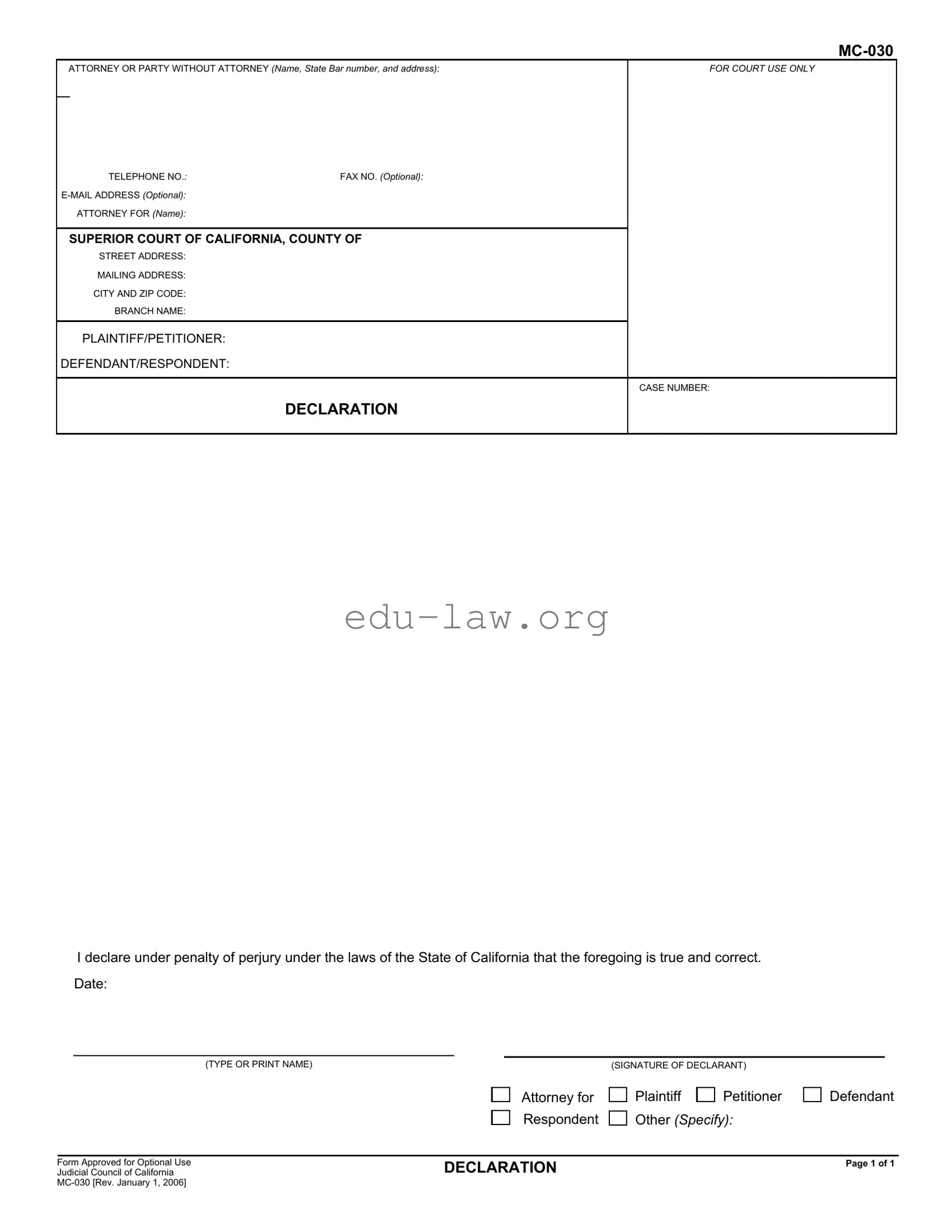
The MC-030 form is an essential document used within the California court system, particularly for individuals who are representing themselves or those who have legal representation. This form captures critical information about the parties involved in a case, including the names, addresses, and contact details of both the attorney and the party they represent. It serves as a declaration, where the signer affirms the truthfulness of the information provided under penalty of perjury. The form also includes sections for the case number and details about the court, ensuring that all relevant information is organized and accessible. By completing the MC-030, parties can facilitate communication with the court, making it easier to navigate the legal process. Understanding the significance of this form is crucial for anyone involved in a legal proceeding in California, as it lays the groundwork for effective representation and proper documentation of the case.
ATTORNEY OR PARTY WITHOUT ATTORNEY (Name, State Bar number, and address): |
FOR COURT USE ONLY |
TELEPHONE NO.: |
FAX NO. (Optional): |
|
|
ATTORNEY FOR (Name): |
|
SUPERIOR COURT OF CALIFORNIA, COUNTY OF
STREET ADDRESS:
MAILING ADDRESS:
CITY AND ZIP CODE:
BRANCH NAME:
PLAINTIFF/PETITIONER:
DEFENDANT/RESPONDENT:
CASE NUMBER:
DECLARATION
I declare under penalty of perjury under the laws of the State of California that the foregoing is true and correct.
Date:
(TYPE OR PRINT NAME) |
(SIGNATURE OF DECLARANT) |
|
|
|
||||||
|
|
Attorney for |
|
Plaintiff |
|
|
Petitioner |
|
|
Defendant |
|
|
|
|
|
|
|
||||
|
|
|
|
|
|
|||||
|
|
Respondent |
|
Other (Specify): |
|
|
|
|||
|
|
|
|
|
|
|||||
Form Approved for Optional Use Judicial Council of California
DECLARATION
Page 1 of 1
| Fact Name | Description |
|---|---|
| Purpose | The MC-030 form is used to declare the identity of an attorney or party involved in a legal matter before the Superior Court of California. |
| Governing Law | This form is governed by the California Rules of Court, specifically Rule 2.100 and Rule 2.101, which outline requirements for court documents. |
| Optional Fields | While the form requires certain information, it also includes optional fields for fax numbers and email addresses to facilitate communication. |
| Declaration Requirement | The individual completing the form must declare under penalty of perjury that the information provided is true and correct, ensuring accountability. |
Completing the MC-030 form is a straightforward process that requires careful attention to detail. This form is essential for individuals involved in legal proceedings in California. After filling out the form, it will be submitted to the appropriate court as part of your case documentation.
What is the MC-030 form used for?
The MC-030 form, also known as the Declaration form, is primarily used in California courts. It allows individuals, whether they are attorneys or parties without attorneys, to make a sworn statement regarding specific facts related to a case. This declaration can be used to support motions, provide evidence, or clarify issues in court proceedings. It serves as a formal way to present information that may be critical to the case at hand.
Who can fill out the MC-030 form?
Both attorneys and individuals representing themselves can complete the MC-030 form. If you are an attorney, you will need to include your name, state bar number, and contact information. For individuals without legal representation, the form still allows you to present your declaration, but you will need to provide your personal details instead of an attorney's information. It is important that whoever fills out the form does so truthfully, as it is signed under penalty of perjury.
What information is required on the MC-030 form?
The MC-030 form requires several key pieces of information. You must provide your name, address, and, if applicable, your state bar number and contact details. Additionally, you need to indicate whether you are representing the plaintiff, defendant, or another party in the case. The case number and the names of the parties involved must also be included. Finally, the form concludes with a declaration statement that affirms the truthfulness of the information provided.
Is there a specific format for the declaration on the MC-030 form?
While the MC-030 form has a designated structure, the content of the declaration can vary based on the specifics of your case. You should clearly state the facts you wish to declare, ensuring they are relevant to the case. It is essential to write in a straightforward manner, avoiding overly complex language. After completing the declaration, you must sign and date the form, affirming that the information is accurate to the best of your knowledge.
Can the MC-030 form be submitted electronically?
Yes, in many California courts, the MC-030 form can be submitted electronically, especially if the court allows for electronic filing. However, it is crucial to check the specific rules of the court where your case is being heard. Some courts may still require a physical copy of the form to be filed. Always confirm the submission guidelines to ensure compliance with court procedures.
Filling out the MC-030 form can be a straightforward process, but mistakes can lead to delays or complications. Here are six common errors people make when completing this form:
Many individuals forget to fill in all required fields. Missing information such as the case number or contact details can hinder the processing of the form.
Some people mistakenly enter the wrong case number. This can lead to confusion and may delay court proceedings.
Not signing the form is a frequent oversight. The declaration must be signed by the declarant to be valid.
Individuals often forget to include the declaration statement. This statement confirms that the information provided is true and correct under penalty of perjury.
Some users do not adhere to the required formatting for names and addresses. Proper formatting is essential for clarity and compliance.
While optional fields like fax number and email address can be left blank, some individuals assume they must fill in every space, leading to unnecessary confusion.
By avoiding these common mistakes, individuals can ensure that their MC-030 form is completed correctly, facilitating a smoother process in court.
The MC-030 form is a declaration form used in California courts, primarily for individuals representing themselves or those without an attorney. It serves to affirm the truthfulness of the information provided under penalty of perjury. Alongside this form, several other documents may be required or beneficial in various legal proceedings. Below is a list of related forms and documents commonly used in conjunction with the MC-030.
These forms and documents play an essential role in the legal process, ensuring that all parties are informed and that the court has the necessary information to make decisions. Proper completion and submission of these forms can significantly impact the outcome of a case.
The MC-030 form, used in California courts, is similar to the MC-010 form, which is a declaration form as well. Both forms require a declaration under penalty of perjury. The MC-010 is often used for various types of declarations in court proceedings, making it essential for parties to provide truthful information. Like the MC-030, the MC-010 also includes spaces for the declarant's name, signature, and date, ensuring that the declaration is officially recorded.
Another document similar to the MC-030 is the MC-020 form, which serves as a request for a court order. The MC-020 requires the party to declare facts supporting their request, similar to how the MC-030 requires a declaration of truth. Both forms emphasize the importance of honesty, as they are made under penalty of perjury. This similarity in purpose highlights the legal obligation to provide accurate information in court documents.
The MC-040 form is also comparable to the MC-030. This form is used for a declaration of service, which confirms that legal documents have been properly delivered to the other party. Like the MC-030, it requires a declaration under penalty of perjury, ensuring that the serving party is truthful about the delivery process. Both forms serve to uphold the integrity of the legal process by requiring accurate declarations.
Next, the MC-050 form, which is a request for a court hearing, shares similarities with the MC-030. Both documents require a declaration of facts to support the request being made. The MC-050 must also be signed and dated, just like the MC-030. This ensures that the court has a clear understanding of the reasons for the request, reinforcing the need for truthful and accurate information.
The MC-060 form, used for a notice of motion, is another document that aligns with the MC-030. Both forms require a declaration under penalty of perjury. The MC-060 outlines the specifics of the motion being filed, while the MC-030 serves as a general declaration. Each form plays a crucial role in the legal process by ensuring that all claims made are backed by truthful statements.
Additionally, the MC-070 form, which is a declaration of facts, is similar to the MC-030. This form is often used to provide evidence or support for a claim or defense in court. Both require a declaration under penalty of perjury, emphasizing the importance of honesty. The MC-070, like the MC-030, must be signed and dated, ensuring accountability in the legal process.
Lastly, the MC-080 form, used for a statement of damages, has similarities with the MC-030. This form requires a declaration that outlines the damages being claimed in a lawsuit. Both forms necessitate a declaration under penalty of perjury, reinforcing the need for truthful disclosures. The MC-080 also requires the declarant's signature and date, mirroring the structure of the MC-030 and ensuring that all claims are properly documented.
When filling out the MC-030 form, it's essential to follow certain guidelines to ensure accuracy and compliance. Here’s a list of things you should and shouldn't do:
By following these guidelines, you can help ensure that your MC-030 form is filled out correctly and efficiently. This will ultimately contribute to a smoother process in your legal proceedings.
The MC-030 form is often misunderstood. Here are seven common misconceptions about it:
When filling out and using the MC-030 form, consider the following key takeaways: