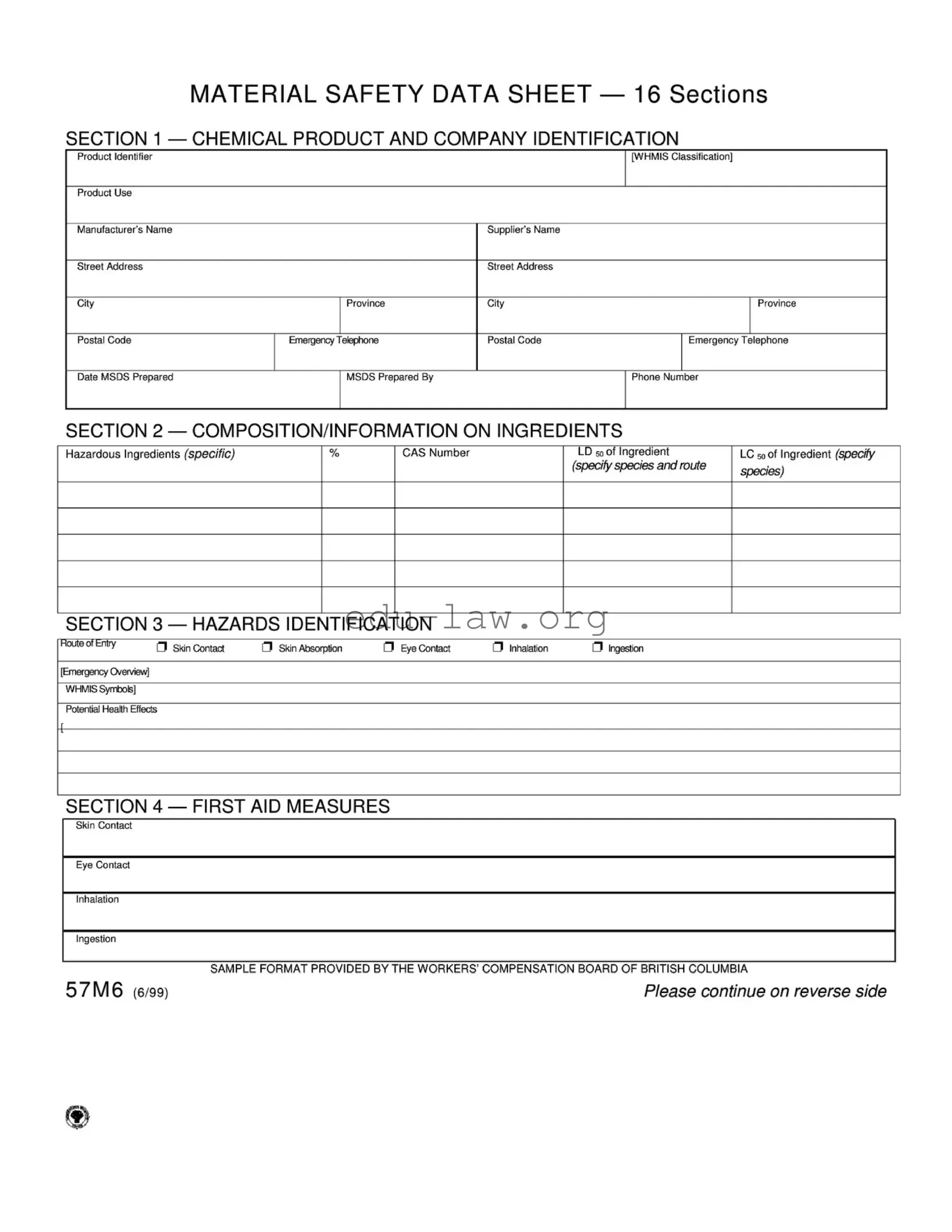
The Material Safety Data Sheet (MSDS) is an essential document that provides critical information about hazardous substances. It serves as a comprehensive guide, detailing the chemical product's identity, its intended use, and the manufacturer’s contact information. The MSDS is organized into 16 sections, each addressing different aspects of the chemical, starting with identification and moving through composition, hazards, first aid measures, and fire-fighting procedures. It also outlines safe handling and storage practices, personal protective equipment recommendations, and exposure limits. Additionally, the sheet includes vital information on the physical and chemical properties of the substance, its stability, and potential ecological impacts. Regulatory information ensures compliance with safety standards, while sections on disposal considerations and transport provide guidelines for safe management and transport of the chemical. This structured format not only aids in ensuring workplace safety but also supports emergency response efforts by providing necessary information in a clear and accessible manner.
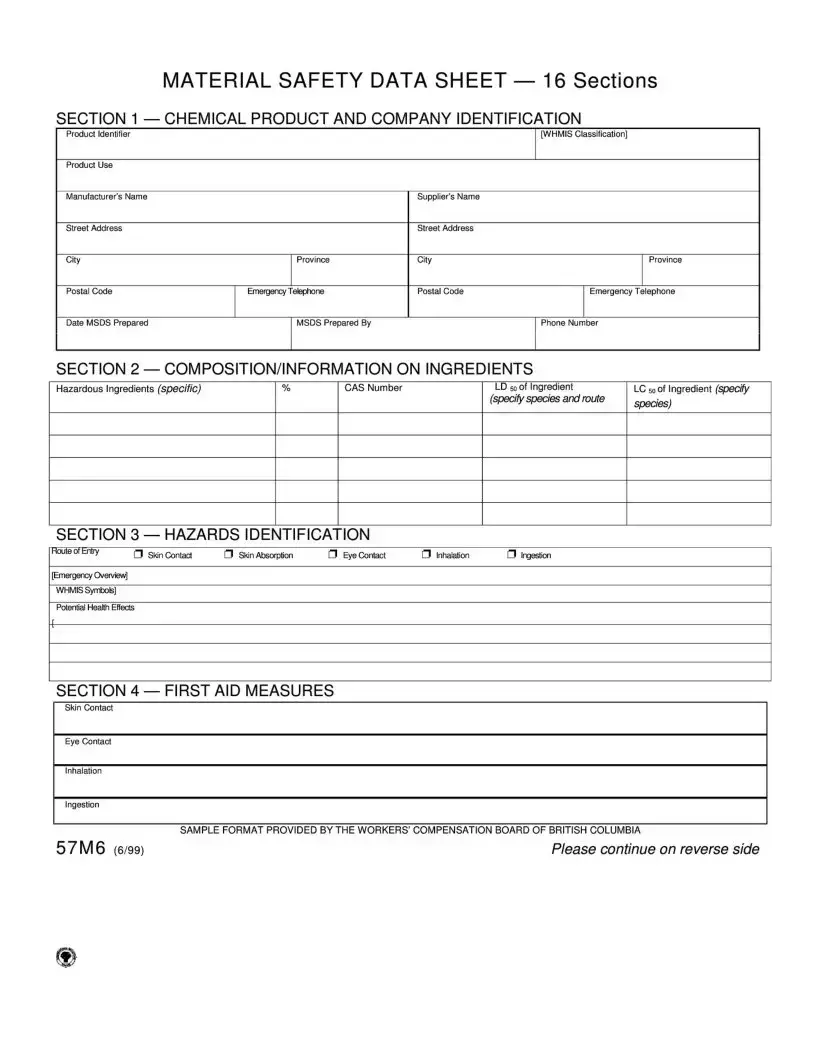
MATERIAL SAFETY DATA SHEET — 16 Sections |
||||
SECTION 1 — CHEMICAL PRODUCT AND COMPANY IDENTIFICATION |
|
|||
Product Identifier |
|
|
[WHMIS Classification] |
|
Product Use |
|
|
|
|
Manufacturer's Name |
|
Supplier’s Name |
|
|
Street Address |
|
Street Address |
|
|
City |
Province |
City |
|
Province |
Postal Code |
Emergency Telephone |
Postal Code |
Emergency Telephone |
|
Date MSDS Prepared |
MSDS Prepared By |
Phone Number |
|
|
SECTION 2 — COMPOSITION/INFORMATION ON INGREDIENTS |
|
|||
Hazardous Ingredients (specific) |
% |
CAS Number |
LD so of Ingredient |
LC so of Ingredient (specify |
|
|
|
(specify species and route |
species) |
|
|
|
|
|
SECTION 3 — HAZARDS IDENTIFICA1RON
О Skin Contact |
П Skin Absorption |
П Eye Contact |
П Inhalation |
П Ingestion |
[Emergency Overview]
WHMIS Symbols]
Potential Health Effects
SECTION 4 — FIRST AID MEASURES
5 7 M 6 (6/99) |
Please continue on reverse side |
Product
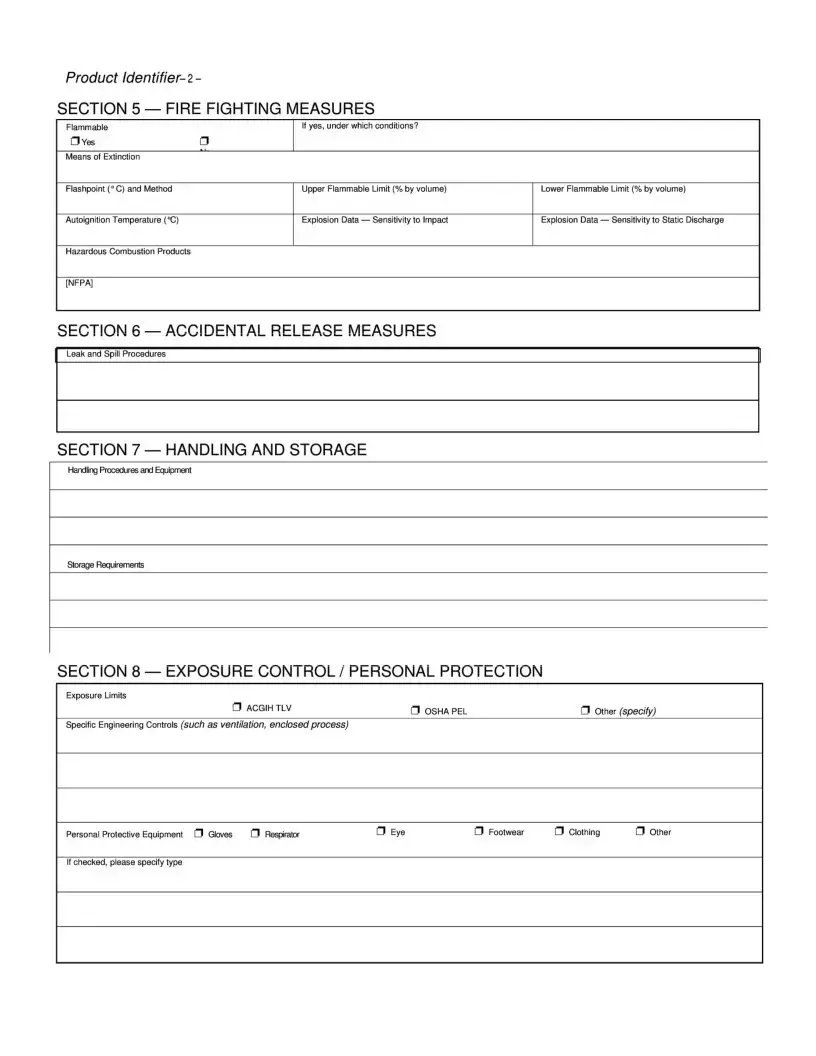
SECTION 5 — FIRE FIGHTING MEASURES
Flammable |
If yes, under which conditions? |
|
Yes |
|
|
Means of Extinction |
|
|
Flashpoint (°C) and Method |
Upper Flammable Limit (% by volume) |
Lower Flammable Limit (% by volume) |
Autoignition Temperature (°C) |
Explosion Data — Sensitivity to Impact |
Explosion Data — Sensitivity to Static Discharge |
Hazardous Combustion Products |
|
|
[NFPA] |
|
|
SECTION 6 — ACCIDENTAL RELEASE MEASURES
Leak and Spill Procedures
SECTION 7 — HANDLING AND STORAGE
SECTION 8 — EXPOSURE CONTROL / PERSONAL PROTECTION
Exposure Limits
ACGIH TLV |
0SHA pEL |
Д Other (Specify) |
Specific Engineering Controls (such as ventilation, enclosed process)
Personal Protective Equipment |
Gloves |
Respirator |
Eye |
Footwear |
Clothing |
Other |
If checked, please specify type
Product Identifiers -
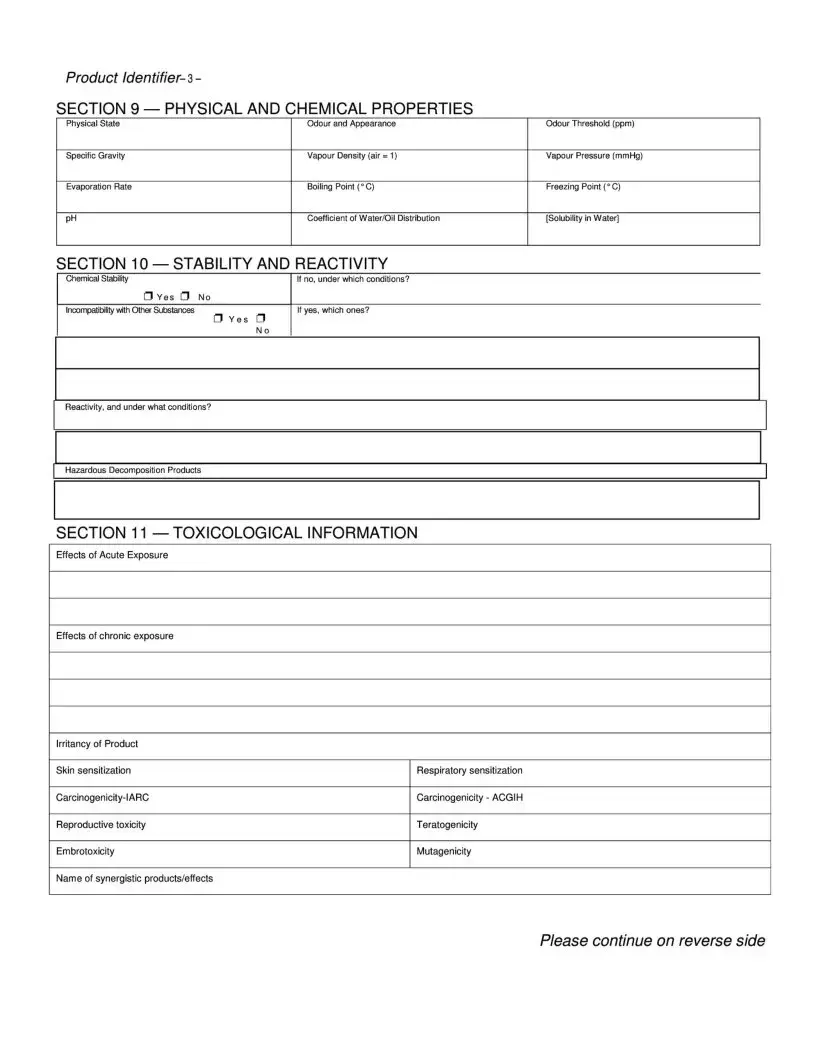
SECTION 9 — PHYSICAL AND CHEMICAL PROPERTIES
Physical State |
Odour and Appearance |
Odour Threshold (ppm) |
Specific Gravity |
Vapour Density (air = 1) |
Vapour Pressure (mmHg) |
Evaporation Rate |
Boiling Point (°C) |
Freezing Point (°C) |
pH |
Coefficient of Water/Oil Distribution |
[Solubility in Water] |
SECTION 10 — STABILITY AND REACTIVITY
Chemical Stability |
If no, under which conditions? |
О Yes П No
Incompatibility with Other Substances |
If yes, which ones? |
|
Yes |
|
N о |
Reactivity, and under what conditions?
Hazardous Decomposition Products |
| |
SECTION 11 — TOXICOLOGICAL INFORMATION
Effects of Acute Exposure
Effects of chronic exposure
Irritancy of Product |
|
Skin sensitization |
Respiratory sensitization |
Carcinogenicity - ACGIH |
|
Reproductive toxicity |
Teratogenicity |
Embrotoxicity |
Mutagenicity |
Name of synergistic products/effects |
|
Please continue on reverse side
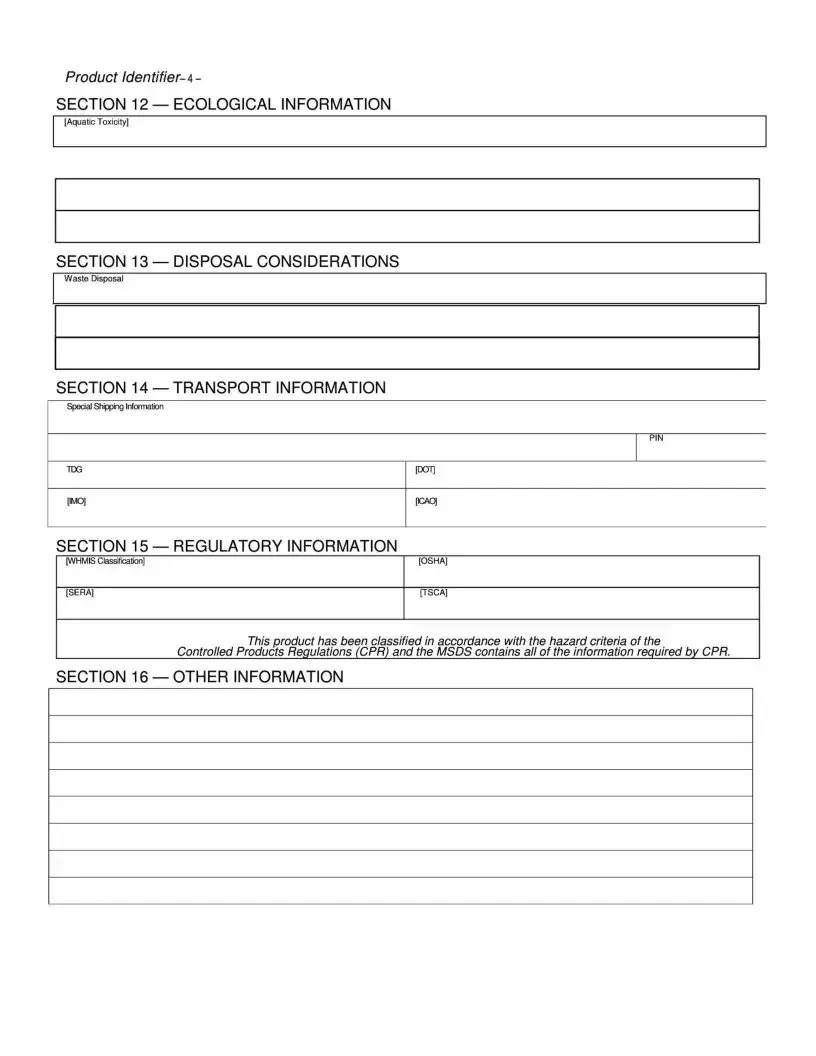
Product Identifier- 4-
SECTION 12 — ECOLOGICAL INFORMATION
[Aquatic Toxicity]
SECTION 13 — DISPOSAL CONSIDERATIONS
Waste Disposal
SECTION 14
Special Shipping Information
TOG
[IMO]
PIN
[DOT]
[CAO]
SECTION 15 — REGULATORY INFORMATION
[WHMIS Classification] |
[OSHA] |
[SERA] |
[TSCA] |
This product has been classified in accordance with the hazard criteria of the
Controlled Products Regulations (CPR) and the MSDS contains all of the information required by CPR.
SECTION 16
| Fact Name | Description |
|---|---|
| Purpose | The Material Safety Data Sheet (MSDS) provides information about the properties of a chemical product and its hazards. |
| Sections | The MSDS consists of 16 sections covering identification, hazards, first aid, fire-fighting measures, and more. |
| Regulatory Compliance | In the U.S., the MSDS must comply with OSHA regulations under the Hazard Communication Standard. |
| Emergency Information | Each MSDS includes emergency contact information for the manufacturer and suppliers. |
| Hazard Identification | Section 3 specifically outlines potential health effects and the risks associated with exposure to the chemical. |
| First Aid Measures | Section 4 details first aid procedures for various types of exposure, such as skin contact and inhalation. |
| State-Specific Forms | Some states may have additional requirements for MSDS forms, governed by state laws such as California's Proposition 65. |
Completing the Material Safety Data Sheet (MSDS) is crucial for ensuring safety and compliance in handling chemicals. This form contains essential information about the chemical product, its hazards, and necessary safety measures. Follow the steps outlined below to accurately fill out the MSDS form.
What is a Material Safety Data Sheet (MSDS)?
A Material Safety Data Sheet (MSDS) is a document that provides essential information about a chemical product. It includes details such as the product's identity, hazards, handling and storage guidelines, first aid measures, and more. The MSDS is designed to ensure the safe use of chemicals in workplaces and to inform employees about potential risks associated with the substances they may encounter.
Why is an MSDS important?
An MSDS is crucial for workplace safety. It helps employees understand the hazards of the chemicals they work with, enabling them to take appropriate precautions. This document also assists in emergency response planning and ensures compliance with regulatory requirements. By providing clear and accessible information, an MSDS promotes a safer working environment.
What information is included in an MSDS?
An MSDS typically contains 16 sections, including product identification, composition of ingredients, hazards identification, first aid measures, fire-fighting measures, accidental release measures, handling and storage, exposure controls, physical and chemical properties, stability and reactivity, toxicological information, ecological information, disposal considerations, transport information, regulatory information, and other relevant details. Each section provides specific information that is vital for safe handling and use.
How do I read an MSDS?
Reading an MSDS involves understanding each of its sections. Start with the product identification to know what you're dealing with. Next, review the hazards identification section to understand potential risks. Pay close attention to the first aid measures and personal protective equipment (PPE) recommendations. Familiarizing yourself with the layout and key sections will help you quickly locate the information you need in case of an emergency.
Who is responsible for providing an MSDS?
The manufacturer or supplier of the chemical product is responsible for providing an MSDS. They must ensure that the MSDS is accurate, up-to-date, and compliant with regulations. Employers are also responsible for making sure that their employees have access to the MSDS for any chemicals they may encounter in the workplace.
How often should an MSDS be updated?
An MSDS should be updated whenever there is a significant change in the product's formulation, hazards, or regulatory requirements. Additionally, it is good practice to review and update the MSDS at least every three years, even if no changes have occurred. This ensures that the information remains current and relevant for safe handling.
What should I do if an MSDS is not available?
If an MSDS is not available for a chemical product, it is essential to contact the manufacturer or supplier to request one. Using a chemical without an MSDS can pose serious risks, as you may not be aware of the hazards or necessary safety precautions. Until you obtain the MSDS, avoid using the product and follow general safety practices.
Can I find MSDS information online?
Yes, many manufacturers and suppliers provide MSDS information online. You can often find MSDS documents on their websites by searching for the specific product name or identifier. Additionally, there are various online databases that compile MSDS documents for a wide range of chemicals. Always ensure that you are accessing the most recent version of the MSDS.
What should I do in case of an emergency involving a chemical?
In the event of a chemical emergency, refer to the first aid measures section of the MSDS for guidance on how to respond. If necessary, call emergency services and provide them with the information from the MSDS. It is important to act quickly and follow the recommended procedures to minimize harm and ensure safety.
Failing to include the Product Identifier in Section 1. This essential information identifies the chemical and ensures proper handling.
Not specifying the Hazardous Ingredients in Section 2. Omitting this information can lead to unsafe exposure and mishandling.
Leaving out the Emergency Telephone numbers in Section 1. This can delay critical response in case of an incident.
Neglecting to detail the Means of Extinction in Section 5. Knowing how to extinguish a fire is vital for safety.
Inadequately describing the Leak and Spill Procedures in Section 6. Clear procedures are necessary to minimize environmental impact.
Not including Personal Protective Equipment in Section 8. This information is crucial for ensuring worker safety during handling.
Failing to provide Exposure Limits in Section 8. This information helps determine safe exposure levels for workers.
Omitting Disposal Considerations in Section 13. Proper disposal methods are essential to comply with environmental regulations.
When working with hazardous materials, it’s essential to have a comprehensive understanding of safety and regulatory requirements. The Material Safety Data Sheet (MSDS) is a critical document, but it often accompanies other forms and documents that provide additional context and instructions. Below are several key documents that are frequently used alongside the MSDS.
Having these documents on hand not only enhances workplace safety but also ensures compliance with legal requirements. Together, they create a comprehensive framework for managing hazardous materials responsibly.
The Safety Data Sheet (SDS) is closely related to the Material Safety Data Sheet (MSDS) and serves a similar purpose. Both documents provide critical information regarding the properties of a chemical substance. They include details on hazards, safe handling practices, and emergency measures. However, the SDS has a standardized format that consists of 16 sections, making it easier to locate specific information. This standardization is particularly beneficial for companies that handle multiple chemicals, as it ensures consistency across all safety documentation.
The Chemical Safety Report (CSR) is another document that shares similarities with the MSDS. It is typically required for substances that are registered under chemical regulations. The CSR contains detailed information about the chemical's risk assessment, including exposure scenarios and risk management measures. Like the MSDS, the CSR aims to inform users about the safe use of chemicals. However, the CSR is often more comprehensive, as it may include data from studies and assessments that evaluate the chemical’s environmental and health impacts over a broader scope.
The Product Safety Data Sheet (PSDS) also parallels the MSDS in its intent to communicate safety information. While the MSDS is often used in industrial contexts, the PSDS is more commonly utilized in consumer products. It provides essential details about the product's ingredients, potential hazards, and safety precautions. Both documents emphasize the importance of safe handling and emergency procedures. However, the PSDS may focus more on consumer safety and regulatory compliance specific to retail products.
The Environmental Safety Data Sheet (ESDS) is another document that shares characteristics with the MSDS. It focuses specifically on the environmental aspects of a chemical. The ESDS outlines potential environmental hazards, including effects on wildlife and ecosystems. Similar to the MSDS, it provides guidelines for safe disposal and emergency response. However, the ESDS places a greater emphasis on the chemical's impact on the environment, making it a vital resource for companies looking to mitigate their ecological footprint.
When filling out the Material Safety Data Sheet (MSDS) form, it is crucial to ensure accuracy and clarity. Here is a list of things you should and shouldn't do:
Misconceptions about the Material Safety Data Sheet (MSDS) can lead to misunderstandings regarding safety protocols and chemical handling. Here are nine common misconceptions clarified:
Understanding these misconceptions can help foster a safer work environment and promote responsible chemical management.
When filling out and using a Material Safety Data Sheet (MSDS), keep these key points in mind: