The Louisiana Transfer-on-Death Deed form is an important legal tool that allows property owners to designate beneficiaries who will inherit their real estate upon their passing, without the need for probate. This form provides a straightforward way to transfer property, ensuring that loved ones receive their intended inheritance quickly and efficiently. By utilizing this deed, property owners can maintain control over their assets during their lifetime while providing clarity and ease for their beneficiaries after death. Importantly, the transfer occurs automatically and does not require court involvement, which can save time and reduce potential disputes among heirs. Understanding the nuances of this form, including the requirements for execution and the implications for both the grantor and the beneficiaries, is essential for anyone considering this estate planning option. With careful consideration and proper completion, the Transfer-on-Death Deed can serve as a valuable addition to a comprehensive estate plan, providing peace of mind for property owners and their families alike.
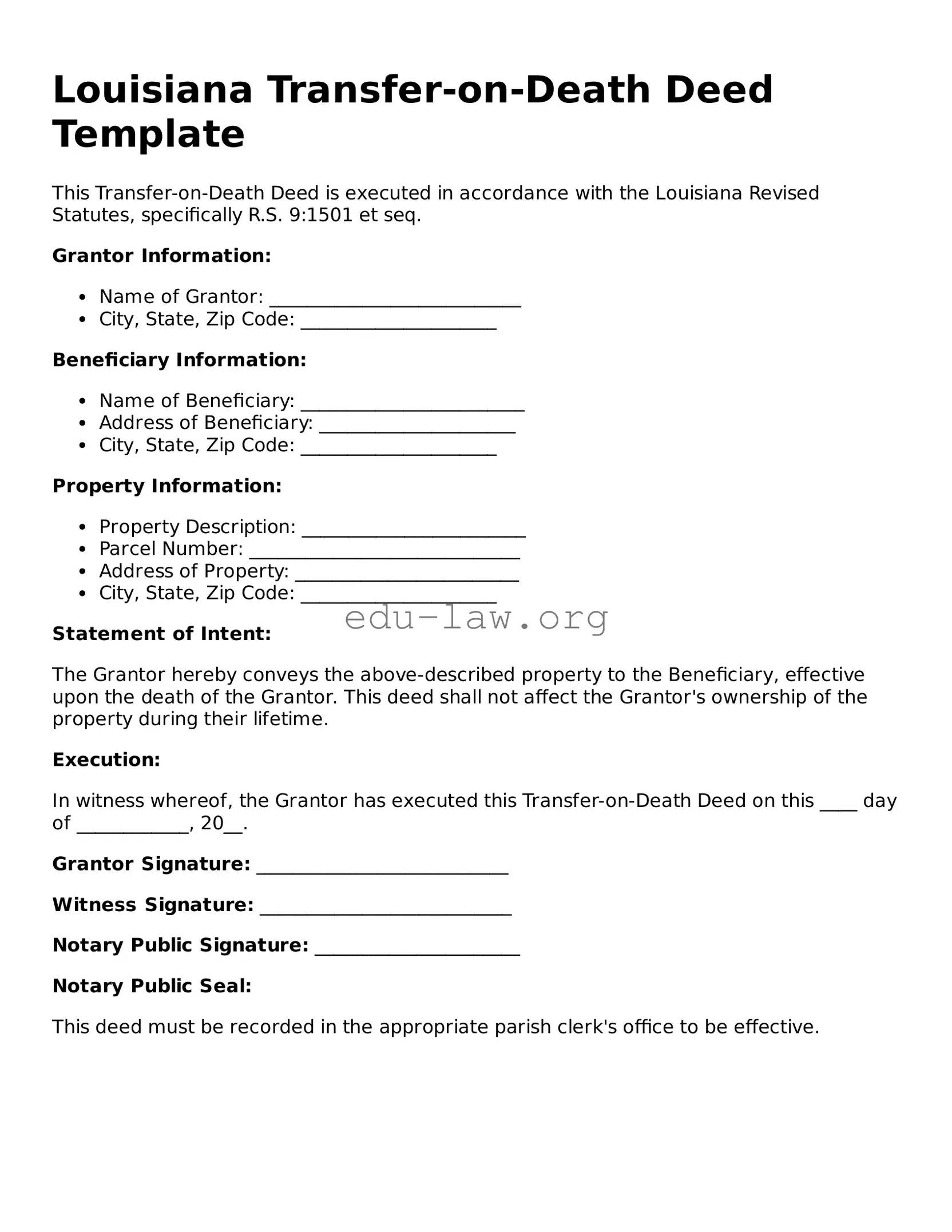
Louisiana Transfer-on-Death Deed Template
This Transfer-on-Death Deed is executed in accordance with the Louisiana Revised Statutes, specifically R.S. 9:1501 et seq.
Grantor Information:
Beneficiary Information:
Property Information:
Statement of Intent:
The Grantor hereby conveys the above-described property to the Beneficiary, effective upon the death of the Grantor. This deed shall not affect the Grantor's ownership of the property during their lifetime.
Execution:
In witness whereof, the Grantor has executed this Transfer-on-Death Deed on this ____ day of ____________, 20__.
Grantor Signature: ___________________________
Witness Signature: ___________________________
Notary Public Signature: ______________________
Notary Public Seal:
This deed must be recorded in the appropriate parish clerk's office to be effective.
| Fact Name | Description |
|---|---|
| Definition | A Transfer-on-Death Deed allows a property owner to transfer real estate to a beneficiary upon their death without going through probate. |
| Governing Law | The Louisiana Transfer-on-Death Deed is governed by Louisiana Revised Statutes, specifically RS 9:2501 - 2506. |
| Eligibility | Only real property can be transferred using this deed; personal property cannot be included. |
| Beneficiary Designation | Multiple beneficiaries can be named, and they can be individuals or entities. |
| Revocation | The deed can be revoked at any time before the property owner's death by executing a new deed or a revocation document. |
| Execution Requirements | The deed must be signed by the property owner and must be notarized and recorded in the parish where the property is located. |
| Effect on Creditors | The property transferred via this deed is still subject to creditors' claims against the estate of the deceased. |
| Tax Implications | Transfer-on-Death Deeds do not avoid estate taxes; the property may still be included in the taxable estate. |
| Use in Estate Planning | This deed is a useful tool for estate planning, allowing for a straightforward transfer of property without probate delays. |
| Limitations | Not all types of property can be transferred; for example, property held in a trust or with a mortgage may have specific rules. |
Filling out the Louisiana Transfer-on-Death Deed form is a straightforward process. Once you have completed the form, you will need to sign it in front of a notary public and then file it with the appropriate parish clerk's office. This ensures that your wishes regarding the transfer of property are legally recognized.
What is a Louisiana Transfer-on-Death Deed?
A Louisiana Transfer-on-Death Deed allows a property owner to transfer their real estate to a designated beneficiary upon their death. This deed enables the owner to maintain control of the property during their lifetime while ensuring a smooth transfer to the beneficiary without the need for probate.
Who can use a Transfer-on-Death Deed in Louisiana?
Any individual who owns real property in Louisiana can use a Transfer-on-Death Deed. This includes homeowners, landowners, and property investors. However, the property must be solely owned by the individual, as joint ownership may complicate the transfer process.
How do I complete a Transfer-on-Death Deed?
To complete a Transfer-on-Death Deed, you must provide specific information, including your name, the name of the beneficiary, and a legal description of the property. It is important to ensure that all details are accurate and that the deed is signed in front of a notary public.
Is a Transfer-on-Death Deed revocable?
Yes, a Transfer-on-Death Deed can be revoked at any time before the property owner’s death. To revoke the deed, the owner must execute a new deed that explicitly states the revocation or record a formal revocation document with the appropriate parish clerk.
What are the benefits of using a Transfer-on-Death Deed?
The primary benefits include avoiding probate, maintaining control of the property during the owner’s lifetime, and providing a clear transfer of ownership upon death. This can save time and money for the beneficiary and simplify the transfer process.
Are there any drawbacks to using a Transfer-on-Death Deed?
While there are many advantages, some drawbacks exist. For instance, the property may still be subject to creditors’ claims after the owner’s death. Additionally, if the beneficiary predeceases the owner and no alternate beneficiary is named, the deed may become void.
Do I need an attorney to create a Transfer-on-Death Deed?
While it is not legally required to have an attorney, consulting one is advisable. An attorney can provide guidance on the process, ensure the deed is properly executed, and help address any specific concerns regarding your property and beneficiaries.
How is a Transfer-on-Death Deed recorded?
To record a Transfer-on-Death Deed, you must file it with the parish clerk of court in the parish where the property is located. There may be a small fee for recording the deed. Ensure that the deed is recorded before the property owner’s death for it to be valid.
Can I name multiple beneficiaries in a Transfer-on-Death Deed?
Yes, you can name multiple beneficiaries in a Transfer-on-Death Deed. It is important to specify how the property will be divided among them. If no specific instructions are provided, the property may be divided equally among the beneficiaries upon the owner’s death.
Not including all required information. It’s crucial to provide complete details about the property and the beneficiaries. Missing information can lead to delays or rejection.
Failing to sign the deed correctly. All necessary parties must sign the form. If signatures are missing or incorrectly placed, the deed may not be valid.
Not having the deed notarized. A Transfer-on-Death Deed must be notarized to be legally binding. Skipping this step can invalidate the document.
Not recording the deed with the appropriate parish office. After completing the form, it must be filed with the local recorder of deeds. If this step is overlooked, the transfer may not take effect.
The Louisiana Transfer-on-Death Deed (TODD) is a valuable tool for estate planning, allowing property owners to transfer their real estate to beneficiaries upon their death without going through probate. However, several other forms and documents often accompany the TODD to ensure a smooth transition of assets. Below is a list of these documents, each serving a specific purpose in the estate planning process.
Incorporating these documents into your estate planning strategy can enhance clarity and ensure that your wishes are honored. Each document plays a crucial role in managing your affairs and protecting your loved ones during what can be a challenging time.
The Louisiana Transfer-on-Death Deed (TODD) allows individuals to transfer real estate to beneficiaries upon their death without going through probate. This document shares similarities with a Living Trust. A Living Trust is an estate planning tool that holds assets during a person's lifetime and specifies how they should be distributed after death. Both documents help avoid probate, ensuring a smoother transfer of property to heirs while maintaining privacy regarding the estate’s details.
An additional document that resembles the TODD is the Last Will and Testament. A will outlines how a person's assets should be distributed after their death. While both the TODD and a will direct the distribution of property, the key difference lies in the timing of the transfer. The TODD transfers property immediately upon death, whereas a will requires probate to enact the distribution of assets.
The Joint Tenancy with Right of Survivorship is another document that bears resemblance to the TODD. This arrangement allows two or more people to own property together, with the surviving owner automatically inheriting the deceased owner’s share. Like the TODD, joint tenancy avoids probate, enabling a direct transfer of ownership upon death, but it requires co-ownership during the lifetime of the parties involved.
The Beneficiary Designation form is similar in that it allows individuals to name a beneficiary for certain types of accounts, such as retirement accounts or life insurance policies. Both the TODD and beneficiary designations facilitate the transfer of assets outside of probate. However, the TODD specifically addresses real estate, while beneficiary designations apply to financial accounts and insurance policies.
The Revocable Living Trust also aligns closely with the TODD. This trust allows individuals to manage their assets during their lifetime and dictate how those assets will be distributed after death. Both documents help avoid probate and provide a clear plan for asset distribution, but a revocable living trust can encompass a wider range of assets beyond just real estate.
Finally, the Family Limited Partnership (FLP) can be compared to the TODD. An FLP is often used for estate planning, allowing family members to pool resources and manage assets collectively. Similar to the TODD, the FLP can facilitate the transfer of ownership and control of assets without probate. However, the FLP is more complex and typically requires ongoing management and compliance with specific regulations.
When filling out the Louisiana Transfer-on-Death Deed form, certain actions can help ensure the process goes smoothly. Here are nine important do's and don'ts:
Understanding the Louisiana Transfer-on-Death Deed can be tricky. Here are some common misconceptions that people often have:
By clarifying these misconceptions, individuals can make more informed decisions regarding their estate planning in Louisiana.
When filling out and using the Louisiana Transfer-on-Death Deed form, consider the following key takeaways: