The Louisiana Small Estate Affidavit is a valuable tool for individuals managing the estate of a deceased person when the total value of the estate falls below a certain threshold. This form simplifies the process of transferring property without the need for a lengthy probate proceeding. It allows heirs or beneficiaries to claim assets directly, streamlining what can often be a complicated and emotional process. By completing this affidavit, individuals can assert their rights to the deceased’s property, which may include bank accounts, personal belongings, or real estate. The form requires specific information, including the names and addresses of the heirs, a description of the assets, and an affirmation that the estate qualifies under the small estate provisions. Understanding how to properly fill out and file this affidavit can significantly ease the burden during a challenging time, ensuring that loved ones receive what they are entitled to in a timely manner.
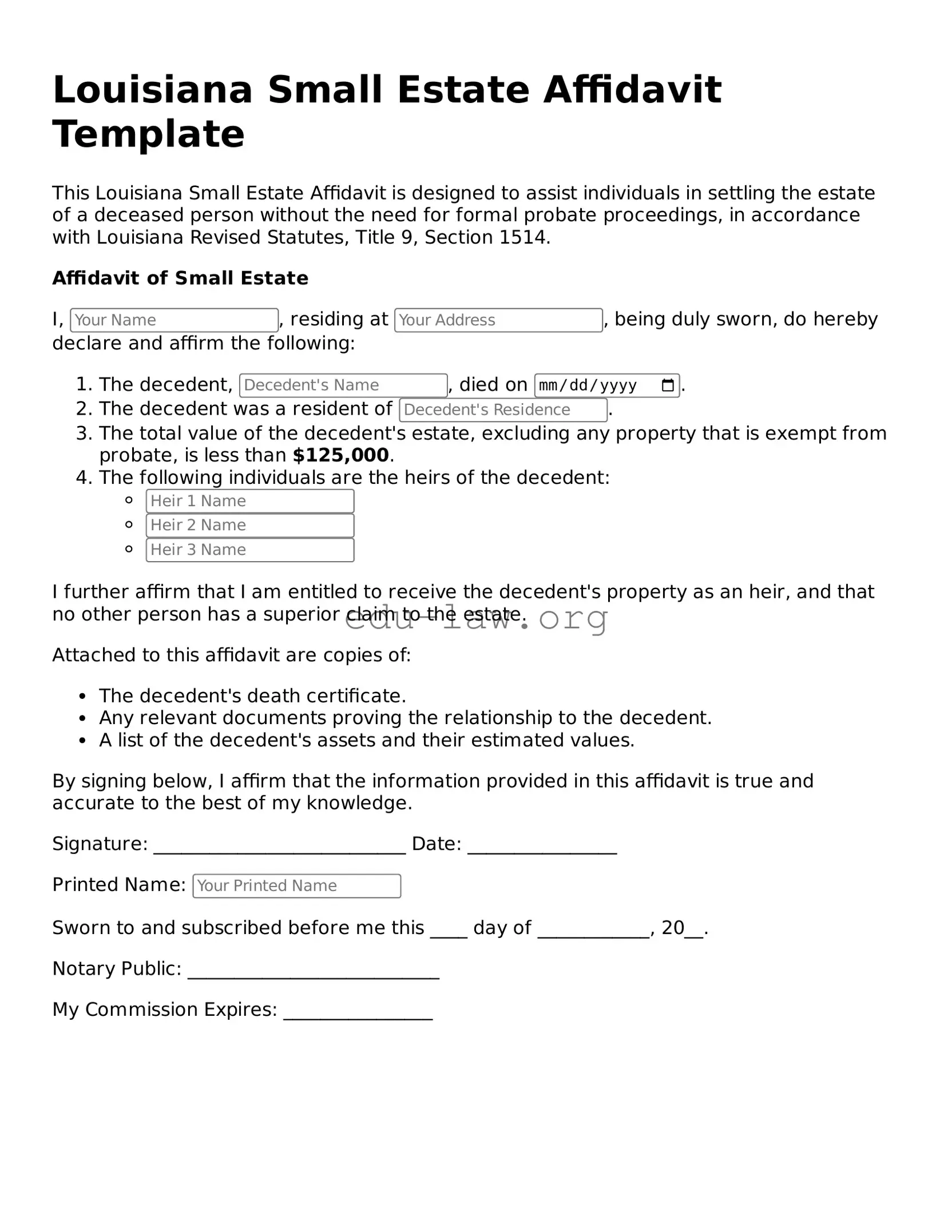
Louisiana Small Estate Affidavit Template
This Louisiana Small Estate Affidavit is designed to assist individuals in settling the estate of a deceased person without the need for formal probate proceedings, in accordance with Louisiana Revised Statutes, Title 9, Section 1514.
Affidavit of Small Estate
I, , residing at , being duly sworn, do hereby declare and affirm the following:
I further affirm that I am entitled to receive the decedent's property as an heir, and that no other person has a superior claim to the estate.
Attached to this affidavit are copies of:
By signing below, I affirm that the information provided in this affidavit is true and accurate to the best of my knowledge.
Signature: ___________________________ Date: ________________
Printed Name:
Sworn to and subscribed before me this ____ day of ____________, 20__.
Notary Public: ___________________________
My Commission Expires: ________________
| Fact Name | Details |
|---|---|
| Purpose | The Louisiana Small Estate Affidavit allows heirs to claim property without formal probate proceedings. |
| Eligibility | The estate must not exceed $125,000 in total value, excluding certain assets. |
| Governing Law | This form is governed by Louisiana Revised Statutes, Title 9, Section 2442. |
| Heirs | Only heirs at law or legatees named in the will can use this affidavit. |
| Required Information | The affidavit must include the decedent's information, a list of assets, and details of the heirs. |
| Notarization | The affidavit must be signed in the presence of a notary public. |
| Filing | There is no need to file the affidavit with the court unless disputes arise. |
| Use of Affidavit | It can be used to transfer ownership of bank accounts, real estate, and other assets. |
| Tax Implications | Heirs may be responsible for any applicable taxes on the estate assets. |
| Limitations | This process cannot be used if the decedent had a will that requires formal probate. |
Once you have the Louisiana Small Estate Affidavit form, you’re ready to fill it out. This process will help you detail the necessary information about the deceased and their estate. Follow these steps carefully to ensure everything is completed correctly.
After filling out the form, you will need to submit it to the appropriate court. This will initiate the process of settling the estate in accordance with Louisiana law.
What is a Louisiana Small Estate Affidavit?
The Louisiana Small Estate Affidavit is a legal document that allows heirs to claim the assets of a deceased person without going through the formal probate process. This option is available when the total value of the deceased's estate falls below a certain threshold, which is currently set at $125,000, excluding certain assets like life insurance and retirement accounts. This process simplifies the transfer of assets, making it quicker and less costly for the heirs.
Who is eligible to use the Small Estate Affidavit?
To use the Small Estate Affidavit, you must be an heir of the deceased. Generally, this includes spouses, children, parents, or siblings. Additionally, the estate must meet the value requirements and must not have any pending debts or claims against it that exceed the value of the estate. If the deceased had a will, the affidavit can still be used, provided that the will does not require formal probate.
How do I complete the Small Estate Affidavit?
Completing the Small Estate Affidavit involves filling out the form accurately and providing necessary information about the deceased, the heirs, and the assets involved. You will need to list all assets, their estimated values, and any debts. After filling out the form, it must be signed in the presence of a notary. It’s important to ensure that all information is truthful and complete to avoid any legal complications.
Where do I file the Small Estate Affidavit?
The completed Small Estate Affidavit must be filed with the Clerk of Court in the parish where the deceased lived at the time of death. Depending on the parish, there may be specific filing requirements or fees. After filing, the affidavit serves as proof for transferring the deceased's assets to the heirs without going through probate.
Can the Small Estate Affidavit be contested?
What happens if the estate exceeds the Small Estate threshold?
If the estate's value exceeds the Small Estate threshold, the Small Estate Affidavit cannot be used. In such cases, the estate must go through the formal probate process. This process involves filing a petition with the court, appointing an executor, and following legal procedures to settle debts and distribute assets according to the will or state law if there is no will.
Incomplete Information: Many individuals fail to provide all necessary details. This can include missing names, addresses, or dates. Every section must be filled out completely to avoid delays.
Incorrect Signatures: Signatures must be from the correct individuals. Often, people mistakenly sign on behalf of someone else or forget to have witnesses sign. This can lead to the affidavit being rejected.
Failure to Include Required Documentation: Supporting documents are essential. Some forget to attach a death certificate or other necessary paperwork. Without these, the affidavit may not be accepted.
Not Following State Guidelines: Each state has specific rules. Many people overlook Louisiana's requirements for small estate affidavits. Ignoring these can result in complications or denials.
The Louisiana Small Estate Affidavit is a useful tool for settling the estates of individuals who have passed away with limited assets. However, there are other important forms and documents that often accompany this affidavit to ensure a smooth process. Below are four key documents that may be required in conjunction with the Small Estate Affidavit.
Having these documents prepared and organized can streamline the estate settlement process. It is advisable to consult with a legal professional to ensure all necessary paperwork is in order, which can alleviate potential complications down the road.
The Louisiana Small Estate Affidavit form shares similarities with the Affidavit of Heirship. Both documents serve to establish the rightful heirs of a deceased person's estate without the need for formal probate proceedings. In the case of the Affidavit of Heirship, heirs can provide sworn statements regarding their relationship to the deceased, which helps in transferring assets. Like the Small Estate Affidavit, this document simplifies the process for families dealing with the loss of a loved one, allowing them to access property and funds more efficiently.
Another document akin to the Small Estate Affidavit is the Probate Petition. While the Small Estate Affidavit is used for estates below a certain value, a Probate Petition is necessary for larger estates. Both documents initiate the process of settling an estate but differ in the complexity of the procedures involved. The Probate Petition requires court approval, while the Small Estate Affidavit can often be executed without court intervention, making it a more accessible option for smaller estates.
The Transfer on Death (TOD) deed is also similar to the Small Estate Affidavit in that it allows individuals to transfer property upon death without going through probate. Both documents aim to streamline the transfer of assets, but the TOD deed specifically addresses real estate. By designating beneficiaries in advance, property owners can ensure their assets pass directly to their chosen heirs, minimizing delays and legal hurdles, much like the Small Estate Affidavit does for personal property and smaller estates.
The Affidavit for Collection of Personal Property is another comparable document. This affidavit permits individuals to collect personal property from a deceased person without the need for formal probate. Like the Small Estate Affidavit, it simplifies the process for heirs, enabling them to access the deceased's belongings swiftly. However, the Affidavit for Collection is generally used for personal property only, while the Small Estate Affidavit can cover a broader range of assets.
The Will is a foundational document in estate planning that bears resemblance to the Small Estate Affidavit. While a Will outlines the distribution of an individual's assets after death, the Small Estate Affidavit serves as a means to facilitate that distribution without extensive legal procedures. Both documents reflect the decedent's wishes, but the Small Estate Affidavit is particularly useful when a Will is not present or when the estate falls below the required threshold for probate.
The Summary Administration form is similar in purpose to the Small Estate Affidavit, as it provides a streamlined process for settling an estate. Summary Administration is typically used in cases where the estate is relatively small, allowing for quicker resolution than traditional probate. Both forms aim to reduce the time and costs associated with settling an estate, but Summary Administration may still involve some court oversight, whereas the Small Estate Affidavit can often be executed without it.
The Small Estate Affidavit also aligns with the Small Estate Statute, which governs the procedures for handling small estates in various jurisdictions. This statute outlines the criteria for what constitutes a small estate and provides the legal framework for using the Small Estate Affidavit. Both the affidavit and the statute work together to facilitate the efficient transfer of assets and minimize the burden on heirs during a difficult time.
Lastly, the Declaration of Trust can be seen as a related document. While it primarily serves to manage assets during a person's lifetime and after their death, it can also simplify the transfer of property, similar to the Small Estate Affidavit. Both documents aim to provide clarity and ease in the management and distribution of assets, ensuring that the wishes of the individual are honored while minimizing complications for heirs.
When filling out the Louisiana Small Estate Affidavit form, it is important to follow specific guidelines to ensure accuracy and compliance. Here are ten things to do and not to do:
The Louisiana Small Estate Affidavit is a useful tool for settling smaller estates without going through the lengthy probate process. However, several misconceptions exist about this form that can lead to confusion. Here are nine common misconceptions:
This is not true. Any qualified heir, including children, siblings, or parents, can utilize the Small Estate Affidavit if they meet the criteria.
Actually, this form is limited to estates valued at $125,000 or less, excluding certain assets like life insurance and retirement accounts.
While it's advisable to settle debts, the Small Estate Affidavit allows for some flexibility. Heirs can still claim their inheritance even if debts exist.
Each state has its own laws and requirements. Louisiana has specific rules governing the Small Estate Affidavit that differ from those in other states.
While it simplifies the process, some legal steps are still necessary, such as filing the affidavit with the appropriate court.
The Small Estate Affidavit can expedite the process, allowing heirs to access their inheritance more quickly than traditional probate.
In fact, the Small Estate Affidavit must be signed in front of a notary to be considered valid.
Multiple heirs can file together if they are all entitled to a share of the estate, making the process more efficient.
This is misleading. Certain assets, like jointly owned property or assets in a trust, may not be eligible for this process.
Understanding these misconceptions can help heirs navigate the process more effectively and ensure that they make informed decisions regarding the estate settlement.
Filling out and utilizing the Louisiana Small Estate Affidavit form can simplify the process of settling a deceased person's estate when the total value of the estate falls below a certain threshold. Here are some key takeaways to consider:
By understanding these key points, individuals can navigate the process of using the Louisiana Small Estate Affidavit more effectively, ensuring a smoother transition during a challenging time.