When it comes to transferring property in Louisiana, understanding the Quitclaim Deed form is essential for both buyers and sellers. This legal document plays a crucial role in the process, allowing one party to relinquish any claim they may have on a property to another party. Unlike other types of deeds, a Quitclaim Deed does not guarantee that the seller holds clear title to the property, which means that the buyer takes on the property "as is." This form is particularly useful in situations involving family transfers, estate settlements, or when the parties know each other well and trust that there are no hidden issues with the title. It's important to note that while a Quitclaim Deed can facilitate a quick transfer, it does not provide the same level of protection as a warranty deed. Therefore, understanding its implications is vital for anyone looking to navigate property transactions in Louisiana smoothly.
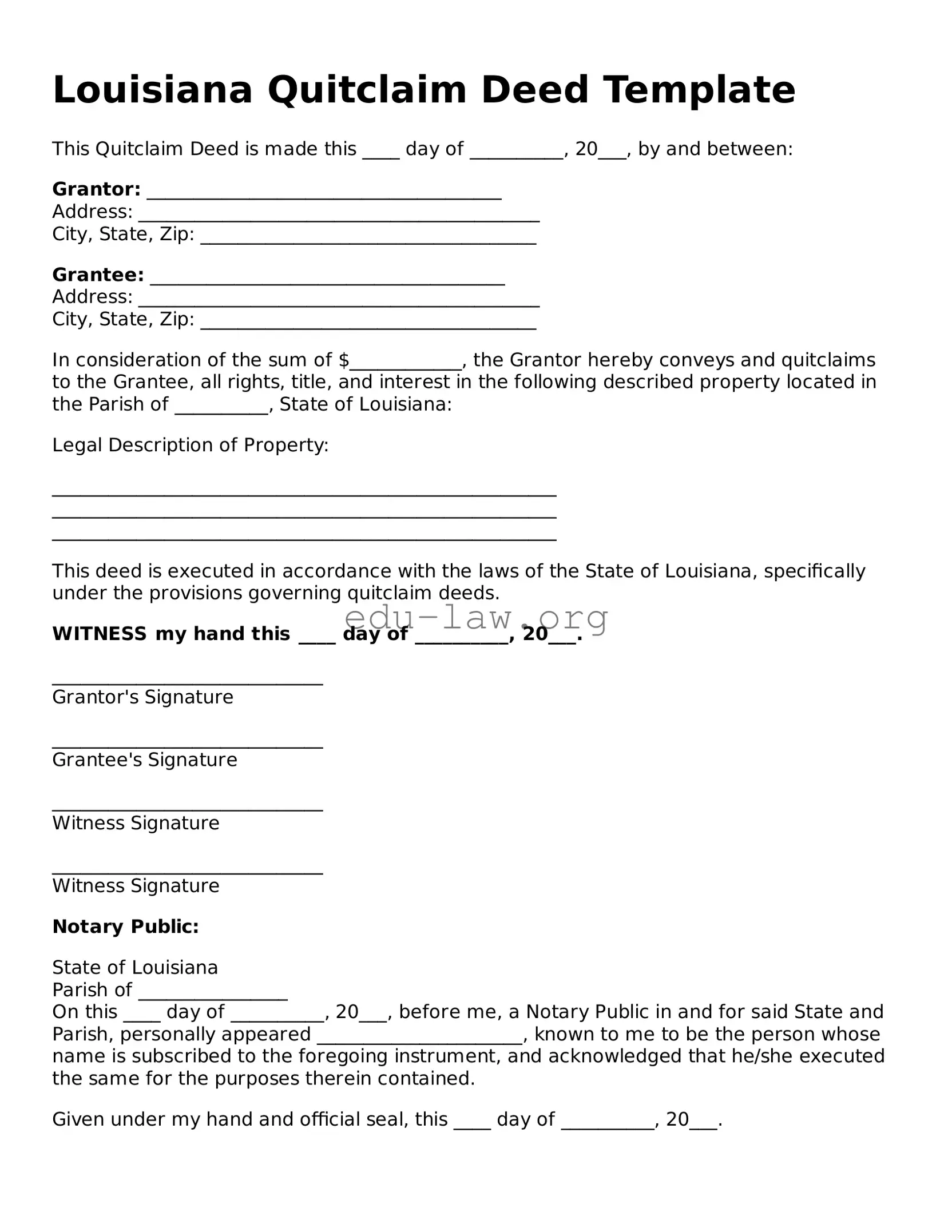
Louisiana Quitclaim Deed Template
This Quitclaim Deed is made this ____ day of __________, 20___, by and between:
Grantor: ______________________________________
Address: ___________________________________________
City, State, Zip: ____________________________________
Grantee: ______________________________________
Address: ___________________________________________
City, State, Zip: ____________________________________
In consideration of the sum of $____________, the Grantor hereby conveys and quitclaims to the Grantee, all rights, title, and interest in the following described property located in the Parish of __________, State of Louisiana:
Legal Description of Property:
______________________________________________________
______________________________________________________
______________________________________________________
This deed is executed in accordance with the laws of the State of Louisiana, specifically under the provisions governing quitclaim deeds.
WITNESS my hand this ____ day of __________, 20___.
_____________________________
Grantor's Signature
_____________________________
Grantee's Signature
_____________________________
Witness Signature
_____________________________
Witness Signature
Notary Public:
State of Louisiana
Parish of ________________
On this ____ day of __________, 20___, before me, a Notary Public in and for said State and Parish, personally appeared ______________________, known to me to be the person whose name is subscribed to the foregoing instrument, and acknowledged that he/she executed the same for the purposes therein contained.
Given under my hand and official seal, this ____ day of __________, 20___.
_____________________________
Notary Public
My commission expires: ________________
| Fact Name | Details |
|---|---|
| Definition | A quitclaim deed is a legal document that transfers ownership interest in a property from one party to another without any warranties. |
| Governing Law | The Louisiana Quitclaim Deed is governed by the Louisiana Civil Code, specifically Articles 2440 to 2460. |
| Use Cases | Commonly used in property transfers between family members, divorce settlements, or to clear up title issues. |
| Requirements | The deed must be in writing, signed by the grantor, and should include a description of the property being transferred. |
| Recording | While not mandatory, it is advisable to record the quitclaim deed with the local parish clerk to provide public notice of the transfer. |
| Limitations | The quitclaim deed does not guarantee that the grantor holds clear title to the property, which can lead to potential disputes. |
After obtaining the Louisiana Quitclaim Deed form, you will need to fill it out accurately to ensure a smooth transfer of property rights. This process involves providing specific information about the property and the parties involved. Follow these steps carefully to complete the form.
What is a Quitclaim Deed in Louisiana?
A Quitclaim Deed is a legal document that transfers ownership of real estate from one person to another without guaranteeing that the property title is clear. In Louisiana, this type of deed is often used between family members or in situations where the parties know each other well. The grantor (the person transferring the property) relinquishes any claim they have to the property, but does not provide any warranties or assurances about the title. This means that if there are issues with the title, the grantee (the person receiving the property) cannot hold the grantor liable.
How do I complete a Quitclaim Deed in Louisiana?
To complete a Quitclaim Deed in Louisiana, you need to gather specific information. This includes the names of the grantor and grantee, a legal description of the property, and the date of the transfer. You must also ensure that the document is signed by the grantor in the presence of a notary public. After signing, the deed must be filed with the local parish clerk of court to be effective. It's important to check with local requirements, as they can vary by parish.
Are there any costs associated with filing a Quitclaim Deed?
Yes, there are costs associated with filing a Quitclaim Deed in Louisiana. These may include notary fees for signing the document and recording fees charged by the parish clerk of court. The recording fees can vary by location, so it’s wise to contact your local clerk’s office for the exact amounts. Additionally, if you are unsure about the process or need assistance, consider consulting a legal professional, which may incur additional costs.
Can a Quitclaim Deed be revoked in Louisiana?
Once a Quitclaim Deed is executed and recorded, it generally cannot be revoked. The transfer of ownership is considered final. However, if there was fraud, coercion, or a mistake in the deed, it may be possible to challenge the deed in court. If you have concerns about a Quitclaim Deed that you have signed or received, it is advisable to seek legal guidance to explore your options.
Not including the correct names of the parties involved. Ensure that the names of both the grantor (the person transferring the property) and the grantee (the person receiving the property) are spelled correctly and match their legal identification.
Failing to provide a complete legal description of the property. The deed must include a detailed description, such as the lot number, subdivision name, and any relevant parcel numbers.
Omitting the date of execution. The date when the deed is signed should be clearly stated to establish when the transfer takes effect.
Not having the deed notarized. A quitclaim deed must be signed in the presence of a notary public to be considered valid. Without notarization, the deed may not be enforceable.
Ignoring state-specific requirements. Each state may have unique rules regarding quitclaim deeds. It is important to verify that all local regulations are followed to avoid complications.
The Louisiana Quitclaim Deed form is a critical document used in property transactions, particularly for transferring ownership rights without guaranteeing clear title. However, several other forms and documents often accompany it to ensure a smooth transfer process. Below is a list of these documents, each serving a specific purpose in the transaction.
Each of these documents plays a vital role in the property transfer process, ensuring that all parties are informed and protected. Proper preparation and understanding of these forms can significantly ease the transaction and prevent potential disputes in the future.
A warranty deed is a document that provides a guarantee from the seller to the buyer regarding the title of the property. In contrast to a quitclaim deed, a warranty deed assures the buyer that the seller holds clear title to the property and has the right to sell it. If any issues arise with the title, the seller is responsible for addressing them. This makes warranty deeds more secure for buyers, as they offer greater protection against potential claims or disputes over ownership.
A special warranty deed is similar to a warranty deed but with a key difference. It only guarantees that the seller has not caused any issues with the title during their ownership. This means that if problems existed before the seller acquired the property, the buyer may not be protected. Special warranty deeds are often used in commercial transactions, where the seller wants to limit their liability while still offering some assurance to the buyer.
A bargain and sale deed transfers property from one party to another without any warranties or guarantees. Like a quitclaim deed, it does not protect the buyer against any potential claims on the title. However, it implies that the seller has some interest in the property. This type of deed is often used in situations where the seller is not willing to provide a warranty but still wants to convey their interest in the property.
A deed of trust is a legal document used in real estate transactions, particularly in financing. It involves three parties: the borrower, the lender, and a trustee. The borrower conveys the property to the trustee, who holds it as security for the loan. While a quitclaim deed transfers ownership, a deed of trust focuses on securing a loan. This document outlines the terms of the loan and the rights of each party involved.
A leasehold deed is a document that grants a tenant the right to use a property for a specified period. Unlike a quitclaim deed, which transfers ownership, a leasehold deed allows the tenant to occupy the property without transferring title. This type of document is common in rental agreements and provides the tenant with certain rights while the landlord retains ownership of the property.
An easement deed allows one party to use another party's property for a specific purpose. This document is not about transferring ownership but rather granting permission for use. For example, a utility company may obtain an easement to run power lines across someone’s land. While a quitclaim deed transfers full ownership, an easement deed maintains the original owner's rights while allowing limited use to another party.
When filling out a Louisiana Quitclaim Deed form, it's essential to approach the task with care. Here are some important dos and don'ts to keep in mind:
Following these guidelines will help ensure that your Quitclaim Deed is completed correctly and is legally valid.
Understanding the Louisiana Quitclaim Deed form can be challenging, especially with the various misconceptions that surround it. Here are ten common misconceptions, along with clarifications to help demystify this important legal document.
A Quitclaim Deed does not guarantee that the person transferring the property actually owns it. Instead, it simply transfers whatever interest the grantor has, if any.
Unlike other types of deeds, a Quitclaim Deed comes with no warranties. This means that the grantee receives no assurance about the title's validity or any claims against it.
While Quitclaim Deeds are often used in family transactions, they can be utilized by anyone. They are suitable for various types of property transfers.
Although this type of deed is common in Louisiana, Quitclaim Deeds are used in many states across the U.S. Each state may have its own specific rules, but the concept remains similar.
Executing a Quitclaim Deed does not remove any existing liens or encumbrances on the property. The new owner may still be responsible for these financial obligations.
While it is highly recommended to have a Quitclaim Deed notarized for validity and to avoid disputes, notarization is not always a legal requirement in every situation.
In reality, a Quitclaim Deed is relatively straightforward. The form typically includes basic information about the parties involved and the property being transferred.
A Quitclaim Deed does not resolve ownership disputes. Instead, it merely transfers whatever interest the grantor has, which may not be sufficient to settle any legal issues.
While Quitclaim Deeds are most commonly associated with real estate, they can also be used for other types of property, such as personal property, depending on state laws.
A Quitclaim Deed can be revoked or challenged in court under certain circumstances. If issues arise, legal remedies may be available to address them.
By clarifying these misconceptions, individuals can better understand the role and implications of a Louisiana Quitclaim Deed in property transactions. It is always advisable to seek legal counsel when dealing with property transfers to ensure that all aspects are handled correctly.
Filling out a Louisiana Quitclaim Deed form can be a straightforward process, but it’s important to keep a few key points in mind to ensure everything goes smoothly. Here are some essential takeaways:
By keeping these points in mind, you can navigate the Quitclaim Deed process with confidence and clarity.