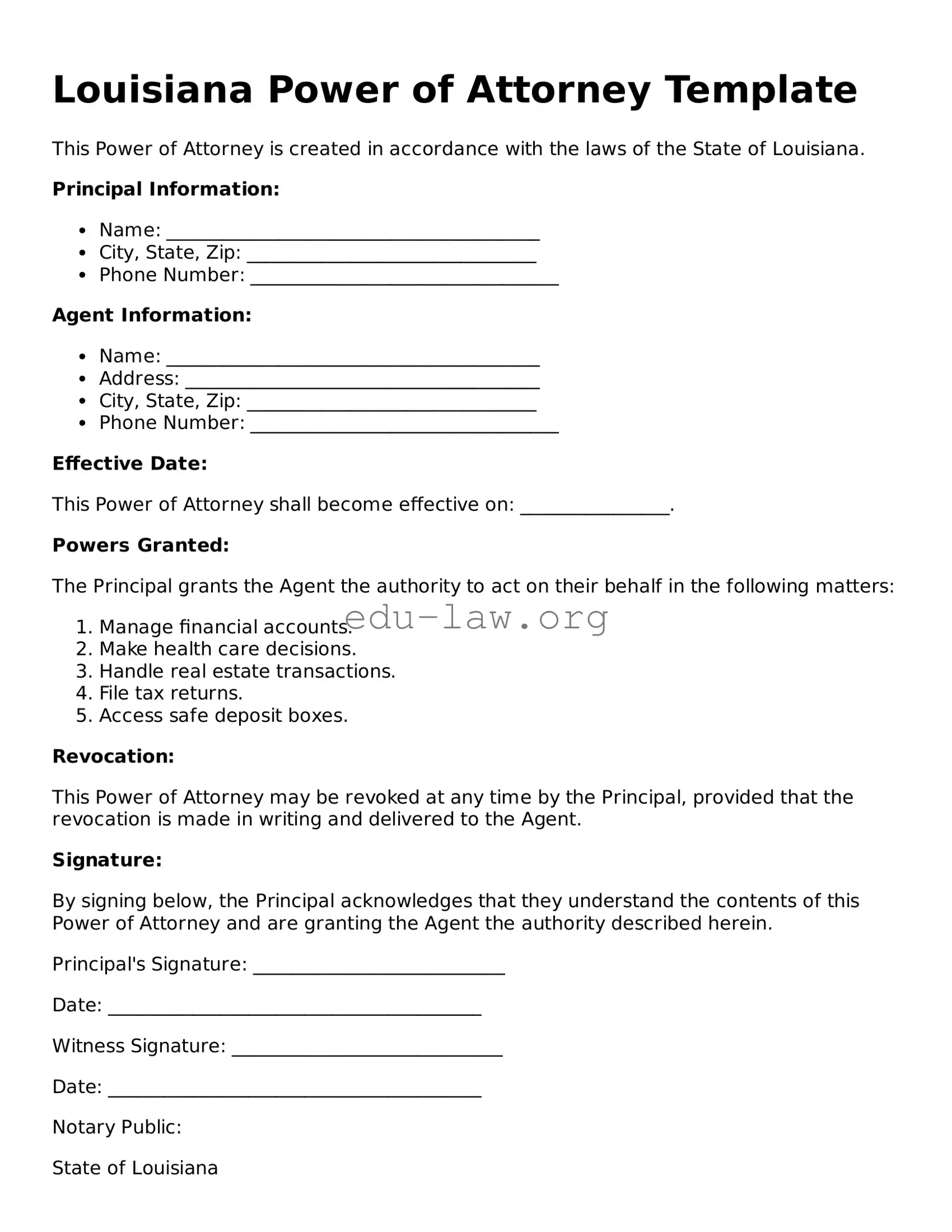
The Louisiana Power of Attorney form serves as a vital legal document that grants an individual, known as the agent or attorney-in-fact, the authority to make decisions on behalf of another person, referred to as the principal. This form is particularly important in situations where the principal may be unable to manage their own affairs due to illness, absence, or incapacity. It covers a wide range of powers, including financial management, property transactions, and health care decisions. In Louisiana, the form must be executed in accordance with specific state laws to ensure its validity. Additionally, the principal can customize the powers granted, allowing for a tailored approach that fits their unique needs. Understanding the nuances of this form is crucial for both the principal and the agent to ensure that the principal's wishes are respected and upheld. Timely completion and proper execution of the Louisiana Power of Attorney form can provide peace of mind and security for individuals facing uncertain circumstances.
Louisiana Power of Attorney Template
This Power of Attorney is created in accordance with the laws of the State of Louisiana.
Principal Information:
Agent Information:
Effective Date:
This Power of Attorney shall become effective on: ________________.
Powers Granted:
The Principal grants the Agent the authority to act on their behalf in the following matters:
Revocation:
This Power of Attorney may be revoked at any time by the Principal, provided that the revocation is made in writing and delivered to the Agent.
Signature:
By signing below, the Principal acknowledges that they understand the contents of this Power of Attorney and are granting the Agent the authority described herein.
Principal's Signature: ___________________________
Date: ________________________________________
Witness Signature: _____________________________
Date: ________________________________________
Notary Public:
State of Louisiana
Parish of ______________________
On this ______ day of ____________, 20__, before me, the undersigned notary public, personally appeared ______________________, known to me to be the person whose name is subscribed to the foregoing instrument, and acknowledged that they executed the same.
Notary Public Signature: ________________________
My Commission Expires: ______________________
| Fact Name | Description |
|---|---|
| Definition | The Louisiana Power of Attorney form allows a person to designate another individual to act on their behalf in legal and financial matters. |
| Governing Law | This form is governed by the Louisiana Civil Code, specifically Articles 2980 to 3020. |
| Types | There are several types of Power of Attorney in Louisiana, including general, durable, and medical. |
| Durability | A durable Power of Attorney remains effective even if the principal becomes incapacitated. |
| Revocation | The principal can revoke the Power of Attorney at any time, as long as they are competent. |
Filling out the Louisiana Power of Attorney form is a straightforward process. After completing the form, you will need to ensure that it is signed, dated, and witnessed as required by state law. This will help ensure that the document is valid and can be used when needed.
Once completed, keep the original document in a safe place and provide copies to your agent and any relevant parties.
What is a Power of Attorney in Louisiana?
A Power of Attorney (POA) in Louisiana is a legal document that allows one person, known as the principal, to grant another person, known as the agent or attorney-in-fact, the authority to make decisions on their behalf. This authority can be broad or limited, depending on the specific terms outlined in the document. It is often used for financial matters, healthcare decisions, or other personal affairs when the principal is unable to act for themselves.
What are the different types of Power of Attorney available in Louisiana?
In Louisiana, there are several types of Power of Attorney. The most common include:
How do I create a Power of Attorney in Louisiana?
To create a Power of Attorney in Louisiana, the principal must complete a written document that clearly states the powers being granted to the agent. The document must be signed by the principal in the presence of a notary public. It is advisable to include specific details regarding the powers granted and any limitations. Additionally, the agent should be informed of their responsibilities. While it is not legally required to file the document with a court, doing so can help ensure its validity and provide a public record.
Can I revoke a Power of Attorney in Louisiana?
Yes, a Power of Attorney can be revoked in Louisiana at any time, as long as the principal is competent to make that decision. To revoke the POA, the principal should create a written revocation document, sign it, and notify the agent. It is also advisable to inform any institutions or individuals who were relying on the Power of Attorney. This ensures that the revocation is recognized and prevents the agent from acting on behalf of the principal after the revocation.
What happens if the principal becomes incapacitated?
If the principal becomes incapacitated, the type of Power of Attorney determines the next steps. A Durable Power of Attorney remains effective during incapacity, allowing the agent to continue making decisions on behalf of the principal. Conversely, a General Power of Attorney would become invalid upon the principal's incapacitation. Therefore, it is crucial to consider the implications of incapacity when creating a Power of Attorney and to choose the appropriate type based on potential future needs.
Not Specifying Powers Clearly: Individuals often fail to clearly outline the specific powers granted to the agent. This can lead to confusion about what decisions the agent can make on behalf of the principal.
Omitting Necessary Signatures: It is crucial that all required signatures are included. Many people forget to sign the document themselves or neglect to have it notarized, which can invalidate the form.
Failing to Update the Document: Life circumstances change, and so do the needs for a Power of Attorney. Some individuals do not update their form when significant life events occur, such as marriage, divorce, or the birth of a child.
Choosing the Wrong Agent: Selecting an agent who may not act in the principal's best interest can lead to serious issues. It is essential to choose someone trustworthy and capable of managing the responsibilities involved.
When creating a Power of Attorney (POA) in Louisiana, it's important to consider additional documents that may complement or be necessary alongside the POA. These documents can help clarify your intentions and ensure that your affairs are managed according to your wishes. Below is a list of commonly used forms and documents that often accompany a Louisiana Power of Attorney.
These documents serve different purposes but can work together to create a comprehensive plan for managing your health and finances. It's advisable to consult with a legal expert to ensure that all documents are properly executed and aligned with your wishes.
The Louisiana Power of Attorney form shares similarities with the Advance Healthcare Directive. Both documents allow individuals to designate someone to make decisions on their behalf. While the Power of Attorney typically covers financial and legal matters, the Advance Healthcare Directive focuses on medical decisions. This ensures that a person's healthcare preferences are honored when they are unable to communicate those wishes themselves. Both forms empower individuals to choose trusted representatives, providing peace of mind in times of uncertainty.
Another document akin to the Louisiana Power of Attorney is the Living Will. This legal document outlines a person's wishes regarding medical treatment in situations where they cannot express their preferences. Like the Power of Attorney, a Living Will allows individuals to take control of their healthcare decisions. However, it is more specific to end-of-life care and does not appoint an agent to make decisions. Both documents work together to ensure that a person's values and desires are respected during critical moments.
The Health Care Proxy is also similar to the Louisiana Power of Attorney. This document enables individuals to appoint someone to make healthcare decisions on their behalf if they become incapacitated. The key difference lies in its focus solely on medical choices, whereas the Power of Attorney can encompass a broader range of financial and legal matters. Both documents emphasize the importance of having a trusted person in place to advocate for an individual's wishes when they cannot do so themselves.
Lastly, the Durable Power of Attorney is closely related to the Louisiana Power of Attorney. While the general Power of Attorney may become invalid if the person becomes incapacitated, a Durable Power of Attorney remains effective in such situations. This ensures that the designated agent can continue to manage financial and legal matters without interruption. Both documents serve to protect individuals' interests and provide a clear plan for handling their affairs, even in challenging circumstances.
When filling out the Louisiana Power of Attorney form, it's important to follow certain guidelines to ensure everything is completed correctly. Here’s a list of things you should and shouldn’t do:
Understanding the Louisiana Power of Attorney form is crucial for making informed decisions. However, several misconceptions can lead to confusion. Here are four common misconceptions:
Many people believe that a Power of Attorney (POA) in Louisiana is only for financial decisions. In reality, a POA can cover various areas, including health care and legal matters. The scope depends on how the document is drafted.
Some think that once a Power of Attorney is created, it cannot be changed or revoked. This is not true. As long as the principal is mentally competent, they can revoke or alter the POA at any time.
While legal assistance can be helpful, it is not mandatory. Individuals can create a POA on their own, provided they follow Louisiana’s requirements. However, seeking legal advice can ensure that the document meets specific needs.
This misconception overlooks the fact that there are different types of POAs. A general POA grants broad powers, while a limited POA restricts authority to specific tasks. Understanding the differences is essential for choosing the right type.
When considering the Louisiana Power of Attorney form, it is essential to understand its significance and the responsibilities it entails. Here are some key takeaways: