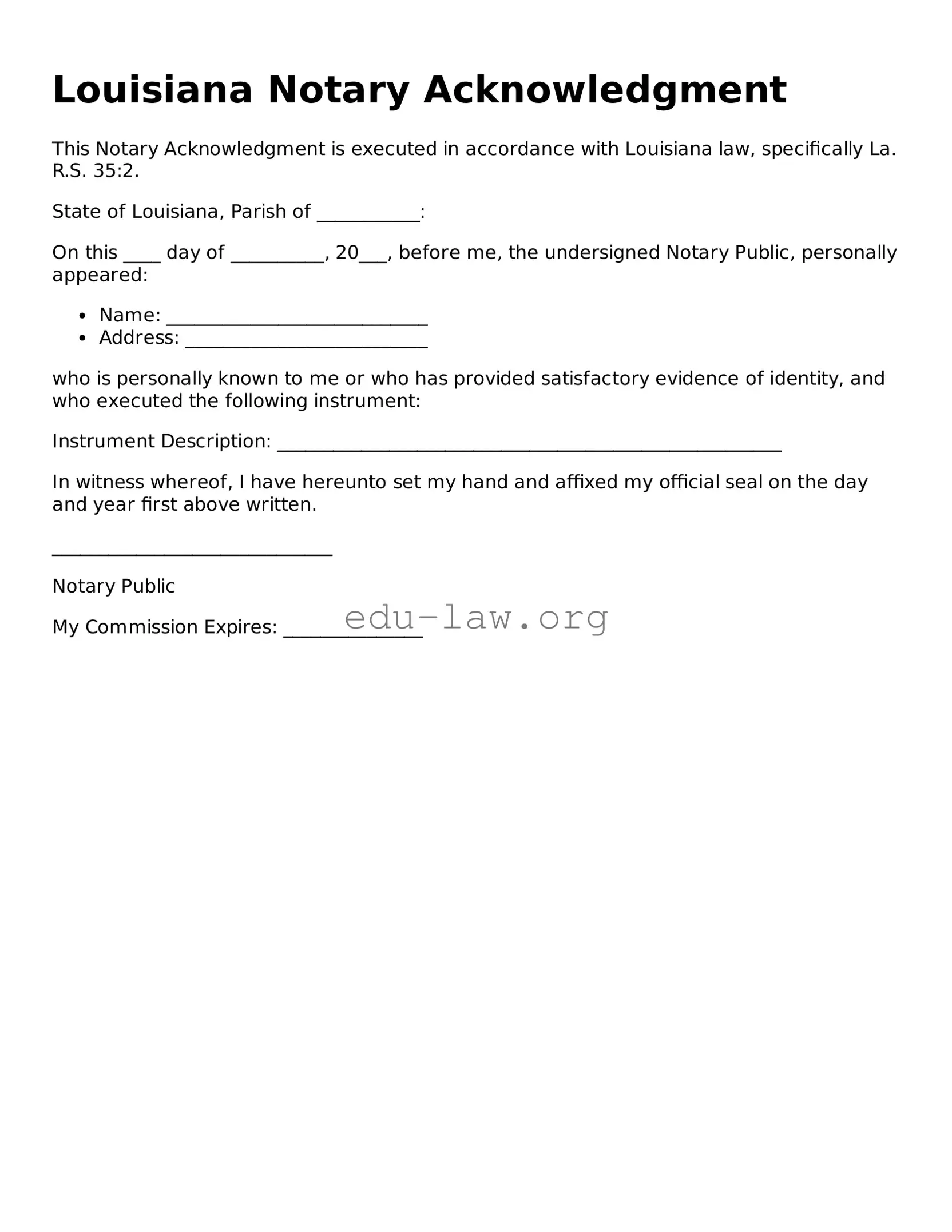
The Louisiana Notary Acknowledgement form plays a crucial role in various legal transactions throughout the state. This form serves as a written declaration that a specific individual has appeared before a notary public, affirming their identity and willingness to sign a document. It is often used in real estate transactions, powers of attorney, and other legal documents where verification of the signer's identity is essential. The notary public, a trusted official, verifies the identity of the signer and ensures that they are signing voluntarily and without coercion. This process helps to prevent fraud and provides a layer of security for all parties involved. Understanding how to properly complete and utilize this form is important for anyone engaged in legal dealings in Louisiana, as it helps ensure that documents are legally binding and recognized by the state.
Louisiana Notary Acknowledgment
This Notary Acknowledgment is executed in accordance with Louisiana law, specifically La. R.S. 35:2.
State of Louisiana, Parish of ___________:
On this ____ day of __________, 20___, before me, the undersigned Notary Public, personally appeared:
who is personally known to me or who has provided satisfactory evidence of identity, and who executed the following instrument:
Instrument Description: ______________________________________________________
In witness whereof, I have hereunto set my hand and affixed my official seal on the day and year first above written.
______________________________
Notary Public
My Commission Expires: _______________
| Fact Name | Details |
|---|---|
| Purpose | The Louisiana Notary Acknowledgement form is used to verify the identity of a signer and their willingness to sign a document. |
| Governing Law | This form is governed by Louisiana Civil Code Article 2992, which outlines notarial acts and their requirements. |
| Signature Requirement | The form must be signed in the presence of a notary public, who will then provide their official seal. |
| Record Keeping | Notaries in Louisiana are required to maintain a record of all acknowledgments performed, ensuring accountability and transparency. |
After you have gathered the necessary information, you can begin filling out the Louisiana Notary Acknowledgement form. This form will require you to provide specific details about the person acknowledging their signature and the notary public who will be witnessing the acknowledgment.
Once you have completed these steps, review the form to ensure all information is accurate and legible. After that, the form is ready for submission or filing as required.
What is a Louisiana Notary Acknowledgement form?
The Louisiana Notary Acknowledgement form is a legal document used to verify that a person has signed a document willingly and in the presence of a notary public. This form serves as proof that the signer has been properly identified and that they understand the contents of the document they are signing. It is often required for documents such as deeds, contracts, and other legal agreements to ensure their validity.
When do I need to use a Notary Acknowledgement form?
You will need to use a Notary Acknowledgement form whenever you are signing a document that requires notarization. This is particularly important for legal documents that may need to be recorded or presented in court. Examples include property deeds, wills, and powers of attorney. Always check if the specific document you are working with requires notarization to ensure compliance with Louisiana law.
Who can serve as a notary public in Louisiana?
In Louisiana, a notary public must be a resident of the state and at least 18 years old. They must also complete a notary training course and pass an examination. Notaries can be appointed by the governor or can be elected in certain parishes. It is important to choose a qualified notary to ensure that your document is properly acknowledged.
What information is required on the Notary Acknowledgement form?
The Notary Acknowledgement form typically requires the name of the signer, the date of signing, and a statement affirming that the signer appeared before the notary and acknowledged their signature. Additionally, the notary will need to include their name, signature, and seal. This information helps to confirm the authenticity of the document and the identity of the signer.
Is there a fee for notarization in Louisiana?
Yes, notaries in Louisiana are allowed to charge a fee for their services. The maximum fee is set by state law and can vary depending on the type of document being notarized. It is advisable to ask the notary about their fees beforehand to avoid any surprises. Some notaries may offer their services for free, especially if they are part of a larger organization or community service program.
How do I find a notary public in Louisiana?
You can find a notary public in Louisiana through various means. Many banks and law offices offer notary services. You can also search online directories or contact your local parish clerk's office for a list of notaries in your area. It's a good idea to check the notary's credentials and confirm their availability before scheduling an appointment.
Incorrect Name or Title: People often write their name incorrectly or use a title that does not match their legal identity. This can lead to confusion and invalidate the document.
Missing Signatures: Some individuals forget to sign the form. Without a signature, the acknowledgment is incomplete and cannot be processed.
Improper Date: It is common to see mistakes with the date. Filling in the wrong date or leaving it blank can cause delays or complications.
Failure to Provide Identification: Notaries require proper identification. Individuals sometimes neglect to bring valid ID, which is essential for the acknowledgment process.
In the state of Louisiana, the Notary Acknowledgment form is often used in conjunction with various other legal documents. Each of these forms serves a unique purpose, ensuring that transactions and agreements are legally binding and properly executed. Below is a list of documents that are frequently associated with the Notary Acknowledgment form.
Each of these documents plays a critical role in various legal processes and transactions. By understanding their purposes and the importance of notarization, individuals can navigate legal requirements with greater confidence.
The Affidavit is a sworn statement made in writing. It is often used in legal proceedings to affirm the truth of certain facts. Like the Louisiana Notary Acknowledgement form, an affidavit requires the signature of a notary public. This ensures that the person making the affidavit is who they claim to be and that they are making the statement voluntarily. The notary's role adds an extra layer of authenticity, similar to the acknowledgment process in Louisiana.
A Power of Attorney document grants someone the authority to act on behalf of another person. In many cases, this document must be notarized to be valid. Just as the Louisiana Notary Acknowledgement form verifies the identity of the signer, a notarized Power of Attorney confirms that the person giving authority understands the implications of their decision. Both documents require the presence of a notary to ensure the integrity of the signatures involved.
The Deed is a legal document that conveys property ownership. When a deed is executed, it typically requires notarization to be enforceable. The Louisiana Notary Acknowledgement form serves a similar purpose by verifying the identities of the parties involved in the transaction. Both documents help prevent fraud and ensure that the transfer of property is legitimate and acknowledged by a notary.
The Certification of Identity is a document used to verify a person's identity for various purposes, such as opening a bank account or applying for a loan. Similar to the Louisiana Notary Acknowledgement form, this certification often requires a notary's signature. The notary's role in both documents is to ensure that the individual presenting the document is indeed who they say they are, adding credibility to the process.
A Trust Agreement outlines how a person's assets will be managed during their lifetime and after their death. When creating a trust, it is common to have the document notarized. This is akin to the Louisiana Notary Acknowledgement form, which serves to verify the identities of the individuals involved. Both documents provide assurance that the terms and intentions are clearly understood and agreed upon by all parties.
The Marriage License Application is a document that couples submit to obtain a marriage license. In many jurisdictions, this application must be notarized to confirm the identities of the applicants. The Louisiana Notary Acknowledgement form performs a similar function by ensuring that the signatures are authentic and that the individuals are entering into the agreement willingly. Both processes help to prevent fraudulent applications and ensure legal compliance.
A Lease Agreement is a contract between a landlord and a tenant outlining the terms of renting a property. While not always required to be notarized, having a lease notarized can provide additional security for both parties. The Louisiana Notary Acknowledgement form serves a comparable purpose by verifying the identities of those signing the lease. This can help protect against disputes regarding the agreement and ensure that both parties are committed to the terms outlined in the document.
When filling out the Louisiana Notary Acknowledgement form, it's important to follow specific guidelines to ensure accuracy and compliance. Here are five things you should and shouldn't do:
Understanding the Louisiana Notary Acknowledgement form is crucial for anyone involved in legal transactions in the state. However, several misconceptions can lead to confusion. Here are five common misconceptions:
Being aware of these misconceptions can help individuals navigate legal processes more effectively. Understanding the true nature of the Louisiana Notary Acknowledgement form is essential for ensuring compliance and avoiding potential legal issues.
Filling out and using the Louisiana Notary Acknowledgement form requires attention to detail. Here are some key takeaways to consider: