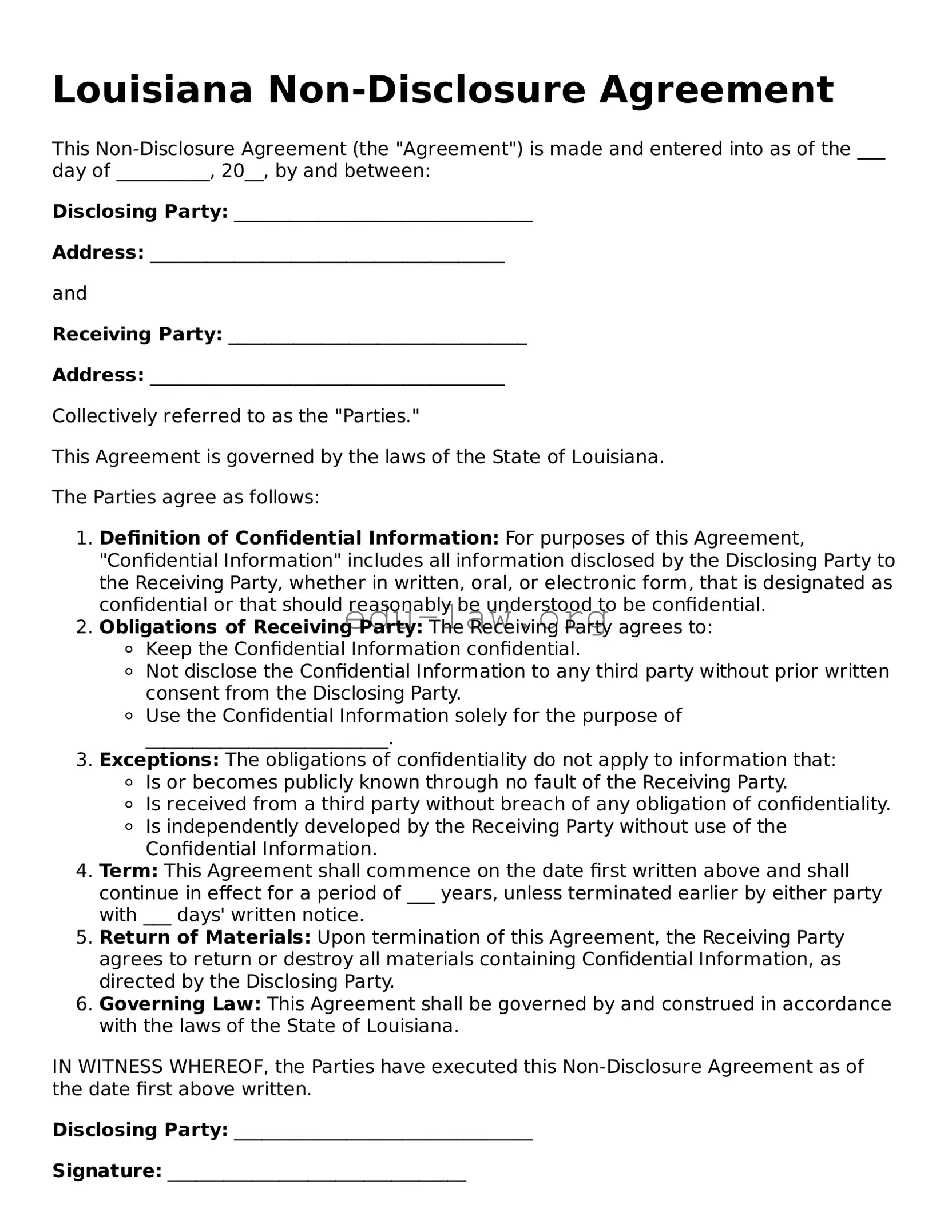
The Louisiana Non-disclosure Agreement (NDA) form serves as a crucial legal tool for individuals and businesses seeking to protect sensitive information. By establishing a formal understanding between parties, this document helps prevent the unauthorized sharing of proprietary data, trade secrets, or confidential business practices. Key elements of the NDA include the definition of what constitutes confidential information, the obligations of the parties involved, and the duration of the confidentiality obligation. Additionally, the form outlines the consequences of a breach, ensuring that all parties are aware of the potential legal ramifications. With its clear structure and defined terms, the Louisiana NDA fosters trust and transparency, enabling collaboration while safeguarding vital information. Understanding the nuances of this agreement is essential for anyone looking to engage in business relationships in Louisiana, as it not only protects intellectual property but also upholds the integrity of professional interactions.
Louisiana Non-Disclosure Agreement
This Non-Disclosure Agreement (the "Agreement") is made and entered into as of the ___ day of __________, 20__, by and between:
Disclosing Party: ________________________________
Address: ______________________________________
and
Receiving Party: ________________________________
Address: ______________________________________
Collectively referred to as the "Parties."
This Agreement is governed by the laws of the State of Louisiana.
The Parties agree as follows:
IN WITNESS WHEREOF, the Parties have executed this Non-Disclosure Agreement as of the date first above written.
Disclosing Party: ________________________________
Signature: ________________________________
Date: ________________________________
Receiving Party: ________________________________
Signature: ________________________________
Date: ________________________________
| Fact Name | Description |
|---|---|
| Purpose | A Louisiana Non-disclosure Agreement (NDA) protects confidential information shared between parties. |
| Governing Law | The NDA is governed by Louisiana state law, particularly the Louisiana Civil Code. |
| Parties Involved | The agreement typically involves at least two parties: a disclosing party and a receiving party. |
| Duration | The duration of confidentiality can vary, but it is commonly set for a specific time period, often 2-5 years. |
| Enforceability | Louisiana courts will enforce NDAs as long as they are reasonable in scope and duration. |
| Exceptions | Common exceptions to confidentiality include information that is publicly available or independently developed. |
After obtaining the Louisiana Non-disclosure Agreement form, you will need to fill it out accurately to ensure that all necessary information is provided. Completing this form is an important step in establishing confidentiality between the parties involved.
What is a Louisiana Non-disclosure Agreement (NDA)?
A Louisiana Non-disclosure Agreement is a legal contract that protects confidential information shared between parties. It ensures that sensitive information, such as trade secrets, business plans, or proprietary data, is not disclosed to unauthorized individuals or entities. This agreement is crucial for businesses that need to share confidential information while maintaining privacy and security.
Who should use a Louisiana NDA?
Any individual or business that plans to share confidential information with another party should consider using a Louisiana NDA. This includes entrepreneurs, companies seeking partnerships, and organizations sharing sensitive information with employees or contractors. It is particularly important in industries where intellectual property and trade secrets play a significant role.
What are the key components of a Louisiana NDA?
A Louisiana NDA typically includes several essential components: the definition of confidential information, the obligations of the receiving party, the duration of confidentiality, and any exclusions from confidentiality. Additionally, it may specify the consequences of a breach and the governing law, which in this case would be Louisiana law.
How long does the confidentiality obligation last?
The duration of the confidentiality obligation can vary depending on the agreement. Generally, it lasts for a specified period, often ranging from one to five years. However, some agreements may stipulate that certain information remains confidential indefinitely, especially if it pertains to trade secrets.
Can a Louisiana NDA be modified?
Yes, a Louisiana NDA can be modified. Both parties must agree to any changes in writing. It is essential to document any modifications to ensure clarity and maintain the enforceability of the agreement. Parties should review the NDA regularly to ensure it still meets their needs.
What happens if someone breaches the NDA?
If a party breaches the NDA, the non-breaching party may seek legal remedies. This can include monetary damages, injunctive relief to prevent further disclosures, or specific performance to enforce the terms of the agreement. The consequences of a breach will depend on the specific terms outlined in the NDA.
Is it necessary to have a lawyer review a Louisiana NDA?
While it is not legally required to have a lawyer review a Louisiana NDA, it is highly recommended. A legal professional can ensure that the agreement is comprehensive, enforceable, and tailored to the specific needs of the parties involved. This step can help prevent misunderstandings and potential disputes in the future.
Inadequate Identification of Parties: One common mistake is failing to clearly identify all parties involved in the agreement. It is crucial to specify who is disclosing confidential information and who is receiving it. Ambiguities can lead to misunderstandings and potential legal disputes.
Vague Definition of Confidential Information: Another frequent error is not providing a precise definition of what constitutes confidential information. Without clarity, the agreement may not effectively protect sensitive data. It is important to outline specific types of information that are considered confidential.
Omitting Duration of Confidentiality: Many individuals neglect to specify how long the confidentiality obligations will last. An indefinite period can be unreasonable, while a period that is too short may not offer adequate protection. Clearly stating the duration helps manage expectations.
Ignoring Exceptions to Confidentiality: Failing to include exceptions can create problems later on. It is essential to outline circumstances under which confidential information can be disclosed, such as legal requirements or prior knowledge. This helps prevent unnecessary breaches of the agreement.
Not Seeking Legal Review: Lastly, many people fill out the Non-disclosure Agreement without consulting a legal professional. This oversight can lead to poorly drafted agreements that do not hold up in court. Seeking legal advice ensures that the document is comprehensive and enforceable.
When entering into a Non-disclosure Agreement (NDA) in Louisiana, several other documents may also be needed to ensure clarity and protection for all parties involved. These documents can help outline the terms of the agreement, establish expectations, and provide a framework for any potential disputes. Below are some commonly used forms that complement the NDA.
These documents work together to create a comprehensive approach to confidentiality and protection of sensitive information. It is essential to consider each one carefully to ensure that all parties are on the same page and that their interests are adequately safeguarded.
A Confidentiality Agreement, often used interchangeably with a Non-disclosure Agreement (NDA), serves a similar purpose. Both documents protect sensitive information shared between parties. A Confidentiality Agreement may be broader in scope, covering not just trade secrets but also proprietary information, business strategies, and client lists. This document is essential in various contexts, including employment relationships and business partnerships, ensuring that all parties understand their obligation to keep information private.
A Non-compete Agreement shares some characteristics with an NDA, particularly in the realm of business. While an NDA focuses on confidentiality, a Non-compete Agreement restricts an individual from engaging in business activities that directly compete with their employer or a specific business for a defined period and within a certain geographic area. Both documents aim to protect a business’s interests, but they do so in different ways—one by safeguarding information and the other by limiting competition.
An Employment Agreement often includes elements similar to a Non-disclosure Agreement. This document outlines the terms of employment, including job responsibilities, compensation, and confidentiality clauses. Employers frequently incorporate NDA provisions within Employment Agreements to ensure that employees are legally bound to protect sensitive information they may encounter during their tenure. This integration helps to maintain a secure environment for proprietary business data.
When filling out the Louisiana Non-disclosure Agreement form, it is crucial to follow specific guidelines to ensure the document is valid and effective. Here are four things to consider:
There are many misconceptions about the Louisiana Non-disclosure Agreement (NDA) form. Understanding these can help individuals and businesses protect their confidential information more effectively. Here’s a list of ten common misconceptions:
Being aware of these misconceptions can help you navigate the world of NDAs more effectively. Always consider seeking advice from a professional when drafting or signing an NDA.
When dealing with sensitive information in Louisiana, a Non-disclosure Agreement (NDA) can be a vital tool. Here are some key takeaways to consider when filling out and using this form:
Using an NDA properly can safeguard your interests and foster trust in business relationships.