In Louisiana, the Medical Power of Attorney form serves as a vital tool for individuals seeking to ensure their healthcare preferences are honored when they cannot communicate their wishes. This legal document allows a person, known as the principal, to designate a trusted individual, referred to as the agent, to make medical decisions on their behalf. The form covers a range of important aspects, including the authority granted to the agent, the specific types of medical treatments the principal wishes to accept or refuse, and any limitations on the agent's powers. Additionally, it provides guidance on how the agent should act in line with the principal's values and preferences. By establishing clear directives, this form helps to alleviate the burden on family members during challenging times, ensuring that healthcare decisions align with the principal's desires. Understanding the nuances of this document is essential for anyone considering its use, as it plays a crucial role in navigating complex medical situations.
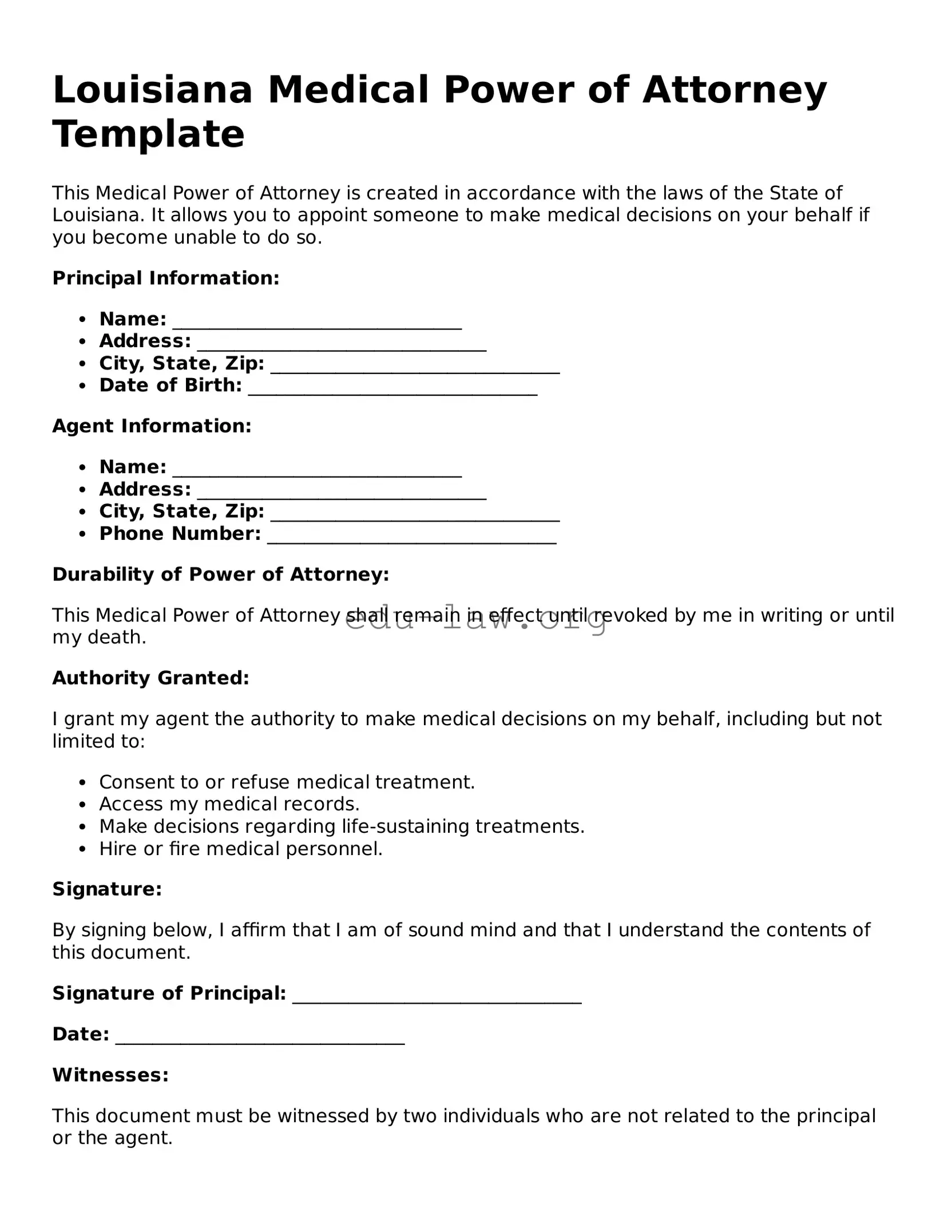
Louisiana Medical Power of Attorney Template
This Medical Power of Attorney is created in accordance with the laws of the State of Louisiana. It allows you to appoint someone to make medical decisions on your behalf if you become unable to do so.
Principal Information:
Agent Information:
Durability of Power of Attorney:
This Medical Power of Attorney shall remain in effect until revoked by me in writing or until my death.
Authority Granted:
I grant my agent the authority to make medical decisions on my behalf, including but not limited to:
Signature:
By signing below, I affirm that I am of sound mind and that I understand the contents of this document.
Signature of Principal: _______________________________
Date: _______________________________
Witnesses:
This document must be witnessed by two individuals who are not related to the principal or the agent.
This document is intended to serve as a guide. It is advisable to consult with a legal professional to ensure that it meets all legal requirements specific to your situation.
| Fact Name | Description |
|---|---|
| Definition | A Louisiana Medical Power of Attorney allows an individual to designate someone to make healthcare decisions on their behalf if they become unable to do so. |
| Governing Law | This form is governed by Louisiana Revised Statutes, Title 40, Chapter 11, which outlines the laws regarding advance healthcare directives. |
| Eligibility | Any adult resident of Louisiana can create a Medical Power of Attorney, provided they are of sound mind. |
| Agent Requirements | The chosen agent must be at least 18 years old and cannot be the patient's healthcare provider or an employee of the healthcare provider unless they are related. |
| Signing Requirements | The form must be signed by the principal in the presence of two witnesses or a notary public to be valid. |
| Revocation | The principal can revoke the Medical Power of Attorney at any time, as long as they are of sound mind. |
| Durability | This document remains effective even if the principal becomes incapacitated, ensuring continuous decision-making authority for the agent. |
Filling out the Louisiana Medical Power of Attorney form is an important step in ensuring that your healthcare preferences are respected. Once you have the form completed, you will need to sign it in the presence of a notary or two witnesses to make it legally valid.
What is a Louisiana Medical Power of Attorney?
A Louisiana Medical Power of Attorney is a legal document that allows you to appoint someone to make medical decisions on your behalf if you become unable to do so. This person, known as your agent or proxy, will have the authority to make choices about your medical treatment, including life-sustaining measures, based on your wishes and best interests.
Who can be appointed as my agent in a Medical Power of Attorney?
You can choose any competent adult to be your agent. This can be a family member, friend, or trusted advisor. It's essential to select someone who understands your values and wishes regarding medical treatment. Keep in mind that your agent should be someone you trust to make decisions that align with your preferences.
How do I create a Medical Power of Attorney in Louisiana?
To create a Medical Power of Attorney in Louisiana, you must fill out the appropriate form, which can often be found online or through legal resources. After completing the form, you need to sign it in front of a notary public or two witnesses. It’s important to ensure that your chosen agent also understands their role and responsibilities. Once executed, provide copies to your agent, healthcare providers, and keep one for your records.
Can I change or revoke my Medical Power of Attorney?
Yes, you can change or revoke your Medical Power of Attorney at any time, as long as you are mentally competent. To revoke it, you should inform your agent and any healthcare providers who have a copy of the document. You may also want to create a new Medical Power of Attorney to replace the old one if you are making changes. Always ensure that your wishes are clearly communicated to avoid any confusion.
Not selecting the right agent. It is important to choose someone trustworthy and capable of making medical decisions on your behalf.
Failing to discuss your wishes with the chosen agent. Open communication helps ensure that your preferences are understood and respected.
Leaving the form unsigned or undated. A signature and date are essential for the document to be valid.
Not providing copies to relevant parties. Share the completed form with your agent, healthcare providers, and family members.
Using outdated forms. Always check to ensure you are using the most current version of the Louisiana Medical Power of Attorney form.
Overlooking state-specific requirements. Each state may have unique rules regarding medical powers of attorney, so it is important to follow Louisiana's specific guidelines.
Neglecting to revoke previous powers of attorney. If you create a new document, make sure to formally revoke any prior ones to avoid confusion.
Not considering alternate agents. It is wise to name a backup agent in case your primary choice is unable or unwilling to act.
When establishing a Louisiana Medical Power of Attorney, it's important to consider other related documents that may complement or enhance your healthcare planning. These documents help clarify your wishes and ensure that your preferences are respected in various situations. Below is a list of forms and documents commonly used alongside a Medical Power of Attorney.
By considering these documents in conjunction with your Louisiana Medical Power of Attorney, you can create a more comprehensive plan for your healthcare and ensure that your wishes are respected in all situations. Each document plays a unique role in your overall healthcare strategy, making it essential to understand their purposes and how they work together.
The Louisiana Medical Power of Attorney (MPOA) is a vital document that allows individuals to designate someone to make medical decisions on their behalf if they become incapacitated. Similar to the MPOA, a Durable Power of Attorney (DPOA) grants authority to an agent to handle financial and legal matters. While the MPOA focuses specifically on healthcare decisions, the DPOA can cover a broader range of responsibilities, ensuring that an individual's financial affairs are managed even when they are unable to do so themselves.
A Healthcare Proxy is another document akin to the MPOA. This form allows individuals to appoint someone to make healthcare decisions for them, but it may not include the same level of detail regarding medical treatment preferences. The Healthcare Proxy is often used in conjunction with the MPOA to ensure that both medical and personal wishes are respected in various situations.
The Living Will is another document that complements the MPOA. It provides clear instructions about an individual's wishes concerning end-of-life care and medical treatment in situations where they cannot communicate their preferences. While the MPOA designates a person to make decisions, the Living Will articulates the specific types of treatments an individual does or does not want, serving as a guide for both the agent and healthcare providers.
A Do Not Resuscitate (DNR) order is also relevant in the context of medical decision-making. This document explicitly states that an individual does not wish to receive CPR or other life-saving measures in the event of cardiac arrest. While it serves a different function than the MPOA, it is an important tool for ensuring that an individual's wishes regarding emergency medical interventions are respected, particularly in conjunction with the MPOA.
The Guardianship document is another important legal instrument. It is used when an individual is deemed unable to make decisions for themselves due to incapacity. Unlike the MPOA, which allows individuals to choose their agent while they are still competent, a Guardianship is often established through a court process and may involve ongoing oversight. This document can be critical in ensuring that the personal and medical decisions of an incapacitated individual are made in their best interest.
The Mental Health Power of Attorney is a specialized form similar to the MPOA, but it specifically addresses mental health decisions. This document allows individuals to appoint someone to make decisions related to mental health treatment, including hospitalization and medication. Given the unique considerations involved in mental health care, this document ensures that an agent can advocate effectively for the individual’s needs in this specific context.
Finally, the Physician Orders for Life-Sustaining Treatment (POLST) form serves a distinct yet complementary role. While the MPOA designates an agent to make decisions, the POLST translates an individual’s treatment preferences into actionable medical orders. This form is particularly useful for individuals with serious illnesses, ensuring that their wishes regarding life-sustaining treatment are clearly communicated and respected by healthcare providers in emergency situations.
Filling out a Medical Power of Attorney form in Louisiana is an important step in ensuring your healthcare preferences are honored. Here are some key do's and don'ts to keep in mind during this process.
Understanding the Louisiana Medical Power of Attorney form is crucial for making informed healthcare decisions. However, several misconceptions exist that can lead to confusion. Here are ten common misunderstandings:
Many believe that a Medical Power of Attorney is only relevant when a person is nearing death. In reality, it can be used for any medical decision when the individual is unable to communicate their wishes.
Some think they can choose anyone as their healthcare agent. However, Louisiana law requires that the agent be an adult and capable of making healthcare decisions.
A Medical Power of Attorney and a living will serve different purposes. The former designates someone to make decisions, while the latter outlines specific wishes regarding medical treatment.
While notarization is beneficial, it is not a strict requirement in Louisiana. The form can be valid if signed by two witnesses who meet specific criteria.
People often think that once a Medical Power of Attorney is established, it cannot be altered. In fact, individuals can revoke or update their form at any time, as long as they are competent.
Some assume that a Louisiana Medical Power of Attorney is only valid within the state. However, it may be recognized in other states, depending on local laws.
This form specifically addresses medical decisions. For financial matters, a separate financial power of attorney is needed.
Many think that only seniors need a Medical Power of Attorney. However, anyone can benefit from having one, regardless of age, especially in unexpected situations.
While discussing wishes verbally is important, a Medical Power of Attorney must be documented in writing to be legally binding.
Some believe that after signing the document, discussions about healthcare preferences are over. In reality, ongoing conversations about wishes and values are essential.
When considering the Louisiana Medical Power of Attorney form, it's important to understand its purpose and how to effectively fill it out. Here are some key takeaways to keep in mind:
By keeping these points in mind, you can ensure that your Medical Power of Attorney is effective and aligns with your healthcare preferences.