Creating a Last Will and Testament is an essential step in ensuring that your wishes are honored after you pass away. In Louisiana, this legal document outlines how your assets will be distributed and who will take care of your dependents. The Louisiana Last Will and Testament form serves as a guide, helping you specify your beneficiaries, appoint an executor to manage your estate, and detail any specific bequests you wish to make. Additionally, it allows you to address guardianship for minor children, ensuring their care aligns with your values and preferences. Understanding the nuances of this form can empower you to make informed decisions about your legacy. From the importance of signatures and witnesses to the implications of revoking previous wills, each aspect plays a crucial role in crafting a valid and effective will that reflects your intentions.
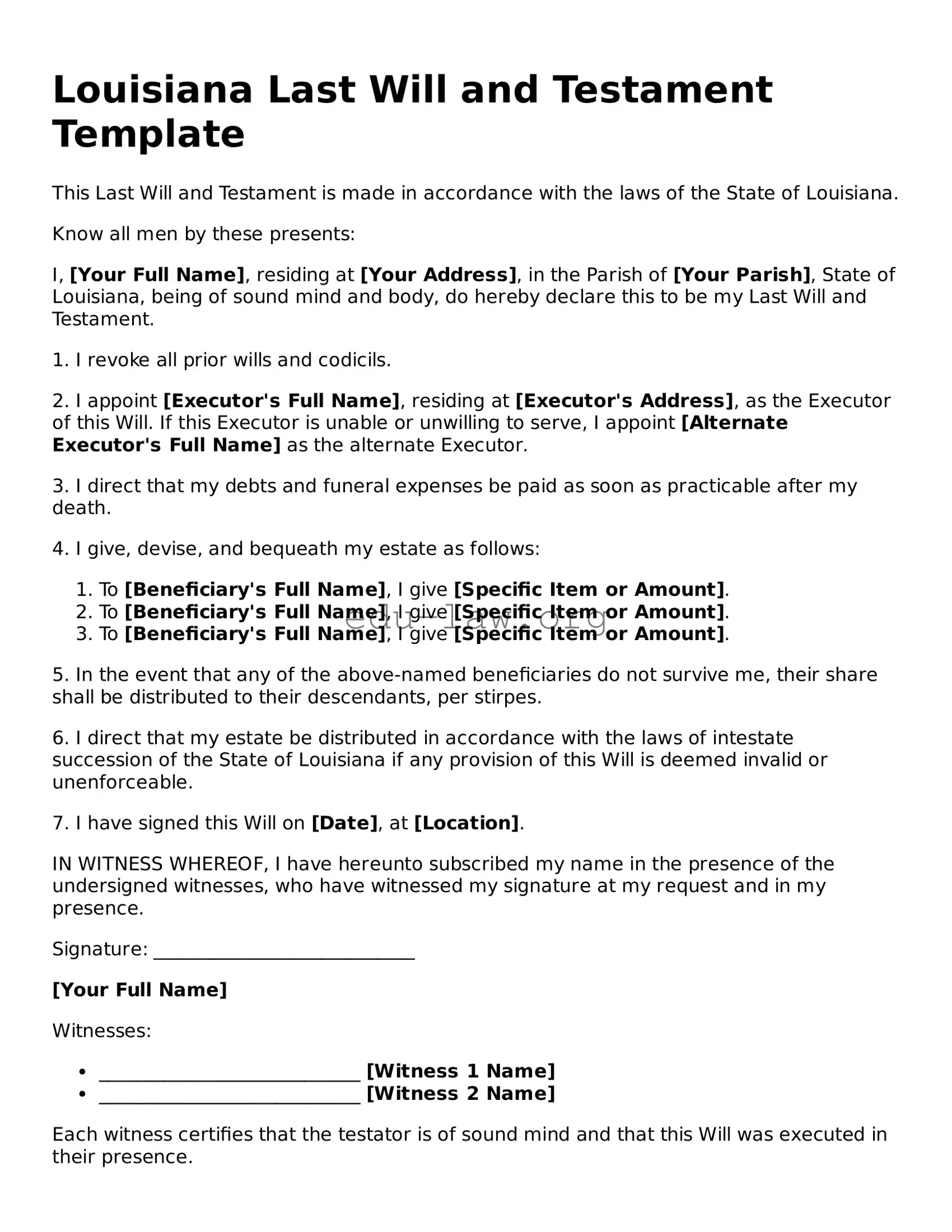
Louisiana Last Will and Testament Template
This Last Will and Testament is made in accordance with the laws of the State of Louisiana.
Know all men by these presents:
I, [Your Full Name], residing at [Your Address], in the Parish of [Your Parish], State of Louisiana, being of sound mind and body, do hereby declare this to be my Last Will and Testament.
1. I revoke all prior wills and codicils.
2. I appoint [Executor's Full Name], residing at [Executor's Address], as the Executor of this Will. If this Executor is unable or unwilling to serve, I appoint [Alternate Executor's Full Name] as the alternate Executor.
3. I direct that my debts and funeral expenses be paid as soon as practicable after my death.
4. I give, devise, and bequeath my estate as follows:
5. In the event that any of the above-named beneficiaries do not survive me, their share shall be distributed to their descendants, per stirpes.
6. I direct that my estate be distributed in accordance with the laws of intestate succession of the State of Louisiana if any provision of this Will is deemed invalid or unenforceable.
7. I have signed this Will on [Date], at [Location].
IN WITNESS WHEREOF, I have hereunto subscribed my name in the presence of the undersigned witnesses, who have witnessed my signature at my request and in my presence.
Signature: ____________________________
[Your Full Name]
Witnesses:
Each witness certifies that the testator is of sound mind and that this Will was executed in their presence.
| Fact Name | Details |
|---|---|
| Governing Law | The Louisiana Last Will and Testament is governed by the Louisiana Civil Code, particularly Articles 1570 to 1621. |
| Witness Requirement | In Louisiana, a will must be signed by the testator and at least two witnesses who are present at the same time. |
| Notarization | A notarial will is an option in Louisiana, which requires the will to be executed before a notary and two witnesses. |
| Revocation | A will can be revoked in Louisiana by creating a new will or by physically destroying the existing will with the intent to revoke. |
Filling out a Last Will and Testament form is an important step in ensuring that your wishes are honored after your passing. After completing the form, it will need to be signed and witnessed according to Louisiana law to be valid.
What is a Last Will and Testament in Louisiana?
A Last Will and Testament is a legal document that outlines how a person's assets and property will be distributed after their death. In Louisiana, this document also allows you to name guardians for minor children and specify funeral arrangements. It ensures your wishes are respected and helps avoid disputes among family members.
Who can create a Last Will and Testament in Louisiana?
Any person who is at least 18 years old and of sound mind can create a Last Will and Testament in Louisiana. This means you must understand the nature of your actions and the consequences of creating a will. There are no specific requirements regarding residency, but it is advisable to follow Louisiana laws if your estate is located there.
What are the requirements for a valid Last Will and Testament in Louisiana?
For a will to be valid in Louisiana, it must be in writing and signed by the testator (the person making the will). Additionally, it must be witnessed by at least two individuals who are not beneficiaries. Alternatively, a holographic will, which is written and signed entirely in the testator's handwriting, can also be valid without witnesses, provided it meets certain criteria.
Can I change or revoke my Last Will and Testament?
Yes, you can change or revoke your Last Will and Testament at any time while you are alive and mentally competent. To revoke a will, you can either create a new will that explicitly states the old one is revoked or physically destroy the old will. It is important to ensure that your wishes are clearly documented in your latest will to avoid confusion.
What happens if I die without a will in Louisiana?
If you die without a will, your estate will be distributed according to Louisiana's intestacy laws. This means your assets will be divided among your relatives based on a predetermined formula. Dying intestate can lead to outcomes that may not align with your wishes, making a will essential for ensuring your preferences are honored.
Do I need an attorney to create a Last Will and Testament in Louisiana?
While it is not legally required to have an attorney to create a will, consulting one is highly recommended. An attorney can help ensure that your will complies with Louisiana laws and accurately reflects your wishes. They can also provide guidance on complex issues such as tax implications and estate planning strategies.
How can I ensure my Last Will and Testament is kept safe?
To keep your will safe, store it in a secure location, such as a safe deposit box or a fireproof safe at home. Inform trusted family members or your executor about where the will is located. Additionally, consider providing copies to your attorney or trusted advisors. Regularly review and update your will as needed to reflect any life changes.
Failing to clearly identify the testator. It is essential to provide the full name and address of the person creating the will. Omitting this information can lead to confusion about the will's legitimacy.
Not signing the will in front of witnesses. Louisiana law requires that the will be signed in the presence of at least two witnesses. Without their signatures, the will may not be valid.
Using outdated or incorrect forms. Always ensure that the form you are using is the most current version. Laws can change, and using an old form can create legal issues.
Neglecting to date the will. A date provides a clear timeline for the document's validity. Without a date, disputes may arise regarding which will is the most recent.
Overlooking the specific distribution of assets. Clearly outline how you want your assets divided. Ambiguities can lead to conflicts among heirs.
Not considering potential changes in circumstances. Life events such as marriage, divorce, or the birth of a child can affect your wishes. Regularly review and update your will as necessary.
Failing to keep the will in a safe place. Store the will in a secure location and inform trusted individuals of its whereabouts. This ensures that it can be easily accessed when needed.
When creating a Last Will and Testament in Louisiana, there are several other documents that may be useful to ensure your wishes are carried out effectively. Each of these documents serves a specific purpose and can help clarify your intentions regarding your estate and care. Here is a list of common forms and documents that often accompany a will.
Using these documents in conjunction with your Last Will and Testament can help ensure that your wishes are clearly communicated and legally recognized. It’s important to consider your personal situation and consult with a professional if needed to create a comprehensive estate plan.
The Louisiana Last Will and Testament form shares similarities with the standard Last Will and Testament used in many states across the U.S. Both documents serve the primary purpose of outlining an individual's wishes regarding the distribution of their assets after death. They typically include provisions for naming beneficiaries, appointing an executor, and specifying guardians for minor children. While the specific legal requirements may vary by state, the fundamental goal remains the same: to ensure that a person's wishes are honored and to provide clarity for loved ones during a difficult time.
Another document comparable to the Louisiana Last Will and Testament is the Living Will. This document focuses on healthcare decisions rather than asset distribution. It outlines an individual's preferences for medical treatment in situations where they may be unable to communicate their wishes. Like a Last Will, a Living Will is essential for ensuring that a person’s desires are respected, particularly in end-of-life scenarios. Both documents require careful consideration and should reflect the individual’s values and intentions.
The Durable Power of Attorney is another important document that complements the Last Will and Testament. This legal instrument allows a person to designate someone to make financial or legal decisions on their behalf if they become incapacitated. While a Last Will only takes effect after death, a Durable Power of Attorney is active during the individual’s lifetime. Both documents are critical for comprehensive estate planning, ensuring that a person’s affairs are managed according to their wishes, whether they are alive or deceased.
The Revocable Living Trust is a document that functions similarly to a Last Will but offers additional benefits. This trust allows individuals to transfer assets into a trust during their lifetime, which can then be managed by a trustee. Upon the individual’s death, the assets in the trust can be distributed to beneficiaries without going through probate. This process can save time and reduce costs. Like a Last Will, a Revocable Living Trust provides a clear plan for asset distribution, but it also offers privacy and flexibility during the individual’s lifetime.
The Codicil is a document that modifies an existing Last Will and Testament. It allows individuals to make changes without drafting an entirely new will. This could include adding or removing beneficiaries, changing executors, or altering specific bequests. The Codicil must meet the same legal requirements as a Last Will to be valid. Both documents work together to ensure that an individual’s estate plan remains up-to-date and reflects their current wishes.
The Self-Proving Affidavit is another document that relates closely to the Last Will and Testament. This affidavit allows witnesses to affirm the validity of the will, streamlining the probate process. By including a Self-Proving Affidavit with the Last Will, the need for witnesses to testify in court can often be eliminated, making the process smoother and more efficient. Both documents serve to validate the individual's intentions and provide assurance that their wishes will be honored.
The Letter of Instruction, while not a legally binding document, complements the Last Will and Testament by providing additional guidance to loved ones. This letter can include details about funeral arrangements, specific bequests, or personal messages to beneficiaries. It serves as a personal touch, offering insights that may not be covered in the will itself. Both documents work together to provide clarity and support for family members during a challenging time.
The Advance Healthcare Directive is similar to the Living Will but encompasses a broader range of healthcare decisions. It allows individuals to outline their preferences regarding medical treatment and appoint a healthcare proxy to make decisions on their behalf. While the Last Will and Testament focuses on asset distribution after death, the Advance Healthcare Directive ensures that a person's healthcare wishes are respected during their lifetime. Both documents emphasize the importance of individual autonomy and decision-making in critical situations.
Finally, the Estate Inventory is a document that lists all assets owned by an individual at the time of their death. While it does not dictate how those assets should be distributed, it serves as a valuable tool for executors and beneficiaries. This inventory can help ensure that all assets are accounted for and can simplify the probate process. Together with the Last Will and Testament, the Estate Inventory provides a comprehensive view of an individual’s estate, facilitating a smoother transition for heirs.
When filling out the Louisiana Last Will and Testament form, it is crucial to follow certain guidelines to ensure your wishes are clearly expressed and legally valid. Here are ten important dos and don’ts to consider:
By adhering to these guidelines, you can create a Last Will and Testament that reflects your wishes and meets legal requirements in Louisiana.
Understanding the Louisiana Last Will and Testament form is essential for anyone looking to ensure their wishes are honored after their passing. However, several misconceptions can lead to confusion. Below is a list of ten common misunderstandings about this important legal document.
By understanding these misconceptions, individuals can better navigate the process of creating a Last Will and Testament in Louisiana. Clarity and preparation can help ensure that your wishes are honored and your loved ones are taken care of.
When preparing a Last Will and Testament in Louisiana, it is essential to understand the process and requirements involved. Here are some key takeaways to guide you:
By keeping these key points in mind, you can create a comprehensive and effective Last Will and Testament that fulfills your intentions and provides clarity for your loved ones.