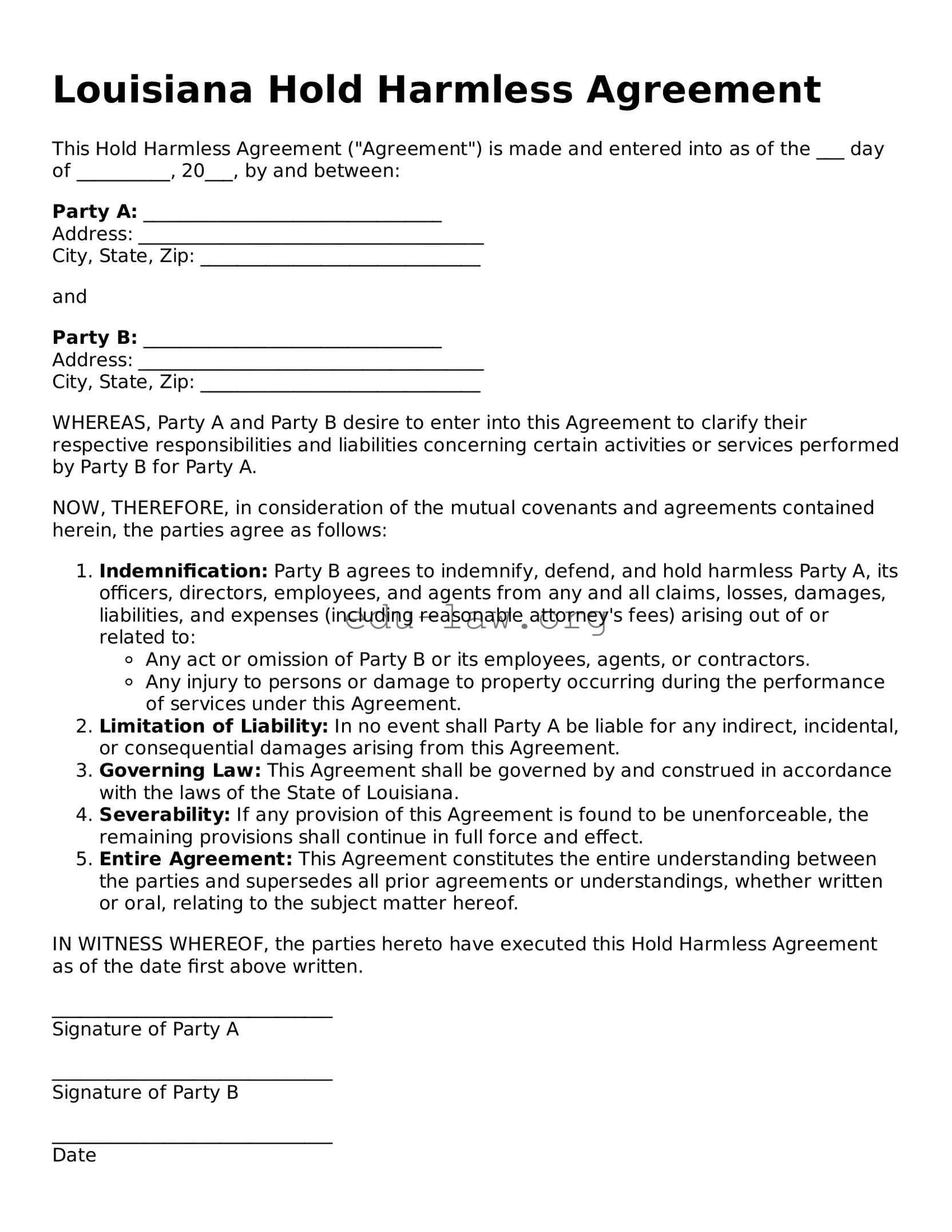
The Louisiana Hold Harmless Agreement is an important legal tool used to protect parties from liability in various situations. This form is often utilized in contracts, particularly in real estate transactions, construction projects, and event planning. By signing this agreement, one party agrees to assume responsibility for any claims, damages, or losses that may arise during the course of an activity or event. It serves to clarify the responsibilities of each party and can help prevent disputes down the line. The agreement typically outlines the scope of the hold harmless provision, detailing what types of claims are covered and any limitations that may apply. Understanding this form can help individuals and businesses safeguard their interests and ensure a smoother transaction process. Whether you are a property owner, contractor, or event organizer, knowing how to effectively use the Louisiana Hold Harmless Agreement can provide peace of mind and clarity in your dealings.
Louisiana Hold Harmless Agreement
This Hold Harmless Agreement ("Agreement") is made and entered into as of the ___ day of __________, 20___, by and between:
Party A: ________________________________
Address: _____________________________________
City, State, Zip: ______________________________
and
Party B: ________________________________
Address: _____________________________________
City, State, Zip: ______________________________
WHEREAS, Party A and Party B desire to enter into this Agreement to clarify their respective responsibilities and liabilities concerning certain activities or services performed by Party B for Party A.
NOW, THEREFORE, in consideration of the mutual covenants and agreements contained herein, the parties agree as follows:
IN WITNESS WHEREOF, the parties hereto have executed this Hold Harmless Agreement as of the date first above written.
______________________________
Signature of Party A
______________________________
Signature of Party B
______________________________
Date
| Fact Name | Description |
|---|---|
| Definition | A Hold Harmless Agreement is a legal document where one party agrees not to hold another party liable for any damages or losses. |
| Purpose | This agreement is commonly used to protect one party from legal claims arising from the actions of another party. |
| Common Uses | It is often used in contracts involving construction, events, and rental agreements. |
| Governing Law | The agreement is governed by Louisiana state law, particularly under the Louisiana Civil Code. |
| Parties Involved | Typically, two parties are involved: the indemnitor (who provides the hold harmless clause) and the indemnitee (who is protected). |
| Liability Scope | The agreement can cover various types of liabilities, including personal injury, property damage, and legal fees. |
| Enforceability | For the agreement to be enforceable, it must be clear, specific, and voluntarily signed by both parties. |
| Limitations | Some liabilities, such as gross negligence or willful misconduct, may not be covered by the agreement. |
| Modification | The agreement can be modified or revoked if both parties consent to the changes in writing. |
| Legal Advice | It is advisable for parties to seek legal counsel before entering into a Hold Harmless Agreement to understand their rights and obligations. |
Completing the Louisiana Hold Harmless Agreement form is a straightforward process that requires careful attention to detail. Once the form is filled out correctly, it will be ready for submission or further processing as needed.
What is a Louisiana Hold Harmless Agreement?
A Louisiana Hold Harmless Agreement is a legal document that protects one party from liability for any injuries or damages that may occur during a specific activity or event. This agreement typically involves two parties: the indemnitor, who agrees to assume the risk, and the indemnitee, who seeks protection from potential claims. It is commonly used in various contexts, such as rental agreements, construction contracts, and event planning.
Why would someone use a Hold Harmless Agreement?
Individuals and businesses use Hold Harmless Agreements to minimize their exposure to legal liability. By signing this document, one party agrees not to hold the other party responsible for certain risks. This can be particularly important in situations where activities involve inherent dangers, such as sports events or construction work.
What are the key components of a Hold Harmless Agreement?
A typical Hold Harmless Agreement includes several essential elements: identification of the parties involved, a clear description of the activity or event, the specific liabilities being waived, and the signatures of both parties. It may also outline any exceptions to the indemnification and specify governing law.
Is a Hold Harmless Agreement legally binding in Louisiana?
Yes, a Hold Harmless Agreement can be legally binding in Louisiana, provided it meets the necessary legal requirements. For the agreement to be enforceable, it must be clear, voluntary, and not against public policy. Courts generally uphold these agreements unless they are deemed overly broad or unconscionable.
Can a Hold Harmless Agreement protect against gross negligence?
Typically, Hold Harmless Agreements do not protect against gross negligence or willful misconduct. Louisiana courts may refuse to enforce an agreement that attempts to waive liability for such serious misconduct. It's essential to carefully draft the agreement to ensure it complies with legal standards.
How does one create a Hold Harmless Agreement?
Creating a Hold Harmless Agreement involves drafting a document that outlines the terms of the indemnification. It is advisable to include specific details about the activity, clarify the scope of liability being waived, and ensure both parties understand their rights and responsibilities. Consulting with a legal professional can help ensure the agreement is properly structured.
Do I need a lawyer to draft a Hold Harmless Agreement?
While it is possible to draft a Hold Harmless Agreement without legal assistance, consulting a lawyer is recommended. A legal professional can help tailor the agreement to your specific situation and ensure it complies with Louisiana law. This can provide added protection and peace of mind.
Can a Hold Harmless Agreement be revoked?
Generally, a Hold Harmless Agreement cannot be revoked unilaterally once it has been signed. However, both parties may agree to modify or terminate the agreement in writing. It’s important to document any changes to avoid future disputes.
What should I do if someone breaches a Hold Harmless Agreement?
If you believe someone has breached a Hold Harmless Agreement, the first step is to review the terms of the agreement carefully. If the breach is significant, you may consider seeking legal advice to discuss potential remedies, which could include negotiation, mediation, or litigation.
Not reading the entire agreement before signing. Understanding the terms is crucial.
Failing to provide accurate personal information. This includes names, addresses, and contact details.
Overlooking the date of signing. Ensure the date is current and correctly filled out.
Neglecting to specify the scope of the agreement. Be clear about what activities or incidents the agreement covers.
Not understanding the implications of the agreement. It’s important to know what rights you may be waiving.
Failing to include all necessary signatures. If there are multiple parties, ensure everyone has signed.
Using unclear language or terms. Avoid vague wording that could lead to misunderstandings.
Not keeping a copy of the signed agreement. Always retain a copy for your records.
Ignoring local laws or regulations. Make sure the agreement complies with Louisiana state laws.
A Louisiana Hold Harmless Agreement is often used in various situations where one party wants to protect themselves from liability. When creating or using this agreement, several other forms and documents may also be relevant. Here are five commonly associated documents:
Using these documents in conjunction with a Louisiana Hold Harmless Agreement can help clarify responsibilities and reduce potential legal issues. Always consider consulting with a professional to ensure that all forms meet your specific needs.
The Louisiana Hold Harmless Agreement is similar to a Liability Waiver, which is a document that releases one party from liability for any injuries or damages that may occur during a specific activity. In both cases, the parties involved agree to assume certain risks. A Liability Waiver is often used in recreational settings, such as sports or outdoor activities, where participants acknowledge the potential dangers and agree not to hold the organizers accountable for accidents. This shared understanding helps to mitigate legal disputes and encourages participation by clarifying responsibilities upfront.
Another document that bears similarity is the Indemnity Agreement. Like the Hold Harmless Agreement, an Indemnity Agreement involves one party agreeing to compensate another for any losses or damages incurred. This type of agreement is often used in business transactions where one party may be exposed to risks due to the actions of another. Both documents aim to protect one party from financial loss, but an Indemnity Agreement may also involve reimbursement for legal costs, thereby expanding the scope of protection beyond mere liability.
The Release of Liability form also shares characteristics with the Louisiana Hold Harmless Agreement. This document is commonly used in situations where an individual agrees to relinquish their right to pursue legal action against another party in exchange for participation in an activity. Similar to the Hold Harmless Agreement, the Release of Liability emphasizes the importance of informed consent, ensuring that individuals understand the risks involved. Both documents serve to limit the legal exposure of the parties involved, fostering a clearer understanding of responsibilities and risks.
Lastly, the Non-Disclosure Agreement (NDA) can be viewed as related in terms of protecting interests, albeit in a different context. While an NDA primarily focuses on safeguarding confidential information, it shares the underlying principle of risk management found in the Hold Harmless Agreement. Both documents are designed to prevent potential harm—whether financial or reputational—by establishing clear terms regarding the handling of sensitive information or liabilities. The emphasis on mutual agreement and understanding is a common thread that links these documents, highlighting the importance of clear communication in legal relationships.
When filling out the Louisiana Hold Harmless Agreement form, it is crucial to approach the process with care and attention. Below are some guidelines to help ensure that the form is completed correctly and effectively.
By following these recommendations, you can help ensure that your Hold Harmless Agreement is both effective and legally sound.
When it comes to the Louisiana Hold Harmless Agreement form, several misconceptions often arise. Understanding these misconceptions can help individuals navigate their legal responsibilities more effectively. Here’s a breakdown of eight common misunderstandings:
By clarifying these misconceptions, individuals can make more informed decisions regarding their legal protections and responsibilities.
When dealing with a Louisiana Hold Harmless Agreement, it’s important to understand the key elements involved. Here are some essential takeaways:
Understanding these points can help you effectively use the Hold Harmless Agreement in Louisiana. Take action to protect yourself and your interests.