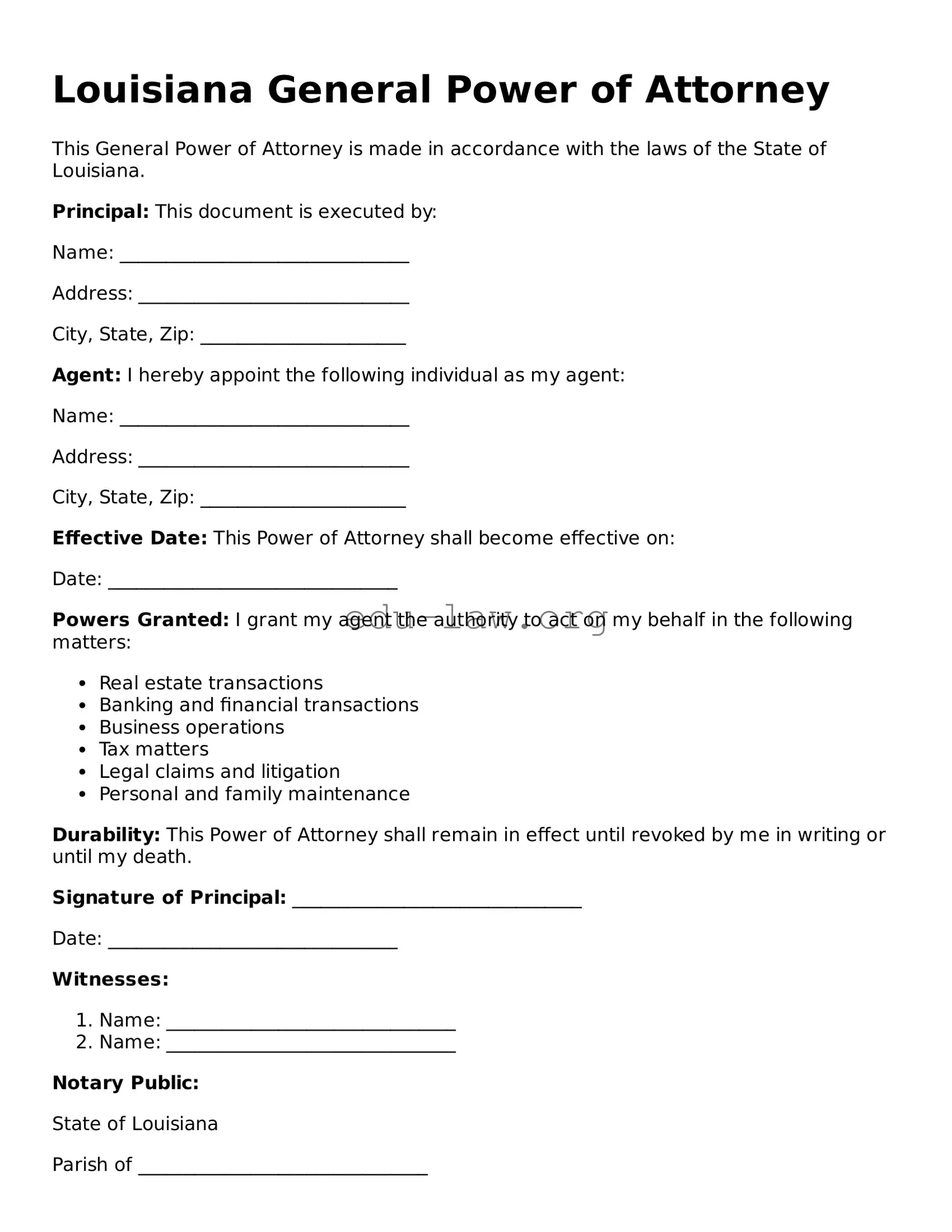
The Louisiana General Power of Attorney form serves as a crucial legal document that empowers an individual, known as the principal, to designate another person, referred to as the agent, to act on their behalf in various matters. This form can encompass a wide range of powers, including managing financial transactions, handling real estate dealings, and making healthcare decisions, depending on the principal's specifications. One of the key aspects of this form is its flexibility; it can be tailored to grant broad or limited authority, allowing the principal to retain control over specific areas of their affairs. Additionally, the General Power of Attorney can be durable, meaning it remains effective even if the principal becomes incapacitated, or it can be non-durable, terminating upon the principal’s incapacitation. It is essential for individuals to understand the implications of granting such authority, as the agent will have the ability to make significant decisions that can impact the principal's life and finances. Proper execution of the form, which typically requires the principal's signature and may need to be notarized, ensures that the document is legally binding and recognized by institutions and authorities in Louisiana.
Louisiana General Power of Attorney
This General Power of Attorney is made in accordance with the laws of the State of Louisiana.
Principal: This document is executed by:
Name: _______________________________
Address: _____________________________
City, State, Zip: ______________________
Agent: I hereby appoint the following individual as my agent:
Name: _______________________________
Address: _____________________________
City, State, Zip: ______________________
Effective Date: This Power of Attorney shall become effective on:
Date: _______________________________
Powers Granted: I grant my agent the authority to act on my behalf in the following matters:
Durability: This Power of Attorney shall remain in effect until revoked by me in writing or until my death.
Signature of Principal: _______________________________
Date: _______________________________
Witnesses:
Notary Public:
State of Louisiana
Parish of _______________________________
On this _____ day of _______________, 20___, before me, a Notary Public, personally appeared the above-named Principal, who is known to me or proved to me on the basis of satisfactory evidence to be the person whose name is subscribed to this instrument.
Notary Signature: _______________________________
My Commission Expires: ________________________
| Fact Name | Description |
|---|---|
| Definition | A Louisiana General Power of Attorney allows one person to grant another the authority to act on their behalf in a variety of matters. |
| Governing Law | This form is governed by the Louisiana Civil Code, particularly Articles 2991 to 3020. |
| Durability | The General Power of Attorney can be durable, meaning it remains effective even if the principal becomes incapacitated. |
| Agent Authority | The agent can perform tasks such as managing finances, signing documents, and making healthcare decisions, depending on the powers granted. |
| Revocation | The principal can revoke the General Power of Attorney at any time, as long as they are mentally competent. |
| Notarization | While notarization is not always required, it is highly recommended to ensure the document's validity and to prevent disputes. |
| Witness Requirement | In Louisiana, the form must be signed in the presence of two witnesses, who must also sign the document. |
| Limitations | The General Power of Attorney does not grant the agent the authority to make decisions regarding the principal's will or estate planning. |
| Form Accessibility | The Louisiana General Power of Attorney form can typically be obtained from legal websites, law offices, or state resources. |
Once you have the Louisiana General Power of Attorney form in hand, you are ready to start filling it out. This form will allow you to designate someone to act on your behalf in various matters. Make sure to have all necessary information available as you proceed.
What is a Louisiana General Power of Attorney?
A Louisiana General Power of Attorney is a legal document that allows one person, known as the principal, to appoint another person, called the agent or attorney-in-fact, to act on their behalf. This document grants broad authority to the agent, enabling them to make decisions regarding financial matters, property transactions, and other significant affairs, depending on the specific powers outlined in the document.
Who can serve as an agent in a General Power of Attorney?
In Louisiana, anyone who is at least 18 years old and is mentally competent can serve as an agent. This includes family members, friends, or professionals such as attorneys. It is essential to choose someone trustworthy and capable of handling the responsibilities that come with this role.
What powers can be granted to the agent?
The powers granted to the agent can vary based on the principal's wishes. Common powers include managing bank accounts, buying or selling property, handling tax matters, and making investment decisions. The principal can specify which powers are included or excluded in the document, allowing for customization according to individual needs.
Does a General Power of Attorney need to be notarized?
Yes, in Louisiana, a General Power of Attorney must be signed in the presence of a notary public. Additionally, it should be witnessed by at least one person. This helps ensure the document's validity and that the principal's intentions are clear and properly documented.
Can a General Power of Attorney be revoked?
Absolutely. A principal can revoke a General Power of Attorney at any time, as long as they are mentally competent. To revoke the document, the principal should create a written revocation and notify the agent and any relevant institutions or parties who may have relied on the original power of attorney.
What happens if the principal becomes incapacitated?
In Louisiana, a General Power of Attorney typically becomes invalid if the principal becomes incapacitated unless it is designated as a durable power of attorney. A durable power of attorney remains effective even if the principal is no longer able to make decisions due to mental or physical incapacity. It is crucial to specify this designation if that is the intent.
Is a General Power of Attorney effective immediately?
Generally, a General Power of Attorney becomes effective as soon as it is signed and notarized. However, the principal can choose to make it effective at a later date or upon the occurrence of a specific event, such as incapacitation. This option allows for flexibility in managing affairs.
Can a General Power of Attorney be used for healthcare decisions?
No, a General Power of Attorney is primarily focused on financial and property matters. For healthcare decisions, a separate document known as a Healthcare Power of Attorney or Advance Directive should be used. This document allows the agent to make medical decisions on behalf of the principal when they are unable to do so.
What should I consider before creating a General Power of Attorney?
Before creating a General Power of Attorney, consider the level of trust you have in the person you wish to appoint as your agent. Assess the specific powers you want to grant and whether you prefer a durable power of attorney. It may also be beneficial to consult with a legal professional to ensure that the document meets your needs and complies with Louisiana laws.
Not specifying the powers granted: Many people forget to clearly outline the specific powers they want to grant. This can lead to confusion or misuse of authority.
Failing to date the document: A common oversight is neglecting to put a date on the form. Without a date, the validity of the document can be questioned.
Not signing in the right place: Some individuals sign the form but do so in the wrong section. Ensure that you sign where indicated to avoid any issues.
Ignoring witness or notary requirements: Louisiana law may require witnesses or a notary public to validate the document. Skipping this step can invalidate the power of attorney.
Not discussing the decision with the agent: It's crucial to have a conversation with the person you are appointing. Failing to do so can lead to misunderstandings about their role and responsibilities.
When setting up a Louisiana General Power of Attorney, it's essential to consider several other forms and documents that can complement your arrangement. These documents can help ensure that your financial and personal affairs are managed according to your wishes. Here’s a list of commonly used forms that you may want to look into:
Understanding these documents can empower you to make informed decisions about your legal and financial affairs. Each one plays a unique role in ensuring that your wishes are honored, both during your lifetime and after. Take the time to review these forms carefully, and consider consulting with a professional to help you navigate your options.
The Louisiana General Power of Attorney (GPOA) form shares similarities with the Durable Power of Attorney (DPOA). Both documents grant an individual the authority to act on behalf of another person in various matters, such as financial and legal decisions. The key difference lies in durability; while the GPOA may become void if the principal becomes incapacitated, the DPOA remains effective even if the principal loses the ability to make decisions. This makes the DPOA a more suitable choice for long-term planning, especially for individuals concerned about future incapacity.
Another document comparable to the GPOA is the Limited Power of Attorney (LPOA). The LPOA allows the principal to specify particular tasks or decisions that the agent can handle, such as selling a property or managing a bank account. Unlike the GPOA, which grants broad powers, the LPOA is tailored to specific situations, giving the principal more control over what authority is delegated. This can be particularly useful for individuals who want to maintain oversight over their affairs while still allowing someone to assist them in certain areas.
The Medical Power of Attorney (MPOA) is another related document. This form specifically empowers an agent to make healthcare decisions on behalf of the principal when they are unable to do so. While the GPOA can include some health-related decisions, the MPOA focuses solely on medical matters. This distinction is crucial for individuals who want to ensure that their healthcare preferences are respected during times of incapacity, as it allows them to designate someone they trust to make those critical choices.
The Advance Healthcare Directive (AHD) is also similar to the GPOA, but it combines elements of the MPOA with specific instructions regarding medical treatment preferences. An AHD allows individuals to outline their wishes for end-of-life care and other medical interventions. While the GPOA gives authority to an agent, the AHD provides clear guidance about the principal's values and preferences, ensuring that their desires are followed even if they cannot communicate them directly.
The Revocable Living Trust (RLT) shares some characteristics with the GPOA as well. An RLT allows individuals to manage their assets during their lifetime while providing for the distribution of those assets upon their death. Like the GPOA, it can help avoid probate, but it offers a more comprehensive approach to estate planning. The RLT can be altered or revoked at any time, giving the principal flexibility in managing their affairs, while the GPOA focuses primarily on granting authority to another person.
The Springing Power of Attorney (SPOA) is another document that is similar to the GPOA. This type of power of attorney becomes effective only under specific conditions, usually when the principal becomes incapacitated. The SPOA allows individuals to maintain control over their affairs until they are unable to manage them, at which point the designated agent can step in. This feature provides peace of mind for those who want to ensure that their affairs are handled by a trusted individual only when necessary.
The Financial Power of Attorney (FPOA) closely resembles the GPOA, as it specifically grants authority to manage financial matters. While the GPOA can encompass a wide range of powers, the FPOA is focused solely on financial transactions, such as managing bank accounts, investments, and property. This specialization can be beneficial for individuals who want to ensure that their financial affairs are handled by someone they trust, without granting broader authority over other aspects of their life.
The Business Power of Attorney (BPOA) is another document that parallels the GPOA. This form is tailored for business-related matters, allowing an agent to make decisions on behalf of a business owner. The BPOA can cover a range of activities, from signing contracts to managing business operations. While the GPOA can include business matters, the BPOA provides a more focused approach for those specifically looking to delegate authority in a business context.
Lastly, the Special Power of Attorney (SPOA) shares similarities with the GPOA in that it allows the principal to grant specific powers to an agent. However, the SPOA is limited to certain tasks or transactions, which the principal defines. This contrasts with the broader authority granted by the GPOA. The SPOA can be useful for individuals who want to delegate authority for a particular event or transaction without giving away comprehensive control over their affairs.
When completing the Louisiana General Power of Attorney form, it is essential to approach the task with care. Here are six important actions to take and avoid:
The Louisiana General Power of Attorney form is a crucial document that allows individuals to appoint someone to make decisions on their behalf. However, several misconceptions surround this form that can lead to confusion. Here are four common misunderstandings:
Many people believe that a General Power of Attorney is limited solely to financial transactions. In reality, this form can grant authority over a wide range of decisions, including health care and property management, depending on how it is drafted.
Another misconception is that the General Power of Attorney continues to be effective even after the person who created it passes away. This is incorrect; the authority granted through this document ends at the death of the principal.
Some individuals think that once a General Power of Attorney is established, it cannot be changed or revoked. However, the principal has the right to revoke or modify the document at any time, as long as they are mentally competent.
People often confuse a General Power of Attorney with a Durable Power of Attorney. While both allow for the delegation of authority, a Durable Power of Attorney remains effective even if the principal becomes incapacitated, unlike a General Power of Attorney, which typically does not.
Filling out and using the Louisiana General Power of Attorney form is an important process that allows individuals to designate someone to act on their behalf. Here are some key takeaways to consider: