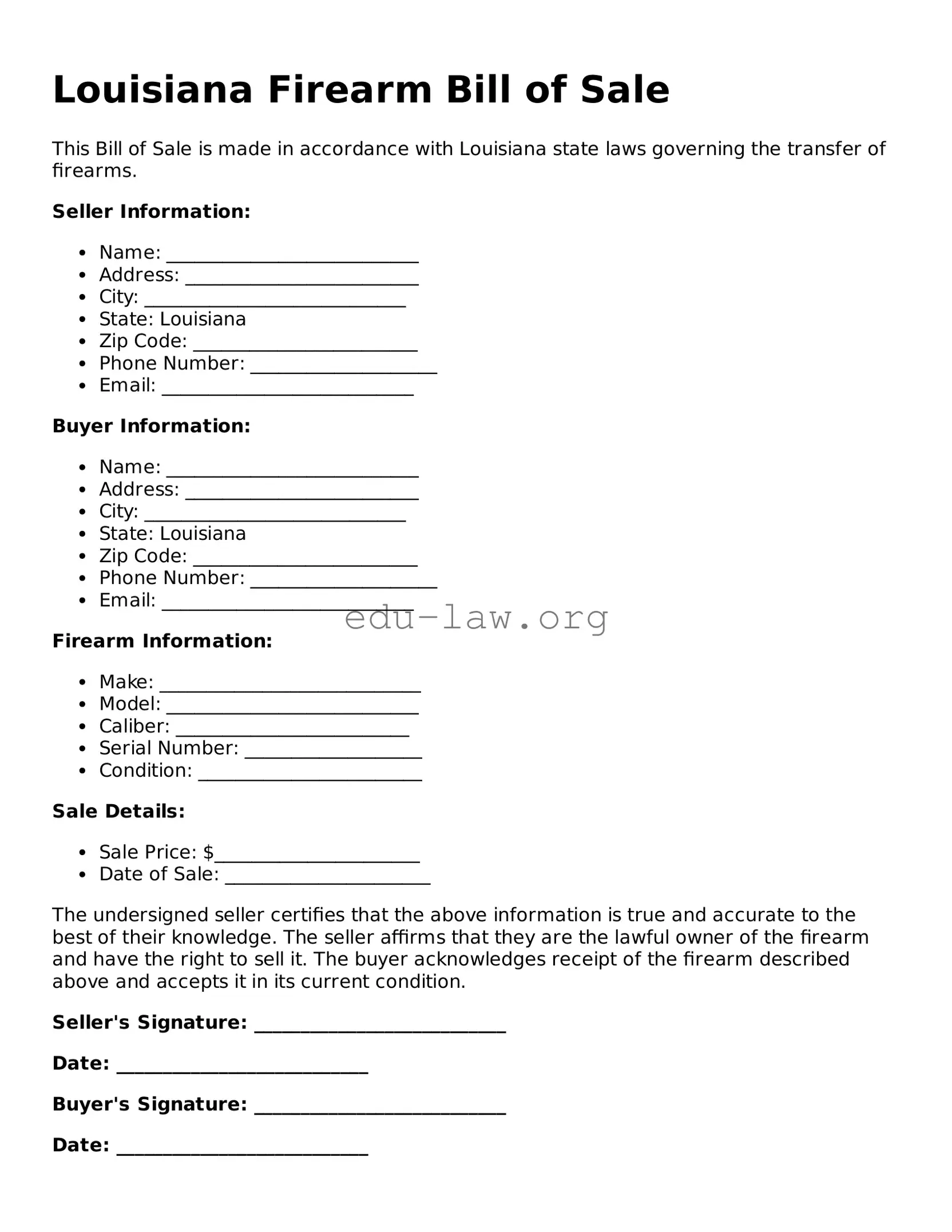
The Louisiana Firearm Bill of Sale form serves as a crucial document for anyone looking to buy or sell a firearm within the state. This form outlines essential details about the transaction, including the names and addresses of both the buyer and seller, the date of the sale, and a description of the firearm being transferred, such as its make, model, and serial number. Importantly, the form also includes a statement confirming that the seller is the legal owner of the firearm and has the right to sell it. Additionally, it may contain a section for both parties to sign, affirming that the transaction complies with state and federal laws. Having a properly completed Bill of Sale not only protects both parties in the event of future disputes but also serves as a record that can be referenced if needed. Understanding the significance of this form is essential for anyone engaging in firearm transactions in Louisiana, ensuring that all legal requirements are met and that the process is conducted smoothly.
Louisiana Firearm Bill of Sale
This Bill of Sale is made in accordance with Louisiana state laws governing the transfer of firearms.
Seller Information:
Buyer Information:
Firearm Information:
Sale Details:
The undersigned seller certifies that the above information is true and accurate to the best of their knowledge. The seller affirms that they are the lawful owner of the firearm and have the right to sell it. The buyer acknowledges receipt of the firearm described above and accepts it in its current condition.
Seller's Signature: ___________________________
Date: ___________________________
Buyer's Signature: ___________________________
Date: ___________________________
| Fact Name | Details |
|---|---|
| Purpose | The Louisiana Firearm Bill of Sale form serves as a legal document to record the sale and transfer of firearms between individuals. |
| Governing Law | This form is governed by Louisiana Revised Statutes Title 14, Section 95.1, which outlines the laws regarding the sale and transfer of firearms. |
| Information Required | The form typically requires details such as the buyer's and seller's names, addresses, and the firearm's description, including make, model, and serial number. |
| Legal Protection | Using a Bill of Sale provides legal protection for both the buyer and seller, confirming that the transaction took place and helping to avoid future disputes. |
Completing the Louisiana Firearm Bill of Sale form is an important step in ensuring a legal transfer of ownership. After filling out the form, both the buyer and seller should retain a copy for their records. This will provide proof of the transaction and help avoid any potential misunderstandings in the future.
What is a Louisiana Firearm Bill of Sale form?
The Louisiana Firearm Bill of Sale form is a document used to record the sale or transfer of a firearm between two parties. This form provides essential details about the transaction, including the buyer's and seller's information, firearm specifics, and the date of the sale. It serves as a legal record that can protect both parties in case of future disputes or legal issues.
Is a Bill of Sale required to sell a firearm in Louisiana?
While Louisiana law does not require a Bill of Sale for private firearm sales, having one is highly recommended. A Bill of Sale can serve as proof of ownership and can protect both the buyer and seller from potential legal complications. Additionally, some local jurisdictions may have specific regulations, so it's wise to check local laws.
What information is typically included in the form?
A typical Louisiana Firearm Bill of Sale form includes the names and addresses of both the buyer and seller, the date of the transaction, a description of the firearm (including make, model, caliber, and serial number), and the sale price. Both parties should sign the document to validate the transaction.
Do I need to have the Bill of Sale notarized?
No, notarization is not required for a Bill of Sale in Louisiana. However, having it notarized can add an extra layer of authenticity and may be beneficial if disputes arise later. It's a good practice to keep a copy of the signed document for your records.
Can I use a generic Bill of Sale form for firearms?
While you can use a generic Bill of Sale form, it is advisable to use a specific Louisiana Firearm Bill of Sale form. This ensures that all necessary details regarding the firearm and the transaction are clearly outlined, reducing the risk of misunderstandings or omissions.
What if the firearm is not in my name?
If the firearm is not registered in your name, you should ensure that the current owner is present during the sale and that they also sign the Bill of Sale. This helps establish a clear chain of ownership and protects you from potential legal issues related to the firearm's history.
Are there any restrictions on who can buy or sell firearms in Louisiana?
Yes, certain individuals are prohibited from purchasing or possessing firearms in Louisiana. This includes felons, individuals with restraining orders, and those deemed mentally incompetent by a court. It's crucial to verify that the buyer meets all legal requirements before completing the sale.
What should I do if I lose my Bill of Sale?
If you lose your Bill of Sale, it is advisable to create a new document that states the original sale details, including the date, parties involved, and firearm information. Both parties should sign this new document. Keeping a digital copy can also help prevent future loss.
Can I sell a firearm to someone from another state?
Yes, you can sell a firearm to someone from another state, but federal laws and the laws of the buyer's state must be followed. Typically, the buyer should go through a licensed firearms dealer in their state to complete the transfer. Always ensure compliance with all applicable laws to avoid legal issues.
Failing to include the date of the transaction. This crucial detail helps establish when the sale occurred.
Not providing accurate personal information. Both the buyer and seller should clearly state their full names, addresses, and contact numbers.
Overlooking the firearm details. It's essential to specify the make, model, caliber, and serial number of the firearm being sold.
Neglecting to sign the form. Both parties must sign the Bill of Sale to validate the transaction.
Using incorrect payment information. Clearly stating the amount paid and the payment method is vital for record-keeping.
Not including any conditions of sale. If there are specific terms or conditions, they should be clearly outlined in the document.
Failing to keep a copy of the Bill of Sale. Both the buyer and seller should retain a copy for their records.
Not verifying the buyer's eligibility. It's important to ensure that the buyer is legally allowed to purchase a firearm.
Using an outdated form. Always ensure you are using the most current version of the Louisiana Firearm Bill of Sale.
Ignoring state laws regarding firearm transfers. Familiarity with local regulations can prevent legal issues down the line.
When purchasing or selling a firearm in Louisiana, the Firearm Bill of Sale form is a crucial document. However, it is often accompanied by several other forms and documents that can help ensure a smooth and legally compliant transaction. Below is a list of these important documents.
Having these documents in place can greatly enhance the security and legality of firearm transactions in Louisiana. Each plays a unique role in protecting the interests of both the buyer and seller, ensuring a smooth process from start to finish.
The Louisiana Firearm Bill of Sale form shares similarities with a standard vehicle bill of sale. Both documents serve as proof of transfer of ownership from one party to another. They typically include details such as the buyer's and seller's names, addresses, and signatures. Additionally, both forms may require the inclusion of specific identifying information, such as the vehicle's VIN or the firearm's serial number, to ensure clarity and prevent disputes regarding ownership.
Another document that resembles the Louisiana Firearm Bill of Sale is a personal property bill of sale. This type of document is used for the transfer of ownership of various personal items, not just firearms. Like the firearm bill of sale, it outlines the parties involved, the description of the item being sold, and the sale price. Both documents serve as legal proof of the transaction and can be used in case of disputes or for record-keeping purposes.
The lease agreement is another document that shares characteristics with the Louisiana Firearm Bill of Sale. While a lease agreement pertains to the rental of property, both documents establish a legal relationship between parties. They specify terms and conditions, including the duration of the agreement and obligations of each party. In the context of a firearm sale, the bill of sale delineates the transfer of ownership, similar to how a lease agreement outlines the temporary transfer of property use.
A rental agreement also bears resemblance to the Louisiana Firearm Bill of Sale. Both documents facilitate the transfer of rights, whether it is the sale of a firearm or the rental of an apartment. Each document includes essential information about the parties involved and the item in question. While one transfers ownership and the other grants temporary possession, both serve to protect the interests of the parties involved.
The receipt for payment is another document that aligns with the Louisiana Firearm Bill of Sale. A receipt confirms that a transaction has taken place, including the amount paid and the item purchased. Similarly, the firearm bill of sale provides a record of the sale and can serve as proof of ownership. Both documents are crucial for financial accountability and can be used to resolve disputes regarding payment or ownership.
A warranty deed is similar to the Louisiana Firearm Bill of Sale in that both documents transfer rights to property. A warranty deed is used for real estate transactions, while the firearm bill of sale is specific to firearms. Both documents include the names of the parties involved, descriptions of the property, and signatures. They also provide legal assurance that the seller has the right to transfer ownership, which is vital in both real estate and firearm transactions.
The promissory note can also be compared to the Louisiana Firearm Bill of Sale. While a promissory note outlines a promise to pay a specified amount, both documents formalize agreements between parties. Each document requires identification of the parties and details of the transaction. The firearm bill of sale indicates the transfer of ownership, while the promissory note indicates a financial obligation, highlighting the importance of documentation in legal agreements.
The power of attorney document shares some similarities with the Louisiana Firearm Bill of Sale. Both documents involve the delegation of authority, whether for ownership transfer or decision-making. A power of attorney allows one person to act on behalf of another, while the firearm bill of sale signifies the transfer of ownership rights. Each document requires clear identification of the parties and the specific rights being transferred.
The insurance policy can also be likened to the Louisiana Firearm Bill of Sale in terms of providing documentation of ownership and responsibility. An insurance policy outlines the coverage for an item, while the firearm bill of sale confirms ownership of the firearm. Both documents serve as legal evidence that can be referenced in case of loss or damage, underscoring the importance of keeping accurate records of ownership.
Finally, the employment contract has similarities with the Louisiana Firearm Bill of Sale in that both establish formal agreements between parties. An employment contract outlines the terms of employment, while the firearm bill of sale details the transfer of ownership. Both documents require signatures and may include terms and conditions that protect the rights of the parties involved, emphasizing the importance of clarity in any legal agreement.
When filling out the Louisiana Firearm Bill of Sale form, it’s crucial to ensure accuracy and compliance. Here are ten important dos and don’ts to keep in mind:
By following these guidelines, you can help ensure a smooth and lawful transaction. Remember, taking the time to do it right protects both parties involved.
Understanding the Louisiana Firearm Bill of Sale form is crucial for anyone involved in the buying or selling of firearms in the state. However, several misconceptions can lead to confusion. Here are four common misunderstandings:
Many believe that a Bill of Sale is required only when selling a firearm privately. In reality, while it is essential for private transactions, it can also serve as a useful record for sales through licensed dealers.
Some think that completing a Bill of Sale automatically ensures that the firearm is legal. However, it is the responsibility of the buyer and seller to ensure that the firearm complies with all state and federal laws.
While notarization is not always required, having the Bill of Sale notarized can add an extra layer of protection and verification for both parties involved in the transaction.
Some assume that the Bill of Sale form used in Louisiana is identical to those in other states. Each state has its own laws and requirements, making it essential to use the correct form specific to Louisiana.
When engaging in the purchase or sale of a firearm in Louisiana, using a Firearm Bill of Sale form is essential. Here are some key takeaways to consider:
By understanding these key points, individuals can navigate the process of buying or selling a firearm in Louisiana more effectively and responsibly.