Creating a comprehensive employee handbook is essential for any business operating in Louisiana. This document serves as a vital resource for both employers and employees, outlining workplace policies, employee rights, and expectations. It typically includes sections on workplace conduct, anti-discrimination policies, and procedures for addressing grievances. Additionally, the handbook may cover topics such as employee benefits, attendance policies, and safety regulations. By providing clear guidelines, the handbook helps foster a positive work environment and ensures compliance with state and federal laws. A well-structured employee handbook not only protects the organization but also empowers employees by informing them of their rights and responsibilities.
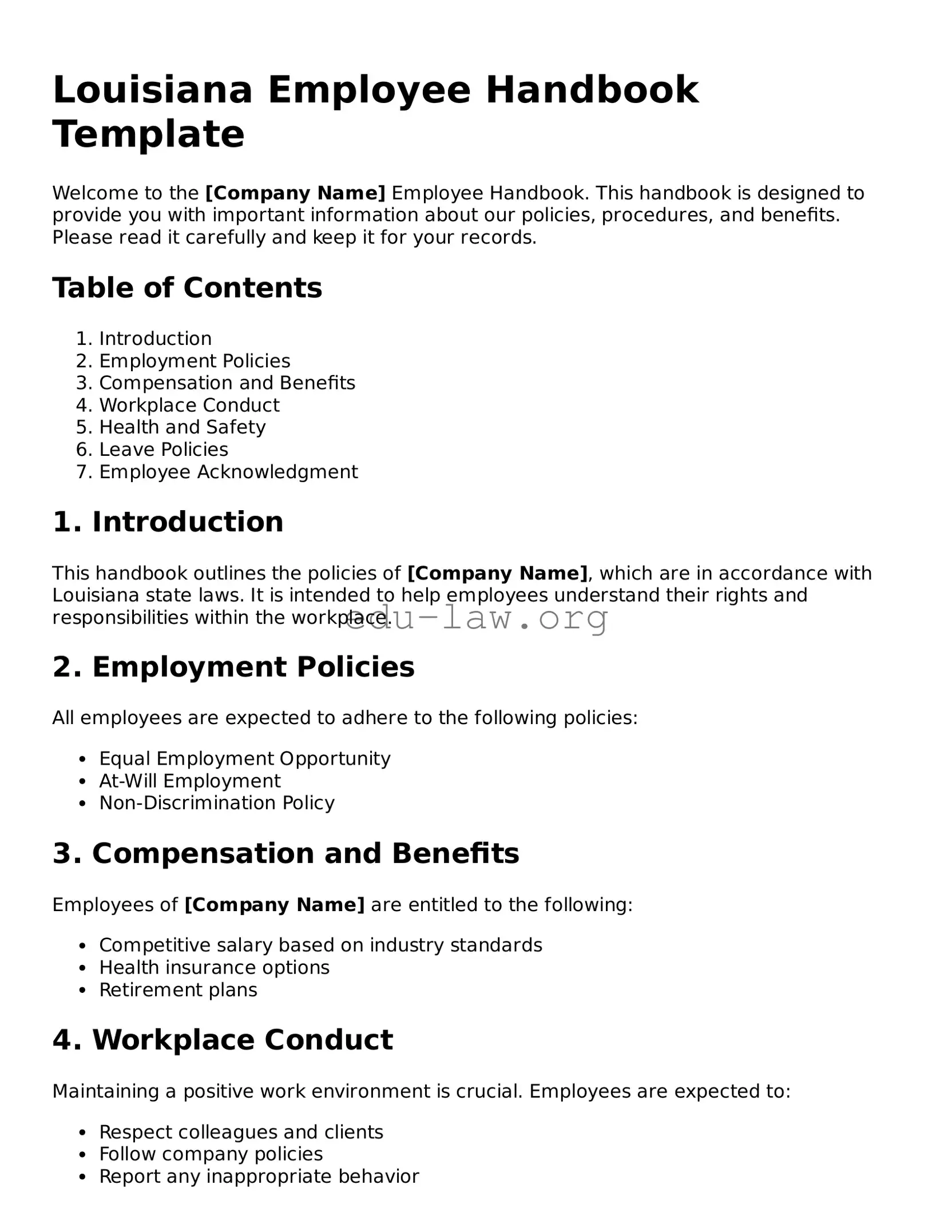
Louisiana Employee Handbook Template
Welcome to the [Company Name] Employee Handbook. This handbook is designed to provide you with important information about our policies, procedures, and benefits. Please read it carefully and keep it for your records.
Table of Contents
1. Introduction
This handbook outlines the policies of [Company Name], which are in accordance with Louisiana state laws. It is intended to help employees understand their rights and responsibilities within the workplace.
2. Employment Policies
All employees are expected to adhere to the following policies:
3. Compensation and Benefits
Employees of [Company Name] are entitled to the following:
4. Workplace Conduct
Maintaining a positive work environment is crucial. Employees are expected to:
5. Health and Safety
[Company Name] is committed to providing a safe workplace. Employees should:
6. Leave Policies
Employees may be eligible for various types of leave, including:
7. Employee Acknowledgment
All employees must sign an acknowledgment form confirming they have read and understood this handbook. Please complete the following:
Employee Name: [Employee Name]
Date: [Date]
Thank you for being a part of [Company Name]. We look forward to a successful partnership!
| Fact Name | Description |
|---|---|
| Purpose | The Louisiana Employee Handbook serves as a guide for employees, outlining company policies, procedures, and expectations. |
| Legal Requirement | While not mandated by law, providing an employee handbook is a best practice for Louisiana employers to communicate workplace policies. |
| Governing Laws | The handbook should comply with Louisiana employment laws, including the Louisiana Employment Discrimination Law (LEDL) and federal laws like the Fair Labor Standards Act (FLSA). |
| Content Recommendations | Recommended sections include anti-discrimination policies, workplace safety guidelines, and procedures for reporting grievances. |
| Review and Updates | Employers should regularly review and update the handbook to reflect changes in laws or company policies, ensuring compliance and clarity. |
Completing the Louisiana Employee Handbook form is a straightforward process. Once filled out, the form will help ensure that all employees understand the policies and procedures of the workplace. Follow the steps below to accurately complete the form.
What is the Louisiana Employee Handbook form?
The Louisiana Employee Handbook form is a document designed to provide employees with essential information about their rights, responsibilities, and the policies of the workplace. It serves as a guide for both employers and employees, outlining expectations regarding conduct, workplace safety, benefits, and various other important topics. By having a clear and comprehensive handbook, employers can help ensure that employees understand their roles and the company culture, which can lead to a more harmonious work environment.
Why is it important to have an Employee Handbook?
An Employee Handbook is crucial for several reasons. First, it sets clear expectations for behavior and performance, helping to reduce misunderstandings between employees and management. Second, it can protect the company legally by documenting policies and procedures that comply with state and federal laws. Additionally, having a handbook can enhance communication within the organization, making it easier for employees to access important information when needed. Overall, it fosters a transparent workplace culture where everyone knows what is expected of them.
How often should the Employee Handbook be updated?
Who is responsible for creating and maintaining the Employee Handbook?
Not reading the entire handbook before filling out the form. Understanding the policies is crucial.
Failing to provide accurate personal information. Double-check names, addresses, and contact details.
Overlooking the signature section. Always sign and date the form to validate it.
Ignoring the deadlines for submission. Late submissions can lead to complications.
Not asking questions when unsure about a section. Clarifying doubts can prevent mistakes.
Using abbreviations or slang in the form. Clear and formal language is preferred.
Neglecting to keep a copy of the completed form. Having a record can be helpful later.
Assuming all sections are optional. Some sections are mandatory and must be filled out.
In addition to the Louisiana Employee Handbook form, several other documents are commonly utilized in the workplace to ensure clear communication and compliance with employment laws. Each of these documents serves a specific purpose and helps to establish guidelines and expectations for both employees and employers.
These documents, along with the Louisiana Employee Handbook, contribute to a structured and organized work environment. They promote transparency and help both employees and employers navigate their rights and responsibilities effectively.
The Louisiana Employee Handbook is similar to the Employee Handbook used in other states, which serves as a guide for employees on company policies and procedures. These handbooks outline expectations for behavior, dress code, attendance, and performance standards. While the specific laws may vary by state, the core purpose remains the same: to inform employees of their rights and responsibilities within the organization. This promotes a clear understanding of workplace culture and helps prevent misunderstandings.
Another comparable document is the Workplace Safety Manual. This manual provides essential information regarding safety protocols, emergency procedures, and reporting incidents. Both documents emphasize the importance of a safe working environment. They aim to educate employees on how to protect themselves and their coworkers, fostering a culture of safety that is crucial for any organization.
The Employee Policy Manual is also similar in its intent to communicate company policies. This document typically includes guidelines on issues such as harassment, discrimination, and disciplinary actions. Like the Employee Handbook, it serves to protect both the employer and the employee by ensuring that everyone is aware of the rules and procedures that govern workplace behavior.
The Orientation Manual shares similarities as well, particularly in its role of onboarding new employees. This document introduces new hires to company culture, benefits, and key personnel. Both the Orientation Manual and the Employee Handbook aim to provide a comprehensive overview of the organization, ensuring that employees feel welcomed and informed from day one.
The Code of Conduct is another document that aligns closely with the Employee Handbook. It outlines the ethical standards and behavioral expectations for employees. Both documents work together to create a respectful workplace environment. They reinforce the values of the organization and set the tone for acceptable behavior among employees.
The Training Manual, while focused on skill development, also shares common ground with the Employee Handbook. It provides employees with the necessary resources to improve their performance and adhere to company standards. Both documents are essential for employee growth and development, ensuring that individuals have the tools they need to succeed in their roles.
Finally, the Benefits Guide is similar in that it communicates important information about employee benefits, such as health insurance, retirement plans, and leave policies. While it may focus more on compensation, it complements the Employee Handbook by providing a complete picture of what employees can expect in terms of support and resources from the organization.
When filling out the Louisiana Employee Handbook form, it's important to keep a few key points in mind. Here’s a list of things you should and shouldn’t do:
Misconceptions about the Louisiana Employee Handbook form can lead to confusion for both employers and employees. Here are ten common misconceptions, along with clarifications.
This is incorrect. While not all employers are legally required to have a handbook, it is highly recommended. A well-crafted handbook provides clarity on policies and expectations.
While the handbook should comply with applicable laws, it does not need to be a legal document. It serves as a guide for employees and can be written in straightforward language.
Each handbook should reflect the unique culture and policies of the organization. There is no one-size-fits-all approach.
This is a misconception. Small businesses can also benefit from having a handbook to set clear expectations and reduce misunderstandings.
Policies and laws change over time. Regular reviews and updates are necessary to ensure the handbook remains relevant and compliant.
While it is good practice to have employees acknowledge receipt, a signature is not legally required. A simple acknowledgment can suffice.
Employers must ensure that all policies comply with federal and state laws. Some policies may be illegal or discriminatory.
A handbook does not create a contract of employment or guarantee job security. Employment is generally at-will unless otherwise stated.
While HR plays a crucial role, input from various departments can improve the handbook's effectiveness and relevance.
Assuming that employees will read the handbook is unrealistic. Employers should encourage discussions and provide training to ensure understanding.
Filling out and utilizing the Louisiana Employee Handbook form is an essential process for both employers and employees. Here are some key takeaways to consider: