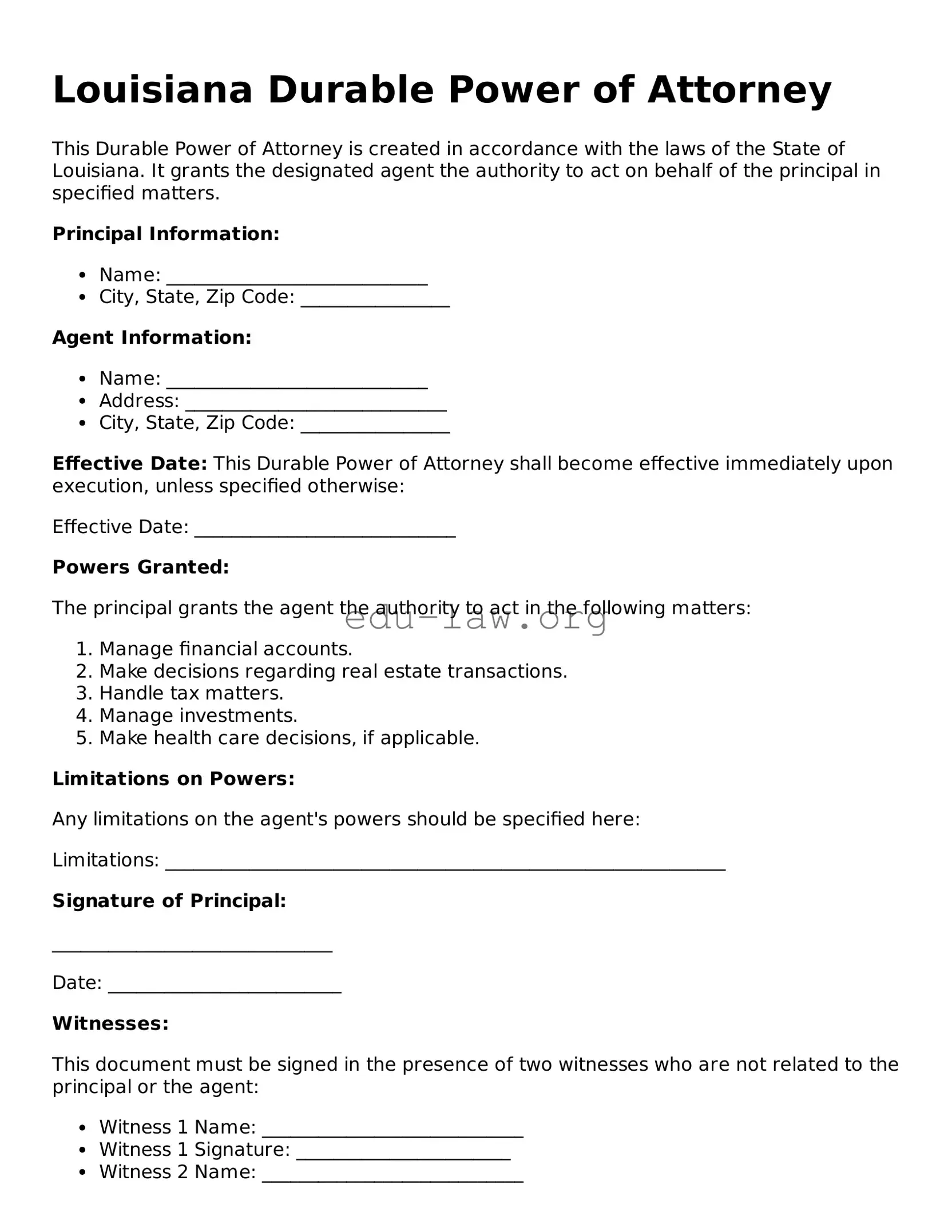
The Louisiana Durable Power of Attorney form is a vital legal document that allows individuals to designate a trusted person to make decisions on their behalf, particularly when they are unable to do so themselves. This form is particularly significant because it remains effective even if the individual becomes incapacitated, ensuring that their financial and healthcare matters are managed according to their wishes. In Louisiana, the form must be executed with specific requirements to be valid, including the signatures of the principal and a notary public. It is essential for the designated agent, often referred to as the attorney-in-fact, to understand their responsibilities and the extent of their authority, which can range from handling financial transactions to making medical decisions. Additionally, the form can be tailored to fit the individual’s preferences, allowing for broad or limited powers. Understanding these aspects is crucial for anyone considering establishing a Durable Power of Attorney in Louisiana, as it provides peace of mind and clarity during uncertain times.
Louisiana Durable Power of Attorney
This Durable Power of Attorney is created in accordance with the laws of the State of Louisiana. It grants the designated agent the authority to act on behalf of the principal in specified matters.
Principal Information:
Agent Information:
Effective Date: This Durable Power of Attorney shall become effective immediately upon execution, unless specified otherwise:
Effective Date: ____________________________
Powers Granted:
The principal grants the agent the authority to act in the following matters:
Limitations on Powers:
Any limitations on the agent's powers should be specified here:
Limitations: ____________________________________________________________
Signature of Principal:
______________________________
Date: _________________________
Witnesses:
This document must be signed in the presence of two witnesses who are not related to the principal or the agent:
Notary Public:
State of Louisiana
Parish of ________________________
On this ______ day of __________, 20____, before me, a Notary Public, personally appeared ____________________________, known to me to be the person whose name is subscribed to this document.
______________________________
Notary Public Signature
My Commission Expires: _______________
| Fact Name | Details |
|---|---|
| Definition | A Louisiana Durable Power of Attorney allows an individual to designate another person to make financial and legal decisions on their behalf, even if they become incapacitated. |
| Governing Law | The form is governed by Louisiana Civil Code Article 2985 and related statutes. |
| Durability | This power of attorney remains effective even if the principal becomes incapacitated, distinguishing it from a standard power of attorney. |
| Execution Requirements | The document must be signed by the principal and witnessed by two individuals or notarized to be valid. |
Completing the Louisiana Durable Power of Attorney form is an important step in designating someone to make decisions on your behalf. Follow these steps to ensure the form is filled out correctly.
What is a Durable Power of Attorney in Louisiana?
A Durable Power of Attorney is a legal document that allows an individual, known as the principal, to appoint someone else, referred to as the agent or attorney-in-fact, to make decisions on their behalf. This document remains effective even if the principal becomes incapacitated, meaning they can no longer make decisions for themselves.
Why should I consider creating a Durable Power of Attorney?
Creating a Durable Power of Attorney can provide peace of mind. It ensures that someone you trust can manage your financial and legal affairs if you are unable to do so. This can help avoid potential complications and delays in decision-making during difficult times.
Who can be appointed as an agent in a Durable Power of Attorney?
In Louisiana, you can appoint almost anyone as your agent, as long as they are at least 18 years old and mentally competent. This can include family members, friends, or even professionals, such as attorneys. It is important to choose someone you trust to act in your best interest.
What powers can I grant to my agent?
You have the flexibility to specify the powers you want to grant your agent. Common powers include managing bank accounts, handling real estate transactions, making investment decisions, and managing bills. You can also limit the powers if you prefer to restrict certain actions.
How does a Durable Power of Attorney differ from a regular Power of Attorney?
The main difference lies in durability. A regular Power of Attorney typically becomes invalid if the principal becomes incapacitated. In contrast, a Durable Power of Attorney remains effective even in such situations, ensuring continuity in decision-making.
Do I need to have my Durable Power of Attorney notarized?
Yes, in Louisiana, a Durable Power of Attorney must be signed in the presence of a notary public. This notarization helps confirm the identity of the principal and ensures that the document is legally binding.
Can I revoke my Durable Power of Attorney once it is created?
Yes, you can revoke your Durable Power of Attorney at any time, as long as you are mentally competent. To do this, you should create a written revocation document and inform your agent and any relevant institutions that may have a copy of your original document.
Is a Durable Power of Attorney only for financial matters?
No, a Durable Power of Attorney can cover a wide range of decisions, including health care decisions if you choose to include those powers. You can create a separate document for health care decisions, known as a Health Care Power of Attorney, or include health care decisions in your Durable Power of Attorney.
What happens if I don’t have a Durable Power of Attorney?
If you do not have a Durable Power of Attorney and become incapacitated, a court may need to appoint a guardian or conservator to manage your affairs. This process can be lengthy and may not result in your preferred choice of decision-maker.
How can I ensure my Durable Power of Attorney is valid and effective?
To ensure your Durable Power of Attorney is valid, it should be properly drafted, signed, and notarized according to Louisiana law. It is advisable to consult with a legal professional to ensure that all requirements are met and that the document accurately reflects your wishes.
Not Specifying Powers Clearly: Individuals often fail to clearly outline the specific powers they wish to grant. This can lead to confusion and disputes later. It is important to be precise about what decisions the agent can make on behalf of the principal.
Neglecting to Date the Document: Some people forget to include the date when signing the form. Without a date, it may be difficult to determine when the powers become effective or if the document is still valid.
Not Including Successor Agents: Many individuals overlook the option to name a successor agent. If the primary agent is unable or unwilling to act, having a backup can ensure that decisions can still be made without interruption.
Failing to Sign in Front of Witnesses: In Louisiana, the Durable Power of Attorney form must be signed in front of a notary public or two witnesses. Skipping this step can render the document invalid.
Ignoring State-Specific Requirements: Each state has its own rules regarding power of attorney forms. Individuals often make the mistake of using a generic form without ensuring it meets Louisiana's specific requirements.
A Louisiana Durable Power of Attorney form is an important document that allows an individual to appoint someone else to make decisions on their behalf. In conjunction with this form, several other documents may be beneficial to ensure comprehensive planning and protection of one’s interests. Below is a list of related forms and documents that are often used alongside the Durable Power of Attorney.
Utilizing these documents in conjunction with the Louisiana Durable Power of Attorney can provide clarity and security in decision-making processes. It is advisable to consult with a legal professional to ensure that all forms are completed correctly and align with personal wishes and state laws.
The Louisiana Durable Power of Attorney form is similar to a General Power of Attorney. Both documents allow an individual, known as the principal, to appoint another person, called the agent, to act on their behalf. However, the key distinction lies in durability. A General Power of Attorney typically becomes void if the principal becomes incapacitated, while a Durable Power of Attorney remains effective even in such situations. This makes the Durable Power of Attorney particularly useful for long-term planning and ensuring that decisions can continue to be made if the principal is unable to do so themselves.
Another document that shares similarities with the Durable Power of Attorney is the Medical Power of Attorney. While the Durable Power of Attorney generally covers financial and legal matters, the Medical Power of Attorney specifically focuses on healthcare decisions. This document allows the principal to designate someone to make medical choices on their behalf in case they are unable to communicate their wishes. Both documents empower an agent to act in the principal's best interest, but they cater to different aspects of life—financial versus health-related decisions.
A Living Will is also comparable to the Durable Power of Attorney, particularly in its focus on end-of-life decisions. While the Durable Power of Attorney allows an agent to manage financial matters, a Living Will outlines the principal's preferences regarding medical treatment and life-sustaining measures in critical situations. Both documents serve to protect the principal’s wishes, but the Living Will is more focused on healthcare decisions, while the Durable Power of Attorney encompasses a broader range of responsibilities.
The Revocable Trust shares some characteristics with the Durable Power of Attorney, particularly in terms of asset management. A Revocable Trust allows an individual to place their assets into a trust, managed by a trustee, while still retaining control over those assets during their lifetime. Similar to a Durable Power of Attorney, a Revocable Trust can provide clarity and direction regarding how assets should be handled if the individual becomes incapacitated. However, a trust typically requires more formalities to establish and manage compared to the simpler Durable Power of Attorney.
The Advance Healthcare Directive is another document akin to the Durable Power of Attorney. This directive combines elements of a Living Will and a Medical Power of Attorney, allowing individuals to express their healthcare preferences while also appointing someone to make decisions on their behalf. Like the Durable Power of Attorney, it ensures that a person’s wishes are respected when they can no longer advocate for themselves. Both documents are crucial for comprehensive planning, addressing different facets of personal care and decision-making.
Lastly, the Guardianship document is similar in that it involves appointing someone to make decisions for another person. However, unlike the Durable Power of Attorney, which is created voluntarily by the principal, a Guardianship is typically established through a court process when an individual is deemed incapable of managing their own affairs. The guardian assumes responsibility for the individual’s well-being, making decisions about their personal and financial matters. While both documents aim to protect the interests of those who cannot act for themselves, the pathways to their establishment and the nature of authority granted differ significantly.
When filling out the Louisiana Durable Power of Attorney form, it is essential to approach the task with care and consideration. This document allows someone to act on your behalf in financial and legal matters, so accuracy is crucial. Below is a list of things you should and shouldn't do while completing this form.
By following these guidelines, you can help ensure that your Durable Power of Attorney form is completed correctly and reflects your intentions clearly.
Understanding the Louisiana Durable Power of Attorney form is essential for effective estate planning. However, several misconceptions can lead to confusion and potential legal issues. Below is a list of common misconceptions, along with clarifications to enhance understanding.
This is incorrect. While many people associate a Durable Power of Attorney with financial decisions, it can also cover health care decisions, depending on how it is drafted.
In Louisiana, your agent does not need to be a lawyer. You can appoint a trusted friend or family member to act on your behalf.
This is misleading. A Durable Power of Attorney remains effective even if the principal becomes incapacitated, which is a key feature of its durability.
While the agent has significant authority, they must act in the best interest of the principal and adhere to the limitations set forth in the document.
This is not necessarily true. A new Durable Power of Attorney will revoke a previous one only if it explicitly states so or if it is executed after the prior document.
These are distinct documents. A living will outlines your wishes regarding medical treatment, while a Durable Power of Attorney appoints someone to make decisions on your behalf.
This is false. The principal retains the right to change or revoke the Durable Power of Attorney at any time, as long as they are competent to do so.
This is incorrect. Each state, including Louisiana, has specific laws and requirements governing Durable Power of Attorney forms, so it is crucial to use the correct form for the jurisdiction.
When considering a Durable Power of Attorney (DPOA) in Louisiana, it's essential to understand the key aspects of this important legal document. Here are some crucial takeaways:
Understanding these points can help ensure that your Durable Power of Attorney serves its intended purpose effectively.