In the state of Louisiana, the Do Not Resuscitate (DNR) Order form plays a crucial role in ensuring that individuals have control over their medical treatment preferences, particularly in end-of-life situations. This form allows patients to communicate their wishes regarding resuscitation efforts in the event of a cardiac arrest or respiratory failure. By completing a DNR Order, individuals can specify that they do not wish to receive cardiopulmonary resuscitation (CPR) or other life-sustaining measures. It is important to understand that this decision is deeply personal and should be made in consultation with healthcare providers, family members, and loved ones. The DNR Order must be signed by a physician and should be readily available in the patient's medical records to ensure that emergency personnel are aware of these wishes. Additionally, Louisiana law requires that the form be clearly identifiable and easily accessible, often by using a specific color or format. As individuals navigate the complexities of healthcare decisions, the DNR Order serves as a vital tool in honoring personal choices and promoting dignity in the face of critical medical situations.
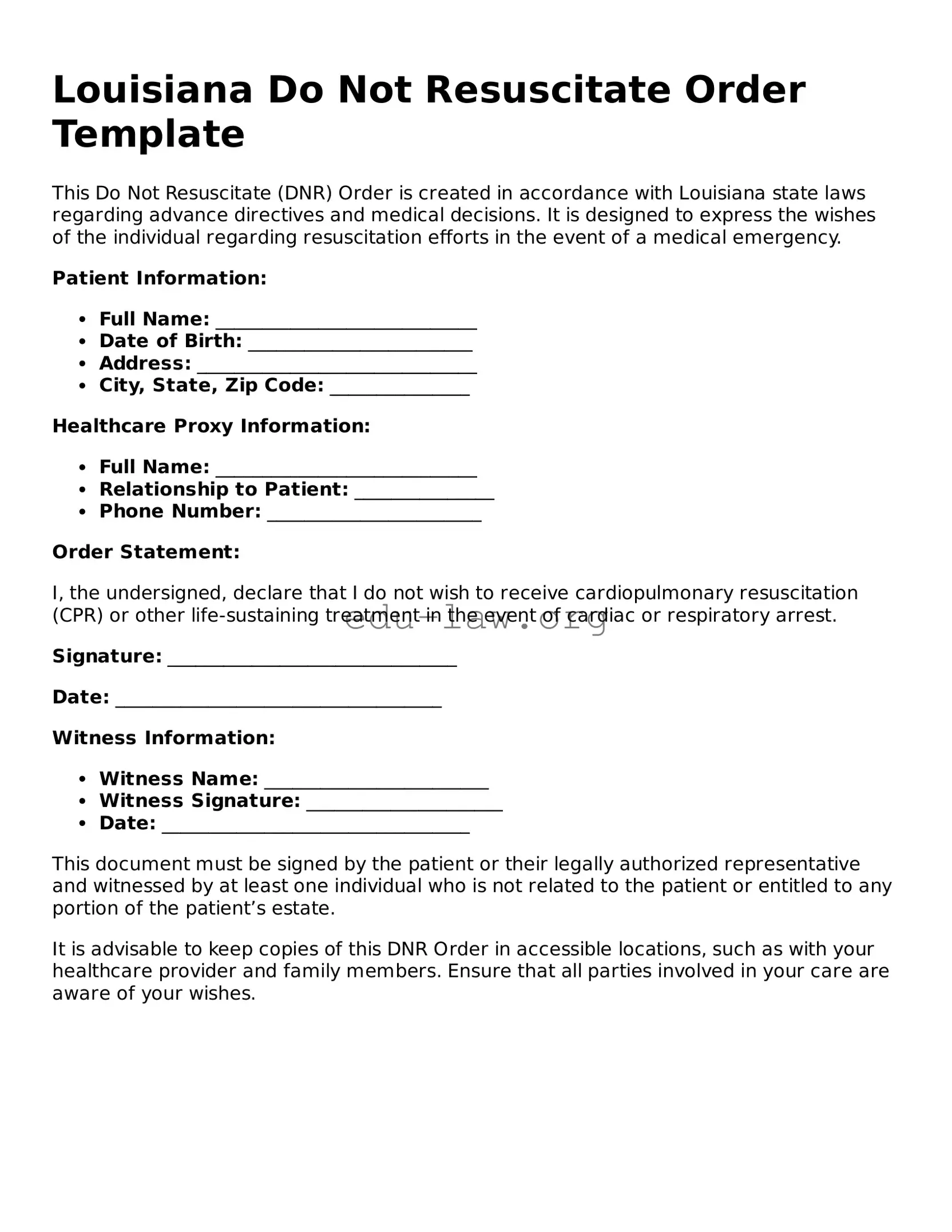
Louisiana Do Not Resuscitate Order Template
This Do Not Resuscitate (DNR) Order is created in accordance with Louisiana state laws regarding advance directives and medical decisions. It is designed to express the wishes of the individual regarding resuscitation efforts in the event of a medical emergency.
Patient Information:
Healthcare Proxy Information:
Order Statement:
I, the undersigned, declare that I do not wish to receive cardiopulmonary resuscitation (CPR) or other life-sustaining treatment in the event of cardiac or respiratory arrest.
Signature: _______________________________
Date: ___________________________________
Witness Information:
This document must be signed by the patient or their legally authorized representative and witnessed by at least one individual who is not related to the patient or entitled to any portion of the patient’s estate.
It is advisable to keep copies of this DNR Order in accessible locations, such as with your healthcare provider and family members. Ensure that all parties involved in your care are aware of your wishes.
| Fact Name | Description |
|---|---|
| Definition | The Louisiana Do Not Resuscitate (DNR) Order form allows individuals to refuse resuscitation efforts in case of cardiac arrest or respiratory failure. |
| Governing Law | This form is governed by Louisiana Revised Statutes, Title 40, Section 1151.1. |
| Eligibility | Any adult may complete a DNR order, provided they are of sound mind and understand the implications. |
| Signature Requirement | The form must be signed by the individual or their legal representative to be valid. |
| Witnesses | The DNR order must be witnessed by at least one adult who is not related to the individual or entitled to any part of their estate. |
| Healthcare Provider Notification | Healthcare providers must be informed of the existence of the DNR order for it to be honored. |
| Revocation | Individuals can revoke their DNR order at any time, either verbally or in writing. |
| Emergency Medical Services (EMS) Compliance | EMS personnel are required to comply with the DNR order as long as it is properly completed and valid. |
| Storage of Form | The DNR order should be kept in a location that is easily accessible to healthcare providers and emergency personnel. |
| Additional Considerations | Individuals are encouraged to discuss their DNR wishes with family members and healthcare providers to ensure clarity and understanding. |
After obtaining the Louisiana Do Not Resuscitate Order form, it is essential to fill it out accurately to ensure your wishes are clearly documented. Follow these steps carefully to complete the form.
Once the form is filled out, ensure that it is kept in an accessible location. It is important to share copies with healthcare providers and family members to ensure everyone is informed of the patient's wishes.
What is a Do Not Resuscitate (DNR) Order in Louisiana?
A Do Not Resuscitate Order is a medical order that instructs healthcare providers not to perform cardiopulmonary resuscitation (CPR) in the event a patient stops breathing or their heart stops beating. In Louisiana, this order is typically used by individuals with serious health conditions who wish to avoid aggressive life-saving measures. It reflects the patient’s wishes regarding end-of-life care and is an important aspect of advance care planning.
Who can request a DNR Order in Louisiana?
In Louisiana, a DNR Order can be requested by the patient themselves if they are capable of making their own medical decisions. If the patient is unable to make decisions, a legally authorized representative, such as a family member or designated healthcare proxy, may request the order on their behalf. It is crucial that the request reflects the patient’s wishes and values regarding their medical treatment.
How is a DNR Order documented in Louisiana?
A DNR Order in Louisiana must be documented on a specific form provided by the state. This form must be completed and signed by the patient or their authorized representative, along with the attending physician. The completed form should be kept in a readily accessible location, such as with the patient’s medical records or displayed prominently in their home. It is essential that healthcare providers are aware of the DNR Order to ensure that the patient’s wishes are respected.
Can a DNR Order be revoked or changed?
Yes, a DNR Order can be revoked or changed at any time by the patient or their authorized representative. If the patient’s wishes regarding resuscitation change, they should communicate this to their healthcare provider and complete a new DNR Order form if necessary. It is important to ensure that any changes are documented and that healthcare providers are informed to avoid any confusion during a medical emergency.
What should I do if I have a DNR Order and need medical care?
If you have a DNR Order and require medical care, it is important to communicate your wishes clearly to all healthcare providers involved in your care. Carrying a copy of the DNR Order with you or wearing a medical alert bracelet can help ensure that your wishes are known in an emergency situation. Additionally, discussing your DNR Order with family members can help ensure that they understand your preferences and can advocate for you if needed.
Inaccurate Personal Information: Individuals often fail to provide accurate personal details. This includes the patient’s full name, date of birth, and address. Any discrepancies can lead to confusion and complications in emergency situations.
Improper Signatures: The form requires signatures from both the patient (or their legal representative) and a physician. Sometimes, people neglect to obtain the necessary signatures, rendering the document invalid.
Missing Witness Requirements: In Louisiana, the Do Not Resuscitate Order must be witnessed by two individuals who are not related to the patient. Failing to include witnesses can invalidate the order.
Not Updating the Form: Life circumstances change. Some individuals forget to update their DNR orders when there are changes in health status, preferences, or legal representation. This can lead to situations that do not reflect the patient’s current wishes.
In Louisiana, the Do Not Resuscitate (DNR) Order form is an important document for individuals who wish to specify their preferences regarding resuscitation in the event of a medical emergency. Alongside this form, several other documents may be relevant for ensuring that a person's healthcare wishes are honored. Below is a list of these documents.
Understanding these documents can help individuals and their families navigate difficult healthcare decisions. It is essential to ensure that personal wishes regarding medical treatment are clearly communicated and legally documented.
The Louisiana Do Not Resuscitate (DNR) Order form shares similarities with the Advance Directive, a legal document that allows individuals to outline their preferences for medical treatment in the event they become unable to communicate their wishes. Both documents serve to guide healthcare providers and family members in making decisions that align with the patient's values and desires. While the DNR specifically addresses resuscitation efforts, the Advance Directive can cover a broader range of medical interventions, including life support and palliative care options.
Another document comparable to the DNR is the Physician Orders for Life-Sustaining Treatment (POLST). Like the DNR, the POLST is designed for individuals with serious health conditions who wish to have their treatment preferences honored. The POLST form translates the patient's wishes into actionable medical orders, ensuring that healthcare providers are aware of the patient's desires regarding resuscitation and other life-sustaining treatments. Unlike the DNR, the POLST can encompass a wider array of medical interventions beyond just resuscitation.
The Health Care Proxy is also similar to the DNR Order, as it allows individuals to appoint someone to make healthcare decisions on their behalf if they are unable to do so. This document emphasizes the importance of having a designated advocate who understands the patient's values and wishes. While the DNR focuses solely on resuscitation preferences, the Health Care Proxy empowers the appointed individual to make broader medical decisions, which may include adhering to the DNR wishes.
The Living Will is another document that bears resemblance to the DNR. This legal instrument enables individuals to specify their preferences regarding end-of-life care, including their desires about resuscitation. Like the DNR, a Living Will can help prevent unwanted medical interventions. However, the Living Will generally addresses a wider scope of treatment options and may provide guidance on issues such as artificial nutrition and hydration, which the DNR does not explicitly cover.
The Medical Power of Attorney also parallels the DNR Order in that it designates an individual to make healthcare decisions for someone who is incapacitated. This document can be crucial in situations where a patient’s wishes regarding resuscitation and other medical treatments may not be clearly articulated. The Medical Power of Attorney can encompass the same decisions outlined in the DNR, but it also grants broader authority to the appointed agent to make various healthcare choices based on the patient's best interests.
Another related document is the Do Not Intubate (DNI) Order, which specifically addresses a patient's wishes regarding intubation and mechanical ventilation. While the DNR focuses on the broader context of resuscitation efforts, the DNI is a more targeted directive that can be included as part of a comprehensive end-of-life plan. Both documents aim to respect the patient's autonomy and ensure that their preferences are followed in critical situations.
Finally, the Comfort Care Order is akin to the DNR in that it emphasizes the provision of comfort and palliative care rather than aggressive medical interventions. This document ensures that patients receive appropriate pain management and supportive care without the expectation of resuscitation. While the DNR prohibits resuscitative efforts, the Comfort Care Order complements it by affirming the patient's right to a dignified and peaceful end-of-life experience.
When filling out the Louisiana Do Not Resuscitate (DNR) Order form, it is important to approach the process with care and consideration. Below is a list of things to do and avoid, which can help ensure that the form is completed correctly and reflects the individual's wishes.
Understanding the Louisiana Do Not Resuscitate (DNR) Order form is crucial for patients and their families. However, several misconceptions can lead to confusion and misinformed decisions. Here are eight common misconceptions about the DNR form:
Addressing these misconceptions is essential for making informed decisions about end-of-life care. Understanding the nuances of a DNR can empower individuals to advocate for their healthcare preferences effectively.
Filling out and using the Louisiana Do Not Resuscitate (DNR) Order form is an important step for individuals who wish to express their medical treatment preferences. Here are some key takeaways to consider:
Being informed about the DNR Order process can help ensure that your healthcare preferences are respected. Take the time to understand the implications and discuss them with your loved ones.