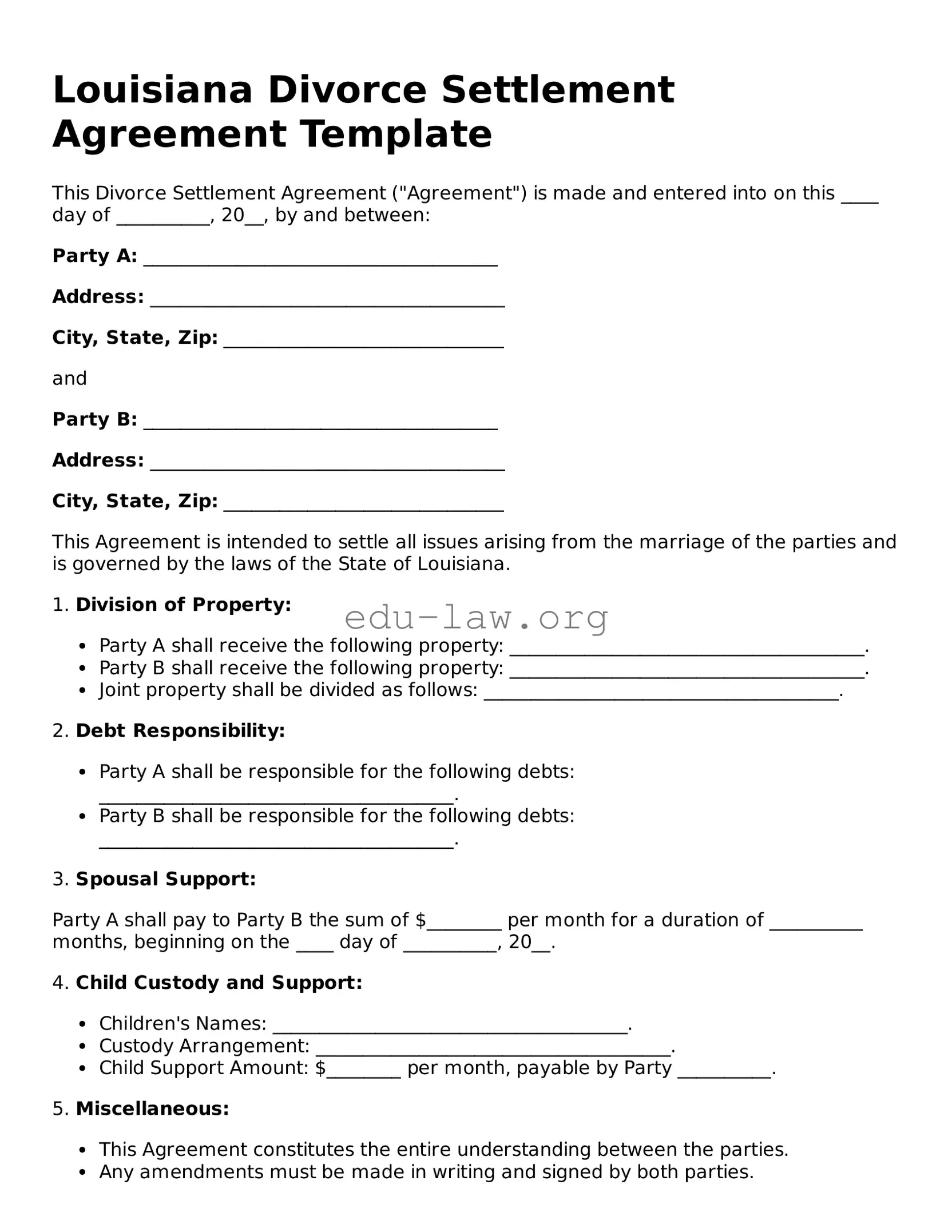
In the state of Louisiana, the Divorce Settlement Agreement form serves as a crucial document in the dissolution of marriage process, outlining the terms and conditions agreed upon by both parties. This form typically addresses key aspects such as the division of marital property, the arrangement for child custody and visitation, and the determination of child support obligations. Additionally, it may include provisions for spousal support, ensuring that both individuals are adequately supported post-divorce. The agreement must be comprehensive, reflecting the mutual understanding and consent of both spouses regarding their rights and responsibilities moving forward. It is essential that this document is carefully drafted to minimize the potential for future disputes, as it serves not only as a legal record but also as a guide for the parties involved in navigating their new circumstances. In essence, the Divorce Settlement Agreement is designed to facilitate a smoother transition for both spouses and any children affected by the divorce, promoting clarity and stability during a challenging time.
Louisiana Divorce Settlement Agreement Template
This Divorce Settlement Agreement ("Agreement") is made and entered into on this ____ day of __________, 20__, by and between:
Party A: ______________________________________
Address: ______________________________________
City, State, Zip: ______________________________
and
Party B: ______________________________________
Address: ______________________________________
City, State, Zip: ______________________________
This Agreement is intended to settle all issues arising from the marriage of the parties and is governed by the laws of the State of Louisiana.
1. Division of Property:
2. Debt Responsibility:
3. Spousal Support:
Party A shall pay to Party B the sum of $________ per month for a duration of __________ months, beginning on the ____ day of __________, 20__.
4. Child Custody and Support:
5. Miscellaneous:
IN WITNESS WHEREOF, the parties have executed this Divorce Settlement Agreement as of the date first above written.
Party A Signature: ____________________________ Date: ____________
Party B Signature: ____________________________ Date: ____________
Witness Signature: ____________________________ Date: ____________
| Fact Name | Details |
|---|---|
| Governing Law | The Louisiana Divorce Settlement Agreement is governed by Louisiana Civil Code, specifically Articles 131 through 158. |
| Purpose | This form is used to outline the terms of a divorce settlement between spouses. |
| Property Division | The agreement addresses how marital property will be divided between the parties. |
| Child Custody | It includes provisions for child custody arrangements, if applicable. |
| Child Support | The form stipulates any child support obligations that one parent must fulfill. |
| Spousal Support | It may also outline any spousal support (alimony) payments agreed upon by the parties. |
| Legal Requirements | The agreement must be signed by both parties and may require notarization to be enforceable. |
Once you have gathered the necessary information, you can begin filling out the Louisiana Divorce Settlement Agreement form. This document is crucial for outlining the terms of your divorce and ensuring that both parties are on the same page. Follow the steps carefully to complete the form accurately.
What is a Louisiana Divorce Settlement Agreement?
A Louisiana Divorce Settlement Agreement is a legal document that outlines the terms of a divorce between two parties. It covers various aspects such as property division, child custody, child support, and alimony. This agreement is crucial as it helps both parties reach a mutual understanding and can be submitted to the court for approval.
Who needs to complete this form?
Both spouses going through a divorce in Louisiana should complete this form if they can reach an agreement on the terms of their divorce. It is essential for couples who want to avoid lengthy court battles and seek a more amicable resolution.
What should be included in the agreement?
The agreement should include details about the division of marital property, debts, child custody arrangements, visitation rights, child support amounts, and any spousal support. Each section should be clear and detailed to avoid misunderstandings in the future.
Is the Divorce Settlement Agreement legally binding?
Yes, once signed by both parties and approved by the court, the Divorce Settlement Agreement becomes legally binding. This means that both parties are required to adhere to the terms outlined in the agreement. Failure to comply can result in legal consequences.
Can the agreement be modified after it is signed?
Yes, the agreement can be modified, but both parties must agree to the changes. If circumstances change significantly, such as a job loss or relocation, it may be necessary to revisit the agreement. Any modifications should be documented and submitted to the court for approval.
Do I need a lawyer to create a Divorce Settlement Agreement?
While it is not legally required to have a lawyer, it is highly recommended. A lawyer can help ensure that the agreement is fair, comprehensive, and compliant with Louisiana laws. Having legal guidance can prevent potential issues down the line.
How do I submit the agreement to the court?
After both parties have signed the Divorce Settlement Agreement, it must be filed with the appropriate court in Louisiana. This typically involves submitting the document along with any required forms and paying a filing fee. The court will review the agreement and, if approved, will issue a divorce decree.
What happens if we cannot agree on the terms?
If both parties cannot reach an agreement, they may need to go to court for a judge to make the decisions regarding the divorce terms. This process can be more time-consuming and costly than reaching a settlement agreement outside of court.
Failing to provide complete and accurate personal information. This includes names, addresses, and contact details for both parties.
Not disclosing all assets and debts. It is crucial to list all properties, bank accounts, and liabilities to ensure a fair settlement.
Ignoring state-specific requirements. Each state has unique rules regarding divorce settlements that must be followed.
Overlooking child support calculations. Accurately determining child support obligations is essential for compliance with state guidelines.
Neglecting to address spousal support. Parties should clearly outline any alimony arrangements to avoid future disputes.
Using vague language. Clarity is important; ambiguous terms can lead to misunderstandings later on.
Failing to consider tax implications. Understanding how the settlement may affect taxes is important for both parties.
Not reviewing the agreement with legal counsel. Consulting a lawyer can help identify potential issues before finalizing the document.
Forgetting to include a dispute resolution clause. This can provide a clear process for resolving future disagreements.
Submitting the form without signatures. Both parties must sign the agreement for it to be legally binding.
When navigating a divorce in Louisiana, several forms and documents may be necessary in addition to the Divorce Settlement Agreement. Each document serves a specific purpose in the divorce process, ensuring that all legal requirements are met and that the rights of both parties are protected.
Understanding these documents can help individuals prepare for the divorce process in Louisiana. Each form plays a vital role in ensuring that the divorce is handled fairly and legally, protecting the interests of all parties involved.
The Louisiana Child Custody Agreement is a document that outlines the arrangements for the care and upbringing of children following a divorce. Similar to the Divorce Settlement Agreement, it addresses the responsibilities and rights of each parent. This agreement can include details about physical custody, legal custody, visitation schedules, and any other relevant provisions that ensure the child's best interests are prioritized. Both documents aim to minimize conflict and provide clarity to all parties involved.
The Louisiana Child Support Order is another important document that functions alongside the Divorce Settlement Agreement. It specifies the financial obligations of one parent to the other for the support of their children. Like the Divorce Settlement Agreement, it addresses the financial aspects of post-divorce life, ensuring that children receive adequate support. This document includes calculations based on income, expenses, and the needs of the children, making it a crucial element in family law.
The Louisiana Spousal Support Agreement is similar in nature to the Divorce Settlement Agreement as it addresses financial support between spouses after separation or divorce. This document can detail the amount and duration of spousal support payments, taking into account factors such as the length of the marriage and the financial needs of both parties. Both agreements aim to provide financial stability and fairness during a significant transition in life.
The Louisiana Property Settlement Agreement serves as a counterpart to the Divorce Settlement Agreement by focusing on the division of marital assets and debts. This document outlines how property will be divided between the spouses, ensuring that each party understands their rights and obligations. Like the Divorce Settlement Agreement, it aims to facilitate a fair and equitable distribution, minimizing potential disputes over property after the divorce.
The Louisiana Prenuptial Agreement is a document created before marriage that can influence the terms of a Divorce Settlement Agreement. It establishes how assets and debts will be handled in the event of a divorce. Both documents share the goal of clarifying financial matters and expectations, which can help streamline the divorce process if the marriage does not last. The prenup can provide a framework that the Divorce Settlement Agreement may build upon.
The Louisiana Mediation Agreement is similar to the Divorce Settlement Agreement in that it often results from discussions aimed at resolving disputes amicably. This document outlines the terms agreed upon during mediation sessions, which may include child custody, support, and property division. Both agreements emphasize collaboration and compromise, seeking to avoid the adversarial nature of court proceedings.
The Louisiana Joint Custody Agreement is closely related to the Divorce Settlement Agreement, particularly in cases involving children. This document specifies how parents will share responsibilities and decision-making regarding their children. Like the Divorce Settlement Agreement, it focuses on the best interests of the child and aims to create a cooperative parenting arrangement post-divorce.
The Louisiana Domestic Partnership Agreement shares similarities with the Divorce Settlement Agreement, particularly in terms of outlining the rights and responsibilities of partners. Although it is typically used for couples who are not married, it can address issues such as property division and support, much like a Divorce Settlement Agreement. Both documents serve to clarify expectations and protect the interests of both parties involved.
The Louisiana Adoption Agreement may also bear resemblance to the Divorce Settlement Agreement in that it involves legal arrangements concerning children. While the focus is different—adoption establishes a permanent legal relationship—both documents require careful consideration of the child's best interests. They emphasize the importance of stability and support in a child's life, whether through divorce or adoption.
When filling out the Louisiana Divorce Settlement Agreement form, it is important to approach the process with care. Here are some key things to do and avoid.
Following these guidelines can help ensure a smoother process during this challenging time.
Understanding the Louisiana Divorce Settlement Agreement form is crucial for anyone going through a divorce in the state. However, several misconceptions can lead to confusion. Here are eight common misconceptions:
Being aware of these misconceptions can help individuals navigate the divorce process more effectively. Understanding the purpose and requirements of the Louisiana Divorce Settlement Agreement form is vital for achieving a fair and equitable resolution.
Filling out the Louisiana Divorce Settlement Agreement form is an important step in the divorce process. This document outlines the terms agreed upon by both parties regarding various aspects of their separation. Here are some key takeaways to consider: