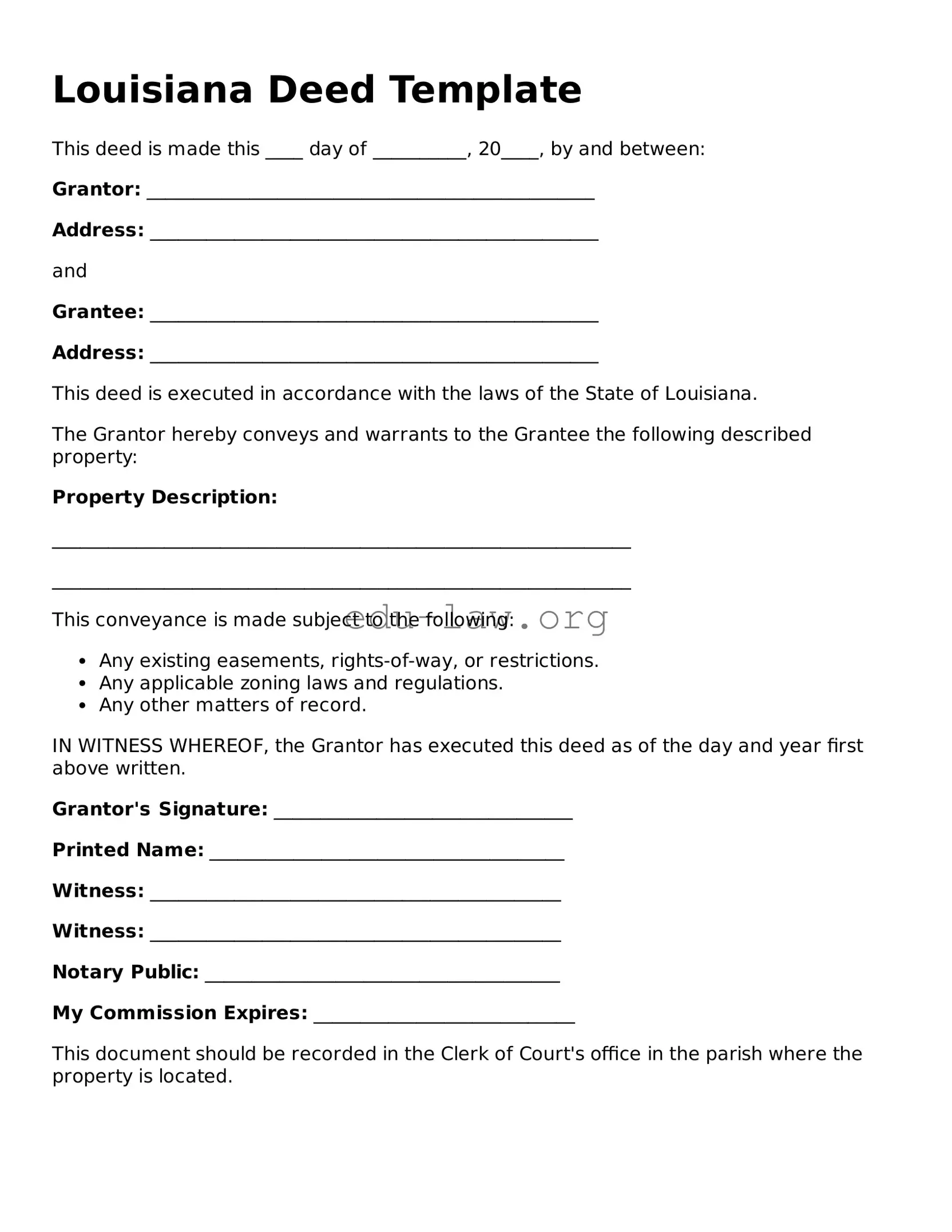
The Louisiana Deed form is a crucial document in real estate transactions, serving as the official record of property transfer between parties. It outlines essential details such as the names of the grantor and grantee, the legal description of the property, and any specific terms or conditions related to the transfer. This form not only ensures that the transaction is legally binding but also provides clarity on ownership rights. In Louisiana, the deed must be executed in writing and typically requires notarization to be valid. Understanding the various types of deeds, such as warranty deeds and quitclaim deeds, is vital for both buyers and sellers. Each type serves different purposes and offers varying levels of protection. Additionally, the form must comply with state laws to ensure enforceability, making it important for individuals to familiarize themselves with the requirements and implications of the Louisiana Deed form before proceeding with a real estate transaction.
Louisiana Deed Template
This deed is made this ____ day of __________, 20____, by and between:
Grantor: ________________________________________________
Address: ________________________________________________
and
Grantee: ________________________________________________
Address: ________________________________________________
This deed is executed in accordance with the laws of the State of Louisiana.
The Grantor hereby conveys and warrants to the Grantee the following described property:
Property Description:
______________________________________________________________
______________________________________________________________
This conveyance is made subject to the following:
IN WITNESS WHEREOF, the Grantor has executed this deed as of the day and year first above written.
Grantor's Signature: ________________________________
Printed Name: ______________________________________
Witness: ____________________________________________
Witness: ____________________________________________
Notary Public: ______________________________________
My Commission Expires: ____________________________
This document should be recorded in the Clerk of Court's office in the parish where the property is located.
| Fact Name | Description |
|---|---|
| Governing Law | The Louisiana Deed form is governed by the Louisiana Civil Code. |
| Types of Deeds | Common types include warranty deeds, quitclaim deeds, and special warranty deeds. |
| Transfer of Ownership | A deed is a legal document that transfers ownership of real property from one party to another. |
| Signature Requirement | All parties involved must sign the deed for it to be valid. |
| Notarization | The deed must be notarized to ensure its authenticity. |
| Recording | It is recommended to record the deed with the local parish clerk to protect ownership rights. |
| Legal Description | A clear legal description of the property must be included in the deed. |
| Consideration | The deed should state the consideration (payment) for the property, though it can be nominal. |
| Revocation | Once executed, a deed cannot be revoked unless a new deed is created to transfer the property back. |
Once you have gathered all necessary information and documents, you are ready to fill out the Louisiana Deed form. Completing this form accurately is crucial for ensuring that the transfer of property ownership is legally recognized. Follow the steps below to fill out the form correctly.
After filling out the form, the next step is to take it to the appropriate parish clerk’s office for recording. This ensures that the deed is officially recognized and protects the rights of the new property owner.
What is a Louisiana Deed form?
A Louisiana Deed form is a legal document used to transfer ownership of real property from one party to another within the state of Louisiana. This form serves as proof of the transaction and outlines the details of the transfer, including the names of the buyer and seller, the property description, and any conditions of the sale. It is essential for both parties to ensure that the deed is properly executed and recorded to protect their rights and interests in the property.
How do I complete a Louisiana Deed form?
Completing a Louisiana Deed form requires accurate information about the property and the parties involved. Start by clearly identifying the seller (grantor) and buyer (grantee) with their full names and addresses. Next, provide a detailed description of the property, including its legal description, which can usually be found in previous deeds or property tax records. After filling out the necessary information, both parties must sign the deed in the presence of a notary public. Finally, the completed deed should be filed with the appropriate parish clerk's office to ensure it is officially recorded.
Are there different types of Deed forms in Louisiana?
Yes, Louisiana recognizes several types of Deed forms, each serving different purposes. The most common types include the Act of Sale, which is used for the sale of property; the Quitclaim Deed, which transfers whatever interest the seller has in the property without guaranteeing that interest; and the Warranty Deed, which provides a guarantee that the seller holds clear title to the property. It is important to choose the appropriate type of deed based on the specifics of the transaction and the level of protection desired.
Do I need an attorney to create a Louisiana Deed form?
Not including the correct property description. A vague or incomplete description can lead to confusion and disputes later on.
Failing to identify all grantors and grantees. Everyone involved in the transaction must be clearly named to avoid legal issues.
Neglecting to sign the document. Without signatures, the deed is not legally valid.
Overlooking the need for witnesses. Louisiana requires that certain deeds be witnessed to be enforceable.
Not having the deed notarized. A notarized deed adds an extra layer of authenticity and can be crucial for legal purposes.
Using outdated or incorrect forms. Always ensure you have the latest version of the deed form to avoid complications.
Forgetting to check for liens or encumbrances on the property. This can affect ownership rights and future transactions.
Not filing the deed with the appropriate government office. Failure to file can result in the deed being considered invalid.
Ignoring local laws and regulations. Each parish may have specific requirements that need to be followed.
When dealing with property transactions in Louisiana, several forms and documents are commonly used alongside the Louisiana Deed form. Each of these documents serves a specific purpose in ensuring a smooth transfer of property ownership. Here’s a brief overview of these important forms:
Each of these documents plays a vital role in the real estate process. Understanding them can help ensure that all aspects of the property transaction are handled correctly and efficiently.
The Louisiana Deed form is similar to the Quitclaim Deed, which is often used to transfer property without any warranties regarding the title. In a Quitclaim Deed, the seller conveys whatever interest they may have in the property, but they do not guarantee that they own it outright. This makes it a quicker and simpler option for transferring property, particularly among family members or in situations where the parties trust each other. However, because there are no guarantees, buyers should exercise caution when using this type of deed.
Another document that shares similarities with the Louisiana Deed form is the Warranty Deed. Unlike a Quitclaim Deed, a Warranty Deed provides a guarantee that the seller holds clear title to the property and has the right to sell it. This type of deed protects the buyer by ensuring that if any issues arise regarding ownership, the seller is responsible for resolving them. Warranty Deeds are often used in traditional real estate transactions, where buyers seek security in their investment.
The Bargain and Sale Deed is also comparable to the Louisiana Deed form. This document transfers property from one party to another but does not provide any warranties about the title. It implies that the seller has ownership and the right to sell, but it does not guarantee that there are no encumbrances or claims against the property. This type of deed is often used in foreclosure sales or tax lien sales, where the seller may not have full knowledge of the property's history.
In some cases, the Special Purpose Deed may resemble the Louisiana Deed form. This type of deed is used for specific transactions, such as transferring property into a trust or conveying property for a particular purpose, like a gift. It often includes unique language tailored to the specific situation, which can make it more complex than a standard deed. However, like other deeds, it serves to officially document the transfer of property ownership.
The Personal Representative Deed is another document that bears similarities to the Louisiana Deed form. This type of deed is used when an estate is being settled, and a personal representative is authorized to transfer property on behalf of a deceased person. It ensures that the transfer is legally recognized and that the new owner receives the property as part of the estate settlement process. While it serves a specific purpose, it functions similarly by transferring ownership from one party to another.
Lastly, the Executor's Deed is akin to the Louisiana Deed form in that it is used in the context of estate management. When someone passes away and leaves property behind, the executor of the estate may use this deed to transfer property to heirs or beneficiaries. The Executor's Deed typically conveys the property without warranties, similar to a Quitclaim Deed. It ensures that the transfer is conducted legally and in accordance with the deceased's wishes, while also simplifying the process of distributing assets.
When filling out the Louisiana Deed form, it's important to be mindful of certain best practices. Here are seven things you should and shouldn't do:
Understanding the Louisiana Deed form is crucial for anyone involved in property transactions in the state. However, several misconceptions can lead to confusion. Here are six common misconceptions about the Louisiana Deed form:
All deeds in Louisiana are the same. Many people believe that every deed is identical in Louisiana. In reality, there are different types of deeds, such as warranty deeds and quitclaim deeds, each serving distinct purposes and offering varying levels of protection for the buyer.
A deed must be notarized to be valid. While notarization is highly recommended for the Louisiana Deed form, it is not strictly required for the deed to be legally valid. However, without notarization, proving the authenticity of the document may become more challenging.
Only the seller needs to sign the deed. Some believe that only the seller’s signature is necessary for a deed to be valid. In fact, both the seller and the buyer should sign the deed to ensure that the transfer of property is properly documented and recognized.
Filing a deed is optional. It is a common misconception that filing the deed with the local clerk of court is optional. In Louisiana, it is essential to file the deed to provide public notice of the property transfer and protect the rights of the new owner.
Deeds can be verbal. Some individuals think that a verbal agreement can suffice for transferring property. However, Louisiana law requires that property transfers be documented in writing through a deed to be enforceable.
Once a deed is signed, it cannot be changed. Many assume that a deed is final and unchangeable once signed. While it is true that changing a deed can be complex, it is possible to correct errors or modify terms through specific legal processes.
Being aware of these misconceptions can help individuals navigate property transactions in Louisiana more effectively. Understanding the nuances of the Louisiana Deed form is essential for ensuring a smooth transfer of property ownership.
Filling out and using a Louisiana Deed form is an important step in the process of transferring property ownership. Here are key takeaways to keep in mind:
Completing a Louisiana Deed form correctly is vital for a smooth property transfer. Attention to detail can save time and prevent future complications.