In Louisiana, when a person passes away, certain legal processes must be followed to settle their affairs and transfer assets. One important document in this process is the Affidavit of Death form. This form serves as a formal declaration of an individual's death, providing essential information such as the deceased's name, date of death, and relevant details about the estate. It is typically used to help transfer property and resolve any financial matters that may arise after someone has died. By filing this affidavit, family members or representatives can streamline the legal proceedings, ensuring that the deceased's wishes are honored and that their assets are distributed according to the law. Understanding how to properly complete and file this form is crucial for those navigating the complexities of estate management in Louisiana.
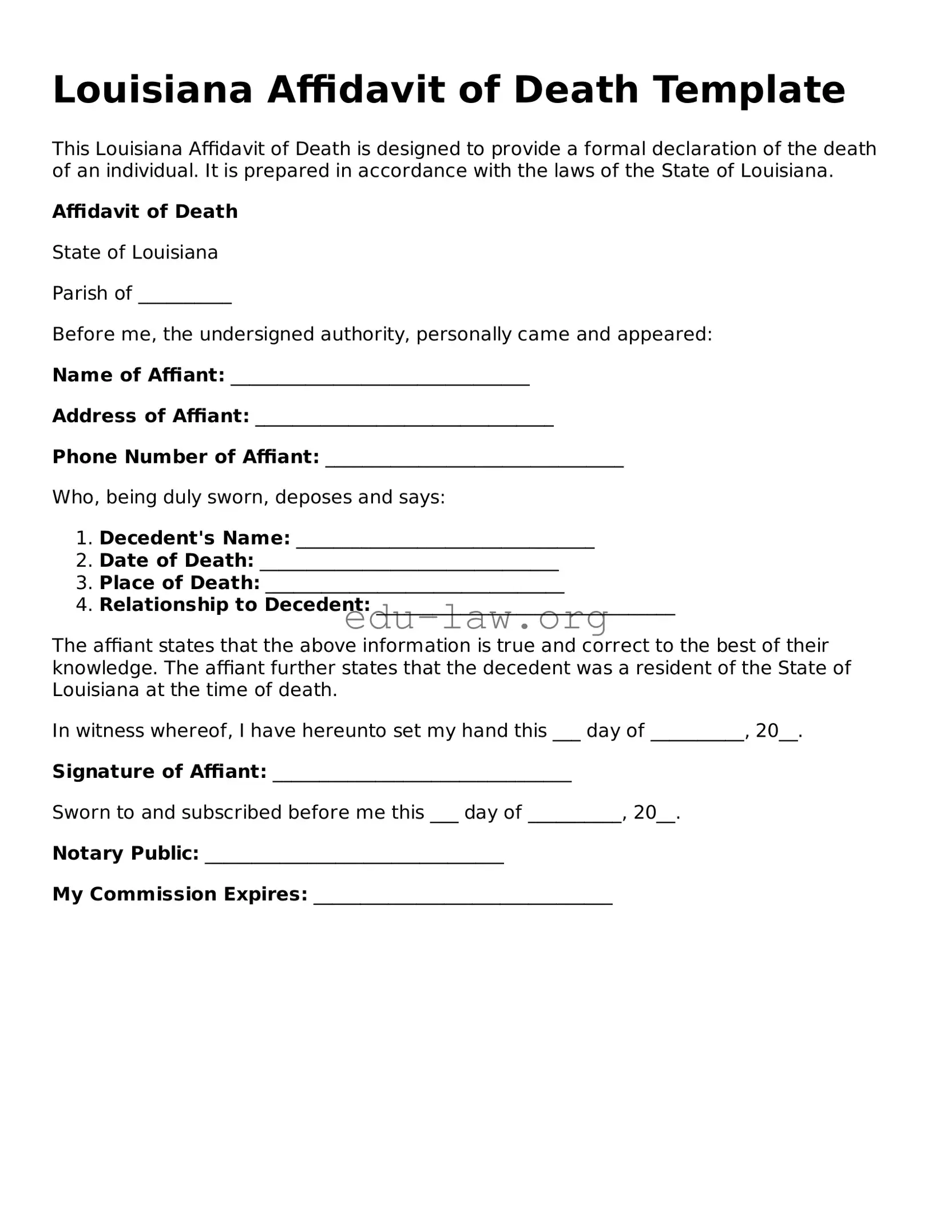
Louisiana Affidavit of Death Template
This Louisiana Affidavit of Death is designed to provide a formal declaration of the death of an individual. It is prepared in accordance with the laws of the State of Louisiana.
Affidavit of Death
State of Louisiana
Parish of __________
Before me, the undersigned authority, personally came and appeared:
Name of Affiant: ________________________________
Address of Affiant: ________________________________
Phone Number of Affiant: ________________________________
Who, being duly sworn, deposes and says:
The affiant states that the above information is true and correct to the best of their knowledge. The affiant further states that the decedent was a resident of the State of Louisiana at the time of death.
In witness whereof, I have hereunto set my hand this ___ day of __________, 20__.
Signature of Affiant: ________________________________
Sworn to and subscribed before me this ___ day of __________, 20__.
Notary Public: ________________________________
My Commission Expires: ________________________________
| Fact Name | Detail |
|---|---|
| Purpose | The Louisiana Affidavit of Death form is used to officially declare the death of an individual. |
| Governing Law | This form is governed by Louisiana Revised Statutes, specifically R.S. 9:5801. |
| Who Can File | Any interested party, such as a family member or executor, can file the affidavit. |
| Required Information | The form requires the deceased's full name, date of birth, date of death, and place of death. |
| Notarization | The affidavit must be notarized to be considered valid. |
| Filing Location | It is typically filed with the local parish clerk of court where the deceased resided. |
| Use in Probate | This affidavit may be used in probate proceedings to establish the death of the decedent. |
| Cost | Filing fees may apply, which vary by parish. |
| Public Record | The affidavit becomes part of the public record once filed. |
| Importance | It is essential for settling the deceased's estate and accessing financial accounts. |
After completing the Louisiana Affidavit of Death form, the next steps typically involve submitting the form to the appropriate authority, which may include a local parish clerk or a vital records office. Ensure that all required documentation accompanies the affidavit for processing.
What is the Louisiana Affidavit of Death form?
The Louisiana Affidavit of Death form is a legal document used to officially declare the death of an individual. This affidavit serves as proof of death and may be required for various legal and financial matters, such as settling estates or transferring property titles.
Who can file the Louisiana Affidavit of Death?
Typically, the affidavit can be filed by a family member, a close relative, or an individual who has personal knowledge of the deceased's death. It is important that the person filing the affidavit has the authority to do so, as it may be used in legal proceedings.
What information is required on the form?
The form generally requires information such as the deceased's full name, date of birth, date of death, and place of death. Additionally, the affiant must provide their own name, relationship to the deceased, and signature. Some forms may also ask for details about the circumstances of the death.
Is there a fee associated with filing the affidavit?
There may be a fee for filing the Louisiana Affidavit of Death, depending on the specific requirements of the parish where the affidavit is submitted. It is advisable to check with the local clerk of court for any applicable fees.
Where should the affidavit be filed?
The affidavit should be filed with the clerk of court in the parish where the deceased resided at the time of death. In some cases, it may also be necessary to file it in the parish where the death occurred.
Do I need to have the affidavit notarized?
Yes, the Louisiana Affidavit of Death typically needs to be notarized. This adds a layer of authenticity to the document, ensuring that the information provided is verified and legally binding.
Can the affidavit be used in other states?
The Louisiana Affidavit of Death is specific to Louisiana law. While it may be recognized in other states, it is advisable to consult with a legal professional in the relevant state to determine if additional documentation is needed.
What happens after the affidavit is filed?
Once the affidavit is filed and accepted by the clerk of court, it becomes a public record. This document can then be used to settle the deceased's estate, transfer assets, and address any other legal matters related to the death.
Not providing complete information about the deceased. It's essential to include full names, dates of birth, and other identifying details.
Failing to sign the affidavit. A signature is a crucial part of the document; without it, the affidavit is not valid.
Incorrectly stating the date of death. Double-check this information to ensure accuracy, as it is a key detail.
Using outdated forms. Make sure you are using the most current version of the Louisiana Affidavit of Death form.
Neglecting to provide the relationship to the deceased. This information helps establish your authority to file the affidavit.
Overlooking the need for notarization. The affidavit typically requires a notary public's signature to be legally binding.
Not attaching supporting documents. Depending on the situation, additional paperwork may be necessary to validate the affidavit.
Failing to keep copies of the completed affidavit. Always retain a copy for your records and future reference.
Submitting the affidavit to the wrong office. Ensure you know where to file the document, whether it’s with a local court or another agency.
When dealing with the Louisiana Affidavit of Death form, several other documents may be needed to ensure a smooth process. These documents help clarify the circumstances surrounding a person's death and facilitate various legal and administrative procedures. Below is a list of commonly associated forms and documents.
Gathering these documents can streamline the process following a death, ensuring that all legal and administrative matters are addressed efficiently. It is advisable to consult with a professional if there are any questions or concerns regarding these forms.
The Affidavit of Death form in Louisiana shares similarities with a Death Certificate. A Death Certificate is an official document issued by a government authority that confirms an individual's death. It includes important details such as the deceased's name, date of birth, date of death, and cause of death. Both documents serve to establish the fact of death, but the Death Certificate is often required for legal purposes, such as settling estates or claiming life insurance benefits.
Another document similar to the Affidavit of Death is the Will. A Will outlines how a person's assets will be distributed after their death. While the Affidavit of Death confirms that an individual has passed away, the Will provides instructions on what should happen to their property. Both documents are crucial in the estate planning process and may be used together to ensure that a deceased person's wishes are honored.
The Affidavit of Death also resembles a Probate Petition. This legal document is filed in court to begin the process of distributing a deceased person's estate. The Probate Petition typically includes information about the deceased, their assets, and the proposed executor. Similar to the Affidavit of Death, this petition must establish that the individual has died before the court can proceed with the probate process.
A similar document is the Letter of Administration. This letter is issued by the court to an administrator of an estate when there is no Will. It grants the administrator the authority to manage the deceased's estate. Like the Affidavit of Death, the Letter of Administration confirms the individual's death and facilitates the legal process of settling their affairs.
The Affidavit of Death can also be compared to a Certificate of Trust. This document provides proof of the existence of a trust and outlines its terms. When a person passes away, their trust may dictate how assets are distributed. Both the Affidavit of Death and the Certificate of Trust help in verifying the deceased's intentions regarding their assets.
Another related document is the Affidavit of Heirship. This affidavit is used to establish the heirs of a deceased person when there is no Will. It often includes information about the deceased's family and their relationship to the heirs. Like the Affidavit of Death, this document is essential for settling an estate and clarifying the distribution of assets.
Lastly, the Affidavit of Death is similar to a Release of Claim. This document is often signed by beneficiaries or heirs to relinquish their rights to a claim against the estate. It may be required during the estate settlement process. Both documents serve to confirm the deceased's passing and facilitate the legal proceedings related to the estate.
When filling out the Louisiana Affidavit of Death form, it’s important to ensure accuracy and clarity. Here are four things you should and shouldn't do:
Understanding the Louisiana Affidavit of Death form can be challenging, especially with the various misconceptions surrounding it. Here are five common misunderstandings:
This is not true. While having legal assistance can be beneficial, individuals can complete the form themselves. It is designed to be user-friendly, allowing families to manage the process without needing a lawyer.
Many believe this document is solely for initiating probate. However, it can also be used to settle various matters, such as closing bank accounts or transferring property titles, making it a versatile tool.
While notarization is highly recommended to enhance the document's credibility, it is not an absolute requirement. The form can still be effective without a notary, depending on the situation.
This misconception overlooks the fact that anyone with a legitimate interest in the deceased's affairs can file the affidavit. Friends, business partners, or other relatives may also have the right to use this document.
In reality, the process can often be completed quickly. Once the form is filled out correctly, it can be filed with the appropriate authorities without significant delays.
By dispelling these misconceptions, individuals can better navigate the complexities surrounding the Louisiana Affidavit of Death form and ensure that they are prepared to handle their loved ones' affairs with confidence.
When filling out and using the Louisiana Affidavit of Death form, keep these key takeaways in mind: