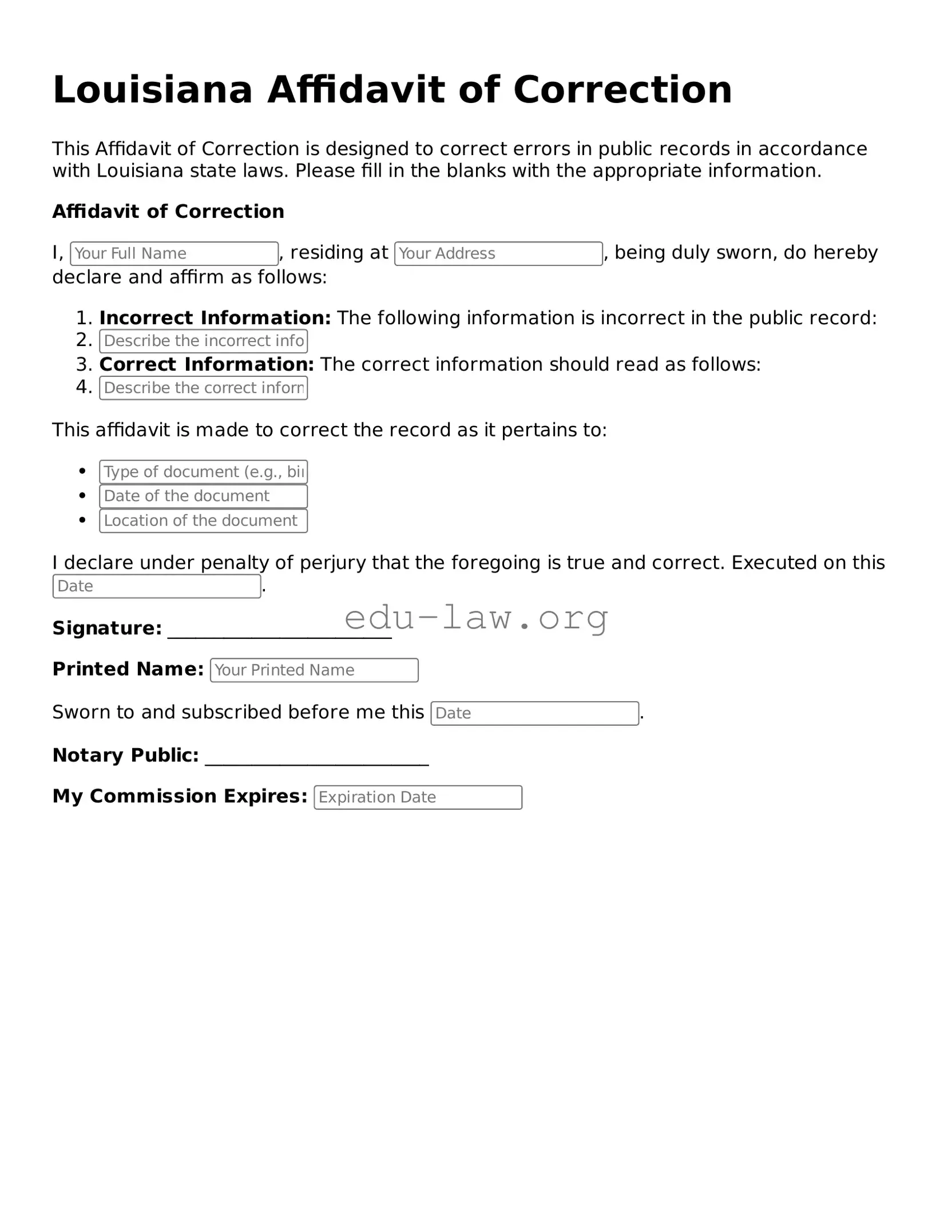
The Louisiana Affidavit of Correction form serves as a vital tool for individuals seeking to amend errors in public records. This document addresses various types of inaccuracies, such as misspellings, incorrect dates, or other factual mistakes that may appear in official filings. By completing this form, individuals can ensure that their records reflect accurate information, which is essential for legal clarity and personal peace of mind. The process typically involves providing specific details about the original document and the corrections needed. Once properly executed, the affidavit must be filed with the appropriate office to make the corrections official. Understanding the significance of this form can help prevent future complications and ensure that your records are kept up to date.
Louisiana Affidavit of Correction
This Affidavit of Correction is designed to correct errors in public records in accordance with Louisiana state laws. Please fill in the blanks with the appropriate information.
Affidavit of Correction
I, , residing at , being duly sworn, do hereby declare and affirm as follows:
This affidavit is made to correct the record as it pertains to:
I declare under penalty of perjury that the foregoing is true and correct. Executed on this .
Signature: ________________________
Printed Name:
Sworn to and subscribed before me this .
Notary Public: ________________________
My Commission Expires:
| Fact Name | Description |
|---|---|
| Purpose | The Louisiana Affidavit of Correction is used to correct clerical errors in public records. |
| Governing Law | This form is governed by Louisiana Revised Statutes, Title 9, Section 280. |
| Eligibility | Anyone who has filed a document with clerical errors can use this form to make corrections. |
| Filing Process | The completed affidavit must be filed with the same office where the original document was recorded. |
| Signature Requirement | The affidavit must be signed by the individual making the correction, and it may need to be notarized. |
Once you have the Louisiana Affidavit of Correction form ready, you will need to fill it out carefully to ensure all the necessary information is provided. After completing the form, it will need to be submitted to the appropriate office for processing.
What is the Louisiana Affidavit of Correction form?
The Louisiana Affidavit of Correction form is a legal document used to correct errors in public records. This could include mistakes in property deeds, marriage licenses, or other official documents. The form allows individuals to clarify or amend inaccuracies to ensure that the public record reflects the correct information.
Who can file an Affidavit of Correction in Louisiana?
Any individual or entity that identifies an error in a public record can file an Affidavit of Correction. This may include property owners, spouses, or representatives of an estate. It is essential that the person filing has a legitimate interest in the document being corrected.
What types of errors can be corrected with this form?
The form can address various types of errors, including typographical mistakes, incorrect names, wrong dates, or misdescriptions of property. Essentially, any clerical error that affects the accuracy of a public record can be corrected using this affidavit.
How do I complete the Louisiana Affidavit of Correction form?
To complete the form, you will need to provide specific information about the original document, including the type of document, the date it was filed, and the nature of the correction. Be clear and concise in your explanations. Ensure all required signatures are included, as this adds to the document's validity.
Is there a fee associated with filing the Affidavit of Correction?
Yes, there may be a fee for filing the Affidavit of Correction. The exact amount can vary depending on the county or parish where you are filing. It’s advisable to check with your local clerk’s office for the most accurate fee schedule.
Where do I file the Louisiana Affidavit of Correction?
The affidavit should be filed with the same office where the original document was recorded. This is typically the parish clerk of court or the recorder of mortgages. Make sure to keep a copy for your records after filing.
Do I need a witness or notary to sign the Affidavit of Correction?
Yes, the Affidavit of Correction generally needs to be notarized. This adds a layer of authenticity to the document. Some jurisdictions may also require a witness signature, so it’s best to verify local requirements before submission.
How long does it take for the correction to be processed?
The processing time can vary based on the office and the volume of filings they are handling. Generally, it may take a few days to several weeks. If you need a quick turnaround, consider following up with the office after submission.
What should I do if my correction is denied?
If your Affidavit of Correction is denied, you will typically receive a notice explaining the reasons for the denial. You can address these issues and refile the affidavit or, if necessary, seek legal advice to explore other options for correcting the record.
Failing to provide complete information. Ensure that all required fields are filled out accurately.
Not signing the affidavit. A signature is necessary for the document to be valid.
Using incorrect or outdated forms. Always check for the most current version of the affidavit.
Not including a clear explanation of the correction. A detailed description helps clarify the changes being made.
Forgetting to include supporting documents. Attach any necessary paperwork that backs up the correction.
Neglecting to date the affidavit. A date is important for tracking the timeline of the correction.
Overlooking the notary requirement. The affidavit must be notarized to be legally recognized.
Providing inconsistent information. Ensure that all details match across different documents.
Submitting the affidavit to the wrong office. Verify the correct location for submission.
Not keeping a copy for personal records. Retain a copy of the completed affidavit for future reference.
The Louisiana Affidavit of Correction form is often accompanied by several other documents that serve various purposes in legal and administrative processes. Below is a list of commonly used forms and documents that may be relevant.
Each of these documents plays a significant role in ensuring that corrections are made accurately and legally. Understanding their purpose can help streamline the process and ensure compliance with applicable regulations.
The Louisiana Affidavit of Correction is similar to the Affidavit of Identity. This document is used when an individual needs to affirm their identity, often to correct errors in personal information. Both forms serve to clarify and rectify discrepancies, ensuring that official records accurately reflect the individual’s identity. The Affidavit of Identity may be required in various situations, such as when applying for a passport or other legal documents, making it essential for maintaining accurate personal records.
Another document akin to the Louisiana Affidavit of Correction is the Declaration of Homestead. This form allows homeowners to declare their primary residence and protect it from certain creditors. Like the Affidavit of Correction, the Declaration serves to provide clear and official recognition of a person's status or property. Both documents play a vital role in safeguarding individual rights and ensuring that legal records are precise and up-to-date.
The Affidavit of Correction also resembles the Certificate of Correction. This document is typically used to amend corporate filings or other business-related records. Just as the Affidavit of Correction addresses personal information errors, the Certificate of Correction addresses mistakes in business documents. Both forms are essential for maintaining the integrity of public records, allowing individuals and businesses to correct mistakes efficiently.
Lastly, the Affidavit of Correction is similar to the Petition for Name Change. This legal document is used when an individual seeks to change their name officially. Both documents require a formal declaration and often involve a court process. They serve to ensure that the individual's name or personal information is accurately reflected in legal records, highlighting the importance of clarity and correctness in personal identification.
When filling out the Louisiana Affidavit of Correction form, it’s essential to approach the task with care. This document serves to correct errors in public records, and ensuring accuracy is crucial. Below is a list of things you should and shouldn't do while completing this form.
By following these guidelines, you can help ensure that your Louisiana Affidavit of Correction is completed correctly, minimizing the chances of further complications.
The Louisiana Affidavit of Correction form is a useful tool for correcting errors in official documents, but several misconceptions surround its use. Understanding these misconceptions can help individuals navigate the correction process more effectively.
By clarifying these misconceptions, individuals can approach the Louisiana Affidavit of Correction form with greater confidence and understanding. This knowledge empowers them to make necessary corrections efficiently and accurately.
When dealing with the Louisiana Affidavit of Correction form, it’s important to understand its purpose and how to fill it out correctly. Here are key takeaways to consider: