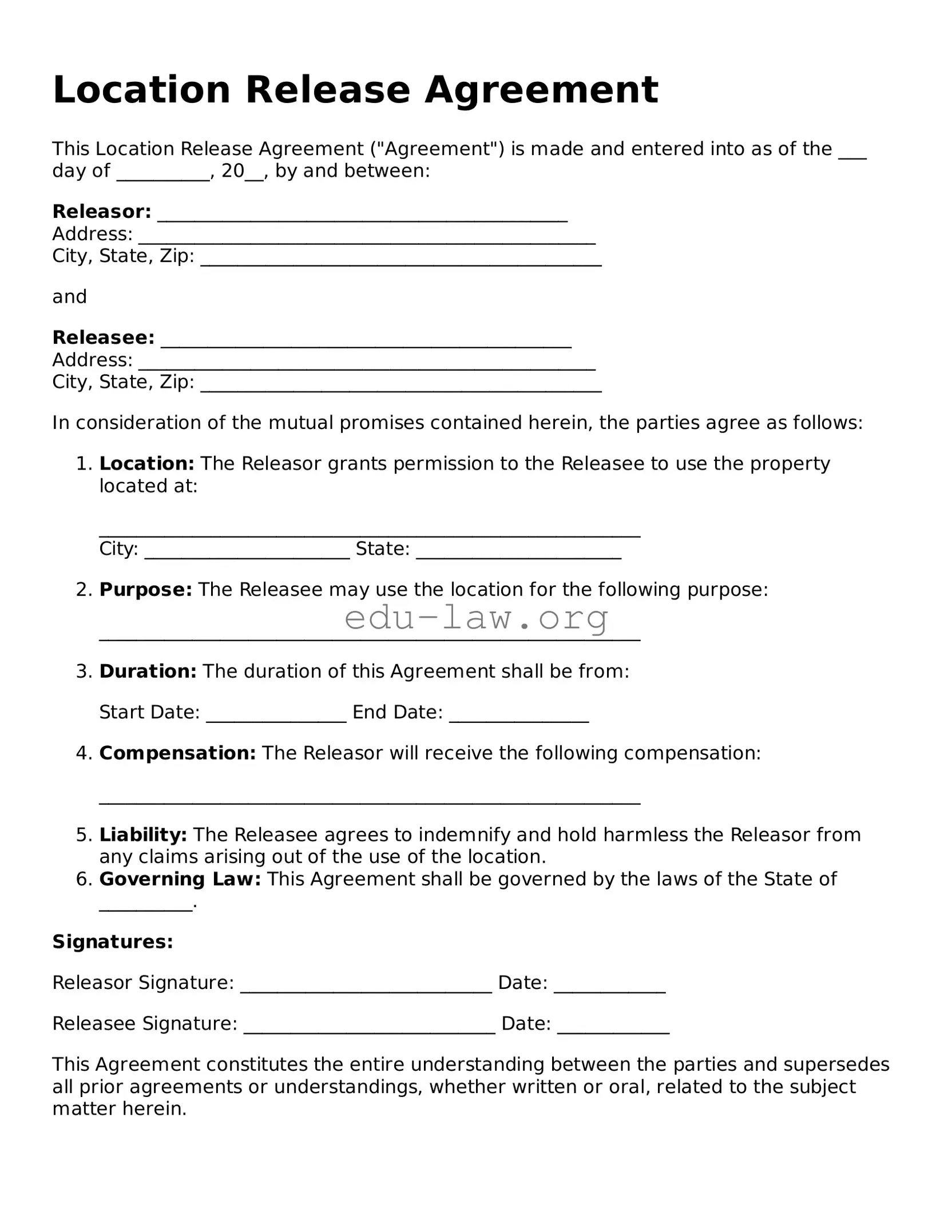
The Location Release form plays a crucial role in the world of film, photography, and other creative projects. It serves as a legal agreement between the property owner and the production team, granting permission to use a specific location for shooting. This form outlines important details, such as the dates of use, any fees involved, and the rights and responsibilities of both parties. By signing the form, property owners protect their interests while allowing filmmakers and photographers the freedom to capture their vision. Additionally, the Location Release form often includes clauses regarding liability and insurance, ensuring that both the property and the individuals involved are safeguarded. Understanding this form is essential for anyone looking to utilize private property in their creative endeavors, as it helps to prevent misunderstandings and legal disputes down the line.
Location Release Agreement
This Location Release Agreement ("Agreement") is made and entered into as of the ___ day of __________, 20__, by and between:
Releasor: ____________________________________________
Address: _________________________________________________
City, State, Zip: ___________________________________________
and
Releasee: ____________________________________________
Address: _________________________________________________
City, State, Zip: ___________________________________________
In consideration of the mutual promises contained herein, the parties agree as follows:
__________________________________________________________
City: ______________________ State: ______________________
__________________________________________________________
Start Date: _______________ End Date: _______________
__________________________________________________________
Signatures:
Releasor Signature: ___________________________ Date: ____________
Releasee Signature: ___________________________ Date: ____________
This Agreement constitutes the entire understanding between the parties and supersedes all prior agreements or understandings, whether written or oral, related to the subject matter herein.
| Fact Name | Description |
|---|---|
| Purpose | A Location Release form grants permission for the use of a specific location in a film, photo shoot, or other media projects. |
| Parties Involved | The form typically involves the property owner or authorized representative and the production company or individual seeking to use the location. |
| Consideration | In many cases, the property owner may receive compensation for the use of their location, which is often specified in the form. |
| Governing Law (California) | In California, the Location Release form is governed by the California Civil Code, particularly sections related to contracts and property rights. |
| Governing Law (New York) | In New York, the governing law includes the New York General Obligations Law, which outlines contract enforceability. |
| Duration | The form usually specifies the duration of the permission granted, detailing how long the location can be used. |
| Liability | Liability clauses are often included to protect the production company from claims arising from the use of the location. |
| Revocation | Property owners may retain the right to revoke permission under certain conditions, which should be outlined in the form. |
| Signatures | The form must be signed by both parties to be legally binding, indicating mutual agreement to the terms outlined. |
Filling out the Location Release form is a straightforward process that requires attention to detail. After completing the form, it will be submitted for review, which will help ensure that all necessary permissions are in place for your project.
What is a Location Release form?
A Location Release form is a legal document that grants permission for filmmakers, photographers, or other creatives to use a specific location for their projects. It outlines the terms under which the location can be used, ensuring that both the property owner and the production team understand their rights and responsibilities.
Why do I need a Location Release form?
This form is essential to protect both parties involved. For the property owner, it provides assurance that their space will be used in a certain way and can help avoid potential disputes. For the production team, it secures the right to use the location without fear of legal repercussions or claims of trespassing.
What information is typically included in a Location Release form?
A standard Location Release form usually includes the names and contact information of both the property owner and the production team, a detailed description of the location, the dates and times of use, and any specific conditions or restrictions related to the use of the property. It may also outline compensation, if applicable.
Do I need to pay for using a location?
Payment depends on the agreement between the property owner and the production team. Some locations may be offered for free, especially if the owner is supportive of the project. However, many property owners will expect compensation for the use of their space, which should be clearly outlined in the Location Release form.
Can I modify a Location Release form?
Yes, modifications can be made to suit the specific needs of both parties. It is crucial that any changes are agreed upon and documented in writing. Both the property owner and the production team should sign off on any amendments to ensure clarity and avoid misunderstandings.
What happens if I don’t use a Location Release form?
Without a Location Release form, you risk facing legal issues, such as claims of trespassing or unauthorized use of property. This can lead to costly disputes and damage to your reputation. It’s always advisable to secure a formal agreement to protect your project and the property owner’s interests.
Is a verbal agreement sufficient?
A verbal agreement is generally not sufficient when it comes to using a location. While it may seem convenient, it lacks the legal weight and clarity of a written document. A Location Release form provides a clear record of the agreement and helps prevent misunderstandings later on.
How can I find the right person to sign a Location Release form?
To find the appropriate person to sign, start by identifying the property owner or authorized representative. This could be a landlord, manager, or even a homeowner. It’s important to communicate openly and ensure that the person you’re dealing with has the authority to grant permission for the use of the location.
What if the location is a public space?
Using a public space can be different. While you may not need a Location Release form for public areas, you might still need permits or permissions from local authorities, especially if your project involves large equipment or a significant number of people. Always check local regulations to ensure compliance.
Can I use a Location Release form for multiple projects?
Yes, a Location Release form can be designed to cover multiple projects, but it should explicitly state this intention. Each project may have different requirements or conditions, so it’s best to outline these clearly to avoid confusion. If the terms change significantly, a new form may be necessary.
Incomplete Information: Individuals often forget to fill out all required fields. This includes missing the name of the location, the date of use, or the contact information of the property owner.
Incorrect Signatures: Some people may not have the property owner or authorized representative sign the form. This can lead to disputes about permissions later on.
Failure to Specify Usage: Not clearly stating how the location will be used can create confusion. It is essential to outline the purpose, whether for filming, photography, or other activities.
Neglecting to Review Terms: Many individuals overlook the terms and conditions associated with the release. Understanding these terms is crucial to avoid potential legal issues.
Missing Dates: Some people forget to include the start and end dates for the use of the location. This information is vital for clarity and to ensure compliance with the agreement.
A Location Release form is essential for securing permission to film or photograph on a particular property. However, several other documents often accompany this form to ensure all legal bases are covered. Below is a list of related forms and documents that may be necessary for production teams.
Having these documents in place helps facilitate a smooth production process and minimizes potential legal issues. It is advisable to consult with legal professionals to ensure all necessary forms are completed accurately and appropriately.
The Location Release form is similar to a Talent Release form, which grants permission for the use of an individual's likeness in a project. This document ensures that the talent involved understands how their image will be used and waives any claims against the production team. Like the Location Release, it protects the production by securing rights and avoiding potential disputes over image use.
Another document is the Property Release form. This form is essential when filming on private property. It allows filmmakers to obtain permission from property owners to use their space in a production. Both the Property Release and Location Release serve to protect the production team from legal issues related to unauthorized use of locations.
The Model Release form is also relevant. It is used when a photographer or filmmaker captures images of a model for commercial purposes. This document ensures that the model consents to the use of their image and understands how it will be utilized. Similar to the Location Release, it mitigates the risk of future legal claims regarding the use of the model's likeness.
A Music Release form is another comparable document. This form is used when a production intends to use a song or musical composition. It secures the rights from the copyright holder, ensuring that the production can legally include the music. Like the Location Release, it protects the production from copyright infringement claims.
The Script Release form is also important. It grants permission to use a written script for production purposes. This document is crucial when adaptations or modifications are made to the original work. The Script Release, much like the Location Release, helps avoid disputes with the original creator over the use of their material.
The Video Release form is similar as well. It is used when filming individuals for a video project. This document ensures that the subjects consent to being recorded and to the use of the footage. Both the Video Release and Location Release are vital in obtaining necessary permissions to avoid legal complications.
The Sound Release form is another document that serves a similar purpose. It is used when recording audio from individuals or environments. This form ensures that the production team has the right to use the recorded sound without facing legal challenges. Like the Location Release, it helps safeguard the production against potential disputes.
The Event Release form is also relevant. This document is used when filming at public events. It allows filmmakers to capture footage of attendees while ensuring they have the right to use the footage for promotional or commercial purposes. Both the Event Release and Location Release help clarify the permissions needed for filming in specific contexts.
Lastly, the Crew Release form is important for productions. This document secures the rights of the production team members to use their contributions in the project. It ensures that all crew members agree to their work being used as intended. Similar to the Location Release, it helps prevent any future disputes regarding the use of the crew's work in the final product.
When filling out a Location Release form, it's important to be thorough and accurate. Here are some dos and don'ts to keep in mind:
When it comes to filming in public or private locations, the Location Release form plays a crucial role. However, several misconceptions can lead to confusion and potentially costly mistakes. Here are five common misconceptions about the Location Release form:
Many believe that filming on public property doesn't require a Location Release. This is not entirely true. While you may not need a formal release for public spaces, obtaining permission can still protect you from potential disputes.
Some think that a handshake or verbal agreement suffices. In reality, having a written Location Release is essential. It clearly outlines the terms and protects both parties in case of disagreements.
While it's true that commercial projects often require a Location Release, independent filmmakers and even student projects should consider using one. It helps clarify rights and responsibilities, regardless of the project's budget.
Some individuals think that a signed Location Release is set in stone. However, amendments can be made if both parties agree. It's important to communicate any changes to ensure everyone is on the same page.
This belief is misleading. A well-drafted Location Release protects both the property owner and the filmmaker. It clarifies what is allowed and helps prevent misunderstandings.
Understanding these misconceptions can help you navigate the complexities of filming and ensure a smoother production process. Always take the time to secure the proper documentation before starting your project.
When filling out and using a Location Release form, it’s essential to understand its purpose and how to complete it effectively. Here are some key takeaways:
Understanding these key points will help ensure a smooth process when using the Location Release form. Properly completing this document not only fosters good relationships but also protects the interests of everyone involved.