When entering into a loan agreement, it is essential to understand the critical components that define the terms and conditions of the loan. A loan agreement form typically outlines the principal amount borrowed, the interest rate applicable, and the repayment schedule. It also includes the duration of the loan, detailing when payments are due and the total repayment period. Borrowers and lenders must be aware of any fees associated with the loan, such as origination fees or late payment penalties. Additionally, the form may specify collateral requirements, which serve as security for the loan. Both parties should pay attention to the conditions under which the loan can be modified or terminated, as well as any default provisions. Clarity in these areas helps ensure that both the lender and borrower have a mutual understanding of their rights and obligations throughout the loan period.
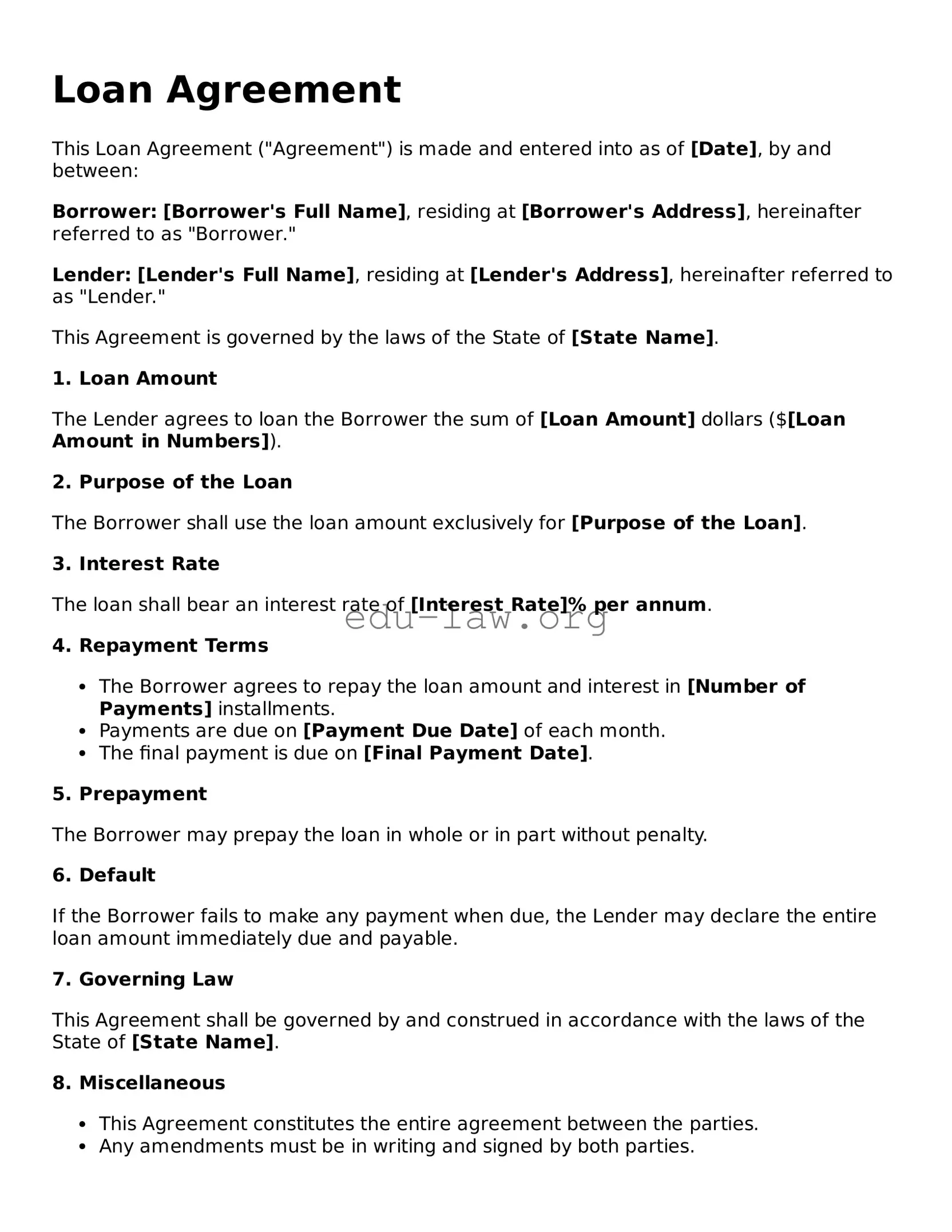
Loan Agreement
This Loan Agreement ("Agreement") is made and entered into as of [Date], by and between:
Borrower: [Borrower's Full Name], residing at [Borrower's Address], hereinafter referred to as "Borrower."
Lender: [Lender's Full Name], residing at [Lender's Address], hereinafter referred to as "Lender."
This Agreement is governed by the laws of the State of [State Name].
1. Loan Amount
The Lender agrees to loan the Borrower the sum of [Loan Amount] dollars ($[Loan Amount in Numbers]).
2. Purpose of the Loan
The Borrower shall use the loan amount exclusively for [Purpose of the Loan].
3. Interest Rate
The loan shall bear an interest rate of [Interest Rate]% per annum.
4. Repayment Terms
5. Prepayment
The Borrower may prepay the loan in whole or in part without penalty.
6. Default
If the Borrower fails to make any payment when due, the Lender may declare the entire loan amount immediately due and payable.
7. Governing Law
This Agreement shall be governed by and construed in accordance with the laws of the State of [State Name].
8. Miscellaneous
IN WITNESS WHEREOF, the parties have executed this Loan Agreement as of the date first above written.
Borrower's Signature: ___________________________
Lender's Signature: ___________________________
| Fact Name | Description |
|---|---|
| Purpose | A Loan Agreement outlines the terms and conditions under which one party lends money to another. |
| Parties Involved | The agreement typically includes a lender and a borrower, clearly identifying both parties. |
| Loan Amount | The specific sum of money being borrowed is stated, ensuring clarity on the financial obligation. |
| Interest Rate | The agreement specifies the interest rate, which can be fixed or variable, affecting repayment amounts. |
| Repayment Terms | Details about how and when the borrower will repay the loan are outlined, including installment schedules. |
| Governing Law | Each state has its own laws governing loan agreements. For example, California law may apply to agreements executed in California. |
| Default Clause | The agreement includes terms that define what constitutes a default and the consequences of defaulting. |
| Collateral | If applicable, the agreement may specify collateral that secures the loan, reducing the lender's risk. |
| Amendments | Any changes to the loan agreement must be documented in writing and signed by both parties to be valid. |
| Signatures | The agreement must be signed by both the lender and the borrower to be legally binding. |
Filling out the Loan Agreement form is a straightforward process. It requires your attention to detail to ensure all information is accurate. Once completed, you will be able to submit the form for processing.
What is a Loan Agreement form?
A Loan Agreement form is a legal document that outlines the terms and conditions of a loan between a lender and a borrower. It specifies the amount borrowed, interest rates, repayment schedule, and any collateral involved. This form serves to protect both parties by clearly stating their rights and obligations.
Who needs to fill out a Loan Agreement form?
Both lenders and borrowers should fill out a Loan Agreement form. Lenders use it to ensure they have a formal record of the loan terms, while borrowers benefit from having a clear understanding of their repayment obligations. This form is essential for personal loans, business loans, and any other financial transactions involving borrowed funds.
What information is typically included in a Loan Agreement form?
A Loan Agreement form generally includes the following information: names and contact details of both parties, loan amount, interest rate, repayment schedule, due dates, and any fees or penalties for late payments. It may also include clauses related to default, prepayment, and the governing law.
Is a Loan Agreement form legally binding?
Yes, a properly executed Loan Agreement form is legally binding. Once both parties sign the document, they agree to adhere to the terms outlined within it. However, for the agreement to be enforceable, it must meet certain legal requirements, such as being signed by both parties and containing clear terms.
Can a Loan Agreement form be modified after it is signed?
Yes, a Loan Agreement form can be modified after it is signed, but both parties must agree to the changes. It is advisable to document any modifications in writing and have both parties sign the amended agreement. This helps to avoid misunderstandings and ensures that all parties are on the same page.
What happens if the borrower defaults on the Loan Agreement?
If the borrower defaults, the lender may take several actions, depending on the terms of the agreement. Common remedies include charging late fees, accelerating the loan (demanding full repayment), or pursuing legal action to recover the owed amount. The specific consequences should be clearly outlined in the Loan Agreement form.
Do I need a lawyer to create a Loan Agreement form?
While it is not strictly necessary to hire a lawyer to create a Loan Agreement form, it can be beneficial. A lawyer can ensure that the agreement complies with state laws and adequately protects both parties’ interests. For simple loans, many templates are available that can be customized without legal assistance.
Where can I obtain a Loan Agreement form?
Loan Agreement forms can be obtained from various sources, including online legal services, financial institutions, or legal stationery stores. Many websites offer free or paid templates that can be downloaded and customized. Ensure that any form you choose is appropriate for your specific situation and complies with local laws.
Not reading the entire Loan Agreement form carefully. Many people skip sections or misunderstand important details.
Failing to provide accurate personal information. Mistakes in names, addresses, or Social Security numbers can lead to delays.
Overlooking the loan amount. Double-check that the amount requested matches the intended purpose.
Ignoring the interest rate. It’s crucial to understand how much interest will be charged over time.
Not including all required documentation. Missing documents can result in the application being rejected.
Providing inconsistent information. Ensure that all details match across different sections of the form.
Not disclosing existing debts. Lenders need a complete picture of your financial situation.
Forgetting to sign and date the form. An unsigned form is not valid and cannot be processed.
Neglecting to ask questions. If something is unclear, it’s important to seek clarification before submitting the form.
When entering into a loan agreement, several additional forms and documents may be required to ensure clarity and legal compliance. These documents serve various purposes, from outlining terms to securing the loan. Below is a list of commonly used forms associated with a loan agreement.
Understanding these documents can help borrowers navigate the loan process more effectively. Each form plays a crucial role in ensuring that both parties are protected and informed throughout the lending relationship.
A promissory note is a financial document that outlines a borrower's promise to repay a specific amount of money to a lender under agreed-upon terms. Like a loan agreement, it includes details such as the loan amount, interest rate, and repayment schedule. However, a promissory note is typically simpler and focuses primarily on the borrower's commitment, while a loan agreement often includes more comprehensive terms and conditions, including covenants and potential penalties for default.
A mortgage agreement is another document closely related to a loan agreement. It specifically deals with real estate loans and serves as a security interest for the lender. In both documents, the borrower agrees to repay the loan, but a mortgage agreement also includes provisions regarding the property being used as collateral. If the borrower defaults, the lender has the right to foreclose on the property, a detail that is not typically present in standard loan agreements.
An installment agreement is similar in that it outlines a repayment plan for a loan. This document specifies how much the borrower will pay in each installment, the frequency of payments, and the total duration of the loan. Both installment agreements and loan agreements aim to clarify the repayment process, but installment agreements often focus more on the payment schedule, while loan agreements provide a broader overview of the entire lending relationship.
A credit agreement is another document that resembles a loan agreement. It is often used in business financing and outlines the terms under which a lender will extend credit to a borrower. Similar to a loan agreement, it includes details such as the loan amount, interest rates, and repayment terms. However, credit agreements may also include additional clauses regarding covenants and conditions that the borrower must meet to maintain the credit line, which can add complexity compared to a standard loan agreement.
A lease agreement shares similarities with a loan agreement in that both involve a contractual relationship between a lessor and a lessee. In a lease agreement, the lessee pays for the use of an asset, such as equipment or property, over a specified period. While a loan agreement typically involves the transfer of funds, a lease agreement focuses on the use of an asset, but both documents require clear terms regarding payments and obligations to avoid disputes.
A personal guarantee is a document that can accompany a loan agreement, particularly in business loans. It involves a third party agreeing to be responsible for the debt if the primary borrower defaults. While a loan agreement outlines the terms of the loan itself, the personal guarantee adds an extra layer of security for the lender. Both documents work together to define the responsibilities of the borrower and any guarantors involved in the transaction.
When filling out a Loan Agreement form, it is essential to approach the task with care and attention. Here are some important do's and don'ts to consider:
When it comes to loan agreements, many people have misunderstandings that can lead to confusion or poor decision-making. Here are six common misconceptions about loan agreements that you should be aware of:
Understanding these misconceptions can help you navigate the world of loans more effectively. Always take the time to read and comprehend your loan agreement before signing. It’s an important step in ensuring a smooth borrowing experience.
When filling out and using the Loan Agreement form, keep the following key takeaways in mind: