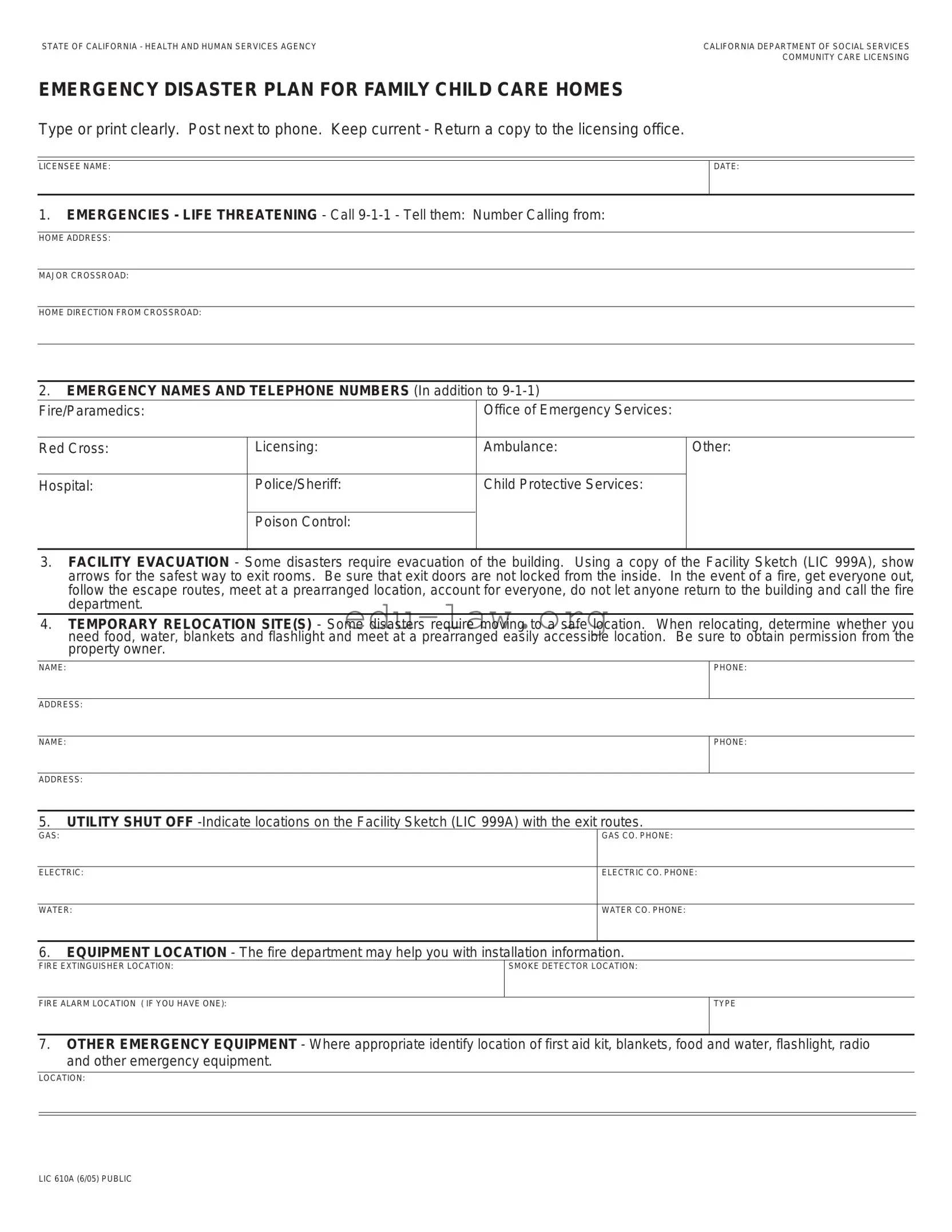
The Lic 610A form, known as the Emergency Disaster Plan for Family Child Care Homes, is an essential document designed to help child care providers prepare for emergencies. This form outlines critical information that must be readily available in case of a life-threatening situation. It includes emergency contact numbers, such as local fire departments, police, and hospitals, ensuring that help can be reached quickly. Additionally, the form emphasizes the importance of facility evacuation procedures, providing clear directions for safely exiting the building and accounting for all individuals present. It also addresses the need for temporary relocation sites, should the home become unsafe. Utility shut-off locations are specified to prevent further hazards during disasters. Moreover, the form highlights the necessity of having emergency equipment, such as fire extinguishers and first aid kits, easily accessible. By maintaining an updated and visible copy of the Lic 610A form, child care providers can ensure the safety and well-being of the children in their care during emergencies.

STATE OF CALIFORNIA - HEALTH AND HUMAN SERVICES AGENCY |
CALIFORNIA DEPARTMENT OF SOCIAL SERVICES |
|
COMMUNITY CARE LICENSING |
EMERGENCY DISASTER PLAN FOR FAMILY CHILD CARE HOMES
Type or print clearly. Post next to phone. Keep current - Return a copy to the licensing office.
LICENSEE NAME: |
DATE: |
|
|
1. |
EMERGENCIES - LIFE THREATENING - Call |
|
||
|
|
|
|
|
HOME ADDRESS: |
|
|
|
|
|
|
|
|
|
MAJOR CROSSROAD: |
|
|
|
|
|
|
|
|
|
HOME DIRECTION FROM CROSSROAD: |
|
|
|
|
|
|
|
|
|
|
|
|
|
|
2. |
EMERGENCY NAMES AND TELEPHONE NUMBERS (In addition to |
|
||
Fire/Paramedics: |
|
Office of Emergency Services: |
|
|
|
|
|
|
|
Red Cross: |
Licensing: |
Ambulance: |
Other: |
|
|
|
|
|
|
Hospital: |
Police/Sheriff: |
Child Protective Services: |
|
|
|
|
|
|
|
|
|
Poison Control: |
|
|
|
|
|
|
|
3.FACILITY EVACUATION - Some disasters require evacuation of the building. Using a copy of the Facility Sketch (LIC 999A), show arrows for the safest way to exit rooms. Be sure that exit doors are not locked from the inside. In the event of a fire, get everyone out, follow the escape routes, meet at a prearranged location, account for everyone, do not let anyone return to the building and call the fire department.
4.TEMPORARY RELOCATION SITE(S) - Some disasters require moving to a safe location. When relocating, determine whether you need food, water, blankets and flashlight and meet at a prearranged easily accessible location. Be sure to obtain permission from the property owner.
NAME: |
PHONE: |
|
|
ADDRESS: |
|
|
|
NAME: |
PHONE: |
|
|
ADDRESS: |
|
5. |
UTILITY SHUT OFF |
|||
GAS: |
|
|
GAS CO. PHONE: |
|
|
|
|
|
|
ELECTRIC: |
|
ELECTRIC CO. PHONE: |
||
|
|
|
|
|
WATER: |
|
WATER CO. PHONE: |
||
|
|
|
|
|
6. |
EQUIPMENT LOCATION - The fire department may help you with installation information. |
|||
FIRE EXTINGUISHER LOCATION: |
SMOKE DETECTOR LOCATION: |
|||
|
|
|
|
|
FIRE ALARM LOCATION ( IF YOU HAVE ONE): |
|
|
TYPE |
|
|
|
|
|
|
7. |
OTHER EMERGENCY EQUIPMENT - Where appropriate identify location of first aid kit, blankets, food and water, flashlight, radio |
|||
|
and other emergency equipment. |
|
|
|
LOCATION:
LIC 610A (6/05) PUBLIC
STATE OF CALIFORNIA - HEALTH AND HUMAN SERVICES AGENCY |
CALIFORNIA DEPARTMENT OF SOCIAL SERVICES |
|
COMMUNITY CARE LICENSING |
EMERGENCY DISASTER PLAN FOR FAMILY CHILD CARE HOMES
Need help filling out the Emergency Disaster Plan Form?
Applicants need to submit a plan to handle possible emergencies. The Emergency Disaster Plan is a plan that identifies resources when an emergency occurs. A copy of the form must be posted in a conspicuous place near a telephone and a copy given to the licensing agency with the application packet. Licensee is responsible for updating information as required and all information should be typed or clearly handwritten.
1.EMERGENCIES - LIFE THREATENING - Whenever a life threatening emergency occurs, use the
2.EMERGENCY NAMES AND TELEPHONE NUMBERS (In addition to
3.FACILITY EVACUATION - The most important action in a fire emergency is getting the children safely out and grouped together in a safe location. As part of your application packet, you need to complete a facility sketch. Take a copy of the sketch and identify the quickest exiting routes from each room. Copies of the exiting routes should be posted in conspicuous locations. You also need to identify a safe location where everyone should gather to be sure everyone is counted and no one remains in the building. You need to have regular fire drills with the children. Your fire department is an excellent resource for fire and evacuation instructions.
4.TEMPORARY RELOCATION SITES - In the event of an emergency or disaster, you need to make arrangements to move to a temporary site, such as at the home of a friend or a local church. You need to identify a second site in the event the first site is not immediately available in the emergency. Be sure to get permission from the property owner of the relocation site.
5.UTILITY SHUT OFF - In emergencies such as floods and earthquakes, it may be necessary to shut the utilities off. It is important to identify the locations of the utility shut off for such emergencies. You should also have a wrench on hand for the gas line. It also may be helpful to put the utility shut off locations on the Facility Sketch.
6.EQUIPMENT LOCATION - Your home must contain a fire extinguisher and smoke detector device which meet the standards established by the State Fire Marshal. The fire extinguisher must be in a location that is easily accessible and identified in this plan. The local fire department may help you with the location of fire equipment. In addition to smoke alarms, you need to identify and locate any other emergency alarms that are on the premises. If a fire is just beginning, it may be possible to extinguish the fire with a fire extinguisher. However, the children should be safely relocated before attempting to extinguish any fire.
7.OTHER EMERGENCY EQUIPMENT - In the event of a flood or earthquake, it may be necessary to have a first aid kit, blankets, food and water, radio, flashlight and other provisions. The plan needs to identify where this other emergency equipment is kept.
LIC 610A (6/05)
| Fact Name | Description |
|---|---|
| Purpose | The LIC 610A form is designed to help family child care homes in California prepare for emergencies by outlining a disaster plan. |
| Governing Law | This form is governed by California Health and Safety Code Section 1596.867, which mandates emergency preparedness for child care facilities. |
| Emergency Contact Information | Licensees must include essential emergency contact numbers, such as local fire departments and child protective services, on the form. |
| Posting Requirement | A copy of the completed LIC 610A form must be posted in a visible location near a telephone and submitted to the licensing office. |
To complete the Lic 610A form, gather the necessary information beforehand. This form is essential for your emergency disaster plan and must be filled out accurately. Once completed, keep a copy near a phone and submit another to your licensing agency.
What is the purpose of the Lic 610A form?
The Lic 610A form, also known as the Emergency Disaster Plan for Family Child Care Homes, is designed to help family child care providers prepare for emergencies. It outlines essential steps to take during life-threatening situations, ensures that contact information for emergency services is readily available, and provides a framework for evacuation and temporary relocation. By having this plan in place, providers can ensure the safety of children in their care during unexpected events.
How should I fill out the Lic 610A form?
When filling out the Lic 610A form, it is important to type or print clearly. Begin by providing your licensee name and the date. Next, list emergency contacts, including local fire and police departments, hospitals, and poison control. You will also need to create a facility sketch that indicates exit routes, utility shut-off locations, and the placement of emergency equipment. Make sure to keep this information updated and return a copy to the licensing office.
What should I do in a life-threatening emergency?
In a life-threatening emergency, your first action should be to call 9-1-1. It is crucial to communicate clearly with the operator, providing your home address, the nearest major crossroad, and directions from that crossroad. Prepare a script in advance to ensure you convey all necessary information quickly and accurately. Remember, the safety of the children in your care is your top priority.
How can I ensure the safety of children during a facility evacuation?
To ensure the safety of children during a facility evacuation, it is essential to conduct regular fire drills. These drills help familiarize children with escape routes and the importance of following instructions during an emergency. Create a facility sketch that clearly marks the safest exit routes from each room and post copies in visible locations. Designate a safe meeting point outside the building where everyone can be accounted for after evacuation.
What are temporary relocation sites, and why are they important?
Temporary relocation sites are alternative locations where you can move children in the event of a disaster or emergency that makes your primary facility unsafe. These sites could be the homes of friends, family, or local community centers. It is vital to have at least one backup site in case your first choice is unavailable. Always obtain permission from the property owner before listing their location as a temporary site.
What emergency equipment should I have on hand?
Having the right emergency equipment is crucial for the safety of children in your care. Essential items include a fire extinguisher, smoke detectors, a first aid kit, blankets, food, water, a flashlight, and a battery-operated radio. Make sure to identify the locations of this equipment on your facility sketch and ensure that it is easily accessible. Regularly check that all equipment is in working order and replenish supplies as needed.
How often should I update the Lic 610A form?
The Lic 610A form should be updated regularly to reflect any changes in emergency contacts, relocation sites, or emergency equipment. Additionally, review and revise the plan after any drills or real emergencies to identify areas for improvement. Keeping the information current is essential for ensuring the safety of the children and maintaining compliance with licensing requirements.
Illegible Writing: Filling out the Lic 610A form requires clear and legible handwriting. If the information is difficult to read, it can lead to misunderstandings and delays. Using a typewriter or computer can help ensure clarity.
Incomplete Emergency Contacts: Failing to provide a complete list of emergency contacts can be a critical mistake. Each section should include all necessary phone numbers, including those for local fire departments, hospitals, and poison control. Missing information can hinder response efforts in an emergency.
Not Updating Information: People often forget to keep the Lic 610A form updated. Changes in contact numbers, addresses, or relocation sites should be promptly reflected on the form. An outdated plan can lead to confusion during an emergency.
Neglecting Facility Sketch: The facility sketch is essential for evacuation planning. Omitting this or failing to accurately mark exit routes can create dangerous situations. Ensure that the sketch is clear and posted in an accessible location.
Ignoring Utility Shut Off Information: Not indicating the locations of utility shut-offs on the form can lead to hazards during emergencies. Clearly marking these locations helps ensure that utilities can be quickly and safely turned off if necessary.
The Lic 610A form is an essential document for family child care homes in California, outlining an emergency disaster plan. To ensure comprehensive preparedness, several other forms and documents are often used alongside it. Below is a list of these important documents, each serving a unique purpose in emergency management.
Having these documents readily accessible alongside the Lic 610A form is vital for the safety and preparedness of family child care homes. Regular updates and reviews of these forms will enhance emergency response capabilities and ensure the well-being of children in care.
The Lic 610A form is similar to the Family Child Care Home License Application (LIC 200) in that both documents are essential for obtaining and maintaining a family child care license. The LIC 200 requires applicants to provide detailed information about their home, including safety measures and emergency plans. Just like the Lic 610A, it emphasizes the importance of preparedness and outlines the necessary steps to ensure the safety of children in care.
Another document that shares similarities with the Lic 610A is the Child Care Facility Self-Assessment (LIC 9227). This self-assessment tool helps child care providers evaluate their compliance with safety regulations and emergency procedures. Both forms require providers to think critically about their emergency plans and ensure that they have the necessary resources in place to respond effectively to emergencies.
The Emergency Preparedness Plan for Child Care Centers (LIC 610) is also akin to the Lic 610A. While the Lic 610 is designed for larger facilities, both documents outline the need for a comprehensive emergency plan. They address evacuation procedures, utility shut-off locations, and emergency contact information, highlighting the critical importance of being prepared for various emergencies.
Similar to the Lic 610A, the Health and Safety Code (HSC) Section 1596.867 mandates that child care providers develop and implement an emergency disaster plan. This legal requirement ensures that all licensed child care providers have a clear strategy for handling emergencies, thereby protecting the health and safety of children in their care. Both documents reinforce the necessity of having a well-thought-out plan in place.
The Child Care Licensing Regulations (Title 22) also bear resemblance to the Lic 610A. These regulations outline the standards for health and safety in child care settings, including emergency preparedness. Both emphasize the need for child care providers to maintain updated emergency plans and ensure that all staff members are trained in these procedures.
The Facility Sketch (LIC 999A) is another document closely related to the Lic 610A. The LIC 999A provides a visual representation of the facility, including exit routes and locations of emergency equipment. This sketch complements the Lic 610A by providing the necessary details that aid in effective evacuation and emergency response.
Moreover, the First Aid and CPR Certification (LIC 910) is relevant to the Lic 610A. While the Lic 610A focuses on emergency preparedness, the LIC 910 ensures that caregivers are equipped with the skills to handle medical emergencies. Both documents work together to promote a safe environment for children in care.
Lastly, the Disaster Preparedness Guide for Child Care Providers is similar to the Lic 610A in its goal of equipping providers with the knowledge and resources to handle emergencies. This guide offers practical tips and checklists that align with the requirements of the Lic 610A, making it a valuable resource for family child care providers aiming to enhance their emergency plans.
When filling out the Lic 610A form, it is essential to follow specific guidelines to ensure accuracy and compliance. Here are four things you should and shouldn't do:
The following list outlines common misconceptions regarding the Lic 610A form, which is crucial for family child care homes in California during emergencies.
This form is mandatory and must be completed and submitted to the licensing agency as part of the application packet.
It is essential to keep the information updated regularly, as circumstances may change over time.
These contacts are crucial for quick access to assistance during emergencies and should include reliable local resources.
Regardless of the size, an evacuation plan is vital for ensuring the safety of all children during emergencies.
All information must be typed or clearly handwritten to ensure readability and accuracy.
This form addresses various emergencies, including floods, earthquakes, and other disasters, outlining comprehensive safety measures.
All staff and caregivers should be familiar with the emergency plan to ensure effective implementation during a crisis.
A copy of the form must be posted in a conspicuous location near a telephone for easy access during emergencies.
It is the responsibility of the licensee to communicate the emergency plan to local emergency services, ensuring they are informed.
All licensed family child care homes, regardless of their age, must maintain and update their emergency disaster plans using this form.
Filling out the Lic 610A form is a crucial step for family child care homes in California. Here are some key takeaways to consider:
By following these guidelines, you can create a safer environment for the children in your care during emergencies.