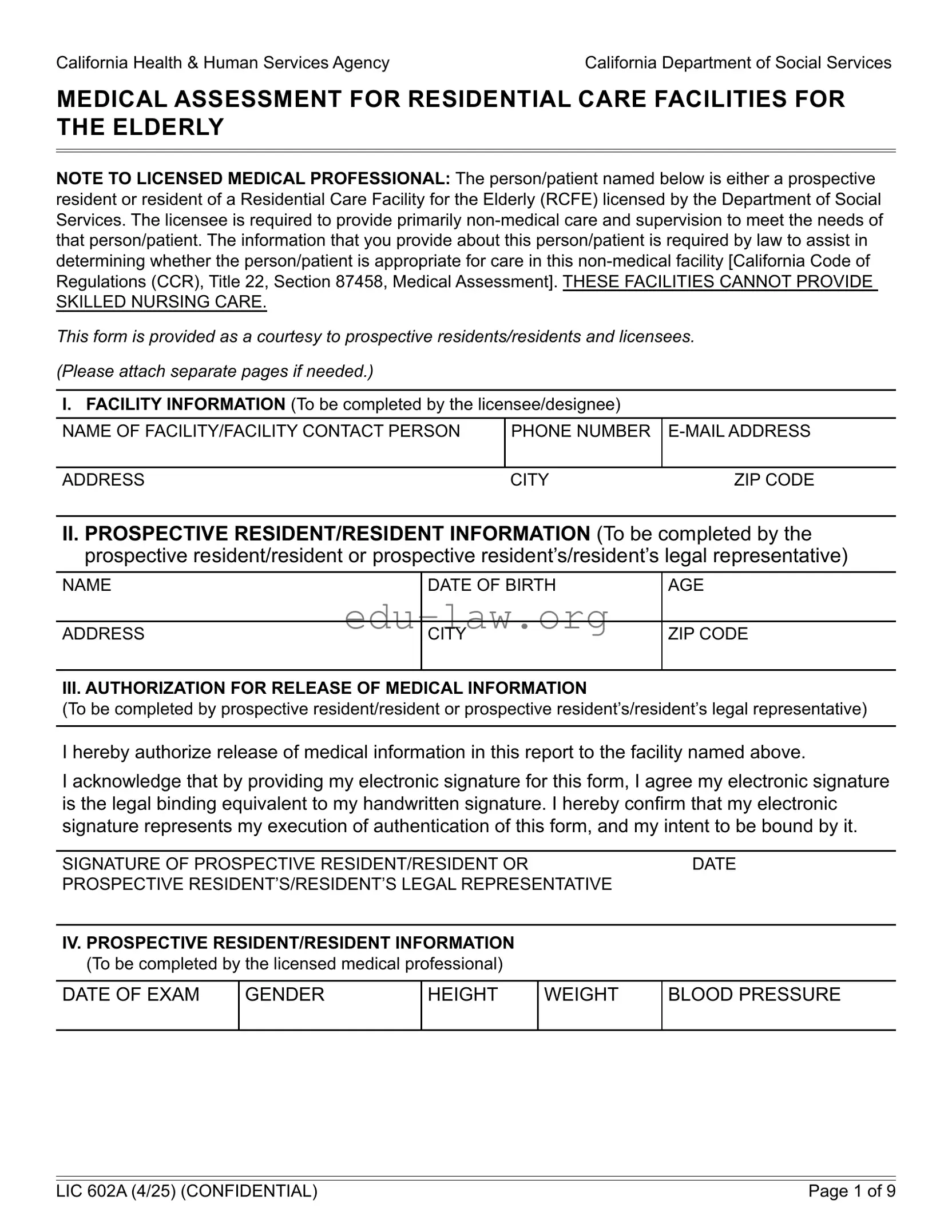
The Lic 602A form plays a crucial role in the assessment and care of residents in Residential Care Facilities for the Elderly (RCFE) in California. Designed to collect comprehensive medical information, this form is essential for ensuring that prospective and current residents receive appropriate non-medical care tailored to their individual needs. The form is divided into several sections, beginning with facility information that identifies the care setting and its licensee. Following this, it gathers vital resident details, including name, birth date, and age, which are necessary for accurate record-keeping. A significant component of the Lic 602A is the authorization for the release of medical information, allowing healthcare providers to share pertinent health data with the facility. Physicians complete the form by providing a detailed diagnosis and relevant medical history, including any cognitive impairments, allergies, and other health conditions that may affect the resident's care. Additionally, the form assesses the resident's capacity for self-care and medication management, which is vital for determining the level of supervision required. By capturing this critical information, the Lic 602A form helps facilities meet legal requirements and ensures that elderly residents receive the best possible care in a supportive environment.
California Health & Human Services Agency |
California Department of Social Services |
MEDICAL ASSESSMENT FOR RESIDENTIAL CARE FACILITIES FOR THE ELDERLY
NOTE TO LICENSED MEDICAL PROFESSIONAL: The person/patient named below is either a prospective resident or resident of a Residential Care Facility for the Elderly (RCFE) licensed by the Department of Social Services. The licensee is required to provide primarily
This form is provided as a courtesy to prospective residents/residents and licensees.
(Please attach separate pages if needed.)
I.FACILITY INFORMATION (To be completed by the licensee/designee)
NAME OF FACILITY/FACILITY CONTACT PERSON
PHONE NUMBER
ADDRESS |
CITY |
ZIP CODE |
II.PROSPECTIVE RESIDENT/RESIDENT INFORMATION (To be completed by the prospective resident/resident or prospective resident’s/resident’s legal representative)
NAME |
DATE OF BIRTH |
AGE |
|
|
|
ADDRESS |
CITY |
ZIP CODE |
|
|
|
III. AUTHORIZATION FOR RELEASE OF MEDICAL INFORMATION
(To be completed by prospective resident/resident or prospective resident’s/resident’s legal representative)
I hereby authorize release of medical information in this report to the facility named above.
I acknowledge that by providing my electronic signature for this form, I agree my electronic signature is the legal binding equivalent to my handwritten signature. I hereby confirm that my electronic signature represents my execution of authentication of this form, and my intent to be bound by it.
SIGNATURE OF PROSPECTIVE RESIDENT/RESIDENT OR |
DATE |
PROSPECTIVE RESIDENT’S/RESIDENT’S LEGAL REPRESENTATIVE |
|
|
|
IV. PROSPECTIVE RESIDENT/RESIDENT INFORMATION |
|
(To be completed by the licensed medical professional) |
|
DATE OF EXAM
GENDER
HEIGHT
WEIGHT
BLOOD PRESSURE
LIC 602A (4/25) (CONFIDENTIAL) |
Page 1 of 9 |

California Health & Human Services Agency |
California Department of Social Services |
|
|
|
|
DIAGNOSIS/DIAGNOSES
a.Please indicate the prospective resident’s/resident’s diagnosis/diagnoses:
b.Treatment/medication (type and dosage)/equipment:
c. Can prospective resident/resident manage own treatment/medication/equipment? |
Yes |
No |
If no, describe what assistance is needed: |
|
|
DEFINITIONS
Mild Cognitive Impairment (MCI): Refers to cognitive abilities that are in a “conditional state” between normal aging and dementia.
Major Neurocognitive Disorder (major NCD): Refers to substantially decreased cognitive or mental function due to a medical disease other than a psychiatric illness. Major NCD includes Alzheimer’s disease and related disorders diagnosed by a licensed medical professional acting within their scope of practice. Related disorders considered to be major NCDs include, but are not limited to, vascular dementia, Lewy body dementia, Parkinson’s disease, and frontotemporal dementia. Major NCDs cause impairment that is sufficient enough to interfere with independence in daily activities and may result in changes that include, but are not limited to, increased tendency to wander and decreased hazard awareness and ability to communicate.
COGNITIVE CONDITIONS |
|
|
a. Does prospective resident/resident have any cognitive conditions? |
Yes |
No |
If yes, please indicate cognitive condition(s): _______________________________________________
b. Treatment/medication (type and dosage)/equipment:
c. Can prospective resident/resident manage own treatment/medication/equipment? |
Yes |
No |
If no, describe what assistance is needed: |
|
|
RESULTS OF EXAM FOR COMMUNICABLE TUBERCULOSIS (TB)
DATE TB TEST GIVEN |
DATE TB TEST READ |
TYPE OF TB TEST |
RESULTS OF TB TEST |
|
|
|
|
Action taken (if positive): |
|
||
LIC 602A (4/25) (CONFIDENTIAL) |
Page 2 of 9 |

California Health & Human Services AgencyCalifornia Department of Social Services
RESULTS OF EXAM FOR INFECTIOUS DISEASES
a. Does prospective resident/resident have any infectious diseases? Yes No
If yes, please indicate infectious disease(s): ________________________________________________
b. Treatment/medication (type and dosage)/equipment:
c. Can prospective resident/resident manage own treatment/medication/equipment? |
Yes |
No |
If no, describe what assistance is needed: |
|
|
RESULTS OF EXAM FOR CONTAGIOUS DISEASES
a. Does prospective resident/resident have any contagious diseases? Yes No
If yes, please indicate contagious disease(s): _______________________________________________
b. Treatment/medication (type and dosage)/equipment:
c. Can prospective resident/resident manage own treatment/medication/equipment? |
Yes |
No |
If no, describe what assistance is needed: |
|
|
RESULTS OF EXAM FOR OTHER MEDICAL CONDITIONS
a. Does prospective resident/resident have any other medical conditions? Yes No
If yes, please indicate other medical condition(s): ____________________________________________
b. Treatment/medication (type and dosage)/equipment:
c. Can prospective resident/resident manage own treatment/medication/equipment? |
Yes |
No |
If no, describe what assistance is needed: |
|
|
LIC 602A (4/25) (CONFIDENTIAL) |
Page 3 of 9 |

California Health & Human Services AgencyCalifornia Department of Social Services
ALLERGIES |
|
|
a. |
Does prospective resident/resident have any allergies (e.g., seasonal, food, medication, dander)? |
|
|
Yes |
No |
|
If yes, please indicate allergy(ies): ________________________________________________________ |
|
b. |
Treatment/medication (type and dosage)/equipment: |
|
c. Can prospective resident/resident manage own treatment/medication/equipment? Yes |
No |
If no, describe what assistance is needed: |
|
1. |
OVERALL PHYSICAL HEALTH |
GOOD |
FAIR |
POOR |
||
|
|
|
|
|
|
|
PHYSICAL HEALTH STATUS |
YES |
NO |
|
ASSISTIVE DEVICE |
EXPLAIN |
|
|
|
|
|
|
(If applicable) |
|
a. |
Hearing Loss |
|
|
|
|
|
|
|
|
|
|
|
|
b. |
Vision Loss |
|
|
|
|
|
|
|
|
|
|
|
|
c. |
Wears Dentures |
|
|
|
|
|
|
|
|
|
|
|
|
d. |
Wears Prosthesis |
|
|
|
|
|
|
|
|
|
|
|
|
e. |
Special Diet |
|
|
|
|
|
|
|
|
|
|
|
|
f. |
Substance Abuse |
|
|
|
|
|
|
|
|
|
|
|
|
g. Use of Alcohol |
|
|
|
|
|
|
|
|
|
|
|
|
|
h. Use of Nicotine or Related |
|
|
|
|
|
|
|
Products |
|
|
|
|
|
i. |
Bowel Incontinence |
|
|
|
|
|
|
|
|
|
|
|
|
j. |
Bladder Incontinence |
|
|
|
|
|
|
|
|
|
|
|
|
k. |
Motor Impairment/Paralysis |
|
|
|
|
|
|
|
|
|
|
|
|
l. |
Requires Assistance with |
|
|
|
|
|
|
Repositioning and Transferring |
|
|
|
|
|
m. History of Skin Condition or |
|
|
|
|
|
|
|
Breakdown |
|
|
|
|
|
COMMENTS: |
|
|
|
|
|
|
LIC 602A (4/25) (CONFIDENTIAL) |
Page 4 of 9 |

California Health & Human Services Agency |
California Department of Social Services |
||||
|
|
|
|
|
|
|
|
|
|
|
|
|
|
|
|
|
|
2. |
CAPACITY FOR |
YES |
NO |
EXPLAIN |
|
|
|
|
|
|
|
a. |
Able to Bathe Self |
|
|
|
|
|
|
|
|
|
|
b. |
Able to Dress/Groom Self |
|
|
|
|
|
|
|
|
|
|
c. Able to Feed Self |
|
|
|
|
|
|
|
|
|
|
|
d. |
Able to Care for Own Toileting |
|
|
|
|
|
Needs |
|
|
|
|
e. Able to Manage Own Cash |
|
|
|
|
|
|
Resources |
|
|
|
|
f. |
Able to Communicate |
|
|
|
|
|
|
|
|
|
|
g. |
Able to Follow Directions/ |
|
|
|
|
|
Instructions |
|
|
|
|
h. |
Able to Leave Facility |
|
|
|
|
|
Unsupervised (considering |
|
|
|
|
|
physical or cognitive abilities); |
|
|
|
|
|
if no, please explain. |
|
|
|
|
COMMENTS:
3. |
OVERALL MENTAL HEALTH |
GOOD |
FAIR |
POOR |
|
|
|
|
|
|
|
MENTAL HEALTH STATUS |
YES |
NO |
|
EXPLAIN |
|
|
|
|
|
|
|
a. |
Depressed |
|
|
|
|
|
|
|
|
|
|
b. |
Suicidal Ideation |
|
|
|
|
|
|
|
|
|
|
c. |
|
|
|
|
|
|
|
|
|
|
|
d. Other |
|
|
|
|
|
|
|
|
|
|
|
COMMENTS: |
|
|
|
|
|
LIC 602A (4/25) (CONFIDENTIAL) |
Page 5 of 9 |

California Health & Human Services Agency |
California Department of Social Services |
|||
|
|
|
|
|
|
|
|
|
|
|
|
|
|
|
4. |
BEHAVIORAL EXPRESSIONS* |
YES |
NO |
EXPLAIN |
|
|
|
|
|
a. |
Disorientation |
|
|
|
|
|
|
|
|
b. |
Lack of Hazard Awareness |
|
|
|
|
|
|
|
|
c. Lack of Impulse Control |
|
|
|
|
|
|
|
|
|
d. |
Unsafe Wandering** |
|
|
|
|
|
|
|
|
e. |
Elopement*** |
|
|
|
|
|
|
|
|
f. |
Expressions of Frustration |
|
|
|
|
|
|
|
|
g. |
Hallucinations |
|
|
|
|
|
|
|
|
h. |
Other |
|
|
|
|
|
|
|
|
*“Behavioral expression” means behavior or behaviors displayed by a resident that may result in harm to self or others including, but not limited to, unsafe wandering, or elopement, expressions of frustration, disorientation, hallucinations, or lacking in hazard awareness or impulse control. Behavioral expression may be due to boredom, fear, overstimulation, perceived threat, fatigue, physical discomfort, pain, “Major Neurocognitive Disorder (major NCD)”, or other causes including, but not limited to, medication interactions and/or illnesses such as urinary tract infections.
**“Unsafe wandering” occurs when a resident at risk enters an area that is physically hazardous or contains items that are potential safety hazards. For example, unsafe wandering may occur when a resident enters another resident’s room when doing so may lead to an altercation or contact with hazardous items.
***“Elopement” occurs when a resident who is at risk of harm due to their cognitive condition leaves the facility unsupervised, or while in the licensee’s care, leaves another safe location unsupervised.
COMMENTS:
LIC 602A (4/25) (CONFIDENTIAL) |
Page 6 of 9 |

California Health & Human Services Agency |
California Department of Social Services |
|
|
|
|
|
|
|
|
|
|
5. ACCESS TO ITEMS |
YES NO |
EXPLAIN |
Would the prospective resident’s/ resident’s or other resident’s safety be at risk if the resident had access to the following items:
a.Personal care and hygiene items
b.Disinfectants, cleaning solutions, poisonous substances, knives, matches, tools, sharp objects, and other similar items which could pose a danger to residents.
c.Nutritional supplements, vitamins, alcohol, cigarettes and other potentially toxic substances, such as certain plants, gardening supplies, and auto supplies.
Does the prospective resident/resident require supervision by the licensee when in proximity to or when there is use of:
a.Ranges, ovens, heaters, fireplaces, wood stoves, inserts, and other heating devices.
b.Fishponds, wading pools, hot tubs, swimming pools, or similar large bodies of water.
c.Birdbaths, fountains, or similar smaller decorative water features.
COMMENTS:
LIC 602A (4/25) (CONFIDENTIAL) |
Page 7 of 9 |

California Health & Human Services Agency |
California Department of Social Services |
|||
|
|
|
|
|
|
|
|
|
|
|
|
|
|
|
6. MEDICATION MANAGEMENT |
YES |
NO |
N/A |
EXPLAIN |
|
|
|
|
|
a. Able to Administer Own |
|
|
|
|
Prescription Medications |
|
|
|
|
b. Able to Administer Own |
|
|
|
|
Injections |
|
|
|
|
c. Able to Perform Own Glucose |
|
|
|
|
Testing |
|
|
|
|
d. Able to Administer Own PRN |
|
|
|
|
Medications |
|
|
|
|
e. Able to Administer Own |
|
|
|
|
Oxygen |
|
|
|
|
f. Able to Store Own |
|
|
|
|
Medications |
|
|
|
|
COMMENTS: |
|
|||
AMBULATORY STATUS:
a. 1. The prospective resident/resident is able to independently transfer to and from bed: |
Yes |
No |
2.For purposes of a fire clearance, this prospective resident/resident is considered:
Ambulatory Nonambulatory Bedridden
Nonambulatory: The prospective resident/resident is unable to leave a building unassisted under emergency conditions. This includes, but is not limited to, a prospective resident/resident who depends upon mechanical aids such as crutches, walkers, and wheelchairs. It also includes a prospective resident/resident who is unable, or likely to be unable, to respond physically or mentally to a sensory signal approved by the State Fire Marshal, or an oral instruction relating to fire or other dangers, and if unassisted, to take appropriate action relating to such danger.
Note: A prospective resident/resident who is unable to independently transfer to and from bed, but who does not need assistance to turn or reposition in bed, shall be considered
purposes of a fire clearance.
Bedridden: For the purpose of a fire clearance, this means a prospective resident/resident who requires assistance with turning or repositioning in bed.
b. If prospective resident/resident is nonambulatory, this status is based upon:
Physical Condition |
Mental Condition |
Both Physical and Mental Condition |
|
|
|
|
|
|
LIC 602A (4/25) (CONFIDENTIAL) |
|
Page 8 of 9 |
California Health & Human Services Agency |
California Department of Social Services |
|
|
|
|
c.If a prospective resident/resident is bedridden, check one or more of the following and describe the nature of the illness, surgery or other cause:
Illness: _______________________________________________________________________
Recovery from Surgery: __________________________________________________________
Other: ________________________________________________________________________
NOTE: An illness or recovery is considered temporary if it will last 14 days or less.
d.If a prospective resident/resident is bedridden, how long is bedridden status expected to persist?
1.________ (number of days)
2.______________________ (estimated date illness or recovery is expected to end or when prospective resident/resident will no longer be confined to bed)
3.If illness or recovery is permanent, please explain:
e.Is prospective resident/resident receiving hospice care?
No |
Yes If yes, specify the terminal illness: ___________________________________ |
COMMENTS:
V. LICENSED MEDICAL PROFESSIONAL INFORMATION
I acknowledge that by providing my electronic signature for this form, I agree my electronic signature is the legal binding equivalent to my handwritten signature. I hereby confirm that my electronic signature represents my execution of authentication of this form, and my intent to be bound by it.
LICENSED MEDICAL PROFESSIONAL NAME AND ADDRESS (PRINT)
PHONE NUMBER
LENGTH OF TIME YOU HAVE PROVIDED CARE TO PROSPECTIVE RESIDENT/RESIDENT
LICENSED MEDICAL PROFESSIONAL SIGNATURE
DATE
LIC 602A (4/25) (CONFIDENTIAL) |
Page 9 of 9 |
| Fact Name | Description |
|---|---|
| Purpose | The LIC 602A form is a physician's report required for residents in Residential Care Facilities for the Elderly (RCFE) in California. It assesses the medical suitability of a resident for non-medical care. |
| Governing Law | This form is governed by California Health and Safety Code, specifically sections related to the licensing and operation of residential care facilities. |
| Confidentiality | The LIC 602A form is marked as confidential, ensuring that the medical information contained within is protected and only shared with authorized personnel. |
| Completion Requirement | Completion of the form is mandatory for all residents or prospective residents, and it must be signed by the resident or their legal representative to authorize the release of medical information. |
Completing the Lic 602A form is a crucial step in ensuring that the necessary medical information is accurately conveyed for residents in a residential care facility for the elderly. Following the steps outlined below will help streamline the process and ensure that all required information is captured effectively.
What is the purpose of the Lic 602A form?
The Lic 602A form, also known as the Physician's Report for Residential Care Facilities for the Elderly (RCFE), is used to gather essential medical information about a resident or prospective resident. This information helps determine if the individual is appropriate for non-medical care and supervision provided by the facility.
Who is required to complete the Lic 602A form?
The form must be completed by various parties. The licensee or designee of the facility fills out the facility information section. The resident or their responsible person provides personal details. Finally, a physician must complete the medical evaluation section.
What information is needed from the physician?
The physician must provide a range of medical details, including the patient's diagnosis, treatment plans, and the ability of the patient to manage their own care. This includes information on any allergies, mental conditions, and the patient's overall physical health status.
Is the Lic 602A form confidential?
Yes, the Lic 602A form is marked as confidential. It contains sensitive medical information that should be protected and shared only with authorized personnel involved in the care of the resident.
What happens if a resident has a positive tuberculosis (TB) test?
If a resident has a positive TB test, the physician must indicate the results and any actions taken. This may include further testing or treatment options, ensuring the facility can manage the resident's health needs appropriately.
Can the resident manage their own medication?
The physician must assess whether the resident can manage their own medications. This includes determining if they can administer prescriptions, perform injections, or store medications safely. If they cannot, the physician should specify the level of medical supervision required.
What is the significance of the ambulatory status section?
The ambulatory status section helps determine how the resident can respond in emergency situations, such as a fire. It categorizes residents as ambulatory, nonambulatory, or bedridden based on their physical and mental abilities to evacuate the facility independently.
What should be included in the section on mental conditions?
This section requires the physician to evaluate the resident for various mental health issues, such as confusion, aggression, or depression. The physician should explain any concerns and how these may impact the resident's ability to live in a non-medical care environment.
How does the Lic 602A form help in assessing care needs?
The information collected on the Lic 602A form assists care facilities in understanding the specific needs of each resident. This ensures that appropriate care plans are developed, which can address both medical and non-medical needs effectively.
Is there a deadline for submitting the Lic 602A form?
Incomplete Facility Information: Failing to fill out all sections in the facility information section can lead to delays. Ensure the facility name, address, and license number are complete.
Missing Resident Information: Omitting critical details about the resident, such as their birth date or age, can cause processing issues. Double-check this section for accuracy.
Authorization Signature Issues: The authorization for the release of medical information must be signed by the resident or their legal representative. A missing signature can invalidate the form.
Incorrect Diagnosis Information: Physicians must provide accurate diagnosis details. Incomplete or vague descriptions may lead to misunderstandings about the resident's needs.
Neglecting TB Test Details: It’s essential to include all relevant TB test information. Missing dates or results can raise concerns about the resident's health status.
Forgetting Secondary Diagnoses: If applicable, ensure all secondary diagnoses are documented. Omitting this information can affect the care plan.
Inaccurate Mental Condition Assessment: Misreporting the resident’s mental condition can lead to inadequate care. Be thorough and honest in this section.
Medication Management Errors: Failing to accurately report the resident's ability to manage medications can lead to serious health risks. This section requires careful attention.
Ambulatory Status Misclassification: Misclassifying a resident's ambulatory status can affect emergency preparedness. Confirm the resident's mobility status accurately.
Not Providing Additional Information: If there are any special conditions or needs, include them in the additional comments section. This information can be crucial for proper care.
The Lic 602A form is essential for residential care facilities for the elderly in California. Along with this form, several other documents are often required to ensure compliance with state regulations and to provide comprehensive care for residents. Here is a list of commonly associated forms and documents.
Each of these documents plays a crucial role in the overall management and operation of residential care facilities. They help ensure that residents receive the appropriate care and support while complying with state regulations. Proper documentation fosters a safe and supportive environment for both residents and staff.
The LIC 602A form is similar to the Physician's Statement for School Enrollment. Both documents require a physician's assessment of an individual's health status, particularly for those entering a new environment. In the case of school enrollment, the statement verifies that a child is fit for school and may include immunization records. Like the LIC 602A, it emphasizes the importance of medical history and any special needs that should be accommodated in the new setting.
Another related document is the Medical Clearance Form for Sports Participation. This form is used to determine if an athlete is physically capable of participating in sports activities. Similar to the LIC 602A, it requires a physician's evaluation of health conditions, including any pre-existing conditions that may affect performance. Both forms aim to ensure safety and well-being in environments that require physical activity, whether in sports or residential care facilities.
The Health Assessment Form for Home Care Services also shares similarities with the LIC 602A. This document is designed for individuals receiving in-home care, requiring a comprehensive evaluation of their health status and needs. Both forms seek to provide care facilities with essential medical information that informs the level of care required. They highlight the importance of understanding an individual's medical history and current health conditions to tailor care appropriately.
Additionally, the Medical History Form for New Patients serves a similar purpose. This form collects vital health information from new patients at a medical practice. Like the LIC 602A, it gathers details about previous medical conditions, medications, and allergies. Both documents aim to provide healthcare providers with a comprehensive overview of an individual's health to ensure appropriate care and treatment.
Lastly, the Disability Verification Form is another document akin to the LIC 602A. This form is used to assess an individual's eligibility for disability benefits and requires a physician's input on the person's health status and limitations. Similar to the LIC 602A, it emphasizes the need for a thorough understanding of the individual's medical condition to determine the appropriate level of support and care needed.
When filling out the Lic 602A form, there are several important considerations to keep in mind. Below is a list of what to do and what to avoid.
This form is also applicable for prospective residents. It helps facilities assess whether new applicants meet their care needs.
While it collects important health information, it primarily focuses on current health status and immediate care needs rather than a complete medical history.
The form explicitly states that these facilities do not provide skilled nursing care, emphasizing their focus on non-medical support.
Completion is required by law to ensure that facilities can adequately meet the needs of residents.
Although primarily for elderly care facilities, it can also apply to younger individuals who may require similar non-medical support.
A physician must complete and sign the form, confirming the resident's health status and care needs.
The form is confidential, and its contents are protected to maintain the privacy of residents.
Facilities may require updated forms periodically, especially if a resident's health status changes significantly.
Many find the form complex due to its detailed requirements for medical information and assessments.
Acceptance depends on the facility's ability to meet the specific care needs outlined in the form.
Filling out the Lic 602A form is an important step for ensuring that residents in residential care facilities for the elderly receive appropriate care. Here are some key takeaways to keep in mind:
By following these key takeaways, you can help ensure that the Lic 602A form is filled out correctly and used effectively to support the health and well-being of residents in care facilities.