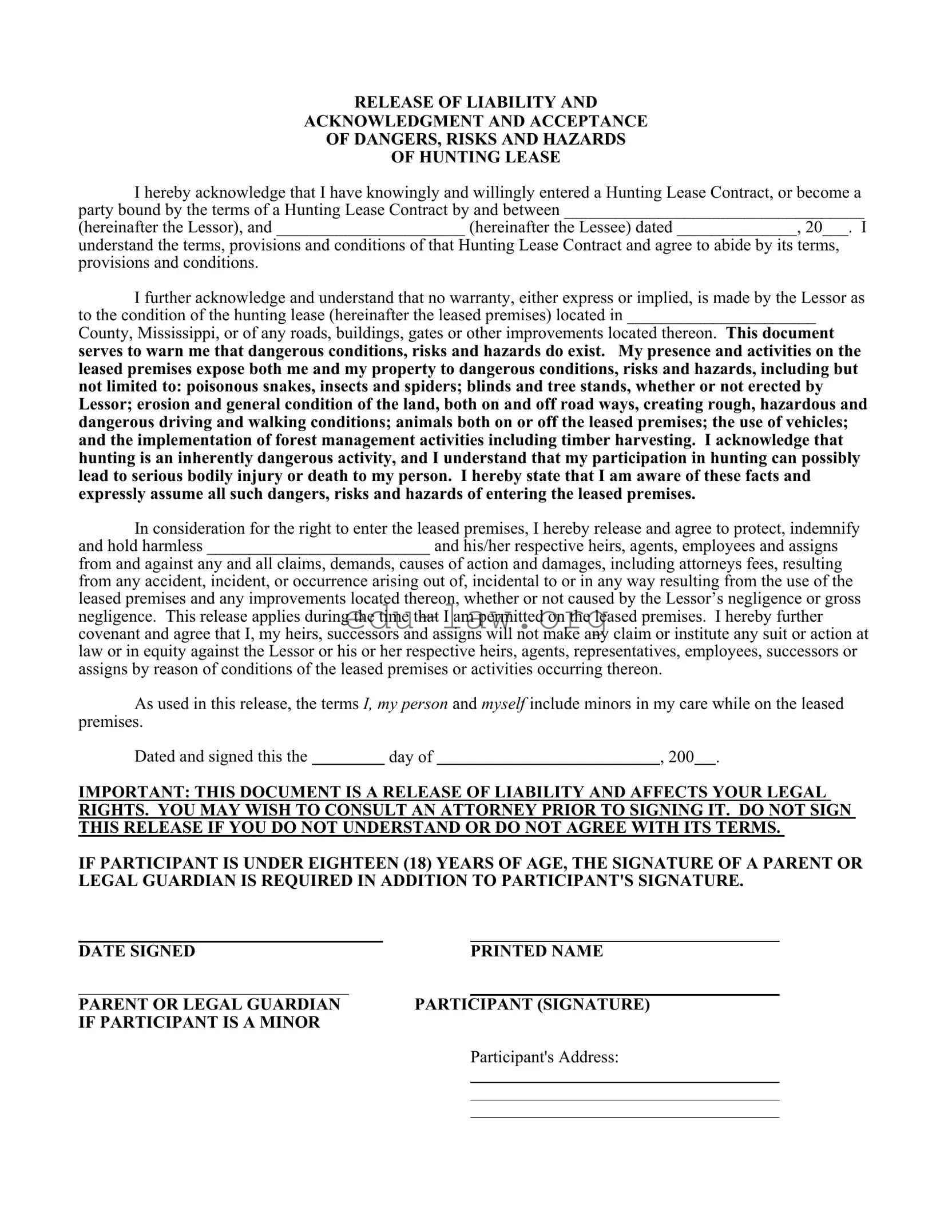
The Liability Hunting form is a crucial document designed to protect both the lessor and the lessee involved in a hunting lease contract. By signing this form, individuals acknowledge their understanding of the inherent dangers associated with hunting activities. It outlines the terms of the lease agreement, specifying the responsibilities and risks that come with entering the leased premises. The form clearly states that the lessor does not provide any warranties regarding the condition of the land or any facilities, which may include roads, buildings, or other improvements. Furthermore, it emphasizes the potential hazards present, such as poisonous wildlife, rough terrain, and the risks associated with hunting itself. Participants are reminded that they assume all risks related to their activities, and they agree to release the lessor from any liability for injuries or damages that may occur. The document also requires the signature of a parent or legal guardian if the participant is under eighteen, underscoring the importance of parental involvement in ensuring the safety and understanding of minors. Ultimately, this form serves as both a warning and a legal safeguard, making it imperative for all parties to read and comprehend its contents before signing.

RELEASE OF LIABILITY AND
ACKNOWLEDGMENT AND ACCEPTANCE
OF DANGERS, RISKS AND HAZARDS
OF HUNTING LEASE
I hereby acknowledge that I have knowingly and willingly entered a Hunting Lease Contract, or become a party bound by the terms of a Hunting Lease Contract by and between ___________________________________
(hereinafter the Lessor), and ______________________ (hereinafter the Lessee) dated ______________, 20___. I
understand the terms, provisions and conditions of that Hunting Lease Contract and agree to abide by its terms, provisions and conditions.
I further acknowledge and understand that no warranty, either express or implied, is made by the Lessor as to the condition of the hunting lease (hereinafter the leased premises) located in ______________________
County, Mississippi, or of any roads, buildings, gates or other improvements located thereon. This document serves to warn me that dangerous conditions, risks and hazards do exist. My presence and activities on the leased premises expose both me and my property to dangerous conditions, risks and hazards, including but not limited to: poisonous snakes, insects and spiders; blinds and tree stands, whether or not erected by Lessor; erosion and general condition of the land, both on and off road ways, creating rough, hazardous and dangerous driving and walking conditions; animals both on or off the leased premises; the use of vehicles; and the implementation of forest management activities including timber harvesting. I acknowledge that hunting is an inherently dangerous activity, and I understand that my participation in hunting can possibly lead to serious bodily injury or death to my person. I hereby state that I am aware of these facts and expressly assume all such dangers, risks and hazards of entering the leased premises.
In consideration for the right to enter the leased premises, I hereby release and agree to protect, indemnify and hold harmless __________________________ and his/her respective heirs, agents, employees and assigns
from and against any and all claims, demands, causes of action and damages, including attorneys fees, resulting from any accident, incident, or occurrence arising out of, incidental to or in any way resulting from the use of the leased premises and any improvements located thereon, whether or not caused by the Lessor’s negligence or gross negligence. This release applies during the time that I am permitted on the leased premises. I hereby further covenant and agree that I, my heirs, successors and assigns will not make any claim or institute any suit or action at law or in equity against the Lessor or his or her respective heirs, agents, representatives, employees, successors or assigns by reason of conditions of the leased premises or activities occurring thereon.
As used in this release, the terms I, my person and myself include minors in my care while on the leased premises.
Dated and signed this the |
|
day of |
|
, 200 . |
||
|
|
|
|
|
|
|
IMPORTANT: THIS DOCUMENT IS A RELEASE OF LIABILITY AND AFFECTS YOUR LEGAL RIGHTS. YOU MAY WISH TO CONSULT AN ATTORNEY PRIOR TO SIGNING IT. DO NOT SIGN THIS RELEASE IF YOU DO NOT UNDERSTAND OR DO NOT AGREE WITH ITS TERMS.
IF PARTICIPANT IS UNDER EIGHTEEN (18) YEARS OF AGE, THE SIGNATURE OF A PARENT OR LEGAL GUARDIAN IS REQUIRED IN ADDITION TO PARTICIPANT'S SIGNATURE.
DATE SIGNED |
|
PRINTED NAME |
|
|
|
PARENT OR LEGAL GUARDIAN |
PARTICIPANT (SIGNATURE) |
|
IF PARTICIPANT IS A MINOR |
|
|
|
|
Participant's Address: |
|
|
|
|
|
|
|
|
|
| Fact Name | Description |
|---|---|
| Document Purpose | This form serves as a release of liability, acknowledging the risks associated with hunting activities on leased land. |
| Governing Law | The form is governed by Mississippi state law, specifically relating to liability waivers and hunting regulations. |
| Assumption of Risks | By signing, the participant acknowledges understanding the inherent dangers of hunting, including potential injuries or fatalities. |
| Minors' Requirement | If the participant is under 18 years old, a parent or legal guardian must also sign the document to validate the release. |
Filling out the Liability Hunting form is an important step for those entering a hunting lease. This document outlines the responsibilities and risks associated with hunting on the leased premises. It’s essential to complete it accurately to ensure all parties are aware of their rights and obligations. Below are the steps to properly fill out the form.
What is the Liability Hunting form?
The Liability Hunting form is a document that outlines the risks associated with hunting on a leased property. It serves as a release of liability for the property owner (Lessor) and acknowledges that the participant (Lessee) understands and accepts these risks before engaging in hunting activities.
Who needs to sign the Liability Hunting form?
Both the participant and, if applicable, a parent or legal guardian must sign the form. If the participant is under 18 years of age, the signature of a parent or legal guardian is required in addition to the participant's signature.
What are the risks mentioned in the form?
The form outlines various risks associated with hunting, including dangerous wildlife, hazardous terrain, and the potential for serious injury or death. It emphasizes that the participant assumes all risks associated with these dangers.
What does it mean to release the Lessor from liability?
By signing the form, the participant agrees to release the Lessor from any legal claims or lawsuits related to accidents or injuries that may occur while on the leased property. This includes situations that may arise due to the Lessor's negligence.
Can the participant make a claim against the Lessor later?
No. The form states that the participant, along with their heirs and assigns, cannot make any claims or lawsuits against the Lessor for conditions or activities on the leased premises. This waiver is in effect for the duration of their presence on the property.
What should I do if I do not understand the form?
If you do not understand the terms of the Liability Hunting form, it is advisable to consult with an attorney before signing. The document affects your legal rights, and clarity is essential.
What happens if the participant is injured while hunting?
If the participant is injured while hunting, the signed form may prevent them from pursuing legal action against the Lessor. The release of liability protects the Lessor from claims resulting from accidents or incidents that occur on the leased property.
Is the form valid if it is not signed on the specified date?
The date on the form is important as it indicates when the participant agreed to the terms. If it is not signed on the specified date, it may raise questions about the validity of the agreement, so it is best to complete and sign it accurately.
What should I do if I have further questions about the form?
If you have additional questions or concerns about the Liability Hunting form, consider reaching out to the Lessor or seeking legal advice to ensure you fully understand your rights and responsibilities before signing.
Failing to read the entire form carefully. Many people overlook important sections, which can lead to misunderstandings about their rights and responsibilities.
Not providing accurate information in the blanks. Whether it’s the names of the Lessor and Lessee or the date, incorrect details can invalidate the form.
Overlooking the warning about risks. Some participants might not fully acknowledge the dangers associated with hunting, which is crucial for their safety.
Neglecting to have a parent or legal guardian sign if the participant is under eighteen. This step is essential for legal compliance.
Not understanding the release of liability. Participants should be fully aware of what they are agreeing to, as this affects their legal rights.
Forgetting to sign and date the document. Without a signature and date, the form is incomplete and cannot be enforced.
Leaving out the participant’s address. This information is often required for identification purposes and should not be skipped.
Not consulting an attorney if unsure about the terms. Seeking legal advice can clarify any doubts and ensure informed consent.
Ignoring the implications of indemnification. Participants should understand that they are agreeing to protect the Lessor from claims, which can have financial consequences.
Assuming that verbal agreements will suffice. All terms must be documented in writing to be legally binding; verbal agreements may not hold up in court.
When engaging in activities related to hunting leases, several important documents often accompany the Liability Hunting form. Each document plays a crucial role in ensuring that all parties understand their rights and responsibilities. Below are some of the key forms that you might encounter.
Understanding these documents is essential for anyone involved in a hunting lease. They help clarify expectations and protect all parties from misunderstandings or legal issues. Make sure to review each document carefully before signing.
The Waiver of Liability is similar to the Liability Hunting form in that it serves to protect an organization or individual from legal claims resulting from injuries or damages. This document requires participants to acknowledge the risks associated with an activity, such as sports or recreational events, and to agree not to hold the organization liable for any accidents that may occur. Like the Liability Hunting form, it emphasizes the importance of understanding the risks before participating.
The Assumption of Risk Agreement is another document that shares similarities with the Liability Hunting form. It specifically outlines the inherent risks involved in certain activities, such as outdoor adventures or extreme sports. Participants sign this agreement to acknowledge their awareness of these risks and to accept responsibility for any injuries that may result. Both documents aim to ensure that individuals are informed about potential dangers before they engage in activities.
The Release of Claims form is also akin to the Liability Hunting form. It allows individuals to relinquish their right to pursue legal action against an organization or individual in the event of an injury. This form typically requires the signer to understand the risks associated with the activity and agree to not hold the entity responsible for any accidents. Both documents emphasize informed consent and the relinquishment of legal rights.
The Indemnity Agreement is similar in purpose to the Liability Hunting form, as it requires one party to compensate another for any losses or damages that may arise from specific activities. This document is often used in situations where one party assumes responsibility for certain risks, thereby protecting the other party from potential claims. Both agreements focus on risk management and liability protection.
The Participant Agreement is another document that parallels the Liability Hunting form. This agreement outlines the expectations and responsibilities of participants in an event or activity. It often includes a section where participants acknowledge the risks involved and agree to follow safety guidelines. Both documents aim to clarify roles and responsibilities while addressing potential hazards.
The Parental Consent Form is similar to the Liability Hunting form, especially when minors are involved. This document requires a parent or guardian to acknowledge the risks associated with an activity and to give permission for their child to participate. It often includes a release of liability clause, similar to that found in the Liability Hunting form, ensuring that the organization is protected from legal claims related to the minor's participation.
The Safety Acknowledgment Form shares similarities with the Liability Hunting form in that it requires individuals to recognize and accept the risks associated with a specific activity. This document typically includes safety guidelines and may ask participants to confirm their understanding of these guidelines. Both forms emphasize the importance of being aware of potential dangers.
The Risk Disclosure Statement is another document that is comparable to the Liability Hunting form. It provides detailed information about the risks associated with a particular activity, ensuring that participants are fully informed before they engage. Like the Liability Hunting form, it serves to protect the organization from liability by making participants aware of the dangers involved.
The Event Participation Agreement also bears similarities to the Liability Hunting form. This document outlines the terms and conditions under which individuals may participate in an event. It often includes a waiver of liability and an acknowledgment of risks, ensuring that participants understand their rights and responsibilities. Both documents aim to create a clear understanding of the relationship between the participant and the organizing entity.
Finally, the Volunteer Waiver is similar to the Liability Hunting form in that it protects organizations from claims made by volunteers who may be injured while participating in an event or activity. This document typically includes a section where volunteers acknowledge the risks involved and agree to waive their right to sue. Both documents focus on risk awareness and liability protection.
When filling out the Liability Hunting form, it’s important to follow certain guidelines to ensure accuracy and clarity. Here are some things you should and shouldn't do:
Following these guidelines can help prevent misunderstandings and ensure that all parties are aware of their responsibilities and rights.
Understanding the Liability Hunting form can be challenging, and several misconceptions often arise. Here are four common misunderstandings about this important document:
Many people believe that signing the Liability Hunting form completely absolves the Lessor of any responsibility. While the document does release them from certain liabilities, it does not protect them from gross negligence or intentional misconduct. If the Lessor acts recklessly, you may still have grounds for a claim.
Some assume that only adults need to sign the form. However, if a minor is participating in hunting activities, a parent or legal guardian must also sign the document. This ensures that the adult understands the risks involved and agrees to them on behalf of the minor.
Another common belief is that the risks outlined in the form are overstated. In reality, hunting involves various inherent dangers, such as wildlife encounters and hazardous terrain. The form serves as a clear reminder of these risks, encouraging participants to take them seriously.
Some individuals may think they can sign the form without fully understanding its content. This is a dangerous approach. The document explicitly states that you should consult an attorney if you have any questions. Taking the time to read and comprehend the terms is essential for protecting your rights.
When filling out and using the Liability Hunting form, it is essential to understand its implications and requirements. Here are some key takeaways:
By keeping these points in mind, you can navigate the process of filling out the Liability Hunting form more effectively and with greater awareness of its implications.