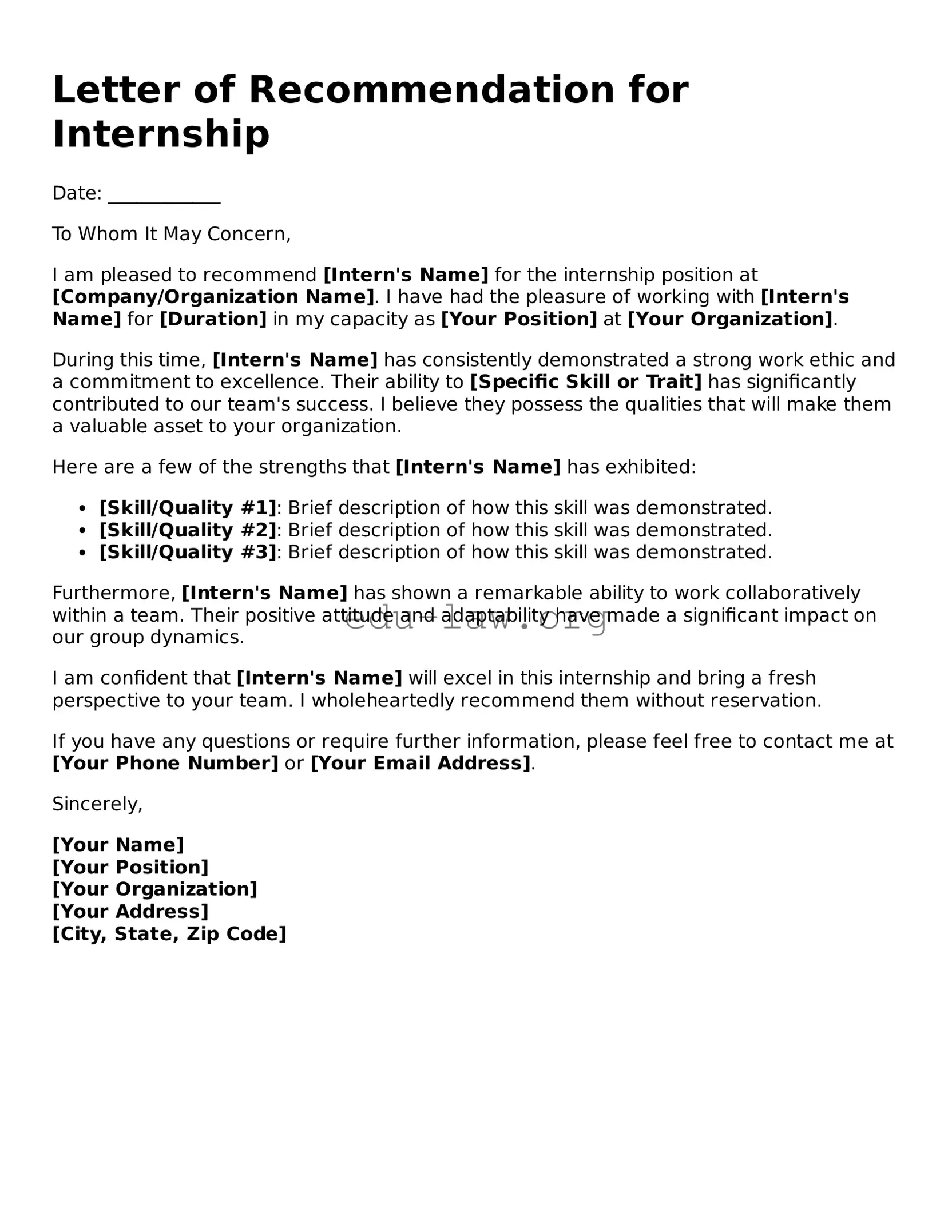
When seeking an internship, a Letter of Recommendation can significantly enhance an applicant's chances of standing out. This form serves as a vital tool for mentors, professors, or employers to endorse a candidate's skills, work ethic, and potential contributions to a prospective organization. Typically, the form includes sections for the recommender's contact information, the relationship between the recommender and the applicant, and a detailed assessment of the applicant's qualifications. Specific attributes such as leadership abilities, teamwork, and problem-solving skills are often highlighted. Additionally, the recommender may be asked to provide examples of the applicant’s accomplishments or experiences that showcase their suitability for the internship. By thoughtfully completing this form, recommenders can play a crucial role in shaping the applicant's future opportunities.
Letter of Recommendation for Internship
Date: ____________
To Whom It May Concern,
I am pleased to recommend [Intern's Name] for the internship position at [Company/Organization Name]. I have had the pleasure of working with [Intern's Name] for [Duration] in my capacity as [Your Position] at [Your Organization].
During this time, [Intern's Name] has consistently demonstrated a strong work ethic and a commitment to excellence. Their ability to [Specific Skill or Trait] has significantly contributed to our team's success. I believe they possess the qualities that will make them a valuable asset to your organization.
Here are a few of the strengths that [Intern's Name] has exhibited:
Furthermore, [Intern's Name] has shown a remarkable ability to work collaboratively within a team. Their positive attitude and adaptability have made a significant impact on our group dynamics.
I am confident that [Intern's Name] will excel in this internship and bring a fresh perspective to your team. I wholeheartedly recommend them without reservation.
If you have any questions or require further information, please feel free to contact me at [Your Phone Number] or [Your Email Address].
Sincerely,
[Your Name]
[Your Position]
[Your Organization]
[Your Address]
[City, State, Zip Code]
| Fact Name | Description |
|---|---|
| Purpose | The Letter of Recommendation for Internship form is used to provide a written endorsement of a candidate's skills, character, and qualifications for an internship position. |
| Format | This form typically includes sections for the recommender's information, the candidate's information, and the content of the recommendation itself. |
| Submission | The completed form can be submitted directly to the internship provider or given to the candidate to include in their application materials. |
| State-Specific Laws | In some states, such as California, recommendations may be governed by employment laws that protect both the recommender and the candidate from defamation claims. |
Once you have the Letter of Recommendation for Internship form in front of you, it's time to get started. This form will help provide insight into the applicant's qualifications and character, allowing the internship committee to make informed decisions. Follow these steps carefully to complete the form accurately.
After completing the form, review it for any errors or omissions. Once you are satisfied with your responses, submit the form as directed. This step is crucial in ensuring that your recommendation reaches the right people in a timely manner.
What is a Letter of Recommendation for an Internship?
A Letter of Recommendation for an Internship is a document written by someone who can vouch for your skills, experiences, and character. This letter is typically provided by a teacher, employer, or mentor who knows you well. It serves to support your application and can significantly enhance your chances of securing the internship.
Who should I ask to write my letter of recommendation?
Choose someone who is familiar with your work ethic and abilities. This could be a professor, a previous employer, or a volunteer coordinator. It’s best if the person can provide specific examples of your skills and contributions. Make sure they can speak positively about your qualifications for the internship you’re applying for.
How do I request a letter of recommendation?
Approach your chosen recommender politely, either in person or through a well-crafted email. Be clear about the internship you’re applying for and why you think they would be a good fit to write your letter. Provide them with any necessary details, such as the deadline and the submission process. It’s also helpful to share your resume and any relevant experiences to assist them in writing a strong letter.
What information should I provide to my recommender?
When requesting a letter, provide your recommender with information about the internship, including the company name, position, and key responsibilities. Share your resume, highlighting your relevant experiences and skills. If there are specific qualities or achievements you would like them to mention, don’t hesitate to include those details as well.
How long should a letter of recommendation be?
A typical letter of recommendation is usually one page long, consisting of about three to five paragraphs. It should be concise yet comprehensive enough to cover your qualifications and character. The goal is to provide a clear and compelling case for why you would be a great fit for the internship.
Can I see the letter before it’s submitted?
It’s generally considered polite to ask if you can review the letter before it’s sent, but be aware that some recommenders may prefer to keep it confidential. If they agree, take the opportunity to ensure that the letter accurately reflects your skills and experiences. Respect their decision if they choose not to share it with you.
What should I do if my recommender misses the deadline?
If the deadline passes and you haven’t received confirmation that your letter has been submitted, reach out to your recommender. A polite reminder can be helpful. If they are unable to provide the letter in time, consider asking someone else who can meet the deadline. Always have a backup plan to avoid any last-minute issues.
Is it appropriate to thank my recommender?
Absolutely! Sending a thank-you note after they submit the letter is a thoughtful gesture. Express your gratitude for their time and effort in helping you with your internship application. This not only shows appreciation but also helps maintain a positive relationship for future opportunities.
Failing to personalize the letter. A generic recommendation can diminish the impact. Tailoring the content to the specific internship shows genuine support.
Not providing specific examples of the candidate's skills and achievements. Vague statements do not convey the candidate’s true potential. Detailed anecdotes can illustrate their capabilities effectively.
Overlooking the submission guidelines. Each organization may have different requirements. Ignoring these can lead to the letter being rejected or not considered.
Neglecting to proofread the letter. Spelling and grammatical errors can undermine credibility. A polished letter reflects professionalism and attention to detail.
Writing too much or too little. A letter that is overly lengthy can lose the reader's interest, while a brief letter may lack depth. Striking the right balance is crucial.
Using overly complex language. While it’s important to sound professional, clarity should never be sacrificed. Simple, direct language is often more effective.
Failing to highlight relevant skills for the internship. Each opportunity may require different strengths. Focusing on the skills that align with the internship can enhance the letter’s relevance.
Not including contact information. If the internship committee has questions, they should be able to reach out easily. Providing a phone number or email adds a personal touch.
Being overly critical or negative. Even if there are areas for improvement, it’s important to maintain a positive tone. Focus on the candidate's strengths and potential for growth.
Forgetting to mention the relationship with the candidate. Stating how long and in what capacity the recommender knows the candidate adds context. This information can help the committee understand the perspective of the recommendation.
When applying for an internship, several documents complement the Letter of Recommendation. Each of these forms plays a vital role in presenting your qualifications and experiences to potential employers. Here’s a brief overview of some commonly used documents.
Having these documents ready can strengthen your application and improve your chances of landing the internship. Each piece tells a part of your story, so make sure they reflect your best self.
A Letter of Recommendation for Employment serves a similar purpose as a Letter of Recommendation for Internship. Both documents highlight an individual's qualifications, skills, and experiences. They provide potential employers with insights into a candidate's work ethic and character. While the internship letter may focus on academic achievements and relevant coursework, the employment letter often emphasizes professional experiences and accomplishments. Ultimately, both letters aim to persuade the reader of the candidate's suitability for the position.
A Letter of Recommendation for Graduate School is another document that shares similarities with an internship recommendation letter. Both letters are written by individuals who can attest to the applicant's abilities and potential. They discuss the candidate's strengths and contributions, often relating them to the specific field of study. The graduate school letter may delve deeper into academic performance, research capabilities, and personal qualities that would contribute to success in a rigorous academic environment.
A Character Reference Letter is akin to a Letter of Recommendation for Internship in that it provides a personal perspective on an individual's character. This type of letter is typically written by someone who knows the candidate well, such as a mentor or community leader. It focuses on the applicant's personal traits, such as integrity, reliability, and interpersonal skills, which are essential for success in both internships and other professional settings.
A Professional Reference Letter also resembles the internship recommendation letter. Both documents are intended to vouch for a candidate's skills and work ethic. However, a professional reference letter is often more formal and may be used in various contexts, such as job applications or promotions. It typically comes from a supervisor or colleague who can speak to the candidate's specific contributions and performance in a work environment.
A Letter of Recommendation for a Scholarship is another document that shares a similar structure and purpose. Both letters aim to advocate for the applicant, highlighting their achievements and qualifications. In the case of a scholarship letter, the focus may be on academic performance, leadership roles, and community involvement. Just like an internship recommendation, it seeks to present the candidate as a worthy investment for the scholarship committee.
A Letter of Recommendation for a Fellowship is comparable to an internship recommendation letter as both documents endorse the candidate's qualifications for a specific opportunity. Fellowship letters often emphasize research experience, academic achievements, and professional goals. Both types of letters serve to assure the reviewing committee that the candidate possesses the skills and dedication necessary to succeed in their respective programs.
A Reference Letter for a Volunteer Position is similar to a Letter of Recommendation for Internship in that it highlights a candidate's abilities and commitment. Volunteer reference letters often come from supervisors or coordinators who can speak to the applicant's contributions and impact in a volunteer role. Both letters emphasize the candidate's willingness to learn, work collaboratively, and contribute positively to an organization.
A Letter of Recommendation for a Job Promotion shares similarities with an internship recommendation letter, as both documents advocate for the candidate's qualifications. A promotion letter typically focuses on the individual’s accomplishments within their current role, showcasing their readiness for increased responsibilities. Like an internship letter, it aims to persuade decision-makers of the candidate's value to the organization.
A Letter of Recommendation for a Professional License is another document that aligns with the internship recommendation letter. Both letters serve to validate a candidate's qualifications and suitability for a specific role or responsibility. In the case of a professional license, the letter often emphasizes the applicant's relevant training, experience, and adherence to ethical standards, which are crucial for obtaining the license.
Lastly, a Letter of Recommendation for a Research Position is akin to an internship recommendation letter in that it highlights the candidate's relevant skills and experiences. Both letters can come from professors, supervisors, or colleagues who can speak to the applicant's qualifications. The research position letter may focus more on analytical skills and research experience, while the internship letter might cover a broader range of experiences, but both ultimately aim to showcase the candidate's potential for success in their respective fields.
When filling out a Letter of Recommendation for an internship, it is essential to approach the task thoughtfully. Here are some important dos and don'ts to consider.
By following these guidelines, you can create a compelling Letter of Recommendation that effectively supports the candidate's application for the internship.
When it comes to securing an internship, a Letter of Recommendation can play a pivotal role in making a strong impression. However, several misconceptions often cloud the understanding of this important document. Here are four common myths that can lead to confusion:
Understanding these misconceptions can help you navigate the process of obtaining a Letter of Recommendation more effectively, ultimately enhancing your internship applications.
When filling out a Letter of Recommendation for Internship form, there are several important considerations to keep in mind. Here are some key takeaways:
By following these guidelines, you can create a compelling Letter of Recommendation that effectively supports the candidate's application for an internship.