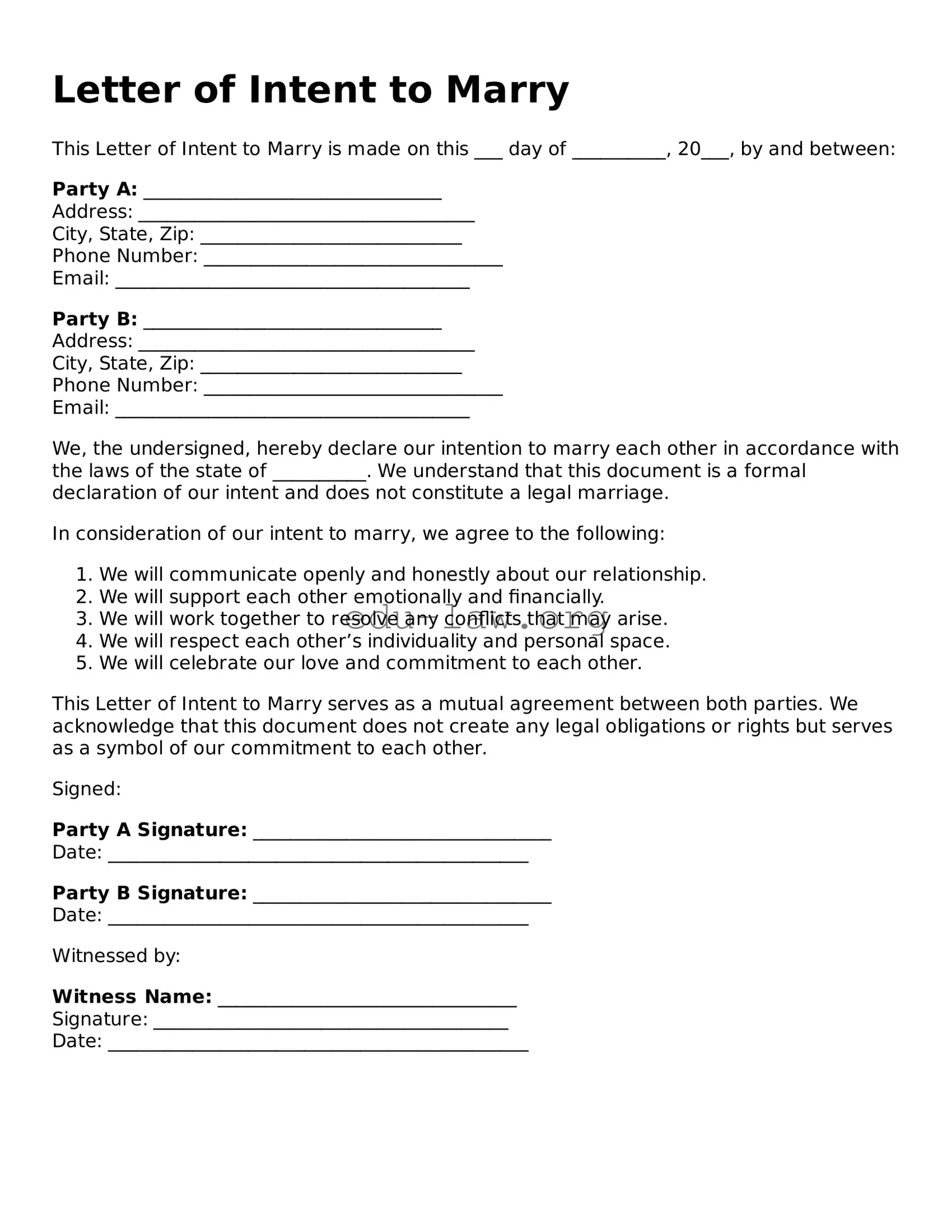
The Letter of Intent to Marry form serves as a preliminary document that expresses the mutual desire of two individuals to enter into marriage. This form typically outlines the basic intentions of the couple, including their commitment to one another and any pertinent details regarding their future plans. By completing this form, individuals can clarify their intentions, which may assist in the organization of wedding plans and legal considerations that follow. While not legally binding, the Letter of Intent can provide a framework for discussions about shared goals, financial arrangements, and other important aspects of their upcoming union. It can also serve as a symbolic gesture, signifying the seriousness of the relationship as the couple prepares to take the next step in their lives together. Ultimately, this document can play a significant role in fostering open communication and mutual understanding as the couple embarks on their journey toward marriage.
Letter of Intent to Marry
This Letter of Intent to Marry is made on this ___ day of __________, 20___, by and between:
Party A: ________________________________
Address: ____________________________________
City, State, Zip: ____________________________
Phone Number: ________________________________
Email: ______________________________________
Party B: ________________________________
Address: ____________________________________
City, State, Zip: ____________________________
Phone Number: ________________________________
Email: ______________________________________
We, the undersigned, hereby declare our intention to marry each other in accordance with the laws of the state of __________. We understand that this document is a formal declaration of our intent and does not constitute a legal marriage.
In consideration of our intent to marry, we agree to the following:
This Letter of Intent to Marry serves as a mutual agreement between both parties. We acknowledge that this document does not create any legal obligations or rights but serves as a symbol of our commitment to each other.
Signed:
Party A Signature: ________________________________
Date: _____________________________________________
Party B Signature: ________________________________
Date: _____________________________________________
Witnessed by:
Witness Name: ________________________________
Signature: ______________________________________
Date: _____________________________________________
| Fact Name | Description |
|---|---|
| Purpose | A Letter of Intent to Marry expresses the mutual desire of two individuals to enter into a marriage. It serves as a formal acknowledgment of their commitment. |
| Legal Status | This document is typically not legally binding but can be used to outline intentions and expectations prior to marriage. |
| State-Specific Forms | Some states may have specific requirements or forms for a Letter of Intent to Marry. For example, California recognizes this letter under Family Code § 1600. |
| Usage | Couples often use this letter in conjunction with prenuptial agreements or as part of wedding planning discussions. |
After obtaining the Letter of Intent to Marry form, you will need to complete it accurately to ensure that your intentions are properly documented. This form is typically required by local authorities and may be needed for future legal processes related to your marriage.
Once you have filled out the form, submit it to the appropriate local authority, which may be a county clerk's office or similar agency. They will guide you on any additional steps or requirements needed to finalize your intent to marry.
What is a Letter of Intent to Marry?
A Letter of Intent to Marry is a document in which two individuals express their intention to enter into a marriage. It serves as a formal declaration of commitment and can be used for various purposes, such as planning a wedding or addressing legal matters related to marriage.
Is a Letter of Intent to Marry legally binding?
No, a Letter of Intent to Marry is not legally binding. It is more of a personal or emotional commitment rather than a legal contract. Couples often use it to express their intentions but must still go through the legal process of obtaining a marriage license to be legally married.
Do I need a lawyer to draft a Letter of Intent to Marry?
While it is not necessary to hire a lawyer to draft a Letter of Intent to Marry, consulting with one can be beneficial, especially if the couple has specific legal considerations or if they want to include certain clauses. However, many couples choose to write it themselves in their own words.
What should be included in a Letter of Intent to Marry?
Typically, a Letter of Intent to Marry should include the names of both parties, a statement of intent to marry, and any specific details about the wedding plans, such as the proposed date or location. Personal sentiments, commitments, and reasons for wanting to marry can also be included to make it more meaningful.
Is there a specific format for a Letter of Intent to Marry?
There is no strict format for a Letter of Intent to Marry. Couples can choose to write it in a formal letter format or a more casual style. The key is that it clearly conveys the couple's intentions and feelings toward each other.
Can a Letter of Intent to Marry be used in court?
Generally, a Letter of Intent to Marry does not hold legal weight in court. However, it may be referenced in certain situations, such as disputes regarding engagement gifts or other personal matters. It is primarily a personal document rather than a legal one.
How does a Letter of Intent to Marry differ from a prenuptial agreement?
A Letter of Intent to Marry is focused on the emotional commitment between partners, while a prenuptial agreement is a legal contract that outlines the division of assets and responsibilities in the event of a divorce. The two documents serve very different purposes.
Can a Letter of Intent to Marry be revoked?
Yes, a Letter of Intent to Marry can be revoked at any time before the marriage takes place. If circumstances change or if one partner decides not to proceed with the marriage, they can simply communicate that decision to the other party.
Is a Letter of Intent to Marry necessary?
A Letter of Intent to Marry is not necessary for a couple to get married. It is an optional document that some couples choose to create to express their commitment. Ultimately, the decision to use one depends on the couple's preferences and circumstances.
Where can I find a template for a Letter of Intent to Marry?
Templates for a Letter of Intent to Marry can be found online through various legal websites, relationship blogs, or even wedding planning resources. Couples can also create their own by simply expressing their thoughts and feelings in writing.
Incomplete Information: Many individuals forget to fill out all required fields. Leaving sections blank can lead to delays or complications.
Incorrect Names: Spelling errors in names can create confusion. Double-checking the spelling of both parties’ names is crucial.
Wrong Dates: Entering incorrect dates, such as the date of birth or intended marriage, can cause issues. It's important to verify all dates before submission.
Missing Signatures: Forgetting to sign the form is a common oversight. Ensure both parties have signed where required.
Inconsistent Information: Providing conflicting details, such as different addresses or contact information, can raise red flags. Consistency is key.
Failure to Review: Skipping a thorough review of the form can lead to unnoticed mistakes. Taking a moment to double-check can save time later.
Ignoring Instructions: Not following the specific guidelines provided can result in an improperly filled form. Always read the instructions carefully.
Submitting Without Copies: Failing to keep a copy of the submitted form can be problematic. Always retain a copy for your records.
Procrastination: Waiting until the last minute to fill out the form can lead to rushed mistakes. Start early to avoid stress.
Neglecting to Check Fees: Some may overlook any associated fees. Be sure to confirm if there are costs involved in submitting the form.
When preparing for a marriage, several important documents accompany the Letter of Intent to Marry. Each of these documents serves a unique purpose, ensuring that both parties are fully informed and legally protected. Understanding these forms can streamline the process and help avoid potential complications.
Gathering these documents alongside the Letter of Intent to Marry is crucial for a smooth transition into married life. Each form plays a significant role in ensuring that both parties enter into the marriage with clarity and legal standing.
The Letter of Intent to Marry form shares similarities with a Prenuptial Agreement, often referred to as a prenup. A prenup is a legal document that outlines the division of assets and responsibilities in the event of a divorce. Both documents serve to clarify intentions and expectations before entering into a marriage, providing a framework that can help prevent misunderstandings later on. While the Letter of Intent expresses a desire to marry, the prenup focuses on financial arrangements and asset protection, making them complementary in nature.
Another document akin to the Letter of Intent to Marry is the Declaration of Intent to Marry. This declaration is typically a formal statement made by individuals who plan to marry, often required by certain states before a marriage license can be issued. Both documents convey a commitment to marry, but the declaration is usually more procedural, serving as a prerequisite for legal marriage, whereas the Letter of Intent may carry more personal significance.
The Marriage License Application is also similar in purpose. This application is a legal document that couples must complete to obtain a marriage license, which is necessary for the marriage to be recognized by the state. While the Letter of Intent expresses the couple’s desire to marry, the marriage license application is a step toward formalizing that intent legally. Both documents underscore the seriousness of the commitment being made.
A Cohabitation Agreement can be compared to the Letter of Intent to Marry as well. This agreement is often used by couples who choose to live together without marrying. It outlines the rights and responsibilities of each partner during the cohabitation period. While the Letter of Intent signifies a commitment to marry in the future, a cohabitation agreement addresses the present relationship dynamics, making it a useful tool for couples considering marriage.
The Affidavit of Common Law Marriage is another document that bears resemblance to the Letter of Intent to Marry. This affidavit serves as a sworn statement declaring that a couple has lived together and has met the requirements for common law marriage in certain jurisdictions. Both documents establish a recognition of commitment, but the affidavit is particularly relevant in states that recognize common law marriage, providing legal acknowledgment without the need for a formal ceremony.
A Postnuptial Agreement is also relevant to this discussion. Similar to a prenuptial agreement, a postnuptial agreement is created after a couple is married and outlines the division of assets and responsibilities. While the Letter of Intent to Marry is focused on the intentions leading up to the marriage, a postnuptial agreement reflects the couple's understanding of their relationship after they have already committed to each other. Both documents aim to protect the interests of both parties.
The Marriage Certificate is another document that shares a connection with the Letter of Intent to Marry. This official document is issued after the marriage has taken place and serves as legal proof of the marriage. While the Letter of Intent expresses the desire to marry, the marriage certificate confirms that the marriage has been legally recognized. Both are integral parts of the marriage process, representing different stages of commitment.
The Consent to Marry is also similar in nature. This document is often required when one or both parties are underage and need parental or guardian approval to marry. It serves as a formal acknowledgment of the parents' or guardians' consent to the marriage. Like the Letter of Intent, it emphasizes the importance of commitment, but it also introduces the element of family involvement in the decision-making process.
Lastly, the Domestic Partnership Agreement can be compared to the Letter of Intent to Marry. This agreement is designed for couples who choose to live together in a committed relationship without marrying. It outlines the rights and responsibilities of each partner, similar to a marriage but without the legal title. Both documents reflect a commitment to a shared life together, though the domestic partnership agreement is often used by couples who may not wish to enter into a traditional marriage.
When filling out the Letter of Intent to Marry form, it’s important to approach the task with care. Here are some essential do's and don'ts to keep in mind:
Misconceptions about the Letter of Intent to Marry form can lead to confusion for couples considering marriage. Here are nine common misunderstandings, along with clarifications.
The Letter of Intent to Marry is not a legally binding contract. It is a statement of intent, expressing the couple's desire to marry in the future.
There is no requirement to file this letter with any government agency. It is a private document meant for the couple's personal use.
Submitting a Letter of Intent to Marry does not set a wedding date. It simply indicates that the couple plans to marry at some point.
Not all couples need to complete this form. It is optional and may not be necessary for every relationship.
The Letter of Intent to Marry does not serve as a marriage license. A marriage license is a legal requirement for the marriage ceremony.
There is no requirement for the Letter of Intent to Marry to be notarized. It is a personal declaration and does not require formal witnessing.
The letter can be used by couples who are not yet engaged but are considering marriage in the future.
There is no standard format for the letter. Couples can express their intentions in their own words.
The Letter of Intent to Marry cannot be enforced in a court of law. It holds no legal weight beyond expressing intent.
Understanding these misconceptions can help couples navigate their path to marriage with clarity and confidence.
Filling out a Letter of Intent to Marry form can be an important step in your journey toward marriage. Here are some key takeaways to keep in mind:
By keeping these takeaways in mind, you can navigate the process of filling out and using the Letter of Intent to Marry form with confidence and clarity.