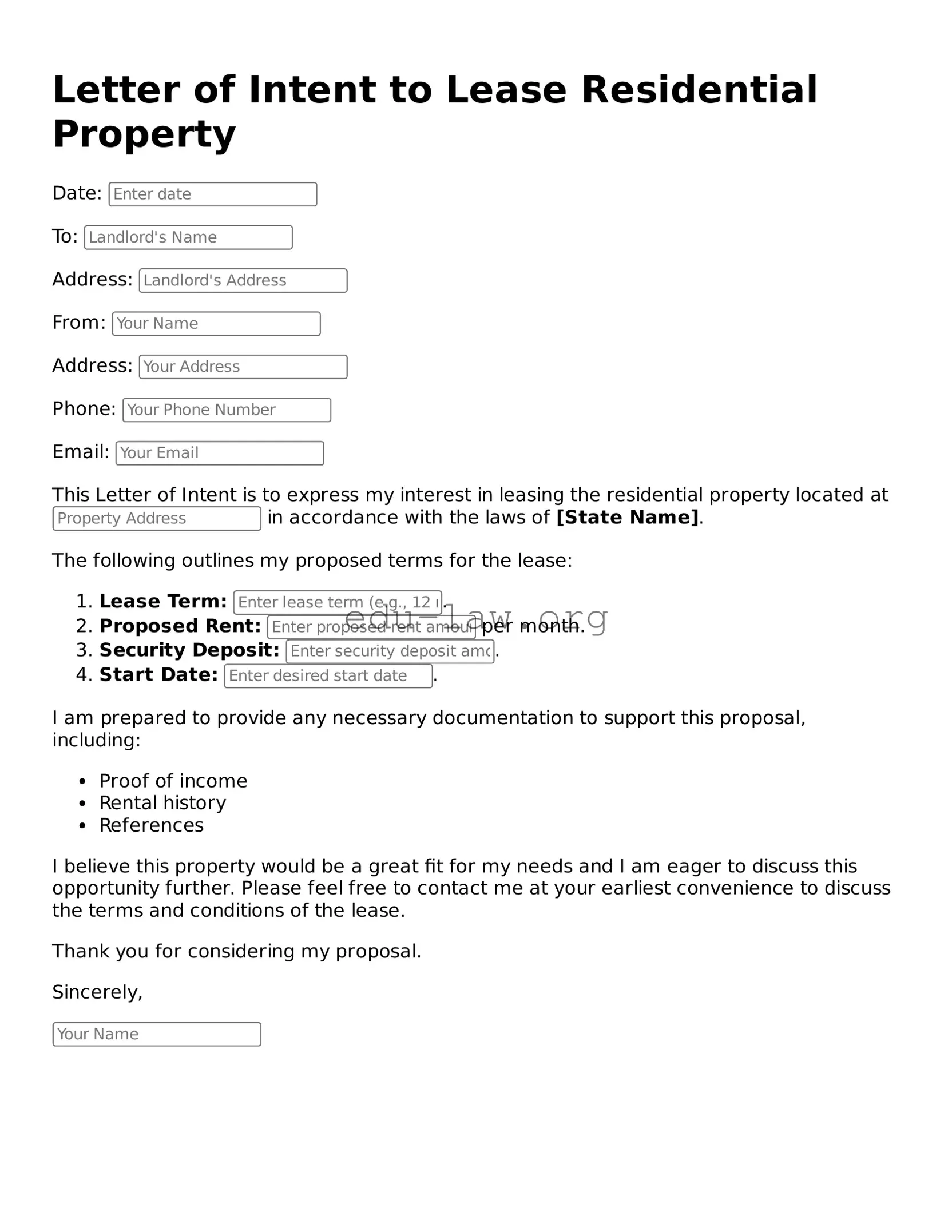
The Letter of Intent to Lease Residential Property serves as a preliminary agreement between a prospective tenant and a landlord, outlining the key terms and conditions that both parties are willing to negotiate before entering into a formal lease. This document typically includes essential details such as the proposed rental amount, duration of the lease, and any specific terms related to the property, such as maintenance responsibilities or pet policies. By providing a framework for discussion, the letter helps to clarify the intentions of both parties and can streamline the leasing process. While not legally binding, it establishes a mutual understanding that can facilitate negotiations and potentially prevent misunderstandings later on. Additionally, the letter may address contingencies, such as the need for a background check or the completion of repairs prior to occupancy, ensuring that both the tenant and landlord are aligned on expectations. Ultimately, this form plays a crucial role in the leasing process, setting the stage for a successful rental agreement.
Letter of Intent to Lease Residential Property
Date:
To:
Address:
From:
Address:
Phone:
Email:
This Letter of Intent is to express my interest in leasing the residential property located at in accordance with the laws of [State Name].
The following outlines my proposed terms for the lease:
I am prepared to provide any necessary documentation to support this proposal, including:
I believe this property would be a great fit for my needs and I am eager to discuss this opportunity further. Please feel free to contact me at your earliest convenience to discuss the terms and conditions of the lease.
Thank you for considering my proposal.
Sincerely,
| Fact Name | Details |
|---|---|
| Definition | A Letter of Intent to Lease Residential Property outlines the preliminary terms of a lease agreement between a landlord and a tenant. |
| Purpose | This document serves as a non-binding agreement that expresses the intent to enter into a lease. |
| Components | Typically includes the property address, proposed lease terms, and parties involved. |
| Binding Nature | While it indicates intent, it is generally not legally binding unless specified otherwise. |
| State-Specific Forms | Each state may have its own version of the form, governed by local landlord-tenant laws. |
| California Law | In California, the governing law includes the California Civil Code sections related to leases. |
| New York Law | In New York, the governing law includes the New York Real Property Law. |
| Negotiation Tool | This letter can facilitate negotiations by clarifying terms before a formal lease is drafted. |
| Expiration | Often, a Letter of Intent will have an expiration date, prompting timely responses from both parties. |
After completing the Letter of Intent to Lease Residential Property form, you'll be ready to move forward with your leasing process. This form helps outline your intentions and sets the stage for future discussions with the property owner or management. Follow these steps to fill it out correctly.
What is a Letter of Intent to Lease Residential Property?
A Letter of Intent to Lease Residential Property is a document that outlines the preliminary terms and conditions under which a tenant intends to lease a residential property. It serves as a starting point for negotiations between the tenant and the landlord, indicating both parties' interest in entering into a formal lease agreement.
Is a Letter of Intent legally binding?
Generally, a Letter of Intent is not legally binding. It is meant to express the intent of both parties to negotiate a lease agreement. However, certain provisions within the letter may be binding if explicitly stated. It is important to clarify which sections, if any, are intended to be enforceable.
What information should be included in the Letter of Intent?
Key information typically includes the proposed rental amount, lease duration, security deposit, property address, and any special conditions or requests from the tenant. Including these details helps to create a clear understanding of the expectations of both parties.
Who should draft the Letter of Intent?
Either the tenant or the landlord can draft the Letter of Intent. However, it is often beneficial for the tenant to draft it to ensure their needs and concerns are adequately represented. Legal advice can be helpful in this process to ensure all necessary elements are included.
How does a Letter of Intent differ from a lease agreement?
A Letter of Intent is a preliminary document that outlines the basic terms of a potential lease. In contrast, a lease agreement is a formal contract that legally binds both parties to the terms and conditions of the rental arrangement. The lease agreement will typically contain more detailed provisions regarding responsibilities, rights, and obligations.
Can a Letter of Intent be modified?
Yes, a Letter of Intent can be modified. Both parties should agree on any changes, and it is advisable to document these modifications in writing. Clear communication is essential to avoid misunderstandings and ensure that both parties are on the same page.
What happens after the Letter of Intent is signed?
After the Letter of Intent is signed, both parties typically move forward to negotiate and draft a formal lease agreement. This process may involve further discussions to finalize terms, and it is crucial to ensure that the lease reflects the intentions expressed in the Letter of Intent.
Should I consult an attorney before signing a Letter of Intent?
Consulting an attorney is advisable, especially if there are complex terms or significant financial implications involved. An attorney can provide guidance on the legal implications of the document and help ensure that your interests are protected throughout the leasing process.
Can a Letter of Intent be used for commercial properties as well?
Yes, a Letter of Intent can be used for both residential and commercial properties. While the basic purpose remains the same—to outline preliminary terms—the specific contents may vary depending on the type of property and the needs of the parties involved.
Missing Personal Information: Many people forget to include their full name, current address, and contact information. This information is crucial for establishing identity and communication.
Incorrect Property Address: Double-checking the address of the property is essential. Errors can lead to confusion and potential legal issues down the line.
Omitting Lease Terms: Failing to specify the desired lease duration or start date can create misunderstandings. Clearly stating these terms helps both parties align their expectations.
Neglecting to Include Financial Details: Some individuals overlook mentioning the proposed rent amount or security deposit. Including these figures provides transparency and helps in negotiations.
Not Specifying Contingencies: If there are conditions that must be met before signing the lease, such as repairs or inspections, they should be clearly stated. This protects the interests of the tenant.
Using Vague Language: Ambiguity can lead to disputes. It's important to use clear and specific language when outlining intentions and expectations in the letter.
Failing to Sign and Date: A common oversight is neglecting to sign and date the letter. Without a signature, the document lacks authenticity and may not be taken seriously.
Not Keeping a Copy: After sending the letter, some individuals forget to keep a copy for their records. Retaining a copy is vital for future reference and to track communication.
When entering into a lease agreement for residential property, a Letter of Intent (LOI) is often the first step. However, several other forms and documents are frequently used in conjunction with the LOI to ensure a smooth leasing process. Understanding these documents can help both landlords and tenants navigate their responsibilities and rights more effectively.
By familiarizing yourself with these forms and documents, you can better prepare for the leasing process. Each plays a crucial role in establishing clear expectations and protecting the rights of both landlords and tenants.
The Letter of Intent to Lease Residential Property is similar to a Rental Application. A rental application is typically submitted by a prospective tenant to a landlord or property manager. It collects essential information such as employment history, rental history, and references. Both documents serve as initial steps in the leasing process, indicating the tenant's interest in the property and providing the landlord with information to evaluate the applicant.
Another document that parallels the Letter of Intent is the Lease Agreement. While the Letter of Intent outlines the basic terms and intentions of both parties, the Lease Agreement formalizes those terms into a legally binding contract. It includes detailed provisions such as rent amount, duration of the lease, and responsibilities of both the tenant and landlord. The Lease Agreement follows the Letter of Intent once both parties agree to proceed.
A Memorandum of Understanding (MOU) is also similar in purpose. An MOU outlines the mutual understanding between the landlord and tenant regarding the lease terms before a formal agreement is signed. It often highlights key points of negotiation and expectations, similar to how a Letter of Intent establishes initial terms and intentions without being legally binding.
The Letter of Intent can also be compared to a Pre-Lease Agreement. This document is used to confirm that the landlord and tenant have reached a preliminary agreement on the lease terms. It may include specifics like the rental rate and move-in date, serving as a bridge between the Letter of Intent and the final Lease Agreement.
A Purchase Agreement for a property can be likened to the Letter of Intent as well. Both documents express the intent of one party to enter into a transaction with another. While a Purchase Agreement is focused on buying property, the Letter of Intent outlines the intent to lease. Both documents can outline terms and conditions that guide further negotiations.
The Intent to Lease form is also similar to a Security Deposit Agreement. While this document specifically addresses the handling of the security deposit, it is often discussed alongside the Letter of Intent. Both documents help clarify expectations and responsibilities before the lease is finalized, ensuring that both parties understand their financial obligations.
Finally, a Tenant Screening Report can be associated with the Letter of Intent. This report is often generated after the submission of a rental application. It provides the landlord with important background information about the prospective tenant. Similar to the Letter of Intent, it helps landlords make informed decisions about potential tenants based on the information provided.
When filling out the Letter of Intent to Lease Residential Property form, it is essential to approach the task with care. Here are some key actions to consider:
Conversely, there are several actions to avoid during this process:
Many people have misunderstandings about the Letter of Intent to Lease Residential Property form. Here are five common misconceptions:
Many believe that signing a Letter of Intent means they are locked into a lease. In reality, this document outlines the terms and intentions but does not create a binding agreement.
Some think that the letter requires signatures from both the landlord and the tenant to be valid. However, it can be a unilateral document expressing one party's intent.
People often assume that Letters of Intent are only used in commercial real estate. In fact, they are also quite common in residential leasing situations.
There is a misconception that this letter outlines all the details of the lease. Instead, it typically highlights key points that will be discussed in the formal lease agreement later.
Some individuals believe that a Letter of Intent is an unnecessary step in the leasing process. However, it can help clarify intentions and streamline negotiations between parties.
When filling out and using the Letter of Intent to Lease Residential Property form, consider the following key takeaways: