The Letter of Intent Lien form serves as a crucial communication tool in the construction industry, designed to notify relevant parties about unpaid dues related to a project. This letter can be sent by contractors, subcontractors, or suppliers who have not received payment for their services or materials. While it is not mandatory to send this letter before filing a claim of lien or serving a stop notice, doing so can often encourage timely payment. The intended recipients typically include the project owner, lender, and original contractor, ensuring that all parties are aware of the outstanding balance. The form allows for flexible delivery methods, although sending it via certified mail with a return receipt is recommended for proof of receipt. By clearly stating the amount owed and the timeline of work, the letter emphasizes the urgency of the situation. It also serves as a final warning, indicating that failure to settle the payment may lead to further actions, such as recording a claim of lien or pursuing other collection measures. Understanding the purpose and proper use of the Letter of Intent Lien form can help protect the financial interests of those involved in construction projects.
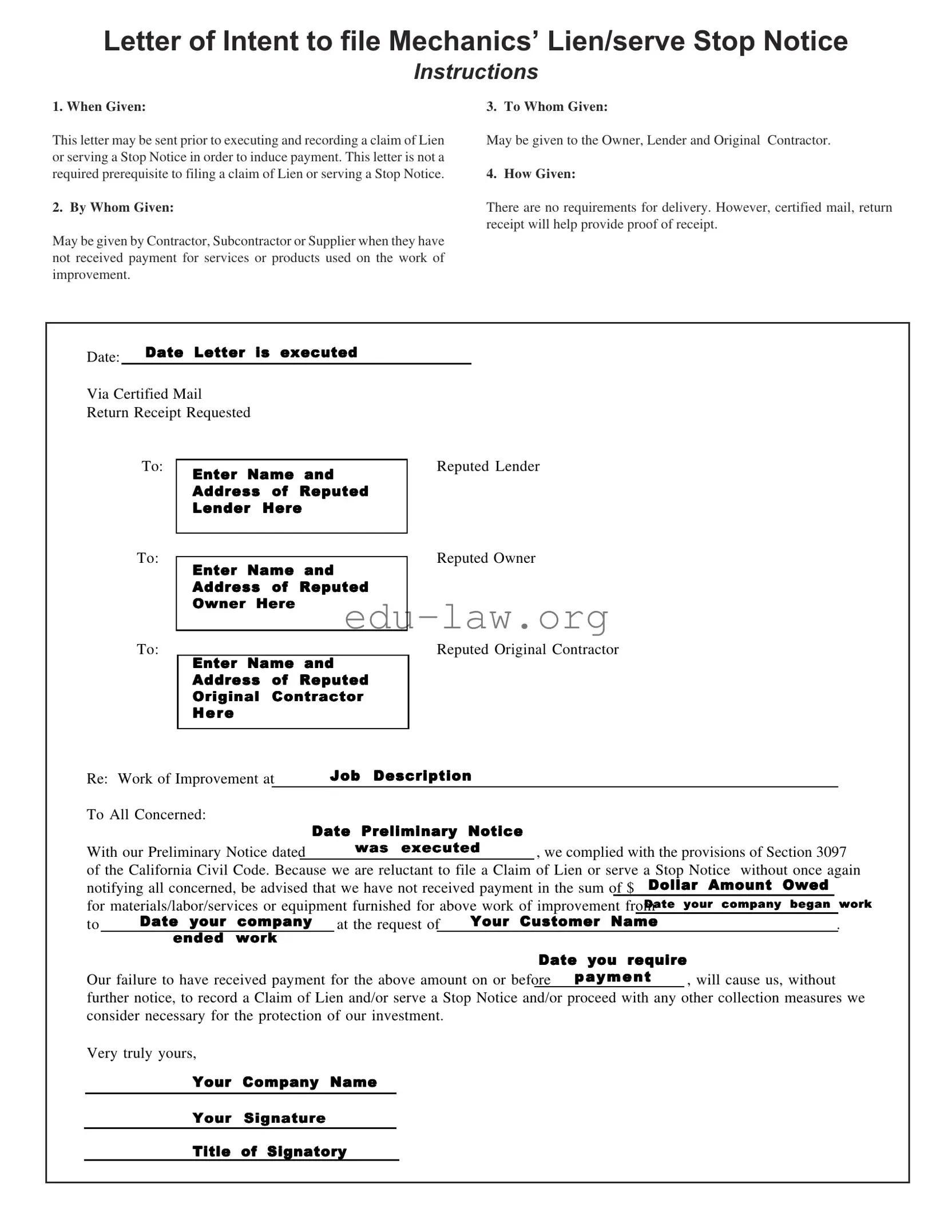
LetterofIntenttofileMechanics’Lien/serveStopNotice
INSTRUCTIONS
1. When Given:
This letter may be sent prior to executing and recording a claim of Lien or serving a Stop Notice in order to induce payment. This letter is not a required prerequisite to filing a claim of Lien or serving a Stop Notice.
2. By Whom Given:
May be given by Contractor, Subcontractor or Supplier when they have not received payment for services or products used on the work of improvement.
3. To Whom Given:
May be given to the Owner, Lender and Original Contractor.
4. How Given:
There are no requirements for delivery. However, certified mail, return receipt will help provide proof of receipt.
Date: Date Letter is executed
Via Certified Mail
Return Receipt Requested
To:
To:
To:
Enter Name and
Address of Reputed
Lender Here
Enter Name and
Address of Reputed
Owner Here
Enter Name and
Address of Reputed
Original Contractor
Here
Reputed Lender
Reputed Owner
Reputed Original Contractor
Re: Work of Improvement at |
Job |
Description |
|
|
|
|
|
||||||
To All Concerned: |
|
|
|
|
|
|
|
|
|
|
|
||
|
|
|
|
Date |
Preliminary |
Notice |
|
|
|
|
|
||
With our Preliminary Notice dated |
|
was executed |
, we complied with the provisions of Section 3097 |
||||||||||
|
|
|
|
|
|||||||||
|
|
|
|
|
|
|
|
||||||
of the California Civil Code. Because we are reluctant to file a Claim of Lien or serve a Stop Notice |
without once again |
||||||||||||
notifying all concerned, be advised that we have not received payment in the sum of $ Dollar Amount Owed |
|||||||||||||
|
|
|
|
|
|
|
|
|
Date your company began work |
||||
for materials/labor/services or equipment furnished for above work of improvement from |
|
|
|
||||||||||
to |
Date your company |
|
at the request of |
Your Customer Name |
|
. |
|||||||
|
ended work |
|
|
|
|
|
|
|
|
|
|
||
|
|
|
|
|
|
|
|
|
Date you require |
|
|
|
|
Our failure to have received payment for the above amount on or before payment |
, will cause us, without |
||||||||||||
|
|
|
|
|
|
|
|
|
|
|
|
|
|
further notice, to record a Claim of Lien and/or serve a Stop Notice and/or proceed with any other collection measures we consider necessary for the protection of our investment.
Very truly yours,
Your Company Name
Your Signature
Title of Signatory

Date:
Via Certified Mail
Return Receipt Requested
To: |
|
Reputed Lender |
|
|
|
To: |
|
Reputed Owner |
|
||
|
|
|
To: |
|
Reputed Original Contractor |
|
|
|
Re: Work of Improvement at
To All Concerned: |
|
With our Preliminary Notice dated |
, we complied with the provisions of Section ___ |
of the _______ Civil Code. Because we are reluctant to file a Claim of Lien or serve a Stop Notice without once again
notifying all concerned, be advised that we have not received payment in the sum of $
for materials/labor/services or equipment furnished for above work of improvement from |
|
|
||||
to |
|
at the request of |
|
. |
||
Our failure to have received payment for the above amount on or before |
|
, will cause us, without |
||||
further notice, to record a Claim of Lien and/or serve a Stop Notice and/or proceed with any other collection measures we consider necessary for the protection of our investment.
Very truly yours,
| Fact Name | Details |
|---|---|
| Purpose | This letter is used to induce payment before filing a claim of lien or serving a stop notice. |
| Sender | Contractors, subcontractors, or suppliers may send this letter when payment has not been received. |
| Recipients | The letter can be sent to the owner, lender, and original contractor involved in the project. |
| Delivery Method | No specific delivery method is required, but certified mail with return receipt is recommended for proof. |
| Legal Reference | In California, it complies with Section 3097 of the California Civil Code. |
| Notification | This letter serves as a reminder before taking further action, such as filing a lien or serving a stop notice. |
| Amount Due | The letter must specify the exact dollar amount owed for materials, labor, or services. |
| Deadline for Payment | A clear deadline for payment should be included, indicating when further action will be taken. |
| Signature Requirement | The letter should be signed by an authorized representative of the company sending it. |
Completing the Letter of Intent Lien form requires careful attention to detail. After filling out the form, the next steps involve sending it to the appropriate parties, which can help facilitate payment for services rendered. This letter serves as a formal notice before taking further action, such as filing a claim of lien or serving a stop notice.
What is a Letter of Intent Lien form?
A Letter of Intent Lien form is a document that contractors, subcontractors, or suppliers can use to notify the owner, lender, and original contractor about unpaid amounts for services or materials provided on a construction project. This letter serves as a preliminary warning before taking more formal actions, such as filing a claim of lien or serving a stop notice. It aims to encourage payment while maintaining communication among all parties involved.
When should I use a Letter of Intent Lien form?
This letter can be sent prior to executing and recording a claim of lien or serving a stop notice. While it is not a mandatory step, sending this letter can help facilitate payment and may reduce the need for more drastic measures. If you have not received payment for your services or products related to a work improvement project, consider using this form to formally notify the concerned parties.
Who can issue a Letter of Intent Lien?
The Letter of Intent Lien can be issued by contractors, subcontractors, or suppliers who have not received payment for their contributions to a project. It is a tool for anyone involved in the supply chain of a construction project who is facing payment delays. By issuing this letter, you are taking a proactive step to communicate your concerns and seek resolution.
How should I deliver the Letter of Intent Lien?
While there are no strict requirements for how to deliver the letter, using certified mail with a return receipt requested is highly recommended. This method provides proof of delivery, which can be crucial if further action is necessary. Ensuring that the letter reaches the appropriate parties can help facilitate a timely response and resolution to the payment issue.
What happens if I do not receive payment after sending the Letter of Intent Lien?
If payment is not received by the specified deadline mentioned in the letter, you may proceed with filing a claim of lien or serving a stop notice. The letter serves as a final reminder, indicating your intent to take further action to protect your investment. It is essential to keep a record of all communications and actions taken, as this documentation can be vital in any subsequent legal proceedings.
Neglecting to Include the Date: Failing to write the date on the Letter of Intent can create confusion about when the notice was sent. Always ensure the date is clearly stated.
Incorrect Recipient Information: Providing inaccurate names or addresses for the Owner, Lender, or Original Contractor can lead to the letter not reaching the intended parties. Double-check all details before sending.
Missing Payment Amount: Omitting the specific dollar amount owed can weaken the impact of the notice. Clearly state the exact sum to emphasize the seriousness of the situation.
Failure to Reference Previous Notices: Not mentioning any prior notices can make it seem like this is the first communication regarding payment. Reference any Preliminary Notices sent earlier to provide context.
Not Specifying Work Details: Leaving out a description of the work performed can make it difficult for recipients to understand the basis for the claim. Include clear details about the job.
Ignoring Delivery Method: While there are no strict requirements for delivery, failing to use certified mail can complicate proving receipt. Opt for certified mail with return receipt requested to ensure delivery is documented.
Inaccurate Timeframes: Providing incorrect dates for when work began or ended can lead to disputes. Make sure these dates are accurate and clearly stated.
Not Signing the Letter: A letter without a signature may be viewed as incomplete or unprofessional. Always sign the letter to validate it.
Using Ambiguous Language: Vague terms can lead to misunderstandings. Be clear and direct in your language to avoid any confusion about the intent of the letter.
Failing to Keep Copies: Not retaining a copy of the sent letter can create issues if you need to prove that the notice was sent. Always keep a copy for your records.
When dealing with construction projects and payment disputes, several documents often accompany the Letter of Intent Lien form. Each of these forms serves a specific purpose and can help clarify the rights and responsibilities of the parties involved. Below is a list of commonly used documents that can complement the Letter of Intent Lien.
Understanding these documents can significantly enhance the effectiveness of the Letter of Intent Lien. Each form plays a crucial role in ensuring that all parties are aware of their obligations and rights throughout the construction process. Proper use of these documents can help avoid costly disputes and ensure timely payments.
The Preliminary Notice serves as a crucial document in the construction industry. Like the Letter of Intent Lien, it is often sent to inform property owners, lenders, and general contractors about unpaid dues for labor or materials. This notice is typically required by law in many states before a contractor or subcontractor can file a lien. By providing this notice, the sender establishes their right to claim a lien later if payment is not received. The urgency is clear: it alerts all parties involved that payment is due and that legal action may follow if the situation is not resolved.
The Claim of Lien is a formal document filed to secure a contractor’s right to payment. Similar to the Letter of Intent Lien, it is a mechanism for contractors, subcontractors, or suppliers to assert their claim against a property when they have not been paid. This document must be recorded with the appropriate government office to be effective. The Claim of Lien serves as a public notice of the unpaid debt, putting all parties on alert that the sender may take legal action to recover their funds. It is a critical step in the collection process.
A Stop Notice is another document that shares similarities with the Letter of Intent Lien. It is used to halt the disbursement of funds from a property owner or lender to a contractor. This notice is typically sent when payment has not been received for services rendered or materials supplied. The Stop Notice compels the owner or lender to withhold payment until the dispute is resolved. Like the Letter of Intent Lien, it serves as a warning that legal measures may be pursued if the matter is not addressed promptly.
The Notice of Non-Payment is a document that alerts the property owner and other stakeholders about the lack of payment for services or materials. This notice is similar to the Letter of Intent Lien in that it communicates the sender's intention to seek payment. It often precedes more formal actions, such as filing a lien. The Notice of Non-Payment emphasizes the urgency of the situation, urging the recipient to take immediate action to avoid further complications.
The Demand for Payment is a straightforward document that demands the recipient settle outstanding debts. Like the Letter of Intent Lien, it is an initial step before more drastic measures are taken. This demand outlines the amount owed and specifies a deadline for payment. It serves to remind the recipient of their obligation and the potential consequences of failing to comply. The tone is direct, emphasizing the necessity of prompt payment to avoid escalation.
The Affidavit of Service is a document that provides proof that a notice or other legal document has been delivered to the appropriate parties. Similar to the Letter of Intent Lien, it is essential in establishing that all parties were informed of the situation. This affidavit serves as a safeguard for the sender, ensuring that they can demonstrate compliance with legal requirements should the matter proceed to court. It reinforces the urgency of the situation by documenting the delivery process.
The Waiver of Lien is a document that relinquishes a contractor's right to file a lien in exchange for payment. While it may seem contrary to the purpose of the Letter of Intent Lien, it is related in that it addresses payment issues. The Waiver of Lien indicates that the contractor has received payment for their services and no longer intends to assert a claim against the property. This document is often used in the context of final payments, ensuring that all parties understand the resolution of any outstanding debts.
The Release of Lien is a formal document that indicates a lien has been satisfied and removed. Similar to the Letter of Intent Lien, it confirms that payment has been made and the contractor no longer holds any claim against the property. This release is critical for property owners, as it clears the title and ensures that no further claims can be made. The urgency lies in the need to finalize all financial obligations and maintain clear ownership of the property.
The Notice of Intent to Lien is a preliminary document that informs the property owner and other interested parties of the sender's intention to file a lien. This notice is similar to the Letter of Intent Lien in that it serves as a warning before formal action is taken. It outlines the amount owed and provides a timeline for payment. The urgency is clear: it gives the recipient an opportunity to resolve the matter before it escalates to a lien filing.
When filling out the Letter of Intent Lien form, it is crucial to follow certain guidelines to ensure clarity and compliance. Below is a list of ten dos and don’ts to keep in mind:
Following these guidelines can help you navigate the process of filing a lien more effectively and protect your interests in the project.
Understanding the Letter of Intent Lien form can be challenging. Here are seven common misconceptions about this important document:
By clearing up these misconceptions, individuals can better navigate the process of using the Letter of Intent Lien form effectively.
When dealing with the Letter of Intent Lien form, there are several important points to keep in mind. Understanding these can help ensure that the process goes smoothly and effectively.
By keeping these key points in mind, individuals can navigate the process of using the Letter of Intent Lien form more effectively. It is an important tool for protecting financial interests in construction projects.