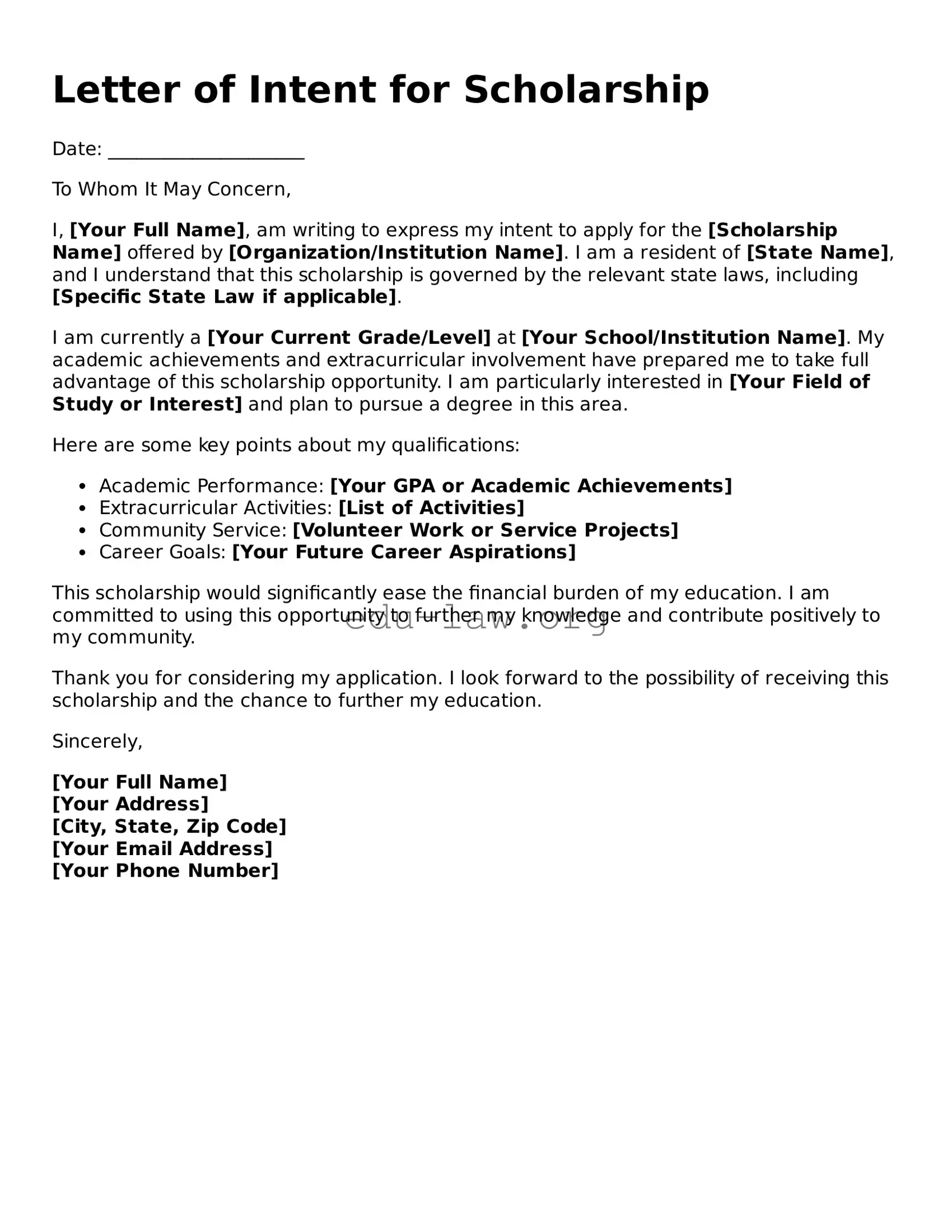
A Letter of Intent for Scholarship is an essential document that communicates a student's commitment to pursuing financial assistance for their education. This form typically includes key information such as the applicant's personal details, academic achievements, and future educational goals. It serves as a formal introduction to scholarship committees, allowing students to express their motivations and aspirations clearly. Additionally, the letter may outline the specific scholarship being applied for, demonstrating the applicant's understanding of the scholarship's purpose and requirements. By effectively highlighting the student's qualifications and intentions, this letter can significantly enhance the chances of securing funding. Overall, the Letter of Intent for Scholarship is not just a formality; it is a vital tool that can pave the way for academic success and financial support.
Letter of Intent for Scholarship
Date: _____________________
To Whom It May Concern,
I, [Your Full Name], am writing to express my intent to apply for the [Scholarship Name] offered by [Organization/Institution Name]. I am a resident of [State Name], and I understand that this scholarship is governed by the relevant state laws, including [Specific State Law if applicable].
I am currently a [Your Current Grade/Level] at [Your School/Institution Name]. My academic achievements and extracurricular involvement have prepared me to take full advantage of this scholarship opportunity. I am particularly interested in [Your Field of Study or Interest] and plan to pursue a degree in this area.
Here are some key points about my qualifications:
This scholarship would significantly ease the financial burden of my education. I am committed to using this opportunity to further my knowledge and contribute positively to my community.
Thank you for considering my application. I look forward to the possibility of receiving this scholarship and the chance to further my education.
Sincerely,
[Your Full Name]
[Your Address]
[City, State, Zip Code]
[Your Email Address]
[Your Phone Number]
| Fact Name | Description |
|---|---|
| Purpose | A Letter of Intent for Scholarship expresses a student's interest in receiving financial aid for their education. |
| Eligibility | Students must meet specific criteria set by the scholarship provider to qualify for consideration. |
| Components | The letter typically includes personal information, academic achievements, and reasons for requesting the scholarship. |
| Submission Deadline | Each scholarship has its own deadline for submitting the Letter of Intent, which must be adhered to strictly. |
| State-Specific Forms | Some states may require specific forms or additional documentation to accompany the Letter of Intent. |
| Governing Laws | Scholarships may be governed by state laws, which vary. Check local regulations for compliance. |
| Format | The letter should be typed, professionally formatted, and free of grammatical errors. |
| Signature | A handwritten signature is often required at the end of the letter to validate the submission. |
| Follow-Up | After submission, students should follow up with the scholarship provider to confirm receipt of the letter. |
Once you have the Letter of Intent for Scholarship form in hand, the next step is to carefully fill it out with the required information. This process ensures that your intentions and qualifications are clearly communicated to the scholarship committee. Follow the steps below to complete the form accurately and effectively.
After filling out the form, you will need to submit it according to the instructions provided by the scholarship committee. This may involve mailing a physical copy or submitting it electronically. Be mindful of any deadlines to ensure your application is considered.
What is a Letter of Intent for Scholarship?
A Letter of Intent for Scholarship is a formal document that expresses a student's intention to apply for a scholarship. This letter typically outlines the applicant's academic achievements, extracurricular activities, and future goals. It serves as an introduction to the scholarship committee and helps convey the applicant's passion and commitment to their educational pursuits.
What should be included in the Letter of Intent?
The letter should include several key components. Start with a brief introduction that states your name and the scholarship for which you are applying. Next, provide details about your academic background, including your GPA, relevant coursework, and any honors received. Discuss your extracurricular activities, leadership roles, and community service involvement. Finally, articulate your future goals and explain how the scholarship will help you achieve them. A personal touch, such as a brief story or experience that inspired your educational journey, can make your letter more compelling.
How long should the Letter of Intent be?
Typically, a Letter of Intent for Scholarship should be one page long. Aim for a concise and focused letter that communicates your key points clearly. Use standard formatting, such as 12-point font and one-inch margins. This length allows you to provide sufficient information without overwhelming the reader.
Who should I address the Letter of Intent to?
Address the letter to the scholarship committee or the specific individual listed in the scholarship guidelines. If no name is provided, "Dear Scholarship Committee" is an acceptable salutation. Ensure that you use a respectful tone throughout the letter, as this demonstrates professionalism and respect for the committee's time.
When is the best time to submit the Letter of Intent?
Submit the Letter of Intent well before the scholarship deadline. This allows time for any necessary revisions and ensures that you meet all requirements. Check the scholarship guidelines for specific submission dates. Ideally, aim to complete your letter a few weeks in advance, giving yourself ample time to review and refine your content.
Failing to read the instructions carefully. Many applicants overlook specific guidelines provided for the Letter of Intent, which can lead to errors.
Not personalizing the letter. A generic letter that does not reflect individual experiences or aspirations may not stand out to the selection committee.
Ignoring the word limit. Exceeding or falling short of the required word count can be viewed as a lack of attention to detail.
Neglecting to proofread. Spelling and grammatical errors can detract from the overall quality of the letter and may create a negative impression.
Being overly formal or too casual. Striking the right tone is important; a letter that is too stiff or too relaxed may not convey professionalism.
Failing to highlight relevant achievements. Applicants sometimes forget to mention key accomplishments that support their case for receiving the scholarship.
Not explaining financial need, if applicable. Providing context about financial circumstances can strengthen the application.
Omitting future goals. A clear outline of future aspirations related to the scholarship can help reviewers understand the applicant's motivation.
Submitting the letter without a signature. A handwritten or digital signature can add a personal touch and confirm authenticity.
When applying for scholarships, a Letter of Intent is a crucial document that outlines your purpose and goals. However, it is often accompanied by several other forms and documents that help paint a complete picture of your qualifications and aspirations. Below is a list of commonly used forms that enhance your scholarship application.
Each of these documents plays a significant role in your scholarship application process. By carefully preparing and submitting them alongside your Letter of Intent, you increase your chances of making a strong impression on scholarship committees. Remember, a well-rounded application can set you apart in a competitive field.
A Letter of Intent for Scholarship serves a specific purpose, but it shares similarities with several other important documents. One such document is the Statement of Purpose. Both documents require the writer to articulate their goals and aspirations. A Statement of Purpose typically delves deeper into an individual’s academic and career objectives, often including detailed explanations of how a particular program aligns with those goals. While the Letter of Intent is more focused on a specific scholarship opportunity, the Statement of Purpose provides a broader overview of the applicant’s journey and future plans.
Another document that resembles the Letter of Intent is the Personal Statement. Like the Letter of Intent, a Personal Statement allows individuals to express their motivations, experiences, and personal background. However, the Personal Statement often emphasizes personal anecdotes and life experiences, providing a narrative that showcases the applicant's character. Both documents aim to create a connection between the applicant and the reviewing committee, yet the Personal Statement tends to be more reflective and narrative-driven.
The Application Essay is also comparable to the Letter of Intent for Scholarship. Both require applicants to present their thoughts clearly and persuasively. An Application Essay may focus on a specific prompt or question, allowing the writer to explore their ideas in a structured manner. In contrast, the Letter of Intent is more focused on the scholarship itself, detailing why the applicant is a suitable candidate. Nonetheless, both documents serve to highlight the applicant's strengths and qualifications.
Additionally, a Cover Letter shares similarities with the Letter of Intent. Both documents introduce the applicant and express interest in a particular opportunity. A Cover Letter typically accompanies a job application, while the Letter of Intent is directed towards scholarships. In both cases, the writer must convey enthusiasm and provide relevant information that captures the attention of the reader. The goal is to make a compelling case for why the applicant deserves consideration.
Lastly, the Curriculum Vitae (CV) can be seen as another document that aligns with the Letter of Intent. While the CV primarily lists qualifications, experiences, and achievements, the Letter of Intent complements this by explaining the significance of those qualifications in relation to the scholarship. Both documents work together to present a well-rounded picture of the applicant, with the CV providing the factual basis and the Letter of Intent offering a personal narrative that ties everything together.
When filling out the Letter of Intent for a scholarship, it’s important to approach the task thoughtfully. Here are some things to keep in mind:
Many students and parents have misunderstandings about the Letter of Intent for Scholarship form. Clearing up these misconceptions can help applicants present themselves more effectively. Here are nine common misconceptions:
Some believe that the Letter of Intent is merely a formality. In reality, it’s a critical component that showcases your passion and commitment to the scholarship.
While academic performance is important, the letter allows you to highlight extracurricular activities, community service, and personal experiences that contribute to your overall profile.
Many think the letter must adhere to a strict formal structure. However, a conversational tone that reflects your personality can make a stronger impression.
Some applicants assume that they can write as much as they want. In fact, being concise and focused is often more effective than lengthy explanations.
People often think that only high school students need to submit a Letter of Intent. However, college students seeking scholarships also need to provide one.
Some believe a generic letter will suffice. Tailoring your letter to the specific scholarship and its values can significantly enhance your chances.
Many underestimate the importance of proofreading. Errors can detract from the professionalism of your letter and may leave a negative impression.
Some applicants think they cannot revise their letter after submission. In many cases, you can update your letter if there’s an opportunity to resubmit or if additional materials are requested.
While the letter serves to request funding, it’s also an opportunity to express your goals, aspirations, and how the scholarship aligns with your future plans.
Understanding these misconceptions can help you craft a more effective Letter of Intent, ultimately improving your chances of securing the scholarship you desire.
Filling out the Letter of Intent for Scholarship form is an important step in securing funding for your education. Here are key takeaways to consider:
By following these takeaways, you can create a compelling Letter of Intent that enhances your chances of receiving scholarship funding.