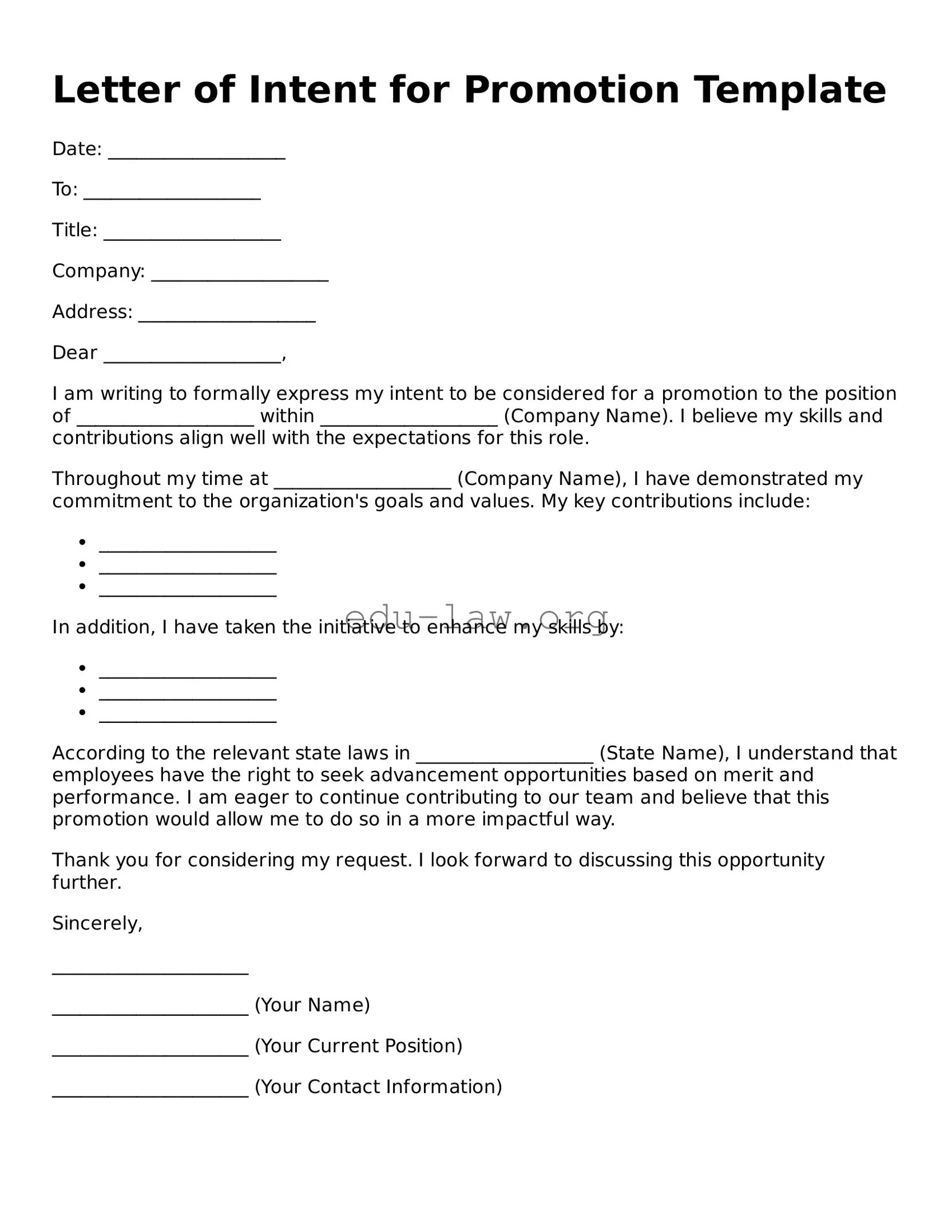
The Letter of Intent for Promotion form serves as a crucial document in the workplace, particularly for employees seeking advancement within their organization. This form not only outlines an employee's desire for promotion but also highlights their qualifications, achievements, and contributions to the company. By detailing specific skills and experiences, the employee can effectively communicate their readiness for increased responsibilities. Additionally, the form often requires the employee to specify the position they are targeting, allowing for a clear understanding of their career aspirations. It may also include sections for management to provide feedback or endorsements, reinforcing the importance of support from supervisors. Completing this form thoughtfully can significantly impact the promotion process, making it an essential step for anyone looking to climb the corporate ladder.
Letter of Intent for Promotion Template
Date: ___________________
To: ___________________
Title: ___________________
Company: ___________________
Address: ___________________
Dear ___________________,
I am writing to formally express my intent to be considered for a promotion to the position of ___________________ within ___________________ (Company Name). I believe my skills and contributions align well with the expectations for this role.
Throughout my time at ___________________ (Company Name), I have demonstrated my commitment to the organization's goals and values. My key contributions include:
In addition, I have taken the initiative to enhance my skills by:
According to the relevant state laws in ___________________ (State Name), I understand that employees have the right to seek advancement opportunities based on merit and performance. I am eager to continue contributing to our team and believe that this promotion would allow me to do so in a more impactful way.
Thank you for considering my request. I look forward to discussing this opportunity further.
Sincerely,
_____________________
_____________________ (Your Name)
_____________________ (Your Current Position)
_____________________ (Your Contact Information)
| Fact Name | Description |
|---|---|
| Purpose | A Letter of Intent for Promotion serves as a formal document expressing an employee's desire to be considered for a promotion within the organization. |
| Format | The letter should be written in a professional format, typically including the date, recipient's information, a subject line, and a closing signature. |
| Content | It should outline the employee's qualifications, achievements, and reasons for seeking the promotion. |
| Submission | Employees usually submit the letter to their immediate supervisor or the human resources department. |
| Timing | It is often recommended to submit the letter during performance review periods or when a position becomes available. |
| State-Specific Forms | Some states may have specific guidelines for internal promotion processes, but generally, the Letter of Intent is a standard practice across the U.S. |
| Governing Laws | There are no specific laws governing the Letter of Intent for Promotion; however, employment laws vary by state and may impact promotion practices. |
| Confidentiality | Employees should be aware that the contents of the letter may be shared with management and HR, so confidentiality cannot be guaranteed. |
| Follow-Up | After submitting the letter, it is advisable to follow up with the supervisor or HR for feedback or next steps in the promotion process. |
Completing the Letter of Intent for Promotion form is an important step in the promotion process. After filling out this form, it will be submitted to the appropriate department for review. Following the submission, you may be contacted for further information or clarification regarding your request.
What is a Letter of Intent for Promotion?
A Letter of Intent for Promotion is a formal document submitted by an employee to express their desire for a promotion within the organization. It outlines the employee's qualifications, achievements, and reasons for seeking the promotion. This letter serves as a way to communicate intent to management and can help facilitate the promotion process.
Who should use the Letter of Intent for Promotion?
This letter is intended for employees who believe they are ready to take on a higher role within the company. If you have demonstrated strong performance, taken on additional responsibilities, or contributed significantly to your team, this letter can be an effective tool to advocate for your advancement.
What should be included in the Letter of Intent for Promotion?
Your letter should include several key elements: a clear statement of your intent to seek a promotion, a summary of your accomplishments, specific examples of how you have contributed to the company, and a discussion of how you can add value in the new role. Additionally, it’s important to express gratitude for the opportunities you’ve had so far.
Is there a specific format for the Letter of Intent for Promotion?
While there is no strict format, it is advisable to keep the letter professional and concise. Start with your contact information, followed by the date, and then the recipient's information. Use a formal greeting, and structure the body of the letter into clear paragraphs. Conclude with a polite closing and your signature.
When should I submit the Letter of Intent for Promotion?
Timing can be crucial. Consider submitting your letter during performance review periods or when your company is discussing promotions. However, if you feel ready at any other time, don’t hesitate to express your intent. Just be sure to choose a moment when your contributions are fresh in the minds of your supervisors.
Will submitting a Letter of Intent guarantee a promotion?
Submitting this letter does not guarantee that you will receive a promotion. It is a way to formally express your interest and qualifications. The decision will ultimately depend on various factors, including company policies, available positions, and the overall performance of candidates.
How should I follow up after submitting the Letter of Intent for Promotion?
After submitting your letter, it’s a good idea to follow up with your supervisor or HR after a reasonable amount of time. A simple email or a brief conversation can help you gauge their thoughts on your request and demonstrate your continued interest in the promotion.
Can I withdraw my Letter of Intent for Promotion?
Yes, you can withdraw your letter if you change your mind or if your circumstances change. It’s best to communicate this decision to your supervisor or HR promptly, so they are aware of your current intentions. This transparency helps maintain a positive professional relationship.
Not clearly stating the desired position. Applicants often forget to specify which position they are seeking, leading to confusion.
Failing to highlight relevant experience. Many individuals neglect to include their qualifications and past achievements that support their case for promotion.
Using vague language. It's important to be specific about skills and contributions. General statements do not effectively convey value.
Ignoring formatting guidelines. Submitting a form that does not follow the required format can create a negative impression.
Omitting contact information. Some forget to include their phone number or email address, making it difficult for decision-makers to reach them.
Not proofreading the document. Spelling and grammatical errors can undermine the professionalism of the letter.
Submitting the form late. Timeliness is crucial. Late submissions may not be considered during the promotion process.
The Letter of Intent for Promotion form serves as a formal request for an employee's advancement within an organization. However, several other documents often accompany this form to provide additional context and support for the promotion request. Below is a list of commonly used forms and documents that may be included in the promotion process.
These documents collectively provide a comprehensive view of the employee's qualifications and readiness for promotion. Including them can strengthen the case for advancement and facilitate a more informed decision-making process by management.
The Letter of Intent for Promotion is similar to a job application cover letter. Both documents serve as an introduction to the individual’s qualifications and aspirations. In a cover letter, the applicant highlights relevant experiences and skills that make them a good fit for the position. Similarly, a Letter of Intent for Promotion outlines the employee’s achievements and readiness for advancement within the organization. Both documents aim to persuade the reader of the individual’s suitability for a new role.
Another document that shares similarities is the resume. While the resume provides a detailed account of work history, education, and skills, the Letter of Intent for Promotion focuses on specific accomplishments and contributions that support the case for promotion. Both documents work together to present a comprehensive picture of the individual’s professional journey. They complement each other by detailing qualifications in different formats.
The Performance Evaluation is also akin to the Letter of Intent for Promotion. A performance evaluation reviews an employee’s work over a certain period, assessing their strengths and areas for improvement. In contrast, the Letter of Intent for Promotion emphasizes the employee’s successes and readiness for greater responsibilities. Both documents reflect the employee’s growth and potential, but the performance evaluation is more retrospective, while the Letter of Intent looks forward.
Similarly, a Statement of Purpose shares common ground with the Letter of Intent for Promotion. A Statement of Purpose often outlines an individual’s goals and motivations for pursuing a particular opportunity, such as graduate school or a specific job. The Letter of Intent for Promotion conveys the employee’s desire to take on new challenges and advance their career. Both documents articulate aspirations and the rationale behind pursuing new opportunities.
Lastly, the Recommendation Letter can be compared to the Letter of Intent for Promotion. A recommendation letter typically comes from a supervisor or colleague who speaks to the individual’s qualifications and character. In contrast, the Letter of Intent is a self-advocacy tool where the employee articulates their own achievements and readiness for promotion. Both documents aim to support the individual’s case for advancement, but they do so from different perspectives.
When filling out the Letter of Intent for Promotion form, it is important to be thorough and precise. Here are ten guidelines to consider:
Many individuals hold misconceptions about the Letter of Intent for Promotion form. Here are ten common misunderstandings and clarifications regarding this important document:
The Letter of Intent for Promotion is not a promise that you will receive a promotion. It expresses your interest and outlines your qualifications, but the final decision rests with management.
All eligible employees can submit a Letter of Intent for Promotion. There are no restrictions based on tenure or position.
A concise letter is often more effective. Focus on key achievements and how they align with the position you seek.
The Letter of Intent is a preliminary step. It does not replace the need to complete any formal application or interview processes.
You can submit a Letter of Intent for Promotion at any time. Timing can be strategic, but it is not limited to review periods.
While in-person submission is acceptable, many organizations allow for electronic submissions. Check your company’s policy.
This form can also be used when applying for positions within the organization that may not be strictly promotions.
While there may be guidelines, there is no one-size-fits-all format. Personalizing your letter is encouraged.
Management often reviews these letters carefully. They can be influential in the decision-making process.
You can revise and resubmit your Letter of Intent if you believe it can be improved or if your circumstances change.
When filling out and using the Letter of Intent for Promotion form, keep these key takeaways in mind: