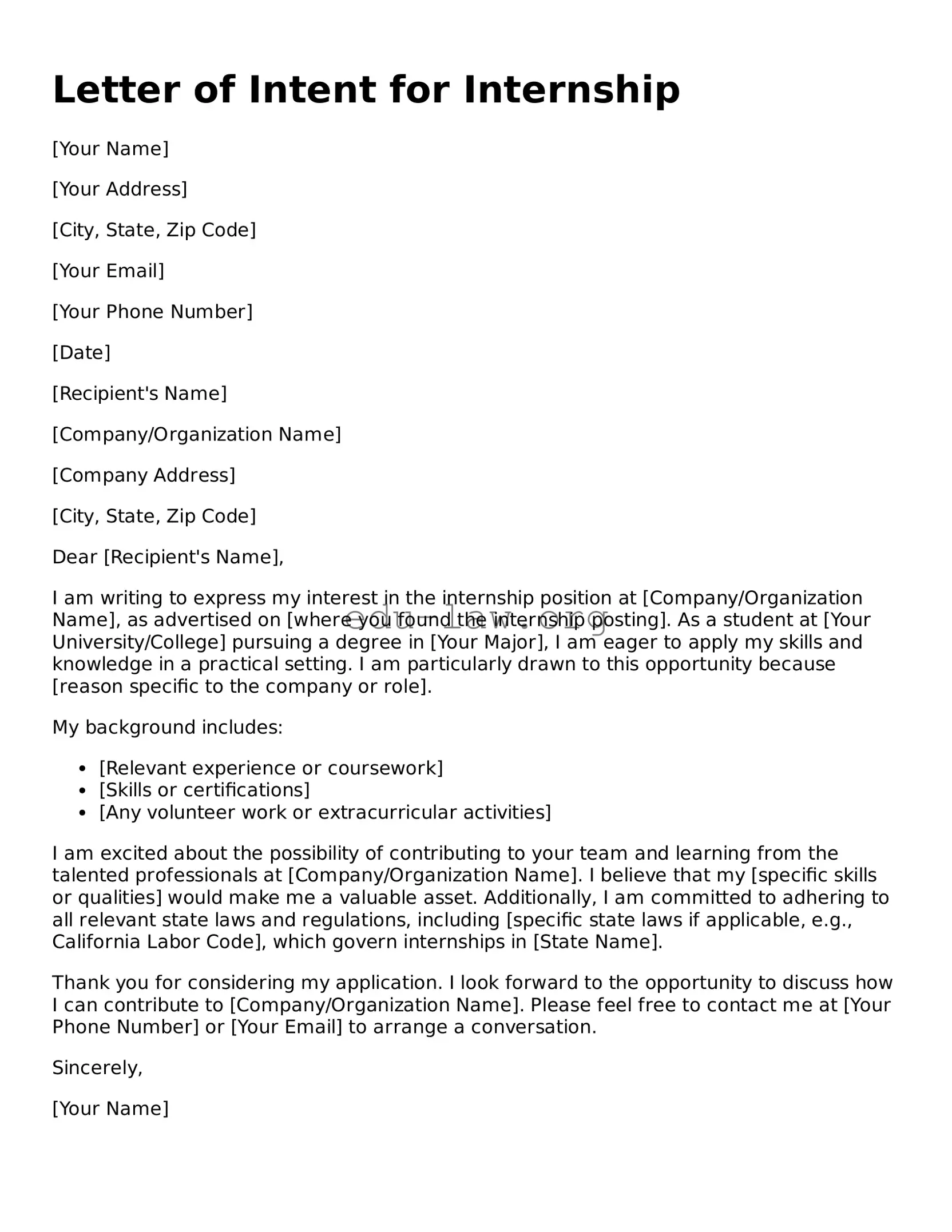
Securing an internship can be a pivotal step in a student's academic and professional journey. One essential tool in this process is the Letter of Intent for Internship form, which serves as a formal introduction to potential employers. This document typically outlines the applicant's goals, interests, and qualifications, providing a snapshot of what they hope to achieve during their internship experience. The form often includes sections for personal information, educational background, and relevant skills, allowing students to present themselves in the best light. Additionally, it may invite candidates to articulate their reasons for choosing a specific organization, emphasizing how their aspirations align with the company’s mission and values. By thoughtfully completing this form, students can not only express their enthusiasm for the opportunity but also demonstrate their commitment to making a meaningful contribution. Ultimately, the Letter of Intent for Internship form is more than just a piece of paper; it is a vital communication tool that can open doors to valuable experiences and professional growth.
Letter of Intent for Internship
[Your Name]
[Your Address]
[City, State, Zip Code]
[Your Email]
[Your Phone Number]
[Date]
[Recipient's Name]
[Company/Organization Name]
[Company Address]
[City, State, Zip Code]
Dear [Recipient's Name],
I am writing to express my interest in the internship position at [Company/Organization Name], as advertised on [where you found the internship posting]. As a student at [Your University/College] pursuing a degree in [Your Major], I am eager to apply my skills and knowledge in a practical setting. I am particularly drawn to this opportunity because [reason specific to the company or role].
My background includes:
I am excited about the possibility of contributing to your team and learning from the talented professionals at [Company/Organization Name]. I believe that my [specific skills or qualities] would make me a valuable asset. Additionally, I am committed to adhering to all relevant state laws and regulations, including [specific state laws if applicable, e.g., California Labor Code], which govern internships in [State Name].
Thank you for considering my application. I look forward to the opportunity to discuss how I can contribute to [Company/Organization Name]. Please feel free to contact me at [Your Phone Number] or [Your Email] to arrange a conversation.
Sincerely,
[Your Name]
| Fact Name | Description |
|---|---|
| Purpose | A Letter of Intent for Internship outlines the mutual understanding between the intern and the organization regarding the internship terms. |
| Duration | The document typically specifies the duration of the internship, including start and end dates. |
| Compensation | It may indicate whether the internship is paid or unpaid, clarifying any stipends or benefits provided. |
| Responsibilities | The letter often details the intern's responsibilities and tasks expected during the internship period. |
| Confidentiality | Many Letters of Intent include a confidentiality clause to protect sensitive information shared during the internship. |
| Governing Law | For state-specific forms, the governing law is usually the state where the internship takes place. For example, California law may apply for internships in California. |
| Signatures | The document requires signatures from both the intern and the organization to confirm agreement on the terms outlined. |
| Amendments | It can include a clause about how amendments to the agreement should be handled, ensuring clarity for both parties. |
Once you have the Letter of Intent for Internship form in front of you, it's time to fill it out accurately. This form is essential for communicating your intentions regarding the internship position. Make sure you have all the necessary information ready before starting.
After completing the form, review it to ensure everything is correct. Once confirmed, you can submit it according to the instructions provided by the organization. Good luck with your internship application!
What is a Letter of Intent for Internship?
A Letter of Intent for Internship is a formal document that expresses your interest in an internship position. It outlines your qualifications, goals, and reasons for wanting to intern with a specific organization. This letter helps employers understand your motivations and how you align with their mission.
Why do I need to submit a Letter of Intent?
Submitting a Letter of Intent allows you to stand out from other candidates. It provides an opportunity to showcase your skills and enthusiasm for the internship. Employers often use it to gauge your commitment and fit for the role, making it an essential part of your application.
What should I include in my Letter of Intent?
Your Letter of Intent should include your contact information, a brief introduction, your academic background, relevant experiences, and specific reasons for wanting to intern with the organization. Make sure to express your enthusiasm and how you can contribute to their goals.
How long should my Letter of Intent be?
Keep your Letter of Intent concise—typically one page is sufficient. Aim for clear and direct language. Avoid unnecessary details, and focus on the most relevant information that highlights your qualifications and interest in the internship.
Is there a specific format I should follow?
While there’s no strict format, a standard business letter format works well. Start with your contact information, followed by the date, the employer's contact information, a greeting, the body of the letter, and a closing. Use a professional font and maintain a clean layout.
When is the deadline for submitting the Letter of Intent?
Deadlines can vary by organization and internship program. Check the specific requirements provided by the employer. It’s best to submit your Letter of Intent as early as possible to ensure you meet any application deadlines.
Can I use the same Letter of Intent for different internships?
While you can use a similar template, customize each Letter of Intent for the specific internship. Tailoring your letter shows that you’ve done your research and are genuinely interested in the position. Highlight unique aspects of each organization to make your application stand out.
Who should I address my Letter of Intent to?
Address your Letter of Intent to the hiring manager or the person responsible for the internship program. If you don’t have a specific name, a general greeting like "Dear Hiring Committee" can work. However, personalizing it with a name is always more effective.
Failing to address the letter properly. Many applicants forget to include the recipient's name and title, which can make the letter seem impersonal.
Not clearly stating their purpose. Some individuals do not specify the internship they are applying for, leading to confusion.
Overlooking the importance of formatting. A cluttered or unprofessional layout can detract from the content of the letter.
Using generic language. Applicants often rely on clichés instead of expressing their unique qualifications and interests.
Neglecting to proofread. Spelling and grammatical errors can undermine the applicant's credibility and attention to detail.
Failing to highlight relevant experience. Many candidates miss the opportunity to connect their past experiences to the internship role.
Not demonstrating enthusiasm. A lack of passion for the internship can make the letter less engaging to the reader.
Ignoring the word limit. Some applicants exceed or fall short of the suggested length, which can affect the overall impression.
Forgetting to include contact information. Omitting phone numbers or email addresses can make it difficult for the employer to follow up.
When applying for an internship, the Letter of Intent is a crucial document that outlines your interest and intentions. However, it is often accompanied by several other forms and documents that help provide a complete picture of your qualifications and intentions. Here’s a list of commonly used documents that you might encounter alongside your Letter of Intent for Internship.
Each of these documents plays a significant role in the internship application process. Together, they help present a well-rounded view of your qualifications and intentions, increasing your chances of securing the position you desire. Be sure to prepare each document carefully to make a strong impression.
A Letter of Intent (LOI) is similar to a Memorandum of Understanding (MOU). Both documents serve as preliminary agreements that outline the intentions of the parties involved. An MOU typically describes the framework of a partnership or collaboration, detailing the roles and responsibilities of each party. Like an LOI, an MOU is not legally binding but expresses a commitment to move forward with negotiations or further discussions. The clarity provided by both documents helps to align expectations and foster cooperation.
Another document akin to the Letter of Intent is the Non-Disclosure Agreement (NDA). While an NDA focuses on protecting confidential information shared between parties, an LOI outlines the intentions and goals of an internship. Both documents emphasize the importance of trust and confidentiality in professional relationships. They establish a foundation for future interactions, ensuring that sensitive information remains protected while parties explore potential opportunities.
An Internship Agreement shares similarities with a Letter of Intent. This document typically outlines the terms of the internship, including duration, responsibilities, and compensation. While the LOI expresses interest in pursuing an internship, the Internship Agreement formalizes the arrangement once both parties agree on the terms. Both documents play crucial roles in defining the relationship between the intern and the organization, ensuring clarity and mutual understanding.
A Job Offer Letter is another document that resembles a Letter of Intent. Both serve as formal communications regarding opportunities. A Job Offer Letter typically includes specific details about the position, salary, and start date, whereas an LOI indicates a desire to pursue an internship opportunity. Each document reflects a commitment to engage in a professional relationship, paving the way for further negotiations and arrangements.
A Proposal is similar to a Letter of Intent in that it outlines a plan or idea for consideration. Both documents aim to persuade the recipient to take action, whether that means moving forward with an internship or approving a project. Proposals often include details about objectives, timelines, and resources needed, while an LOI focuses on expressing interest and intent. Both serve as tools for initiating discussions and building relationships.
Letters of Recommendation can also be compared to Letters of Intent. While a Letter of Intent expresses an individual’s desire to pursue an opportunity, a Letter of Recommendation provides an endorsement of an individual’s qualifications and character. Both documents play a significant role in the decision-making process. They help to establish credibility and trust, influencing the recipient’s perception of the applicant or candidate.
Finally, a Cover Letter shares similarities with a Letter of Intent. Both documents serve as introductions, highlighting an individual’s interest in a specific opportunity. A Cover Letter typically accompanies a resume and outlines the applicant’s qualifications for a job, while an LOI focuses on expressing interest in an internship. Each document aims to make a positive impression and persuade the reader to consider the applicant for the opportunity at hand.
When filling out the Letter of Intent for Internship form, consider the following guidelines:
Misconceptions about the Letter of Intent for Internship form can lead to confusion for both students and employers. Here are eight common misconceptions:
When it comes to filling out and using the Letter of Intent for Internship form, there are several important points to keep in mind. Here are ten key takeaways to ensure you navigate the process smoothly:
By following these key takeaways, you can create a compelling Letter of Intent that stands out to potential employers.