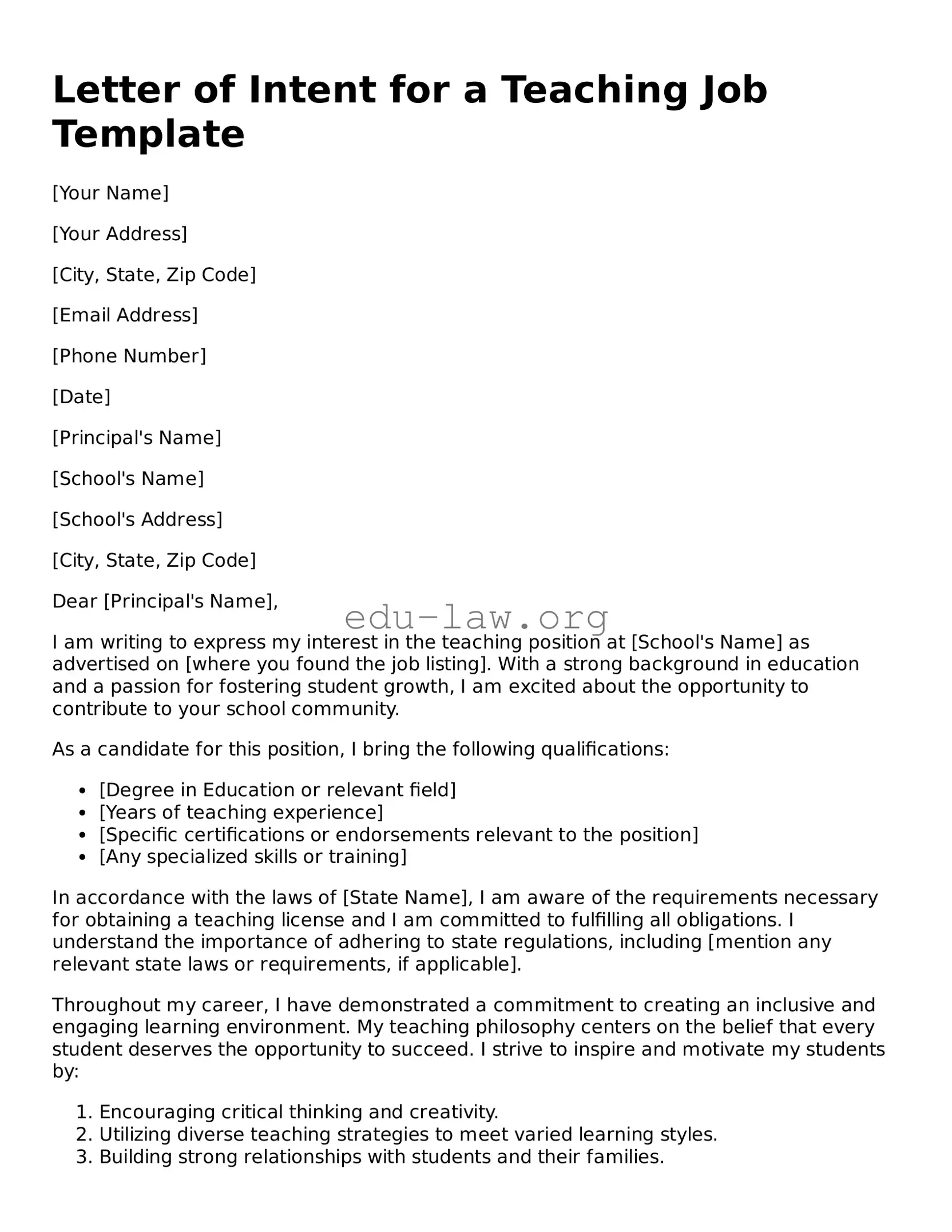
When pursuing a teaching position, a Letter of Intent serves as a crucial first step in the application process. This document outlines your interest in a specific teaching role and provides an opportunity to showcase your qualifications, experience, and passion for education. Typically, the form includes key components such as your personal information, a brief introduction, and a detailed explanation of your teaching philosophy and goals. Additionally, it often highlights relevant credentials, including degrees, certifications, and previous teaching experiences that make you a suitable candidate. By articulating your enthusiasm for the position and the institution, the Letter of Intent not only conveys your commitment to education but also sets the tone for your application, allowing potential employers to gain insight into your personality and teaching style. Crafting a thoughtful and well-structured Letter of Intent can significantly enhance your chances of standing out in a competitive job market.
Letter of Intent for a Teaching Job Template
[Your Name]
[Your Address]
[City, State, Zip Code]
[Email Address]
[Phone Number]
[Date]
[Principal's Name]
[School's Name]
[School's Address]
[City, State, Zip Code]
Dear [Principal's Name],
I am writing to express my interest in the teaching position at [School's Name] as advertised on [where you found the job listing]. With a strong background in education and a passion for fostering student growth, I am excited about the opportunity to contribute to your school community.
As a candidate for this position, I bring the following qualifications:
In accordance with the laws of [State Name], I am aware of the requirements necessary for obtaining a teaching license and I am committed to fulfilling all obligations. I understand the importance of adhering to state regulations, including [mention any relevant state laws or requirements, if applicable].
Throughout my career, I have demonstrated a commitment to creating an inclusive and engaging learning environment. My teaching philosophy centers on the belief that every student deserves the opportunity to succeed. I strive to inspire and motivate my students by:
I am eager to bring my skills and dedication to [School's Name] and work collaboratively with your team. I believe that my background and passion for education align well with the mission of your school.
Thank you for considering my application. I look forward to the opportunity to discuss my candidacy further. Please feel free to contact me at [Your Phone Number] or [Your Email Address] to arrange a meeting.
Sincerely,
[Your Name]
| Fact Name | Description |
|---|---|
| Definition | A Letter of Intent (LOI) for a teaching job is a document expressing interest in a teaching position. |
| Purpose | The LOI serves to introduce the applicant to the hiring committee and highlight qualifications. |
| Content | Typically includes the applicant's background, teaching philosophy, and reasons for applying. |
| Format | Should be professionally formatted, usually one page in length, and addressed to the hiring authority. |
| Timing | Usually submitted along with a resume and other application materials during the hiring process. |
| State-Specific Forms | Some states may have specific requirements or templates for the LOI; check local regulations. |
| Governing Laws | In states like California, the LOI must comply with education employment laws, including the Education Code. |
| Personalization | It is important to tailor the LOI to each specific job and school district to demonstrate genuine interest. |
| Follow-Up | After submission, candidates may follow up with the hiring committee to express continued interest. |
| Common Mistakes | Common errors include generic language, typos, and failure to address the specific job posting. |
After obtaining the Letter of Intent for a Teaching Job form, the next step is to carefully fill it out. This document is crucial in expressing your interest in a teaching position and outlining your qualifications. Completing the form accurately and thoughtfully can significantly impact your application process.
What is a Letter of Intent for a Teaching Job?
A Letter of Intent for a Teaching Job is a document that expresses your interest in a teaching position. It outlines your qualifications, teaching philosophy, and reasons for wanting to work at a specific school or district. This letter serves as an introduction to your application and allows you to showcase your personality and passion for education.
Why is it important to submit a Letter of Intent?
Submitting a Letter of Intent is important because it helps you stand out from other applicants. It provides an opportunity to convey your enthusiasm for teaching and your commitment to student success. A well-written letter can leave a positive impression on hiring committees and may increase your chances of being invited for an interview.
What should I include in my Letter of Intent?
Your Letter of Intent should include several key elements. Start with a brief introduction about yourself and the position you are applying for. Highlight your relevant qualifications, including education and teaching experience. Discuss your teaching philosophy and how it aligns with the school's mission. Finally, express your enthusiasm for the opportunity and your desire to contribute to the school community.
How long should my Letter of Intent be?
A Letter of Intent should typically be one page long. This length allows you to provide enough detail without overwhelming the reader. Aim for clear and concise language. Use short paragraphs to make the letter easy to read and ensure that your main points stand out.
When should I submit my Letter of Intent?
It’s best to submit your Letter of Intent as part of your application package, ideally when you apply for the teaching position. Pay attention to any specific deadlines set by the school or district. If no deadline is provided, submitting your letter as soon as possible can demonstrate your eagerness and professionalism.
Neglecting to personalize the letter. A generic letter can come across as insincere. Tailoring your letter to the specific school and position shows genuine interest.
Failing to address the letter to the right person. Always find out who the hiring manager or principal is and direct your letter to them. This demonstrates attention to detail.
Omitting relevant experience. Highlighting teaching experience, even if it’s volunteer work, can strengthen your application. Don’t assume they’ll know your background.
Using overly complex language. Clear and concise writing is more effective. Avoid jargon that may confuse the reader.
Ignoring formatting guidelines. Use a professional format. A messy or unorganized letter can detract from your qualifications.
Neglecting to proofread. Spelling and grammatical errors can leave a negative impression. Always review your letter before submission.
Not including a closing statement. A strong closing reiterates your enthusiasm for the position and invites further communication.
Being too vague about teaching philosophy. Clearly articulating your teaching philosophy helps the school understand your approach to education.
Overlooking the importance of a strong opening. The first few sentences should grab attention. Starting with a compelling statement can set a positive tone.
Failing to express enthusiasm. Conveying genuine excitement about the opportunity can make a significant difference. Passion is often contagious!
When applying for a teaching position, various forms and documents accompany the Letter of Intent. Each of these documents plays a crucial role in presenting qualifications, experiences, and intentions to potential employers. Below is a list of common forms and documents that may be required alongside the Letter of Intent.
These documents collectively enhance your application, providing a comprehensive view of your capabilities and commitment to education. Preparing them thoughtfully can significantly impact your chances of securing a teaching position.
A Letter of Intent for a Teaching Job shares similarities with a Cover Letter. Both documents serve as an introduction to a potential employer, highlighting a candidate's qualifications and enthusiasm for a position. A Cover Letter typically accompanies a resume, providing a narrative that connects the applicant's experiences with the job requirements. Just like the Letter of Intent, it expresses interest in the role and outlines the reasons why the applicant is a good fit, often tailored to the specific school or educational institution.
Another document akin to the Letter of Intent is a Statement of Purpose. While commonly used in graduate school applications, a Statement of Purpose outlines an individual's motivations, experiences, and goals related to a specific field. Similarly, a Letter of Intent for a Teaching Job articulates the candidate's passion for education and their vision for contributing to the school community. Both documents require a personal touch, allowing the writer to convey their unique perspective and aspirations.
A Teaching Philosophy Statement is also comparable to the Letter of Intent. This document articulates an educator's beliefs about teaching and learning. Just as the Letter of Intent outlines a candidate's qualifications and interest in a teaching position, a Teaching Philosophy Statement reflects their approach to education and their commitment to student success. Both documents require introspection and clarity, showcasing the candidate's understanding of educational principles and their dedication to fostering a positive learning environment.
The Resume is another important document that parallels the Letter of Intent. While the Letter of Intent focuses on expressing interest and intent to apply for a teaching position, the Resume provides a detailed account of a candidate's educational background, work experience, and skills. Both documents work together to present a comprehensive picture of the applicant, with the Letter of Intent adding a personal narrative to the factual information found in the Resume. Together, they create a compelling case for the candidate's suitability for the teaching role.
Finally, a Job Application Form is similar to the Letter of Intent in that both are essential components of the hiring process. The Job Application Form typically includes personal information, educational background, and employment history, while the Letter of Intent offers a more personalized touch. Both documents aim to provide the hiring committee with a clear understanding of the applicant's qualifications and intentions. They complement each other, with the application form serving as a factual basis and the Letter of Intent allowing the candidate to express their passion for teaching and their fit for the position.
When filling out a Letter of Intent for a Teaching Job, there are several important guidelines to follow. Below is a list of things you should and shouldn't do to ensure your application stands out positively.
By adhering to these guidelines, you can craft a compelling Letter of Intent that effectively communicates your passion for teaching and your fit for the role.
When it comes to the Letter of Intent for a Teaching Job, many people hold misconceptions that can lead to confusion. Here are seven common misunderstandings:
Many believe that a Letter of Intent is merely a formality. In reality, it serves as a crucial tool for expressing your interest and qualifications for a teaching position.
While both documents share similarities, a Letter of Intent is typically more focused on your long-term goals and commitment to the school or district.
Some think that a generic letter will suffice. However, tailoring your letter to the specific school and position can significantly enhance your chances of standing out.
Even with a strong resume, a well-crafted Letter of Intent can provide context and showcase your passion for teaching, which a resume alone may not convey.
While qualifications are important, it’s equally essential to convey your teaching philosophy and how you align with the school’s values.
A brief and vague letter may not make a strong impression. Taking the time to articulate your thoughts can demonstrate your commitment and professionalism.
Some individuals think that once they submit their Letter of Intent, it cannot be altered. In many cases, you can revise and resubmit if necessary, especially if you find new information or insights.
Understanding these misconceptions can help you craft a more effective Letter of Intent and improve your chances of securing a teaching position.
Filling out a Letter of Intent for a teaching job is an important step in the application process. Here are some key takeaways to keep in mind:
By keeping these points in mind, you can create a compelling Letter of Intent that effectively communicates your qualifications and enthusiasm for the teaching position.