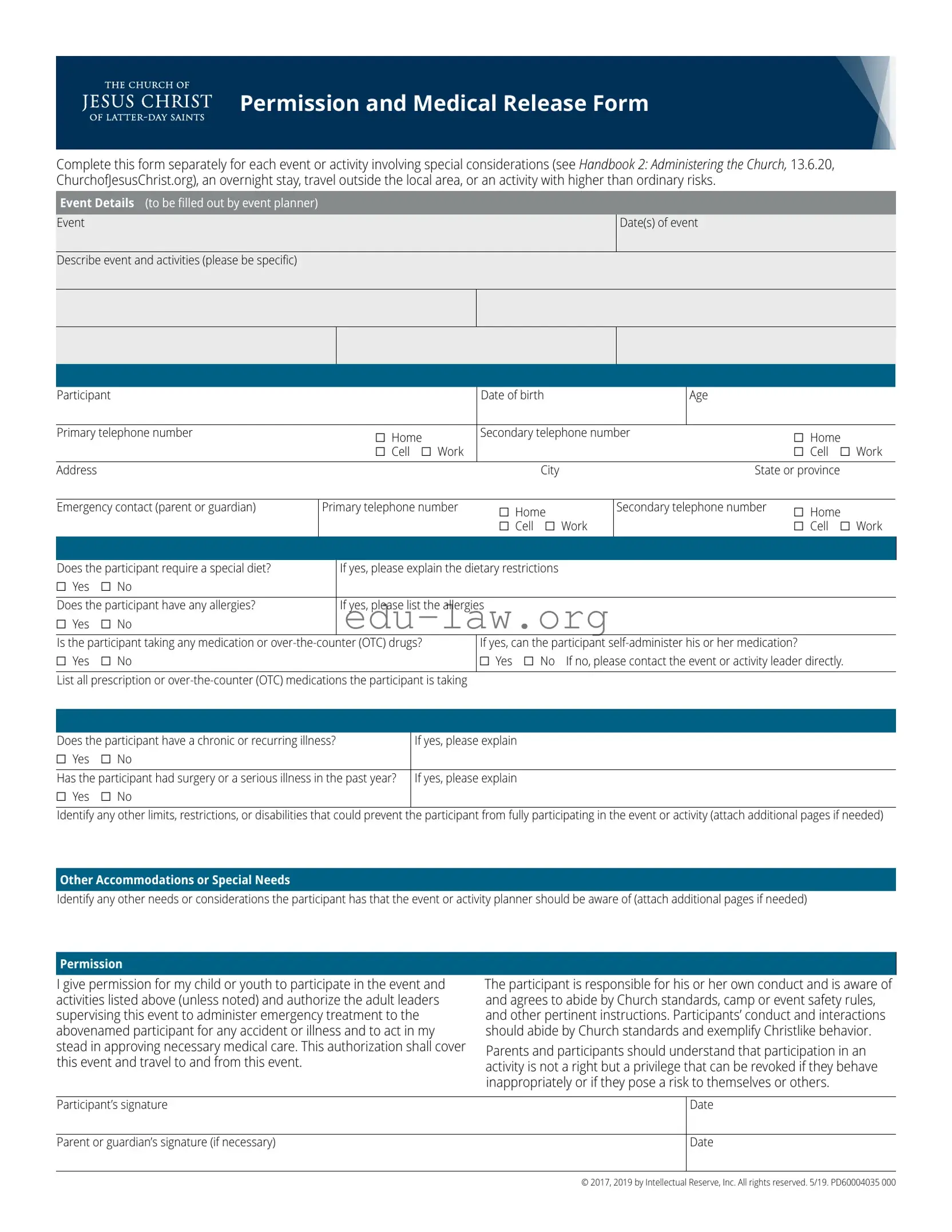
The LDS Permission and Medical Release Form serves a critical role in ensuring the safety and well-being of participants during church-sponsored events and activities. Designed to be filled out for each specific event, the form captures essential details such as the event date, description, and the contact information of the event leader. It also requires pertinent information about the participant, including their age, contact numbers, and emergency contacts, typically a parent or guardian. Importantly, the form addresses health considerations by inquiring about dietary restrictions, allergies, medications, and any chronic illnesses that may affect participation. This thorough approach not only helps event planners prepare for individual needs but also ensures that participants can fully engage in activities without compromising their health. Furthermore, the form includes a section for parents or guardians to grant permission for their child or youth to participate, while also authorizing adult leaders to administer emergency treatment if necessary. This authorization extends to travel to and from the event, reinforcing the commitment to participant safety. By signing the form, parents and guardians acknowledge the importance of adhering to church standards and event safety rules, emphasizing that participation is a privilege contingent upon appropriate behavior. Overall, this form is a vital tool in fostering a safe and supportive environment for all involved.

THE CHURCH OF |
|
Permission and Medical Release Form |
I |
OF |
|
||
JESUS CHRIST |
|
|
|
l
Complete this form separately for each event or activity involving special considerations (see Handbook 2: Administering the Church, 13.6.20, ChurchofJesusChrist.org), an overnight stay, travel outside the local area, or an activity with higher than ordinary risks.
Event Details (to be filled out by event planner) |
|
|
|
|
|
|
|
|
Event |
|
|
|
|
Date(s) of event |
|
|
|
|
|
|
|
|
|
|
|
|
Describe event and activities (please be specific) |
|
|
|
|
|
|
|
|
|
|
|
|
|
|
|
|
|
Ward |
|
|
|
Stake |
|
|
|
|
|
|
|
|
|
|
|
|
|
Event or activity leader |
|
Event or activity leader’s phone number |
Event or activity leader’s email |
|
|
|||
|
|
|
|
|
|
|
|
|
|
|
|
|
|
|
|
|
|
Participant |
|
|
|
Date of birth |
|
Age |
|
|
|
|
|
|
|
|
|
|
|
Primary telephone number |
|
□ Home |
Secondary telephone number |
|
□ Home |
|
||
|
|
□ Cell □ Work |
|
|
|
□ Cell □ Work |
|
|
Address |
|
|
|
City |
|
State or province |
|
|
|
|
|
|
|
|
|
|
|
Emergency contact (parent or guardian) |
Primary telephone number |
□ Home |
Secondary telephone number |
□ Home |
|
|||
|
|
|
|
□ Cell □ Work |
|
|
□ Cell □ Work |
|
|
|
|
|
|
|
|
|
|
Does the participant require a special diet? |
|
If yes, please explain the dietary restrictions |
|
|
|
|
||
□ Yes □ No |
|
|
|
|
|
|
|
|
Does the participant have any allergies? |
|
If yes, please list the allergies |
|
|
|
|
||
□ Yes □ No |
|
|
|
|
|
|
|
|
Is the participant taking any medication or |
If yes, can the participant |
|
||||||
□ Yes □ No |
|
|
|
□ Yes □ No If no, please contact the event or activity leader directly. |
|
|||
List all prescription or |
|
|
|
|
|
|||
|
|
|
|
|
|
|
||
|
|
|
|
|
|
|
||
Does the participant have a chronic or recurring illness? |
|
If yes, please explain |
|
|
|
|
||
□ Yes □ No |
|
|
|
|
|
|
|
|
Has the participant had surgery or a serious illness in the past year? |
If yes, please explain |
|
|
|
|
|||
□ Yes □ No |
|
|
|
|
|
|
|
|
Identify any other limits, restrictions, or disabilities that could prevent the participant from fully participating in the event or activity (attach additional pages if needed) |
|
|||||||
Other Accommodations or Special Needs
Identify any other needs or considerations the participant has that the event or activity planner should be aware of (attach additional pages if needed)
Permission
I give permission for my child or youth to participate in the event and activities listed above (unless noted) and authorize the adult leaders supervising this event to administer emergency treatment to the abovenamed participant for any accident or illness and to act in my stead in approving necessary medical care. This authorization shall cover this event and travel to and from this event.
The participant is responsible for his or her own conduct and is aware of and agrees to abide by Church standards, camp or event safety rules, and other pertinent instructions. Participants’ conduct and interactions should abide by Church standards and exemplify Christlike behavior. Parents and participants should understand that participation in an activity is not a right but a privilege that can be revoked if they behave inappropriately or if they pose a risk to themselves or others.
Participant’s signature
Parent or guardian’s signature (if necessary)
Date
Date
© 2017, 2019 by Intellectual Reserve, Inc. All rights reserved. 5/19. PD60004035 000
| Fact Name | Fact Description |
|---|---|
| Purpose | The form is used to obtain permission and medical release for participants in events organized by The Church of Jesus Christ of Latter-day Saints. |
| Event Specificity | A separate form must be completed for each event or activity that involves special considerations, overnight stays, or higher risks. |
| Event Details | The event planner is required to fill out specific details such as event date, description, and contact information for the event leader. |
| Participant Information | Participants must provide personal information, including date of birth, age, and multiple contact numbers. |
| Emergency Contact | An emergency contact, typically a parent or guardian, must be designated along with their contact information. |
| Dietary Restrictions | The form inquires about any special dietary needs and allergies that participants may have. |
| Medication Disclosure | Participants must disclose any medications they are taking and whether they can self-administer them. |
| Chronic Illness | Participants are asked if they have any chronic or recurring illnesses that may affect their participation. |
| Conduct Expectations | The form emphasizes that participants must adhere to Church standards and safety rules during the event. |
| Legal Authority | By signing, parents or guardians authorize adult leaders to administer emergency treatment and make medical decisions if necessary. |
To complete the LDS Permission form, gather all necessary information about the event and the participant. This form must be filled out for each event that requires special considerations. Once completed, submit it to the event planner or leader for further processing.
What is the purpose of the LDS Permission and Medical Release Form?
The LDS Permission and Medical Release Form is designed to ensure the safety and well-being of participants during church-sponsored events. It collects essential information about the participant, including medical needs, dietary restrictions, and emergency contacts. This form also grants permission for adult leaders to administer emergency treatment if necessary.
When should I complete this form?
This form should be completed for each specific event or activity that involves special considerations. This includes overnight stays, travel outside the local area, or activities that carry higher than usual risks. It is important to fill out a separate form for each event to provide accurate and relevant information.
Who needs to fill out the form?
What information do I need to provide on the form?
Participants and their guardians will need to provide details such as the event date, a description of the event, contact information, dietary restrictions, allergies, any medications being taken, and any chronic illnesses or disabilities. This information helps event planners accommodate participants' needs effectively.
What if my child has special dietary needs?
If your child has special dietary needs, you should indicate this on the form and provide specific details about the dietary restrictions. This ensures that event planners can make appropriate arrangements for meals and snacks during the event.
What happens if my child has a medical emergency during the event?
By signing the form, you authorize adult leaders to administer emergency treatment to your child in case of an accident or illness. This authorization allows them to act on your behalf and approve necessary medical care, ensuring that your child receives prompt attention if needed.
Can I revoke my child's permission to participate?
Yes, parents or guardians have the right to revoke permission at any time. If you feel that your child should not participate in the event for any reason, you can notify the event leaders. It’s important to communicate any concerns promptly.
What if my child does not behave appropriately during the event?
Participation in church events is a privilege, not a right. If a participant behaves inappropriately or poses a risk to themselves or others, leaders have the authority to revoke their participation. It is crucial for all participants to adhere to Church standards and event safety rules.
Is there a deadline for submitting the form?
While specific deadlines may vary by event, it is generally advisable to submit the form as early as possible. This allows event planners to prepare adequately and ensures that all necessary accommodations can be made for participants.
Incomplete Information: Many people fail to fill out all required fields. This includes missing details such as the participant's date of birth or emergency contact information. Ensure that every section is completed to avoid delays or issues during the event.
Ignoring Special Needs: Some participants may have dietary restrictions, allergies, or medical conditions. Neglecting to disclose these can lead to serious health risks. Always provide detailed information regarding any special needs or accommodations.
Missing Signatures: It’s crucial to obtain the necessary signatures from both the participant and their parent or guardian when applicable. Without these signatures, the form may not be considered valid, which could prevent participation in the event.
Not Updating Information: Participants often forget to update their medical information, especially if there have been changes since the last event. Regularly review and revise the form to reflect the most current information.
The LDS Permission Form is essential for ensuring that participants can safely engage in church-related events and activities. However, there are other documents that often accompany this form to cover various aspects of participation and safety. Here’s a brief overview of these important forms.
These documents work together to ensure the safety and well-being of participants while also clarifying expectations and responsibilities. Having them prepared in advance can help facilitate a smooth and enjoyable experience for everyone involved.
The LDS Permission and Medical Release Form shares similarities with a school field trip permission slip. Both documents require parental consent for a child’s participation in an event outside the regular classroom setting. They typically ask for emergency contact information and any medical concerns, ensuring that the school has the necessary details to care for the child during the trip. Just like the LDS form, the school slip emphasizes the importance of safety and adherence to rules during the event.
Another document that resembles the LDS Permission Form is a sports participation waiver. This waiver is designed to protect organizations from liability in case of injury during athletic activities. It requires parents to acknowledge the risks involved and grant permission for their child to participate. Similar to the LDS form, it often includes sections on medical conditions and emergency contacts, ensuring that all necessary precautions are taken for the participant’s well-being.
A medical release form used by summer camps is also akin to the LDS Permission Form. Both documents serve to inform organizers about a child’s health needs and dietary restrictions. They require parents to provide detailed medical histories and consent for emergency medical treatment. This ensures that camp staff are prepared to handle any health issues that may arise, mirroring the careful attention to participant safety found in the LDS form.
Additionally, a youth group consent form parallels the LDS Permission Form in its purpose of securing parental approval for participation in group activities. These forms often include sections for emergency contacts and medical information, similar to the LDS document. They also outline the expectations for behavior and the consequences of inappropriate conduct, reinforcing the importance of safety and respect in group settings.
A volunteer release form is another document that shares features with the LDS Permission Form. This form is typically used when individuals volunteer for community service projects, requiring participants to acknowledge potential risks and provide emergency contact information. Both forms emphasize the importance of understanding and accepting the responsibilities that come with participation, fostering a sense of accountability among participants.
The consent form for school sports teams also mirrors the LDS Permission Form. It requires parental permission for a child to engage in sports activities, along with medical information and emergency contacts. Both documents highlight the importance of safety and preparedness, ensuring that organizers can respond effectively in case of an emergency, thus promoting a safe environment for all participants.
A travel consent form used by youth organizations is similar to the LDS Permission Form as well. This document provides permission for minors to travel with adults, often including details about the trip, emergency contacts, and medical information. Both forms prioritize the safety and well-being of the participant, ensuring that organizers have all necessary information to provide care during the trip.
Moreover, a daycare permission slip shares characteristics with the LDS Permission Form. Parents fill out this document to grant permission for their child to participate in activities organized by the daycare. It typically includes sections for medical information and emergency contacts, much like the LDS form, ensuring that caregivers are prepared to address any needs that may arise during activities.
A consent form for educational workshops is also comparable to the LDS Permission Form. This document is used to obtain parental approval for a child’s participation in workshops or classes outside of school. It often includes sections for medical information and emergency contacts, ensuring that organizers are aware of any special needs or considerations, similar to the attention given in the LDS form.
Lastly, a consent form for extracurricular activities, such as drama or music programs, is akin to the LDS Permission Form. This document requires parental permission for students to participate in after-school programs and includes sections for medical information and emergency contacts. Both forms emphasize the importance of safety and proper conduct during activities, reinforcing the shared goal of creating a safe and supportive environment for all participants.
When filling out the LDS Permission form, it's important to get it right. Here’s a helpful list of things you should and shouldn’t do to ensure a smooth process.
Following these guidelines will help ensure that your child or youth has a safe and enjoyable experience. Remember, clear communication is key!
This form is required for various events, not just those involving youth. It applies to any activity with special considerations, including those for adults.
In reality, the form is mandatory for events involving overnight stays, travel outside the local area, or activities with higher risks. It ensures participant safety and compliance with Church guidelines.
While individuals over 18 can sign for themselves, parental guidance is still encouraged. The form serves as a reminder for all participants to consider their responsibilities.
The permission granted extends beyond medical emergencies. It also includes authorization for adult leaders to make decisions regarding necessary medical care during the event.
Signing the form does not exempt participants from following Church standards and safety rules. Conduct is crucial, and violations can lead to revocation of participation privileges.
While it is essential for Church events, the form can also be beneficial for activities organized by members that involve similar risks or considerations.
Even non-physical events that may involve travel or special dietary needs require the form. It ensures that all relevant information is collected for participant safety.
All sections of the form should be completed to provide comprehensive information. Incomplete forms may lead to misunderstandings or lack of necessary accommodations.
Parents or guardians can withdraw permission at any time prior to the event. Open communication is encouraged to ensure everyone is informed.
While it gathers medical data, the form also addresses dietary restrictions, allergies, and any other special needs. This holistic approach helps event planners accommodate all participants effectively.
When using the LDS Permission form, keep these key points in mind: