Applying to law school can be a daunting task, and one of the key components of a successful application is the Law School Letter of Recommendation. This form plays a crucial role in showcasing an applicant's strengths, character, and potential for success in the legal field. Typically, it requires the recommender to provide insights into the applicant's academic abilities, work ethic, and interpersonal skills. Additionally, the form often includes specific prompts that guide the recommender in addressing relevant experiences and qualities that make the applicant a strong candidate for law school. Understanding the structure and expectations of this letter can significantly enhance an applicant's chances of standing out in a competitive admissions process. By highlighting personal anecdotes and professional accomplishments, recommenders can provide a comprehensive view of the applicant, thus enriching their overall application package.
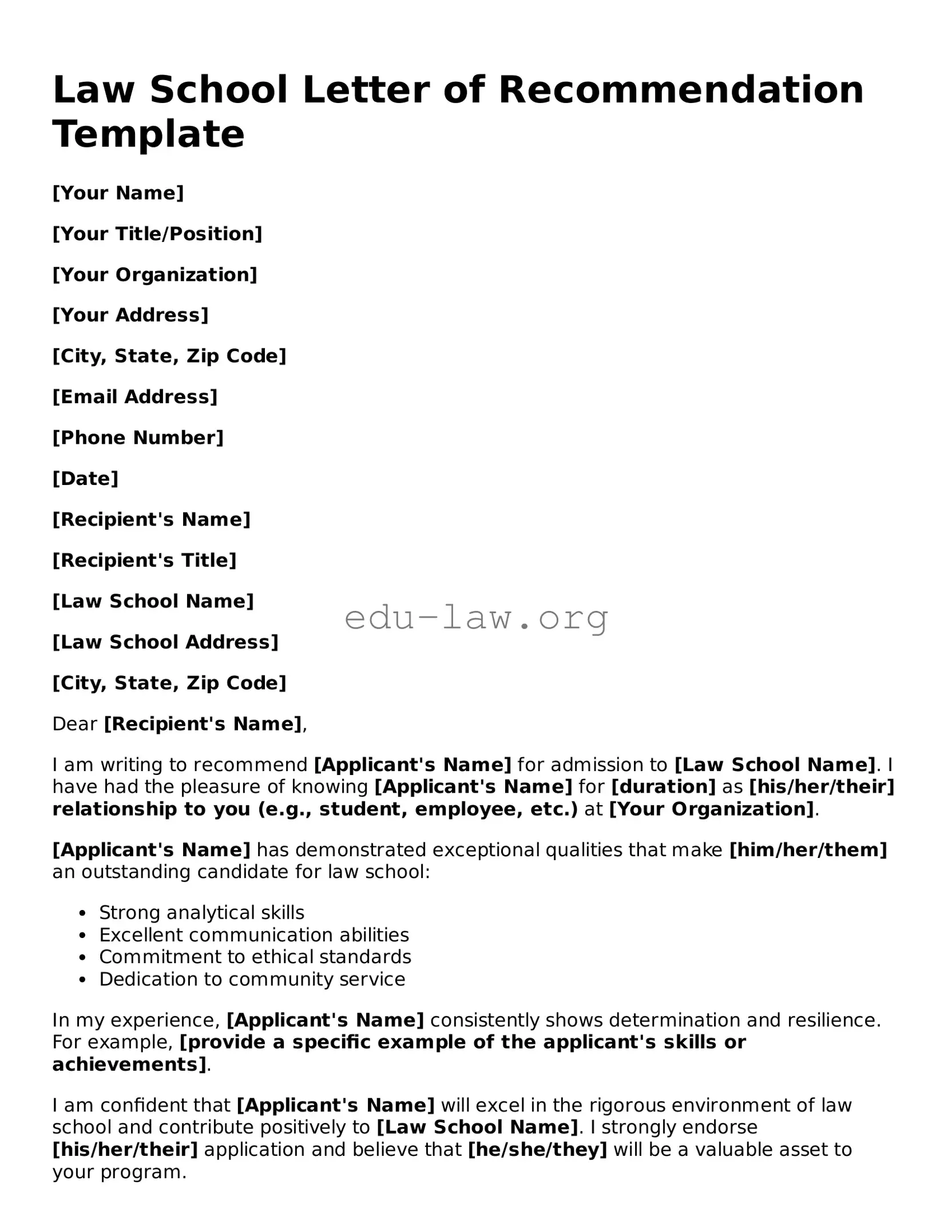
Law School Letter of Recommendation Template
[Your Name]
[Your Title/Position]
[Your Organization]
[Your Address]
[City, State, Zip Code]
[Email Address]
[Phone Number]
[Date]
[Recipient's Name]
[Recipient's Title]
[Law School Name]
[Law School Address]
[City, State, Zip Code]
Dear [Recipient's Name],
I am writing to recommend [Applicant's Name] for admission to [Law School Name]. I have had the pleasure of knowing [Applicant's Name] for [duration] as [his/her/their] relationship to you (e.g., student, employee, etc.) at [Your Organization].
[Applicant's Name] has demonstrated exceptional qualities that make [him/her/them] an outstanding candidate for law school:
In my experience, [Applicant's Name] consistently shows determination and resilience. For example, [provide a specific example of the applicant's skills or achievements].
I am confident that [Applicant's Name] will excel in the rigorous environment of law school and contribute positively to [Law School Name]. I strongly endorse [his/her/their] application and believe that [he/she/they] will be a valuable asset to your program.
Thank you for considering this recommendation. Please feel free to contact me at [Your Phone Number] or [Your Email Address] if you need any further information.
Sincerely,
[Your Name]
[Your Title/Position]
[Your Organization]
| Fact Name | Description |
|---|---|
| Purpose | The Law School Letter of Recommendation form is used to gather endorsements from individuals who can speak to a candidate's qualifications for law school. |
| Recommender Qualifications | Typically, recommenders should be individuals who know the applicant well, such as professors, employers, or professionals in the legal field. |
| Submission Process | Most law schools require the form to be submitted directly by the recommender, often through an online portal. |
| Confidentiality | Some forms are confidential, meaning applicants may waive their right to view the recommendation letters. |
| State-Specific Forms | Certain states may have specific requirements or forms for recommendations, which can vary by law school. |
| Content Guidelines | Recommenders are usually encouraged to discuss the applicant's skills, character, and potential for success in law school. |
| Deadlines | Each law school sets its own deadlines for submission of recommendation letters, which must be adhered to for the application to be complete. |
Once you have the Law School Letter of Recommendation form in hand, it's time to fill it out carefully. Make sure you have all the necessary information at hand to ensure a smooth process. Follow these steps to complete the form accurately.
After submitting the form, you can expect your recommender to receive a notification or further instructions on how to proceed. Keep an eye on your email for any updates regarding your application.
What is a Law School Letter of Recommendation?
A Law School Letter of Recommendation is a written endorsement from someone who can speak to your qualifications for law school. This could be a professor, employer, or mentor who knows you well and can provide insight into your skills, character, and potential as a law student.
Who should I ask to write my letter of recommendation?
Choose individuals who are familiar with your academic or professional abilities. Ideally, they should be people who can highlight your strengths relevant to law school. Professors in courses related to critical thinking or writing are often good choices, as are employers who can attest to your work ethic and analytical skills.
How many letters of recommendation do I need?
Most law schools require two to three letters of recommendation. Always check the specific requirements of each school you’re applying to, as they can vary. Some schools may allow additional letters, while others may have strict limits.
What information should I provide to my recommenders?
Provide your recommenders with your resume, a list of your accomplishments, and details about the law schools you are applying to. It’s also helpful to share why you are interested in law and any specific areas of law that excite you. This information will help them write a more personalized and impactful letter.
How should my recommender submit the letter?
Most law schools have an online application system where recommenders can upload their letters directly. Be sure to inform your recommenders about the submission process and deadlines. If a school allows mailed letters, ensure your recommender has the correct address and any necessary forms.
Can I read my letter of recommendation?
Generally, you cannot read your letter of recommendation unless your recommender agrees to share it with you. Many applicants choose to waive their right to view the letter, which can encourage recommenders to write more candidly. Check the policies of the law schools to which you are applying for specific guidelines.
What if my recommender misses the deadline?
If a recommender misses the deadline, contact them immediately to remind them. It’s essential to ensure that all materials are submitted on time. If it becomes clear they cannot meet the deadline, consider asking someone else to write a letter. Always have backup options to avoid last-minute issues.
Failing to provide specific examples of the candidate's skills and accomplishments. Letters that lack detail may not effectively convey the candidate's strengths.
Not adhering to the word limit or guidelines set by the law school. Exceeding or not meeting these requirements can reflect poorly on the recommender's attention to detail.
Using vague language or general statements. Recommendations should be personalized and tailored to the individual, rather than relying on clichés.
Submitting the letter late. Timeliness is crucial, and delays can hinder the candidate's application process.
Neglecting to proofread the letter for spelling and grammatical errors. Mistakes can undermine the credibility of the recommendation.
Not including relevant context about the relationship with the candidate. Explaining how long and in what capacity the recommender knows the candidate can provide valuable insight.
When applying to law school, candidates often need to submit various forms and documents to support their application. One of the most crucial components is the Law School Letter of Recommendation form. However, several other documents typically accompany this form to provide a comprehensive view of the applicant's qualifications and character. Below is a list of these important documents.
In summary, submitting a law school application involves more than just the Law School Letter of Recommendation form. Each of these accompanying documents plays a vital role in presenting a well-rounded picture of the applicant. Together, they help admissions committees assess the candidate's potential for success in law school and beyond.
The Law School Letter of Recommendation form shares similarities with the College Application Recommendation form. Both documents serve the purpose of providing insight into a candidate's character, academic abilities, and potential for success in a rigorous educational environment. They typically require a recommender to assess the applicant’s skills and contributions, thus helping admissions committees make informed decisions about prospective students.
Another document that resembles the Law School Letter of Recommendation form is the Graduate School Recommendation form. Like the law school version, this form requests detailed evaluations from individuals who can speak to the applicant's qualifications. Graduate programs often seek specific examples of a candidate's accomplishments and work ethic, similar to how law schools look for evidence of analytical thinking and commitment to the field of law.
The Employment Reference Letter also shares commonalities with the Law School Letter of Recommendation form. Both documents are intended to provide a third-party perspective on an individual's capabilities and character. In an employment context, references discuss the applicant’s work performance and interpersonal skills, paralleling how law school recommendations highlight academic and personal attributes relevant to legal studies.
The Medical School Letter of Recommendation form is another document that functions similarly. Both forms require evaluators to provide a comprehensive assessment of an applicant’s readiness for a demanding program. Medical schools, like law schools, value insights into an applicant’s ethical judgment, commitment to the field, and ability to work under pressure, making the evaluation process crucial for admissions decisions.
The Fellowship Recommendation Letter is also akin to the Law School Letter of Recommendation form. Both types of documents are used to support an applicant’s pursuit of advanced studies or professional opportunities. They often require the recommender to detail the candidate’s qualifications, leadership skills, and potential contributions to the field, thus influencing selection committees in their decision-making process.
The Scholarship Recommendation Letter exhibits similarities as well. This document aims to bolster an applicant’s case for financial assistance by providing a detailed account of their achievements and character. Just as law school recommendations highlight relevant skills and experiences, scholarship letters emphasize the applicant's potential impact and commitment to their chosen field.
The Internship Recommendation Letter is another document that aligns with the Law School Letter of Recommendation form. Both letters are designed to provide insight into an individual’s professional abilities and work ethic. Internships often serve as stepping stones to further education, and recommendations for these positions can mirror the evaluations sought by law schools regarding an applicant's preparedness for advanced study.
The Character Reference Letter is similar in purpose to the Law School Letter of Recommendation form. This document focuses on an individual’s personal qualities and ethical standards, which are essential for success in law school and the legal profession. Both types of letters emphasize the importance of integrity and moral judgment, which are critical in both academic and professional settings.
The Professional Reference Letter also shares characteristics with the Law School Letter of Recommendation form. This document is used to assess an individual’s qualifications in a professional context. Both forms require a recommender to provide specific examples of the applicant’s skills and contributions, helping to paint a comprehensive picture of the individual’s capabilities and potential for success.
Lastly, the Academic Reference Letter is akin to the Law School Letter of Recommendation form. This document focuses on an applicant’s academic performance and intellectual capabilities. Both types of letters aim to provide a deeper understanding of the candidate’s academic journey, highlighting achievements and strengths that are pertinent to their future studies in law or other fields.
When filling out the Law School Letter of Recommendation form, it's important to approach the task thoughtfully. Here are some essential dos and don'ts to consider:
When applying to law school, the letter of recommendation is a crucial component of your application. However, several misconceptions can cloud the understanding of this important document. Here are eight common misunderstandings about the Law School Letter of Recommendation form:
Understanding these misconceptions can help applicants navigate the recommendation process more effectively, ultimately strengthening their law school applications.
When it comes to filling out and using the Law School Letter of Recommendation form, there are several important points to keep in mind. Here are six key takeaways: